
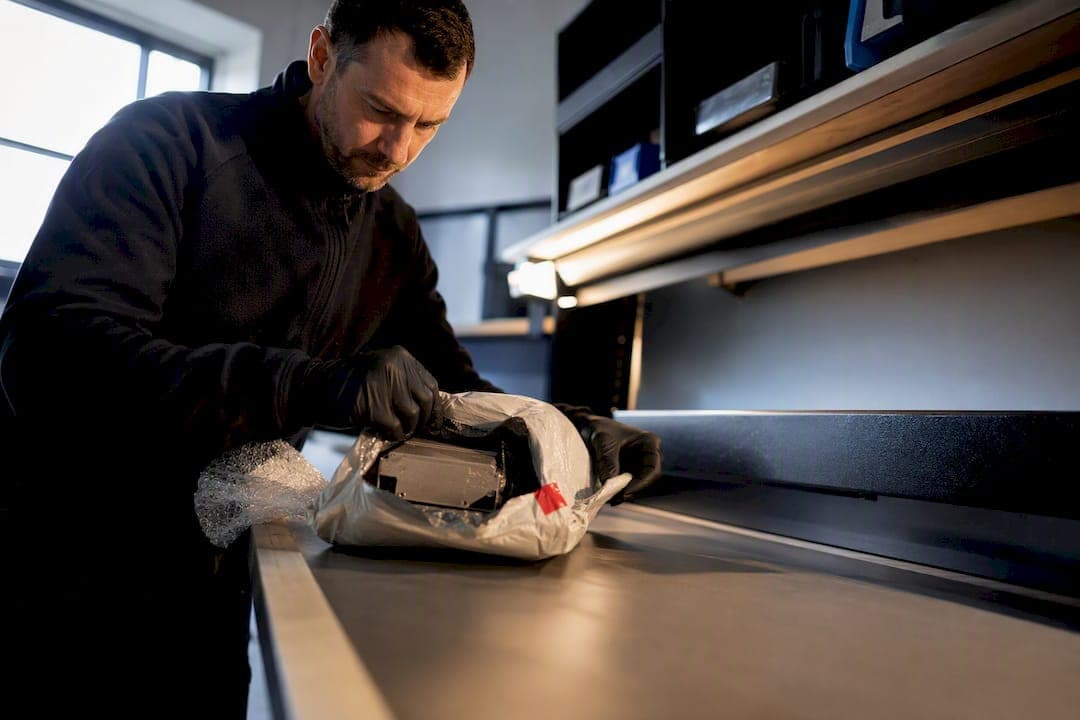
A bench crash-data clear restores the SRS module's stored state, but only once deployed inflators and any damaged sensors or wiring have been replaced. Send a module before that repair work is finished and the reset either fails outright or, worse, arms a system built on unrepaired hardware. This task can be handled via a postal service, with prices starting at a modest fee, making it a realistic option once the mechanical repair is genuinely complete.
TL;DR:
- Sending a crash-data module for clear must only occur after replacing all deployed inflators, pretensioners, and checking or repairing sensors and wiring.
- Hard crash codes reside in protected EEPROM memory and require specialized programming tools for clearance, not standard OBD-II scanners.
- Proper repair procedures include verifying hardware replacement, photographing the module, and ensuring the vehicle's safety before shipping it for reset.
- Post-reset, the module must pass a wiring, sensor, and system check, with the SRS light briefly illuminating and then turning off to confirm success.
- Postal reset services offer same-day turnaround at a lower cost than dealer clears, especially for trade customers handling multiple modules.
Table of Contents
- After airbag deployment, why does the SRS light stay on?
- Preconditions checklist: what must be fixed before you send the module for a clear
- What happens on the bench: the reset workflow explained
- How do you verify the module after it's reinstalled?
- What does a postal bench reset cost, and how long does it take?
- Safety precautions after airbag deployment and before reset
- What are the legal and insurance implications of an airbag reset?
- What happens if an airbag module is reset improperly?
- Which dashboard warnings indicate an SRS fault after deployment?
- Postal reset or dealer clear: which suits you better?
- A trade perspective on getting bench clears right first time
- Book your postal crash-data reset with Airbag Reset UK
- Sources
After airbag deployment, why does the SRS light stay on?
The airbag light doesn't stay lit because of a glitch. It stays lit because the module is designed to remember exactly what happened.
When an airbag deploys, the SRS control module writes a permanent crash-event flag into protected EEPROM memory, alongside a deployment counter, a timestamp, and a set of diagnostic trouble codes. This data is built to survive a battery disconnect, a flat 12V system, even a full module removal, because crash-event flags and deployment counters are designed to persist through exactly those events.
That permanence is deliberate. A module that had already fired its airbags once should never quietly re-arm and fire again without someone checking the system is actually safe. Locking the crash record is the manufacturer's way of forcing a proper inspection before the car goes back on the road.
This is also why a code reader from the local parts shop won't touch it. There's a real difference between two categories of fault code:
- Soft codes: temporary faults (a loose connector, a low-voltage event) that clear on their own once the underlying issue is fixed
- Hard codes: the permanent crash-event record and any associated deployment DTCs, stored in a protected memory sector
Standard OBD-II tools can usually clear soft codes without trouble. But hard crash codes typically need direct EEPROM programming or a bench programmer, because they're deliberately walled off from generic diagnostic commands. That's the whole reason bench-level services exist.
Preconditions checklist: what must be fixed before you send the module for a clear
Sending a module off before the car itself is repaired is the single most common mistake we see, and it wastes everyone's time.
The correct order is repair first, then clear, and the recommended sequence runs: repair or replace the physical restraint components, then perform the module clear, then verify the system. Reverse that order and you're clearing a fault code on a car that still has an unrepaired hazard.
Before you package anything, confirm the following has actually happened:
- Deployed inflators replaced — driver, passenger, side and curtain airbags that fired must be swapped for new units, not reused.
- Pretensioners replaced — seatbelt pretensioners that fired mechanically or pyrotechnically need replacing, even if the belt itself looks fine.
- Impact sensors checked and replaced if faulty — crash sensors damaged in the impact need testing, not just visual inspection.
- Clock spring inspected — a damaged clock spring under the steering wheel commonly causes ongoing squib-circuit faults that a clear cannot fix.
- Wiring harness repaired — any cut, chafed, or corroded SRS wiring from the collision needs proper repair, not a temporary splice.
Watch for diagnostic codes that point to squib loop opens or shorts. Those indicate a live hardware fault in the firing circuit itself, completely separate from the crash-event flag, and no amount of bench work on the module will resolve them.
Pro Tip: Photograph the part number label on the module and the damaged area of the vehicle before you box anything up. A postal service can usually confirm fitment from a photo alone, and it avoids delays if the wrong module variant gets sent.
What happens on the bench: the reset workflow explained
Once a module arrives at a bench service, it goes through a defined sequence rather than a single "clear all" command.
The technician starts with a visual inspection, checking the case for cracks, scorch marks or connector damage before anything else happens. Assuming it passes, the bench workflow moves through EEPROM read, crash-flag rewrite, checksum recalculation, and a bench arm test to verify the fix:
- Full EEPROM dump taken and archived before any changes are made
- Crash-flag and related deployment bytes identified and rewritten
- Checksums recalculated so the module doesn't reject its own memory as corrupted
- Bench arm test run to confirm the module powers up and passes its internal self-checks
That archived dump matters more than most owners realise. It's a copy of the module's pre-clear state, kept largely for legal and insurance reference should a question ever arise about what the module recorded at the time of the crash.
Not every module makes it through. A bench clear cannot repair modules with genuine hardware failure, a cracked case, a burnt internal component, or damaged capacitors. In those cases, replacement is the only realistic route, and a competent service will tell you that rather than attempt a clear that won't hold.
How do you verify the module after it's reinstalled?
Getting the module back isn't the end of the job. The reinstall check is what actually confirms it worked.
- Turn the ignition to the "on" position and watch the SRS light. It should illuminate briefly, then go out within a few seconds. That short bulb check is normal and expected; it's the system proving the warning lamp itself works.
- Run a full diagnostic scan once the light has settled. You're looking for the absence of any crash-event DTCs. Any leftover soft codes, unrelated to the deployment, should clear normally through the scan tool.
- If the light stays on or returns, don't assume the reset failed. Re-check the wiring harness, the clock spring, and the sensor connectors first, since a live hardware fault will re-trigger a fault code even on a correctly cleared module.
- If hardware checks come back clean and the light persists, the module likely needs to go back for further bench diagnostics rather than a second attempt at the same clear.
Worth knowing: a properly cleared module doesn't simply pretend everything is fine. It runs its own squib loop tests at key-on and will refuse to arm if those circuits test open or shorted. The clear removes the historical block. It doesn't override a genuine wiring fault, which is exactly as it should be.
What does a postal bench reset cost, and how long does it take?
Pricing for a bench clear sits well below the cost of a new module, and turnaround is usually measured in hours rather than weeks.
A postal service offers a modest starting fee, with same-day turnaround on most standard modules once they arrive. Complex or less common modules, particularly on motorhomes or specialist commercial vehicles, may take slightly longer, but pricing stays fixed and transparent rather than being quoted case by case.
For trade customers running repeat volume, discounted trade accounts can remove the need to negotiate pricing on every single job. That matters for independent garages and bodyshops processing several modules a month, where consistent turnaround and predictable cost feed directly into how a job gets quoted to the end customer.
The economics against replacement are usually the deciding factor:
- A bench clear on the original module preserves the existing VIN coding, meaning no risk of the coding mismatches that come with fitting a used module
- A new OEM module typically costs considerably more than a bench clear, before any programming labour is added
- A used module carries its own risk: it may need matching to the vehicle's VIN and could arrive with an unknown crash history of its own
For a vehicle with no physical module damage, sending the original unit for a clear is generally the more sensible route financially, provided the surrounding hardware has already been properly repaired.
Safety precautions after airbag deployment and before reset
Before any module goes anywhere near a postal service, the vehicle itself needs treating as a genuine hazard, not just a warning light to clear.
Deployed airbags and fired pretensioners can leave sharp mounting brackets, residual sodium azide byproducts (a fine white or grey powder), and hot components immediately after deployment. Ventilate the vehicle interior before working inside it, and wear gloves when handling the steering wheel, dashboard trim or seatbelt assemblies where deployment occurred.
Disconnect the 12V battery before removing the airbag module or touching any SRS wiring. Airbag control modules retain reserve energy specifically so a deployed system can still fire briefly even with the battery disconnected, which is exactly why technicians treat every SRS connector as live until proven otherwise.
Never attempt to test, probe, or apply voltage to a squib circuit with standard multimeter settings not rated for airbag work. Ordinary continuity testing can supply enough current to fire a live squib. If a technician isn't confident distinguishing a genuinely inert circuit from a live one, that's a job for someone who works on SRS systems regularly, not a general auto electrician doing it for the first time.
Store any removed but undeployed airbag units, if applicable, face-up and away from heat sources, exactly as the vehicle manufacturer's collision repair procedure specifies. These precautions aren't optional extras. They're the difference between a routine hardware repair and a second, entirely avoidable, injury on the same vehicle.
What are the legal and insurance implications of an airbag reset?
An insurer's total loss decision usually happens before any reset conversation starts, and that sequencing matters for how you handle the vehicle.
If the vehicle was assessed and repaired rather than written off, the insurer's engineer will typically expect to see confirmation that deployed restraint components were replaced through a proper repair invoice, not just that the warning light went out. A cleared module with no corresponding parts replacement on record can raise questions if the vehicle is inspected or sold on later.
The archived EEPROM dump taken before a bench clear has genuine legal relevance here. Airbag control modules function similarly to a vehicle's event data recorder, and deployment events are stored as locked records that persist independently of normal ignition cycles. That data can matter in liability disputes, insurance claims, or, less commonly, in a legal proceeding connected to the collision. Keeping a copy of that pre-clear record protects both the vehicle owner and the workshop that carried out the repair.
For trade customers specifically, this is also a documentation issue. A bodyshop invoice showing new inflators and pretensioners fitted, alongside a bench service's confirmation of the reset, gives a clean paper trail if a customer, insurer, or future buyer ever asks what work was done and when.
What happens if an airbag module is reset improperly?
Clearing a crash-data flag on a module attached to unrepaired hardware doesn't fix anything. It just hides the problem until the airbags are needed again.
The clearest danger is a system that appears functional on the dashboard but has deployed inflators sitting behind the wheel that were never replaced. The SRS light might go out entirely, giving a false sense that the safety system is live, when in reality there's nothing left to deploy in an impact.
There's also a genuine failure mode on the other side: attempting a clear on a module with real internal damage. A cracked case, a burnt component or damaged capacitors won't respond properly to a rewrite, and modules with genuine hardware failure need replacement rather than a reset. Forcing a clear onto damaged hardware can produce a module that reports healthy but behaves unpredictably.
The insight worth remembering here is that a reset should never come before the repair. Services that market clearing the module ahead of hardware repair, treating it as a quick fix for the warning light rather than the final step, are getting the sequence backwards. It's the equivalent of resetting a smoke alarm's memory without replacing the battery that's actually dead.
For trade technicians, the liability exposure is real too. A garage that clears a module without confirming the restraint hardware was replaced is putting its own name on a safety system it hasn't actually verified.
Which dashboard warnings indicate an SRS fault after deployment?
Not every warning light after a collision means the same thing, and knowing the difference saves a wasted trip to the bench service.
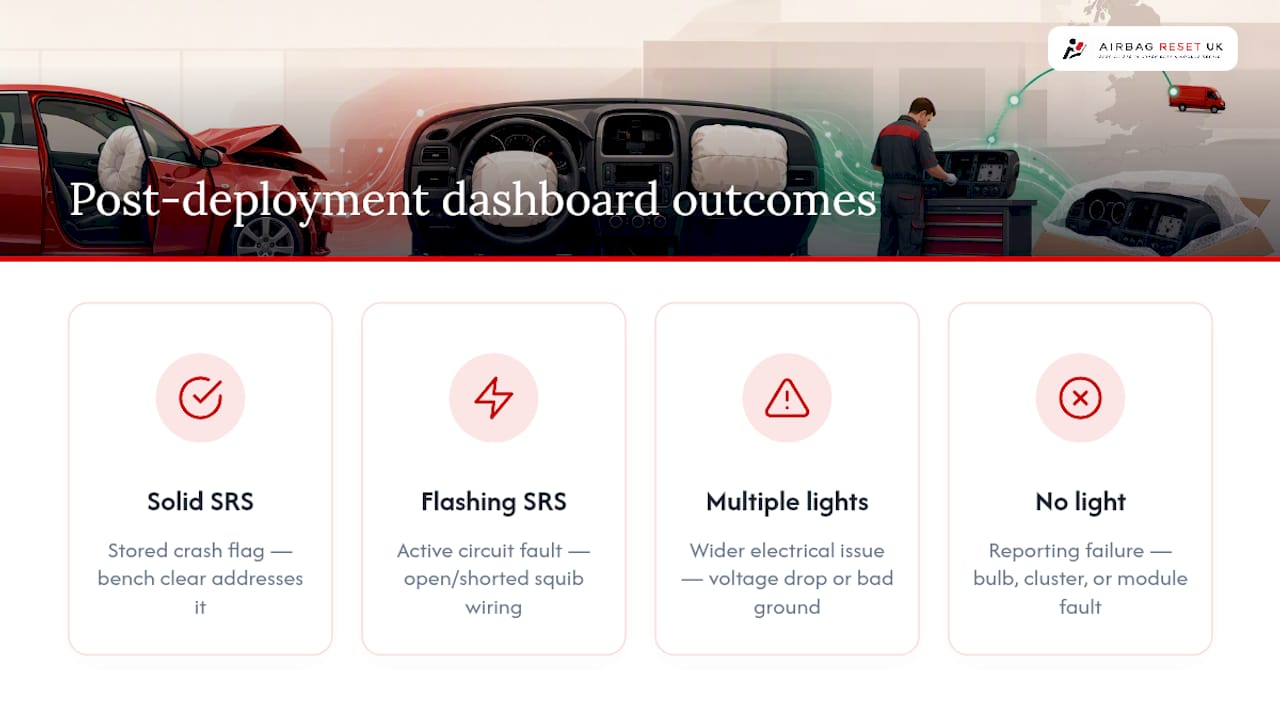
A solid SRS or airbag light that stays on continuously after the ignition cycle usually indicates the crash-event flag itself, the exact fault a bench clear is designed to address, assuming hardware repairs are already complete.
A flashing or rapidly blinking SRS light more often points to an active circuit fault, commonly a squib loop that's open or shorted somewhere in the system. That's a live wiring problem, not a stored historical record, and no bench clear will resolve it until the physical fault is found and repaired.
Multiple warning lights firing together (SRS alongside ABS, traction control or the general check-engine light) usually signals a wider electrical issue from the collision, often battery voltage drop or a damaged ground point, rather than an SRS-specific fault in isolation.
No warning light at all after a known deployment is arguably the most concerning scenario. It suggests either a bulb or dashboard cluster fault, or a module that has failed in a way that stops it reporting anything, which needs investigating before the vehicle is considered roadworthy.
Any of these warrant a full diagnostic scan before assuming which category applies, since dashboard behaviour alone doesn't distinguish reliably between a stored crash flag and a live circuit fault.
Postal reset or dealer clear: which suits you better?
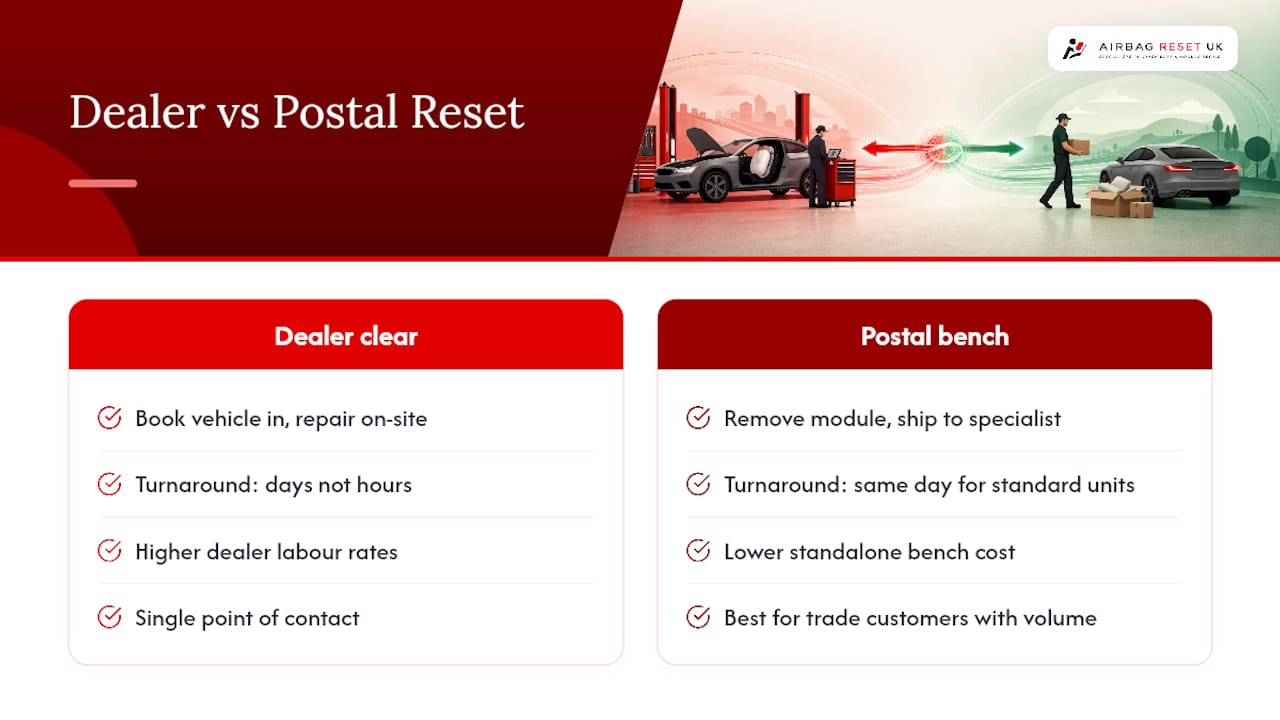
The two routes solve the same problem through very different logistics, and the right choice depends mostly on turnaround needs and budget.
A dealer-based clear typically means booking the vehicle in, leaving it with the dealership for diagnosis, and paying dealer labour rates on top of the clear itself. The advantage is having a single point of contact for the whole repair, inflators, pretensioners and the reset, handled under one roof. The downside is cost: dealer diagnostic and programming rates run considerably higher than a standalone bench service, and booking slots can push turnaround out by days rather than hours.
A postal bench reset removes the module, ships it to a specialist service, and gets it back with same-day turnaround on most standard units. It works well once the physical repair is already sorted elsewhere, whether that's a bodyshop, an independent garage, or a trade technician doing the mechanical work. The trade-off is that it requires someone competent to safely remove and refit the module themselves, and it depends on postal reliability rather than a same-premises handover.
For trade customers running multiple jobs a month, the postal route with a trade account tends to work out both cheaper and faster than routing every module through a dealer network. For a one-off owner without the confidence to remove an SRS module safely, pairing a local garage's removal and refit with a postal bench service often lands as the more practical middle ground.
Either way, if your local garage handles the physical inspection separately, a broader post-deployment inspection covering wiring and sensors is worth running before the module goes anywhere.
A trade perspective on getting bench clears right first time
Most failed or delayed bench jobs come down to the same three mistakes: missing paperwork, shipping damage, or a module sent before the hardware repair was actually finished.
Paperwork sounds trivial until a job sits waiting because nobody confirmed the part number or included proof the inflators were replaced. Shipping damage is avoidable too. A module rattling loose in an oversized box arrives with a cracked connector far more often than one packed snugly with the original mounting bracket still attached.
Here's the shortcut worth adopting: bag the module in anti-static wrap, wedge it firmly in a box sized close to its actual dimensions, and tape a printed slip inside the parcel (not just on the outside label) stating the vehicle registration, part number, and a one-line note on what caused the deployment. It costs two minutes and saves a phone call.
— John
Book your postal crash-data reset with Airbag Reset UK
This kind of service exists for exactly the moment you've reached once the hardware repair is done and you just need the warning light gone without a dealer's diagnostic bill attached to it.
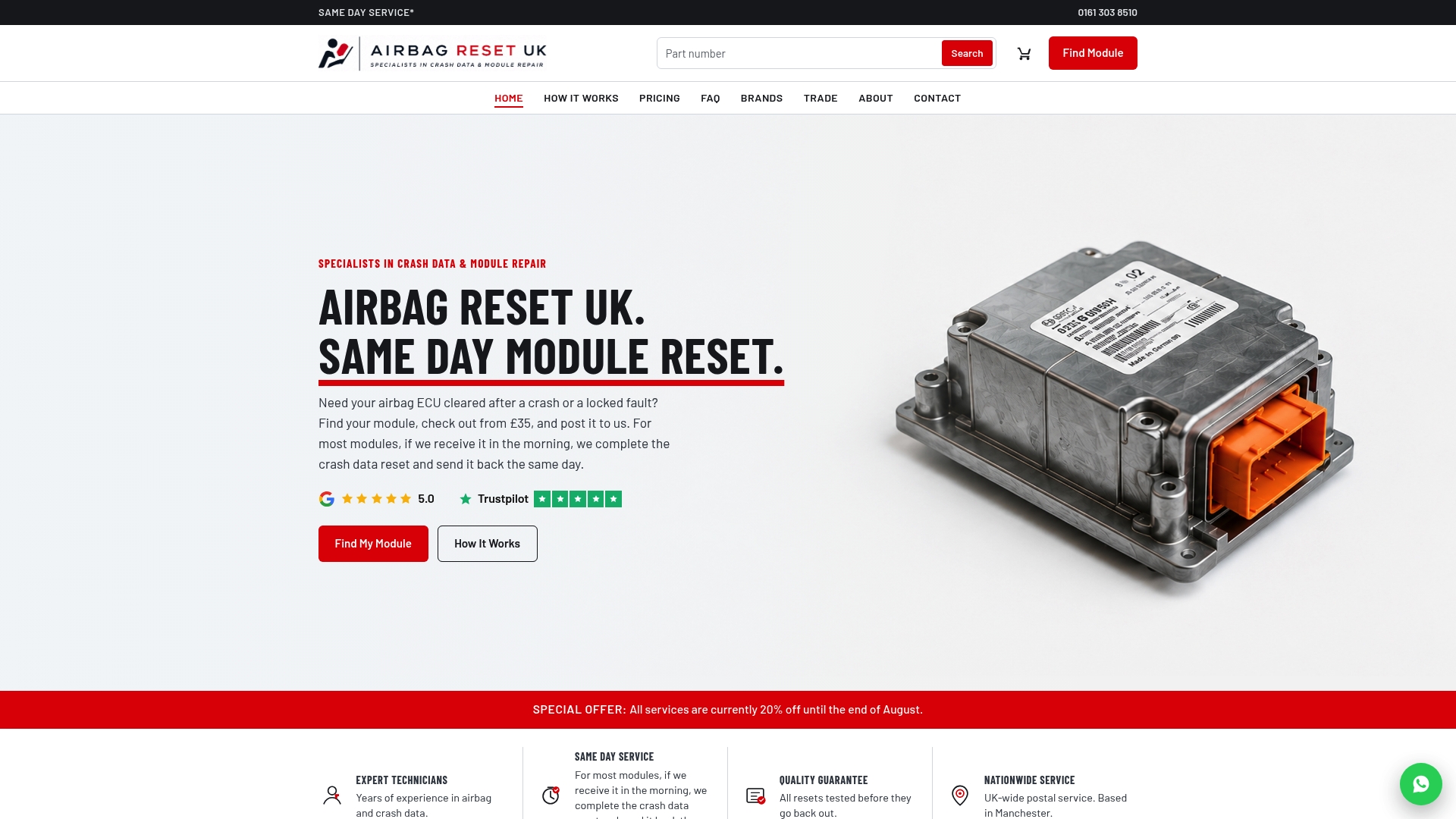
The service works as this guide has described: post the module and get it back with same-day turnaround on most standard units, at prices starting from a modest fee. If you're not certain which module you have, sending a photo of the part number label can often help confirm fitment before you commit to anything.
For independent garages, bodyshops, and fleet or mobile technicians handling repeat jobs, discounted trade accounts can remove the friction of quoting individually every time a module comes in. Experienced technicians handle both standard and specialist modules alike.
Ready to get a module moving? Visit Airbag Reset UK to confirm your part number, check pricing for your specific vehicle, and book your postal reset today.