
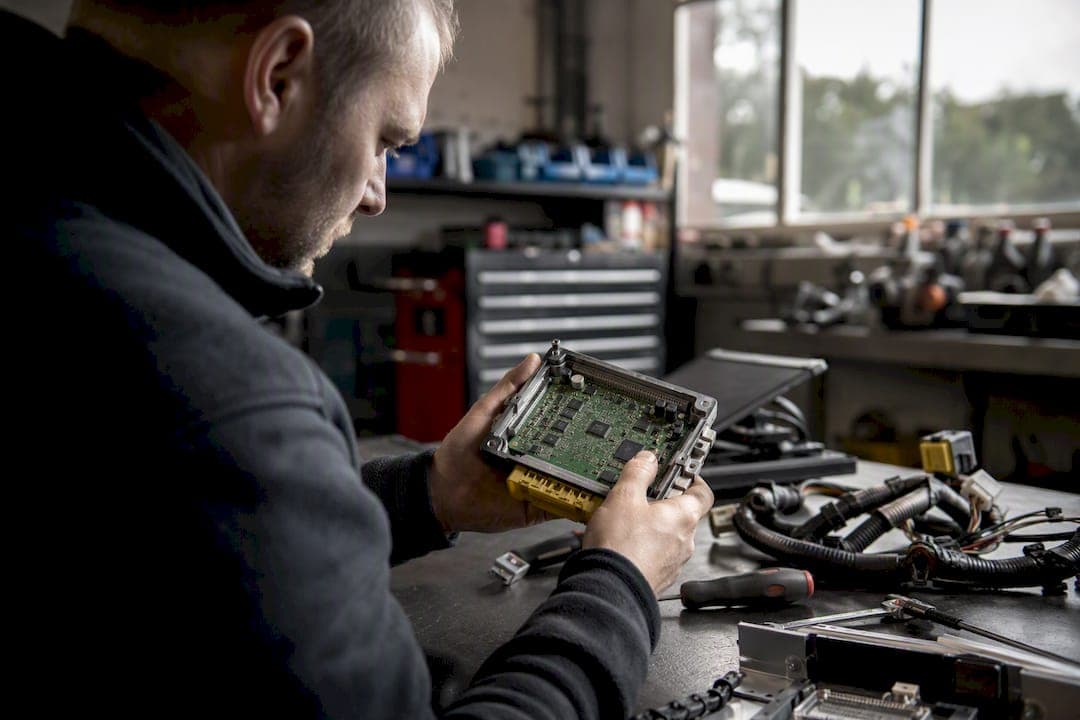
Yes, airbag crash data can usually be cleared, but only through a professional bench reset, not a generic scan tool or a battery disconnect. Once a module has logged a deployment or a crash-event flag, that record sits in protected memory and stays there regardless of how many times the vehicle is switched on and off.
The first move isn't reaching for a diagnostic reader. It's confirming the physical restraint system, airbags, seatbelt pretensioners, and impact sensors, has been inspected and repaired where needed. A module clear does nothing to fix hardware; it only resets the software record once the underlying fault has been dealt with.
A reputable provider should hand back three things:
- A diagnostic report showing the module's fault history before and after the clear
- A pre-clear EEPROM/EDR archive for insurance or legal reference
- Verification logs or screenshots confirming the crash flag has actually been rewritten, not just masked
Independent bench-level analysis of SRS crash-data clears confirms this is a chip-level procedure, not a software toggle, which is exactly why OBD tools can't do it.
Key Takeaways
A crash-data clear only resets the module's software record; it never repairs or substitutes for inspecting and replacing physical restraint hardware.
| Point | Details |
|---|---|
| Reset needs a bench, not a scanner | Crash-event flags live in EEPROM and require chip-level rewrite; OBD tools and battery disconnects can't touch them. |
| Fix hardware before clearing data | Deployed airbags, pretensioners and sensors must be inspected and replaced first; the module only arms if hardware tests correctly. |
| Demand documentation | Ask for a pre-clear EDR archive, a diagnostic report, and verification logs before trusting any provider. |
| Reset versus replace depends on damage | Intact cases with only crash-flag data usually reset fine; burned, corrupted, or internally faulty modules need replacing. |
| Airbag Reset UK offers a documented postal route | Fixed pricing from £35, same-day turnaround for most modules, price matching, and 40-plus years of combined technician experience. |
Table of Contents
- What airbag crash data actually is and why the module locks
- How professional crash-data clears are performed
- Should the module be reset or replaced?
- How to choose a reputable crash-data reset service
- The postal reset workflow, step by step
- Airbag Reset UK: what a documented postal service should deliver
- Does clearing crash data affect resale value or your warranty?
- How long does the whole process actually take?
- What insurers and claims processes expect from a crash-data reset
- What the industry gets wrong about crash-data resets
- Get your module assessed by Airbag Reset UK
- Sources
What airbag crash data actually is and why the module locks
Airbag crash data is the record an SRS (Supplemental Restraint System) module keeps every time it detects an impact severe enough to consider deploying, or actually deploying, the airbags. It's not one single piece of information. It's a bundle of entries: crash-event flags, deployment commands sent to specific squibs, sensor trigger timestamps, and often Event Data Recorder (EDR) elements like delta-V (the change in velocity during the crash) and pre/post-impact timing traces.
Technical analysis of the NASS EDR database shows that deployment thresholds and recorded variables aren't standardised across the industry. One manufacturer's module might log five seconds of pre-crash data at high resolution; another logs less, or records different parameters entirely. That variability matters because it means no two crash-data clears look quite the same at a technical level, even when the symptom on the dashboard, a lit airbag warning light, looks identical.
Here's the sequence that typically happens after a collision:
- Sensors detect an impact and send acceleration data to the module.
- The module's logic decides whether the impact crosses a deployment threshold.
- If it does, deployment commands fire to the relevant airbags and pretensioners.
- The module writes a permanent crash-event flag to non-volatile memory (EEPROM) that survives power loss.
- The module refuses to arm again until that flag is addressed.
The crash flag isn't a bug. It's a deliberate design choice. Manufacturers write these flags to non-volatile memory precisely so a disconnected battery, a blown fuse, or a full workshop reflash can't erase evidence of what the sensors detected. That permanence protects investigations, insurance claims, and, most importantly, stops a compromised system quietly re-arming itself.
This is why a battery disconnect or a standard diagnostic reset achieves nothing. Non-volatile memory, by definition, holds its contents without power. The flag was never going to disappear on its own, and treating it as if it might is one of the more common misunderstandings among owners trying a DIY fix.
How professional crash-data clears are performed
Clearing a crash flag correctly is a bench procedure, done with the module removed from the vehicle, not a plug-in job. The workflow used by specialist services follows a consistent sequence regardless of vehicle make.
- Module identification. The part number and hardware revision are confirmed, since firmware and memory maps vary between platforms.
- EEPROM read and backup. The chip is read via a bench programmer (chip-clip, for accessible EEPROMs, or chip-off, where the chip must be desoldered) and a full image is archived before anything else happens.
- Crash-flag rewrite. The specific memory addresses holding the crash-event flag, and any associated fault codes, are rewritten to their factory "no fault" state.
- Checksum recalculation. The module verifies data integrity using checksums; get this wrong and the module will flag corruption rather than accept the clear.
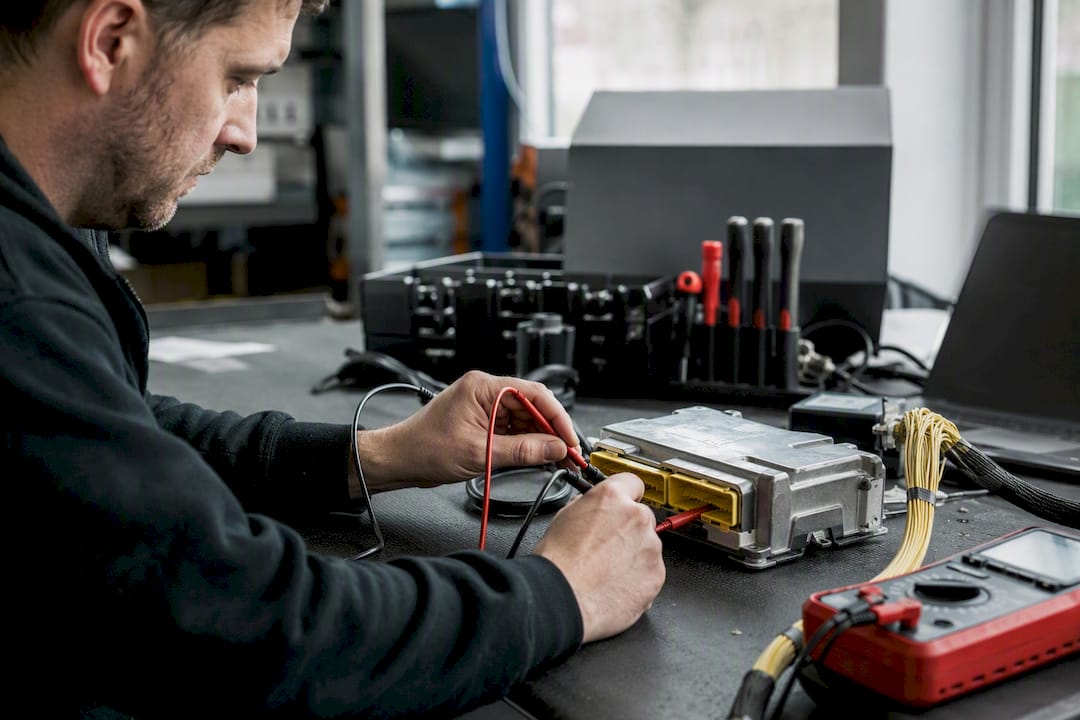
- Verification read and bench arm test. The chip is read back and compared against the rewritten data, and the module is bench-tested to confirm it arms correctly, without a real airbag connected.
This is fundamentally different from OEM diagnostic reprogramming, which can clear certain soft codes through a dealer-level tool but generally cannot touch a hard-latched crash-event flag. That distinction trips a lot of people up: a dealer might tell you the module "can't be reset" when what they mean is their diagnostic tool can't do it, not that the flag is permanently unreadable at chip level.
Not every module accepts this treatment. Some platforms deliberately lock the module against any rewrite once certain fault conditions are logged, and a competent technician will identify this during the initial diagnostic check rather than after billing you for a failed attempt.
Pro Tip: Ask any provider to confirm, before they start work, whether your specific module part number is a known "resettable" platform. A five-minute check against their parts database saves you from paying for an attempt that was never going to succeed.
Verification afterwards should include an OEM-format DTC scan to confirm no fault codes remain, a simulated squib load test to check circuit continuity without firing a live airbag, and a side-by-side comparison of the read-back data against the rewritten image, exactly the checks outlined in detailed guides to the SRS clear process.
Should the module be reset or replaced?
This is the decision that actually matters, and it's one too many owners skip straight past because they assume a warning light always means a new module.
Reset is usually appropriate when:
- The case is intact with no cracking, burning, or water ingress
- The only fault present is a crash-event flag or EDR entry, with no internal component failure
- Connected sensors, pretensioners, and the wiring harness have already been inspected and are sound
- The EEPROM reads cleanly with no corruption on the initial diagnostic pull
Replacement is required when:
- There's physical damage, scorch marks, or evidence of internal component failure inside the module casing
- The EEPROM is corrupted beyond reliable rewrite, common after a very high-severity impact
- The manufacturer has designated that specific module variant as non-resettable at a policy level
- Multiple hard fault codes point to an internal circuit failure rather than just a stored flag
As a rough pattern, crash-event flags and EDR-only entries clear reliably with a bench reset. Codes pointing to squib circuit resistance faults, internal memory faults, or communication bus failures inside the module itself usually mean the unit needs replacing, no amount of chip-level work fixes a physically damaged circuit. A technician using specialised bench tools, rather than a generic scanner, is what separates a safe reset from a risky one, because that distinction between a software flag and a hardware fault is exactly what a proper diagnostic read is meant to reveal.
How to choose a reputable crash-data reset service
Before you post a module anywhere, ask the provider a short list of direct questions. Their answers tell you almost everything about whether they're running a proper bench operation or a back-room "online reset" claim that shouldn't be trusted.
- Do you archive a pre-clear EDR/EEPROM dump, and will you provide it to me on request?
- What diagnostic report do I get, and does it show before-and-after fault codes?
- What verification tests do you run before shipping the module back?
- What's your turnaround time, and is pricing fixed before you start work?
- Do you offer a trade account for garages sending modules regularly?
Trust indicators worth checking for include serial-number logging on intake, a documented bench procedure they can describe in plain terms (not just "we reset it"), published pricing rather than a quote that appears only after you've committed, and technicians who can talk you through the checksum and verification steps without hesitation.
Pro Tip: A provider who can't explain why a battery disconnect doesn't clear a crash flag probably doesn't understand EEPROM-level work well enough to be trusted with your module.
Red flags are just as telling. Walk away from anyone claiming they can clear an installed module "online" or remotely, since crash-event flags are chip-level and physically require the module on a bench. Be equally wary of a provider who refuses to supply verification logs, won't confirm fixed pricing upfront, or quotes a price so low it couldn't possibly cover proper EEPROM backup and checksum work. Documentation is the tell, every legitimate service leaves a paper trail.
The postal reset workflow, step by step
Sending a module by post sounds riskier than it is, provided you follow a straightforward sequence.
- Confirm the part number printed on the module casing, and photograph both the unit and its connector faces before removal. This protects you if there's any dispute about condition later.
- Remove the module following the vehicle's disconnection procedure (battery disconnected first, always), and keep any mounting bolts or brackets together with it.
- Pack it securely in a rigid box with padding around the connectors, which are the most vulnerable point for transit damage.
- Ship via an insured, tracked service. Clearly label the part number on the outside of the package to speed up intake.
- Wait for confirmation of receipt, then for most standard modules, same-day turnaround is realistic; complex or platform-locked units can take longer while the technician confirms resetability.
- Receive the return package, which should include the cleared module, a verification report, and the archived pre-clear EDR dump if you requested one.
Once refitted, run a full OEM diagnostic scan before considering the job finished.
Airbag Reset UK: what a documented postal service should deliver
Airbagresetuk specialises in exactly this kind of postal bench crash-data reset, covering cars, vans, and motorhomes, the last of which is a category many general repair shops simply won't touch because motorhome SRS wiring often differs significantly from standard passenger vehicles.
- Same-day turnaround for most modules, with realistic timeframes given upfront for complex units
- Transparent fixed pricing starting from £35, plus price matching against genuine like-for-like quotes
- Backed by more than 40 years of combined technician experience across the team
- Every job includes diagnostic verification, not just a rewrite and a hope it works
- Discounted trade accounts available for garages, bodyshops, and mobile technicians sending modules regularly
You can see current pricing and identification help based on part number or photo on the Airbag Reset UK service page.
Does clearing crash data affect resale value or your warranty?
A cleared crash-data flag, done properly and documented, generally has a neutral effect on resale value. Buyers and trade valuers care about whether the airbags themselves are original, correctly fitted, and functioning, not whether a fault flag was once logged and professionally addressed. What damages resale value is undisclosed physical airbag replacement or a warning light that reappears because the underlying hardware fault was never actually fixed, only masked.
Warranty implications depend heavily on timing and cause. If the vehicle is still under a manufacturer warranty and the airbag deployment or fault stemmed from a genuine defect rather than a collision, working through the dealer network may be the better route since it keeps the warranty claim intact. Once a vehicle has been in a genuine collision, most manufacturer crash warranties don't apply anyway, the incident itself, not the reset, is what typically ends that coverage.
The safest approach for resale is straightforward: keep the diagnostic report and the pre-clear EDR archive with the vehicle's paperwork. A documented reset, with before-and-after records, reads to a future buyer or valuer as responsible ownership, not concealment. It's the absence of documentation, a warning light silenced with no explanation, that raises questions during a used-vehicle inspection or an HPI-style history check.
How long does the whole process actually take?
Understanding the realistic timeline helps you plan around it, particularly if the vehicle is off the road while you wait.
Day one typically covers preparation: identifying the module's part number, photographing it, and disconnecting it from the vehicle. Postal collection or drop-off to a tracked courier service usually happens the same day or the next, depending on your schedule.
Transit time to the service provider is the biggest variable outside anyone's control, generally one to two working days with a standard tracked and insured service, though next-day options exist for urgency.
Once the module arrives, the bench work itself is often the fastest part of the whole process. Most standard modules with straightforward crash-event flags are turned around the same day they're received, EEPROM read, backup, rewrite, checksum recalculation, and verification, because the actual technical procedure takes hours, not days. Complex platforms or modules requiring chip-off work (where the chip must be desoldered rather than accessed via clip) can take longer while the technician confirms the platform's specific requirements.
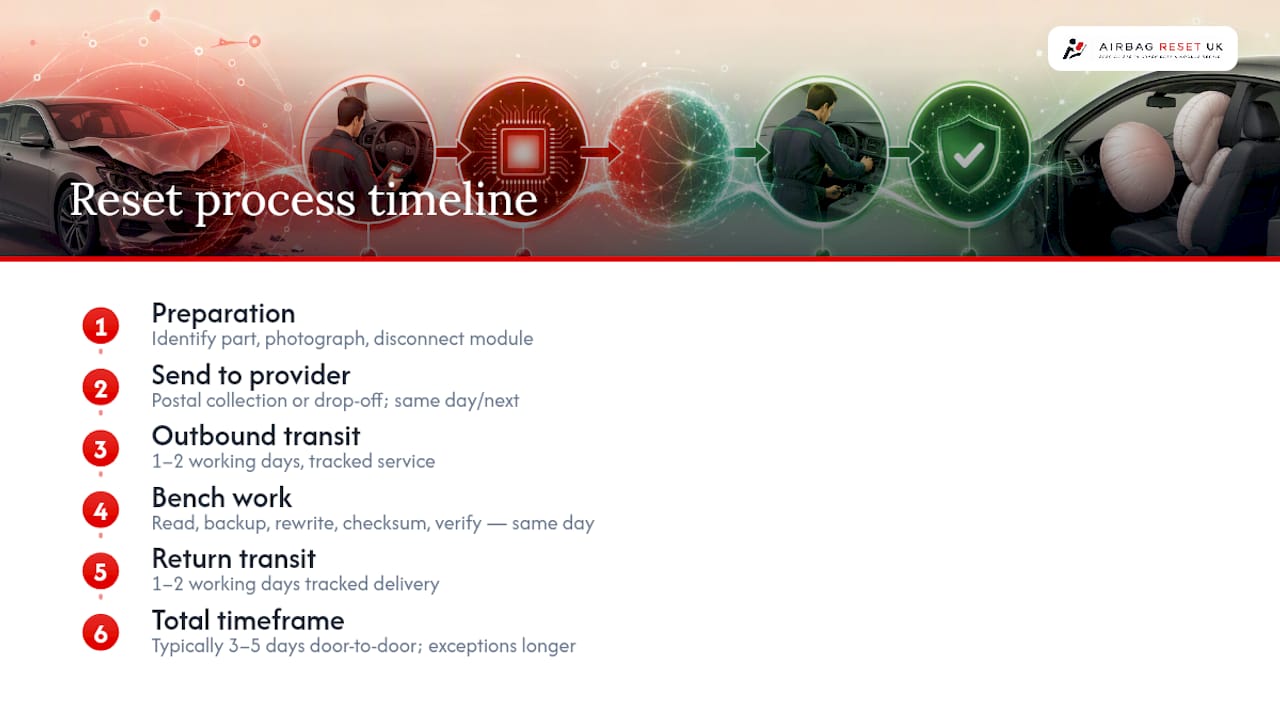
Return transit mirrors the outbound leg, another one to two days with tracked delivery. All told, a straightforward job commonly completes within three to five days door to door, prep and transit included, though this is naturally slower for motorhome modules or unusual platforms.
What insurers and claims processes expect from a crash-data reset
Insurers generally aren't concerned with whether a crash flag gets cleared, they're concerned with whether the underlying damage was properly assessed and repaired, and whether records exist to prove it. This is where archiving the pre-clear EDR dump earns its keep.
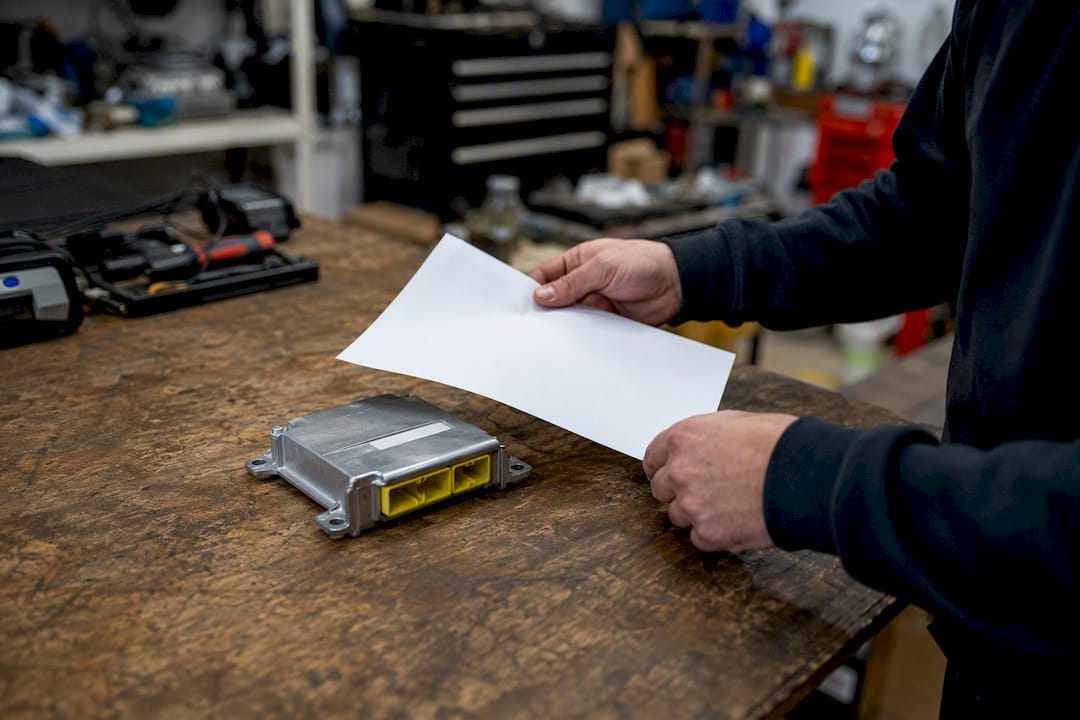
If a claim is still open, or could reasonably reopen (a dispute over fault, a personal injury claim, a total-loss dispute), preserving the original crash data before any clear takes place protects everyone involved. The EDR record, including delta-V and timing data, can be requested during accident reconstruction or dispute resolution, and once it's been overwritten without a backup, it's gone permanently.
Disclosure matters more than most owners assume. If a vehicle changes hands, or if you're making a subsequent claim on the same vehicle, being able to produce a diagnostic report and pre-clear archive demonstrates the airbag system was properly assessed rather than quietly reset to hide a problem. Reputable bench services archive this data specifically for that reason, not as an optional extra but as standard practice, as reflected in guidance on documenting airbag light issues after an accident.
If you're unsure whether your specific claim status requires you to disclose a reset, that's a conversation for your insurer or a solicitor, not something to guess at. But keeping the paperwork ready costs nothing and closes off the question before it becomes a problem.
What the industry gets wrong about crash-data resets
Most advice online treats a cleared warning light as the finish line. It isn't. The genuinely important question is never "can this module be reset", it's "was the hardware that caused the fault actually fixed first". A module that arms correctly on a bench test but sits behind unreplaced pretensioners is a bigger risk than one still showing a warning light.
The conventional wisdom also undersells documentation. Owners fixate on price and turnaround, understandably, but the pre-clear EDR archive is the part that protects you months later if a claim reopens or a buyer asks questions. Skipping it to save time is a false economy.
If there's one thing worth prioritising above cost, it's evidence preservation. A £35 reset with no archive and no verification report is not cheaper than a properly documented job, it's just a decision you haven't paid for yet.
— John
Get your module assessed by Airbag Reset UK
If your airbag warning light won't clear after a collision, sending the module by post beats guessing with a generic scan tool or gambling on a battery disconnect that was never going to work. Airbagresetuk runs exactly the bench-level EEPROM process this article has walked through, complete with pre-clear archiving, a diagnostic report, and verification testing, rather than a vague promise to "sort the light out".
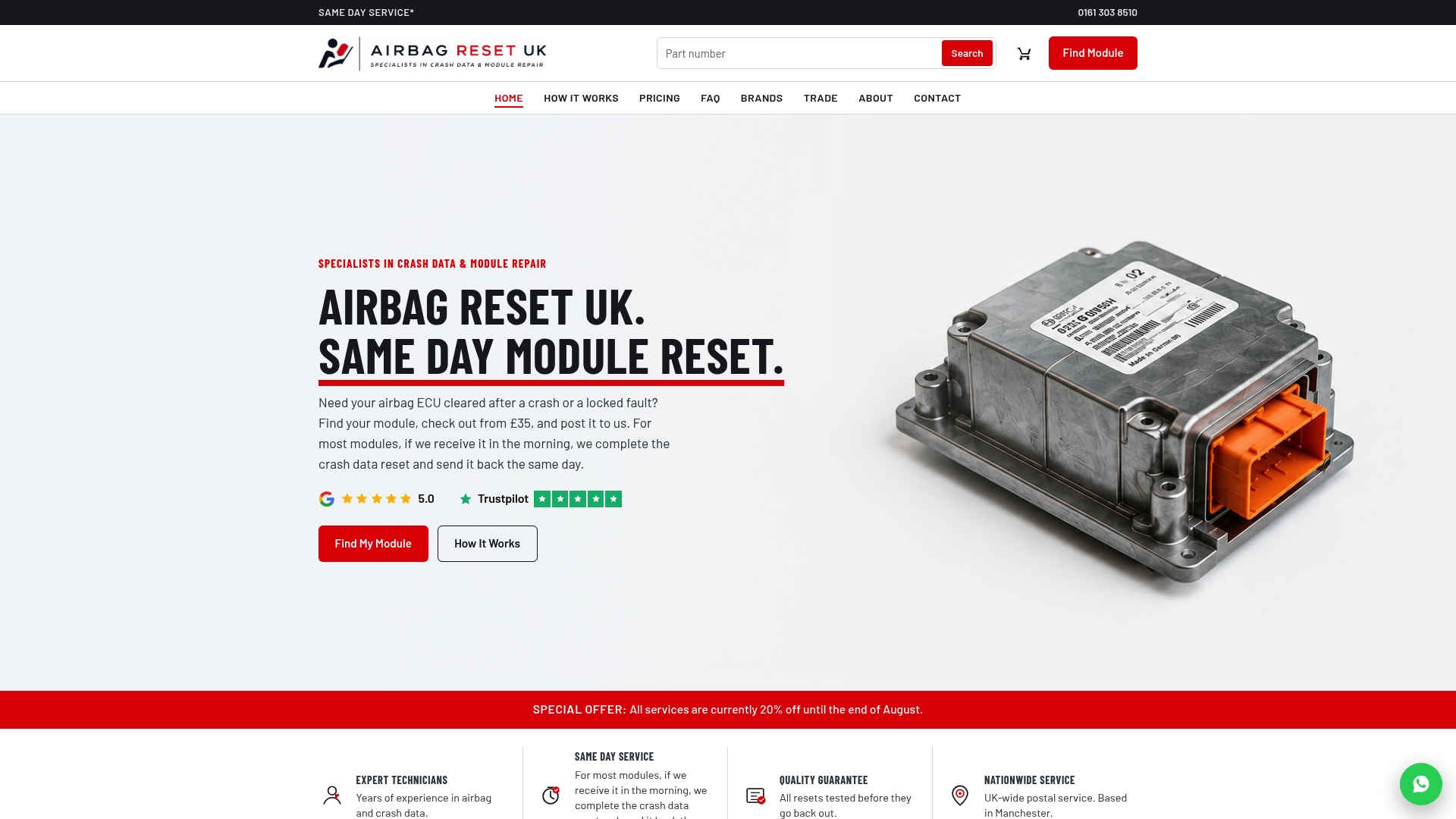
What sets it apart for most owners and garages is speed without cutting corners: same-day turnaround on most modules, fixed pricing from £35, and price matching against any genuine like-for-like quote you've already had. Motorhome owners in particular tend to struggle finding anyone who'll even look at their module, Airbagresetuk covers cars, vans, and motorhomes as standard. Trade accounts are available too, so garages sending modules regularly get discounted rates rather than paying retail every time.
To get started, identify your module's part number or photograph it, then check current pricing and send it in via the Airbag Reset UK postal service page.