

Whether you repair or replace an airbag ECU depends on physical damage and what the manufacturer's instructions say, not on preference. If the module is intact with no deployment, blown inflators or heat damage, a verified crash data reset is usually the safest, fastest and cheapest route. Visible deployment or a manufacturer mandate changes that calculus entirely: check the MOT rules and confirm your provider actually verifies its work before sending anything.
TL;DR:
- Resetting an airbag ECU is safe and cost-effective when no physical damage, deployment, or heat exposure exists, and it can clear fault codes from minor incidents.
- Manufacturer instructions and MOT rules always override repair preferences; genuine faults causing the warning light to stay on result in a Major defect and test failure.
- Proper reset procedures depend on correct identification, battery disconnection, safe handling, verification through documentation, and adherence to bench safety protocols.
- Replacement is mandatory when airbags have deployed, the module shows damage, or manufacturer guidance specifies new parts, especially for insurance or MOT compliance.
- Verified resets typically cost less than new ECUs, with turnaround times around one day, whereas parts and labor for replacement can take weeks and be substantially more expensive.
Table of Contents
- What repairing an airbag ECU actually means versus replacement
- Safety rules and MOT implications you cannot ignore
- How a reset service works and the safety checks that matter
- When replacement is the only sensible option
- Cost, turnaround and availability: what to expect
- Choosing a competent provider: questions and red flags
- How Airbag Reset UK fits the checklist above
- Does repairing or replacing an airbag ECU affect your warranty?
- How reliable are repaired ECUs compared with replaced ones over time
- Can a repaired airbag ECU cause compatibility problems in newer cars
- Warning signs that point to an airbag ECU fault
- Where safety, cost and sustainability actually meet
- Get a postal reset or mobile visit started
- Where to check the official guidance
- Sources
- FAQ
What repairing an airbag ECU actually means versus replacement
A crash data reset clears the stored fault codes and crash record from the airbag control unit after a non-deployment event, such as a minor bump that triggered the warning light without firing any airbags. It does not touch the pyrotechnic components themselves: no inflator, no squib, no seatbelt pretensioner is opened, repaired or reused. Replacement means fitting a new or manufacturer-approved unit entirely, often alongside new inflators or pretensioners if those fired.
A reset can fix:
- A persistent SRS warning light caused by stored crash data after a non-deployment incident.
- Fault codes left behind from a minor collision, a disconnected battery or a sensor glitch.
- An ECU that is electronically sound but logically "locked" by its last recorded event.
A reset cannot fix physical damage, a spent inflator or a cracked housing, and nobody should attempt to open or repair a pyrotechnic device at home.
Safety rules and MOT implications you cannot ignore
Manufacturer instructions and government guidance sit above any repair-first preference. If a vehicle maker says a specific fault requires a new unit, that instruction overrides cost and convenience every time.
The starkest consequence shows up at MOT time. An illuminated SRS malfunction indicator lamp that signals a genuine system fault is treated as a Major defect under the MOT inspection manual, which causes an outright test failure. A passenger airbag that has been deliberately switched off is not a defect in itself: the manual is clear that only a malfunction indication fails the test, not a disabled indicator.
Three points worth fixing in your mind before you decide anything:
- A lit SRS warning light tied to a genuine fault is a Major MOT defect, full stop.
- HSE handling guidance discourages repairing or modifying airbag modules and recommends returning suspect units to suppliers instead.
- Manufacturer service information should always be checked first, since rules vary by model and can mandate replacement regardless of what a reset provider offers.
An SRS malfunction indicator that stays lit for a genuine system fault is classed as a Major defect under the MOT inspection manual, meaning the car cannot pass until the fault is properly resolved and the light cleared through a verified process.
How a reset service works and the safety checks that matter
A competent postal reset follows a fairly consistent sequence. You identify the module by part number or photo, the provider confirms compatibility, the vehicle's battery is isolated, the unit is removed and posted, the crash data is erased on a bench rig, the reset is verified, and the module is returned ready to refit.
The bench stage is where safety and competence actually show:
- Correct orientation and a secure mount during testing, since moving the module incorrectly can trigger false internal sensor faults.
- A minimum battery isolation period, often around 30 minutes, before removing or refitting the module to avoid accidental deployment.
- Verification through OBD clearing, test readouts and a written or photographic record of the module's status before and after work.
Pro Tip: Ask any provider for a written verification report before you commit, not just a verbal "it's done".
A reset without proper bench protocol risks spurious fault codes or, in the worst case, an accidental deployment during handling.
When replacement is the only sensible option
Some situations take the decision out of your hands entirely. Replacement, not reset, is the correct call when any of the following apply:
- The airbag has visibly deployed: a spent inflator, a torn bag or chemical residue inside the housing.
- The module casing shows heat damage, corrosion or physical cracking from impact.
- The manufacturer's own fault codes or service documentation specify that a particular failure requires a new unit.
- Your insurer or an MOT requirement specifies manufacturer-approved parts, ruling out a reset of a compromised component.
HSE guidance is direct on this point: once a pyrotechnic device has fired or shows damage, the correct response is replacement and proper disposal, never an attempt at repair.
Cost, turnaround and availability: what to expect
Reset pricing varies with module type and complexity, but it sits well below the cost of a new ECU in almost every case. Replacement costs climb fast once you add the part itself, fitting labour, and any recalibration the manufacturer requires, plus dealer lead times that can stretch into weeks if the part is not in stock.
- Reset services typically turn jobs around within a day when the module arrives in the morning.
- Replacement parts, especially from main dealers, can take days to weeks depending on stock and model.
- Labour and calibration charges on top of a new ECU often make replacement the costlier route when a reset would have worked.
- Second-hand inflators or modules carry real risk: manufacturer guidance warns against fitting second-hand airbag components because they may offer reduced protection compared with new or approved parts.
A verified reset avoids the waste and risk of swapping a perfectly sound ECU for a new one, while an unverified second-hand replacement can leave you with a part of unknown history fitted to a safety system.
Choosing a competent provider: questions and red flags
Before sending a module anywhere, run through a short checklist:
- Ask how long they have been resetting modules and whether they offer a turnaround guarantee.
- Confirm pricing upfront, including whether complex modules cost more than standard ones.
- Check whether they help identify your exact module from a photo or part number before you commit.
- Request confirmation of bench safety practices and a written report on the module's condition and verification.
Pro Tip: If a provider cannot describe their bench testing process in plain terms, treat that as a warning sign rather than a minor gap.
Red flags include anyone willing to open an inflator, anyone pushing second-hand inflators without provenance, or anyone who cannot explain how they verify a reset actually worked. Choose reset when a provider offers verified work with a guarantee; choose replacement when physical damage or a manufacturer mandate makes reset unsafe or non-compliant.
How Airbag Reset UK fits the checklist above
Airbag Reset UK runs a postal crash data reset service for cars, vans and motorhomes, with identification help from a photo or part number before you send anything. The business states it offers same-day turnaround for most modules received in the morning. Pricing is published rather than quoted on request. Readers can check module identification and current pricing directly before deciding whether reset is the right route for their vehicle.
Does repairing or replacing an airbag ECU affect your warranty?
Warranty terms depend entirely on the manufacturer and the specific component involved, so there is no single rule that applies across every make and model. A manufacturer's warranty on airbag system components typically assumes genuine parts fitted through approved channels, and fitting a used or non-approved replacement part can affect cover for that specific system. A crash data reset performed on your own original module, rather than a part swap, does not introduce a new component into the vehicle, which is one reason some owners prefer it when the module itself is undamaged.
That said, always check your specific warranty documentation rather than assuming. Some manufacturers specify that any work on safety-critical systems, including resets, must go through an approved dealer network to preserve cover. Others are silent on third-party resets entirely, which leaves it to the vehicle owner to weigh the trade-off between cost and warranty risk. If your vehicle is still within its manufacturer warranty period and the fault might be covered, it is worth asking the dealer directly before paying for an independent reset or replacement, since a covered repair could cost nothing at all. For out-of-warranty vehicles, this concern largely disappears, which is part of why resets are most commonly chosen on older cars, vans and motorhomes where dealer warranty cover has already lapsed.
How reliable are repaired ECUs compared with replaced ones over time
A correctly performed crash data reset restores the module to its pre-incident electronic state without altering its hardware, so a reset unit that passes verification should perform exactly as it did before the fault was logged. The long-term reliability question really comes down to whether the original hardware was sound in the first place, which is precisely why reputable providers verify the module's condition rather than simply clearing codes blind.
A new replacement ECU carries its own hardware with a fresh service life, which can be the safer long-term choice when the original module has any physical damage, heat exposure or corrosion. In those cases, a reset would not address the underlying problem even if it temporarily cleared the warning light, and the fault would likely return. For a module with no physical damage, there is no inherent reason a verified reset should be less durable than a replacement over time, since the electronics being reused are the same ones the manufacturer originally fitted and tested.
The practical difference tends to show up in documentation rather than performance. A replaced ECU comes with its own paperwork and part traceability from the manufacturer, while a reset relies on the provider's own verification report to demonstrate the work was done correctly. Keeping that report alongside your vehicle's service history gives you the same kind of audit trail if questions arise later, whether from an MOT tester, an insurer or a future buyer.

Can a repaired airbag ECU cause compatibility problems in newer cars
Modern vehicles increasingly tie the airbag control unit into a wider network of sensors, including crash severity sensors, seatbelt pretensioners and sometimes the vehicle's broader safety electronics architecture. A crash data reset does not change the module's coding or its relationship to that network, since it only clears the stored event data rather than reprogramming the unit, so compatibility issues from a reset alone are uncommon when the original module was correctly matched to the vehicle.
Compatibility problems are far more likely to arise with used or reprogrammed replacement modules sourced from a different vehicle, where coding, sensor alignment and configuration need to match precisely. Technician forums describing this process note that correct coding and sensor alignment, followed by thorough post-fit checks, are necessary steps when a module is moved between vehicles, since a mismatch can trigger fresh fault codes or leave the system unable to communicate properly with other control units.
This is one of the clearer arguments for resetting your own original module rather than sourcing a replacement of uncertain history: the module was already matched to your vehicle at the factory, so there is no coding or alignment step to get wrong. If a replacement is genuinely necessary because of physical damage, insisting on a part that is correctly coded and verified for your specific vehicle, rather than assuming compatibility, avoids a second round of fault-finding after the work is done.

Warning signs that point to an airbag ECU fault
Most owners first notice a problem through the dashboard rather than anything physical. The most common signals worth acting on include:
- A persistent SRS or airbag warning light that stays on after the engine starts, rather than flashing briefly and switching off.
- The warning light flashing in a repeating pattern, which on many vehicles indicates a stored fault code rather than a momentary glitch.
- A warning light that appeared immediately after a minor collision, a kerb strike, a jump start or a battery disconnection.
- Intermittent illumination of the light that comes and goes, which often points to a connector or wiring issue feeding false data to the module rather than the module itself.
None of these symptoms alone tell you whether the fix is a reset or a replacement. A light that appeared after a minor, non-deployment incident with no visible damage anywhere in the car is a strong candidate for a straightforward reset. A light accompanied by a deployed airbag, visible damage to the dashboard or seats, or a manufacturer fault code pointing to a specific hardware failure is a signal that replacement is the appropriate next step rather than a cheaper fix. The safest approach in either case is diagnosis first: a scan to read the actual stored codes tells you far more than guessing from the dashboard light alone, and it is the first thing any competent reset provider should ask for before quoting you anything.
Where safety, cost and sustainability actually meet
Repair-first makes sense precisely because most SRS lights follow minor, non-deployment events where the module itself is fine. But that preference only holds when manufacturer instructions and MOT rules allow it: never override those for the sake of a cheaper fix. Keep the verification report from any reset or replacement with your service history, and always get written confirmation of a module's condition before agreeing to any work.
— John
Get a postal reset or mobile visit started
If your module is intact and the fault looks like a minor, non-deployment event, you do not need to replace an entire ECU to fix a persistent warning light.
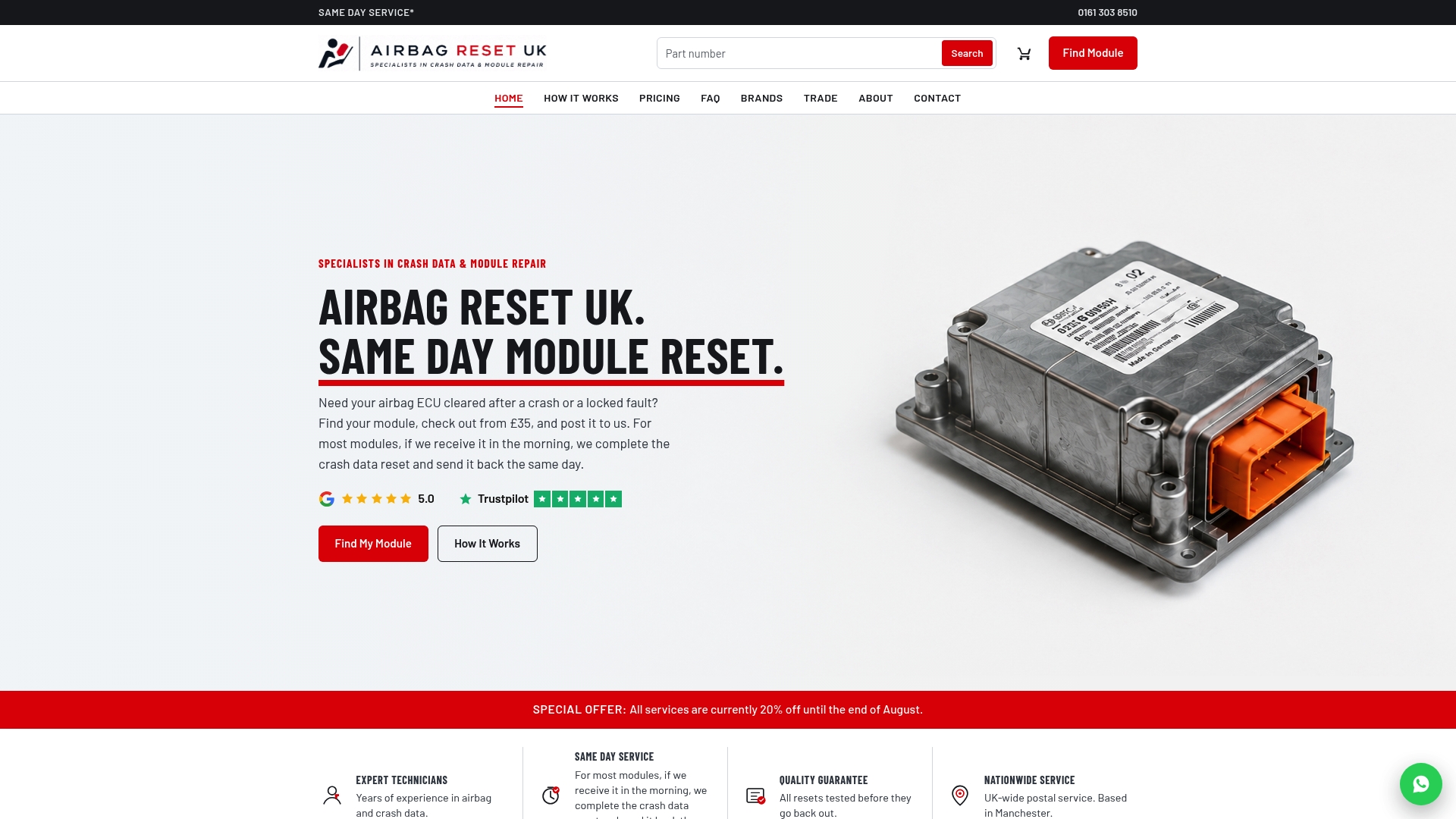
For vehicles where posting a module is impractical, a mobile visit or a motorhome-specific service may suit better:
- Postal reset for cars and vans, with fixed pricing published upfront and a price-match offer against genuine like-for-like quotes.
- A dedicated motorhome airbag reset service for larger vehicles with their own module variants.
- A mobile option for customers who prefer a technician to come to them rather than posting the unit.
| Service | What it covers |
|---|---|
| Airbag module reset | Postal crash data reset for standard car and van modules |
| Motorhome airbag reset | Reset service for motorhome-specific airbag modules |
| Mobile Airbag reset | On-site technician visit instead of a postal send |
Check current pricing and start the identification process on the airbag module reset page.
Where to check the official guidance
For the rules behind the advice in this guide, the MOT inspection manual covers SRS warning light defect categories, HSE guidance sets out safe handling and storage rules, and the depolluting guidance for end-of-life vehicles explains safe removal and deployment procedures for pyrotechnic devices.
Sources
- Gov
- Storing and handling airbags and seat belt pretensioners safely - HSE
- Depolluting end-of-life vehicles (cars and light goods vehicles): guidance for authorised treatment facilities
FAQ
How much does it cost to repair an airbag ECU?
Reset pricing depends on the module type and its complexity rather than a single flat figure, and providers typically publish a price range rather than one-size pricing. Airbag Reset UK publishes typical prices for their postal reset.
Is it worth replacing an ECU if it still works?
If the module is physically intact with no deployment or damage, replacing it is rarely worth the extra cost and lead time compared with a verified reset. Replacement becomes worthwhile, and often necessary, once there is evidence of deployment, heat or corrosion damage, or a manufacturer fault code that specifically calls for a new unit.
How can you tell if an airbag ECU is damaged?
The clearest signs are a persistent or flashing SRS warning light, a light that appeared right after a collision or battery disconnection, or visible damage such as a deployed airbag or a cracked module housing. A diagnostic scan reading the stored fault codes gives a far more reliable answer than relying on the dashboard light alone.
Does the airbag control module always need to be replaced after a crash?
No: if the airbags did not deploy and the module shows no physical or heat damage, a crash data reset is often sufficient to clear the fault and restore the system. Replacement becomes necessary once the airbags have actually fired, the module is physically damaged, or the manufacturer's own guidance specifies a new unit for that particular fault.
Will a reset or replacement affect my MOT?
A genuine SRS system malfunction that leaves the warning light illuminated is treated as a Major defect under the MOT inspection manual and will fail the test. Either a verified reset or a proper replacement resolves this, provided the work is confirmed and the warning light is correctly cleared before the test.