
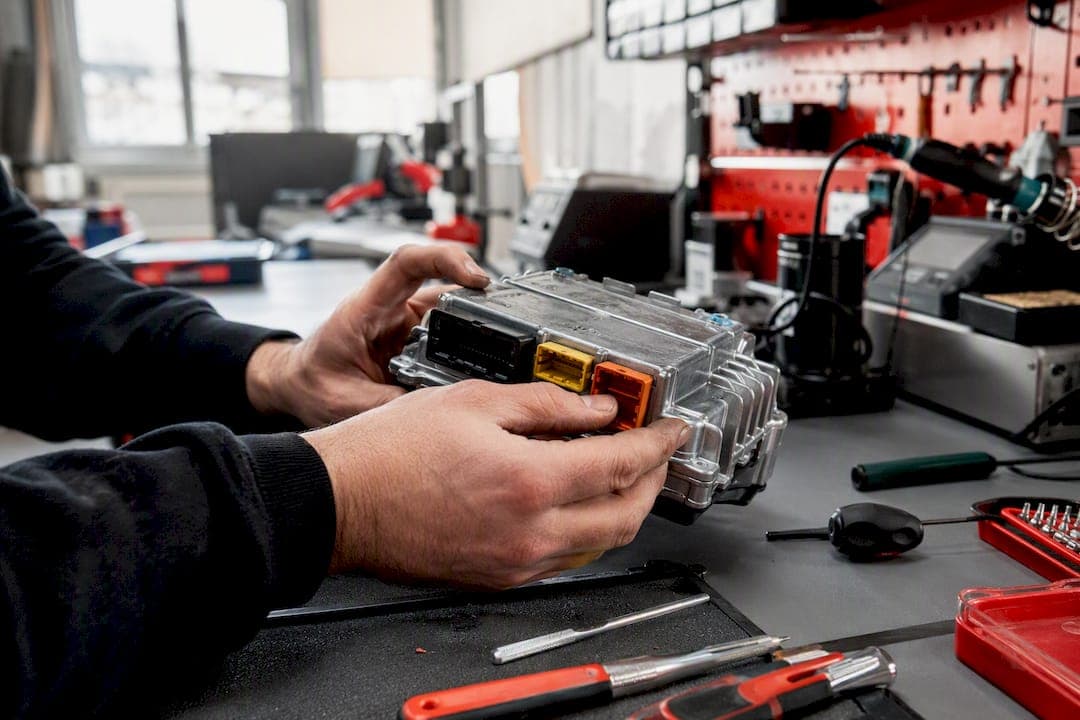
An intermittent airbag warning light means the SRS has detected a fault and logged it, and there's a real chance your airbags are currently disabled. Don't clear anything yet. Get an SRS-capable scan done, have the codes recorded before anyone touches "reset", and if the light is flashing or the fault followed a battery job or jump start, treat the car as a lower priority for anything but essential journeys.
TL;DR:
- Intermittent airbag warning lights often result from loose connectors, damaged wiring, or corroded modules, especially under the seats or steering wheel area.
- Owners should perform basic checks like a controlled restart, inspecting under-seat wiring, and testing related systems before seeking professional diagnosis.
- A proper diagnostic requires an SRS-capable scan tool to read fault codes, as generic OBD-II scanners usually cannot access the airbag system’s specific codes.
- Repair costs vary from around £100 for simple connector reseats to over £1,000 for module repairs or replacements after a crash event.
- Clearing fault codes without recording them risks losing essential clues, making thorough documentation and proper reset services crucial for safety and resale value.
Table of Contents
- Quick, safe checks before you book anything in
- Common causes that produce intermittent airbag warning lights
- How a professional diagnostic actually works
- DIY checks vs professional repair: where the line sits
- Repair types, typical costs and how long they take
- Safety, MOT and legal notes
- How crash-data resets and postal repair services actually work
- Why documentation matters more than a quick fix
- Getting your airbag module sorted through Airbag Reset UK
- Sources
Quick, safe checks before you book anything in
Before you spend money on a diagnostic, a few minutes of your own detective work can save the technician time and save you cash. None of these checks require tools beyond a torch and a bit of patience.
- Do a controlled restart. Turn the ignition off, wait ten seconds, then start the car and watch the dashboard. The airbag symbol should light up for a few seconds as part of the self-test, then go off. If it stays on, flashes, or comes back after a delay, that's the intermittent pattern worth documenting.
- Think back to recent work on the car. Did anyone disconnect the battery, jump-start it, or work under a seat (fitting a stereo, cleaning, child seat installation)? Airbag faults triggered by this kind of disturbance are extremely common.
- Look under the front seats. Airbag wiring typically runs through a bright yellow connector. Check it's fully clipped in, and look for signs of dampness, mud, or a spilled drink that's crept underneath.
- Test related systems. Does the horn work? Do steering-wheel buttons respond normally? Is there a passenger-airbag OFF light behaving oddly? These share wiring paths with the SRS and can hint at where the fault sits.
Pro Tip: Keep a note of exactly when the light comes on and off, including mileage and any bump in the road, a pothole, or seat adjustment that seemed to trigger it. That timeline is often more useful to a technician than the fault code itself.
Common causes that produce intermittent airbag warning lights
Intermittent faults are frustrating because they hide when you go looking for them, but the electrical and mechanical causes tend to fall into a short list of usual suspects. According to WhoCanFixMyCar, the most frequent triggers include faulty sensors, damaged clock springs, corroded modules, seatbelt sensor issues, and loose wiring or connectors.
- Under-seat connectors and harness damage. Seat rails move every time someone adjusts the seat, and over years that repeated flexing frays wiring or works a connector loose. Corrosion from spilled drinks or wet boots makes this worse.
- Clock spring wear. This coiled ribbon of wiring sits behind the steering wheel and carries signal to the driver's airbag, horn, and often cruise or audio controls. A worn clock spring frequently shows up alongside a dead horn or unresponsive wheel buttons, not just the airbag light on its own.
- Low or unstable voltage. A weak battery, a poor earth connection, or the aftermath of a jump start can dip voltage just enough to trip the SRS module's self-check without there being a genuine mechanical fault.
- Seatbelt pretensioner and occupant-detection faults. The mat or sensor under the passenger seat that judges whether someone is sitting there can fail intermittently, especially with weight shifts or age.
- Module corrosion or stored crash data. Airbag Center notes that water ingress or corrosion inside the SRS module itself can cause faults that come and go depending on temperature or vibration, and a module that still holds data from a prior collision will often throw warnings until that data is properly addressed.
Seat-track pinch points deserve a special mention. A visual trace of the wiring loom from the steering column down to the under-seat connectors, following the common failure points practitioners see repeatedly, usually finds the fault faster than jumping straight to swapping parts.
How a professional diagnostic actually works
The airbag light's brief flash at start up is the SRS running its own self-test, checking bulb function and confirming the module can communicate. When that light stays on, flashes, or reappears after driving, the system has logged a fault, and reading it properly needs the right tool.
Standard OBD-II code readers, the sort many owners keep in the glovebox, usually can't see into the SRS network at all. Airbag fault codes typically carry a 'B' prefix (for example B0101), and these codes often sit outside what a generic scanner can access. You need an SRS-capable scan tool, and ideally one with enough manufacturer coverage to pull live data, not just a flashing light and a shrug.
A proper diagnostic sequence looks something like this:
- Read the stored DTCs and any freeze-frame data (what the car was doing when the fault triggered) before touching anything else.
- Inspect connectors, particularly under the seats and around the steering column, for looseness or corrosion.
- Where a squib circuit needs testing, use a ballistic resistor or dedicated airbag simulator rather than probing the live circuit directly. Rick's Free Auto Repair Advice is clear that this substitution is the safe way to check resistance without risking accidental deployment.
- Test clock spring continuity if the horn or wheel controls are also misbehaving.
- Decide whether the fault needs a wiring repair, a crash-data reset, or full module replacement.
One detail worth flagging: a technician who clears codes before recording them has thrown away the one piece of evidence that explains what actually went wrong. It's a common shortcut, and it's the wrong one.
Battery disconnection and a wait for the SRS capacitor to discharge are standard safety steps before any of this work begins. Skipping that wait is how people get hurt.
DIY checks vs professional repair: where the line sits
There's a sensible middle ground between "ignore it" and "take it apart yourself," and it's worth knowing where that line falls.
Reasonable to do yourself:
- Visual inspection of accessible wiring and connectors under seats.
- Reseating a connector that's clearly worked loose (a firm click, nothing forced).
- Checking your battery voltage and charging system health.
- Writing down exactly when the fault appears, what you were doing, and any other symptoms.
Leave this to a workshop:
- Probing squib circuits directly with a multimeter.
- Replacing a clock spring, which needs the steering wheel removed and airbag handled correctly.
- Clearing hard fault codes without first documenting what they were.
Pro Tip: When you do book a diagnostic, bring photos of the connector or wiring you've inspected and a written timeline of when the light behaves oddly. It cuts down guesswork and often shortens the bill.
Repair types, typical costs and how long they take
Costs vary enormously depending on what's actually wrong, and that's not a dodge, it genuinely depends on whether you're looking at a £20 connector or a water-damaged module.
| Repair type | Typical cost range | Turnaround |
|---|---|---|
| Connector reseat or minor wiring repair | Lower end of the scale | Often same-day |
| Clock spring, pretensioner or occupancy mat replacement | Medium, parts plus labour | Usually a day in the workshop |
| Module repair or crash-data reset | Variable, higher for full replacement | Depends on parts availability |
Blackcircles puts the overall range at roughly £100 for a straightforward connector fix up to over £1,000 for complex module faults or post-accident repairs, and that spread comes down to labour time, parts cost, and how badly corroded or damaged the module itself is. A car that's had water ingress under the seat is a different job to one with a single loose plug.
Safety, MOT and legal notes
An illuminated airbag light is a safety-critical warning, not a cosmetic annoyance. The car will likely still start, steer, and stop, but it's driving without the crash protection you're paying insurance to cover.
- The vehicle can pass a basic drivability check while genuinely lacking full airbag protection, which is exactly why the warning matters more than it looks.
- MOT testers assess restraint system indicators under the official Gov, which sets out the criteria testers follow for this category of fault.
- Avoid long or high-risk journeys until the fault's identified, particularly motorway driving where a collision is more likely to be severe.
- If the light appeared after a knock, jolt, or accident, however minor, get it checked before driving further rather than assuming it will settle on its own.
How crash-data resets and postal repair services actually work
A crash-data reset isn't the same thing as clearing a code. Clearing a code just wipes the fault from memory, often temporarily, while a proper reset addresses the crash record stored inside the module itself, the data that tells the SRS a deployment event happened and locks the system accordingly.
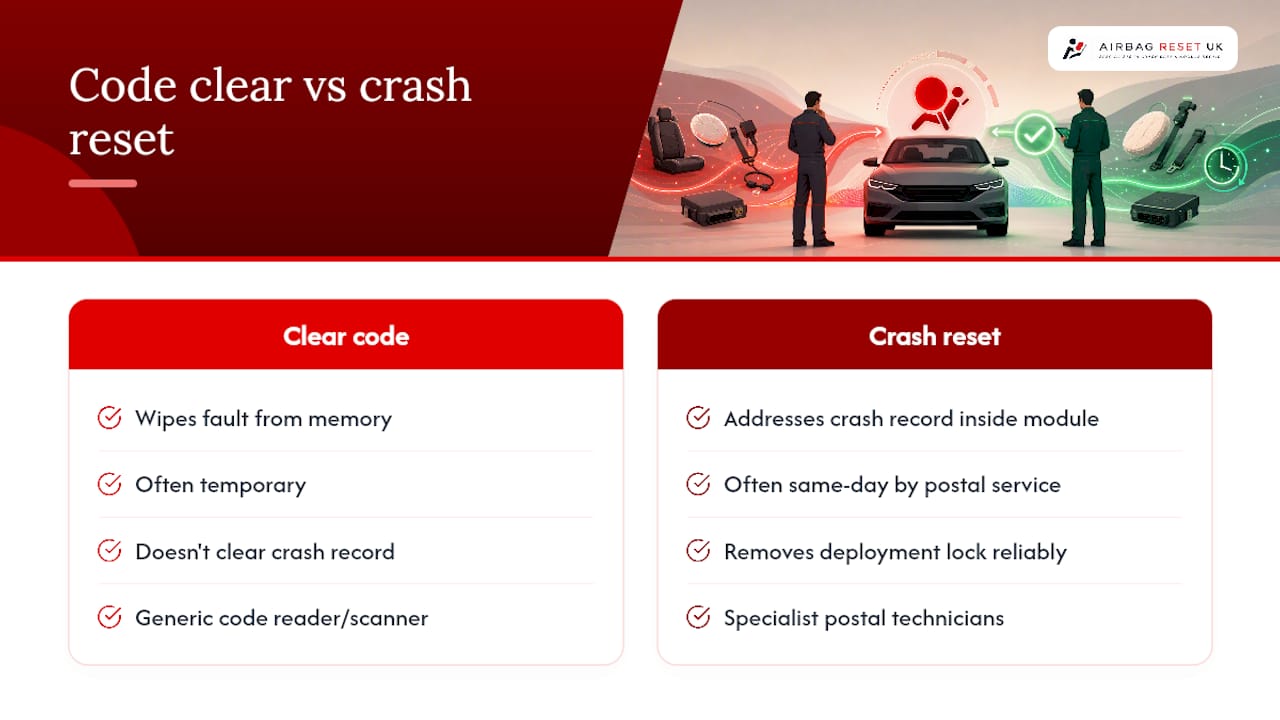
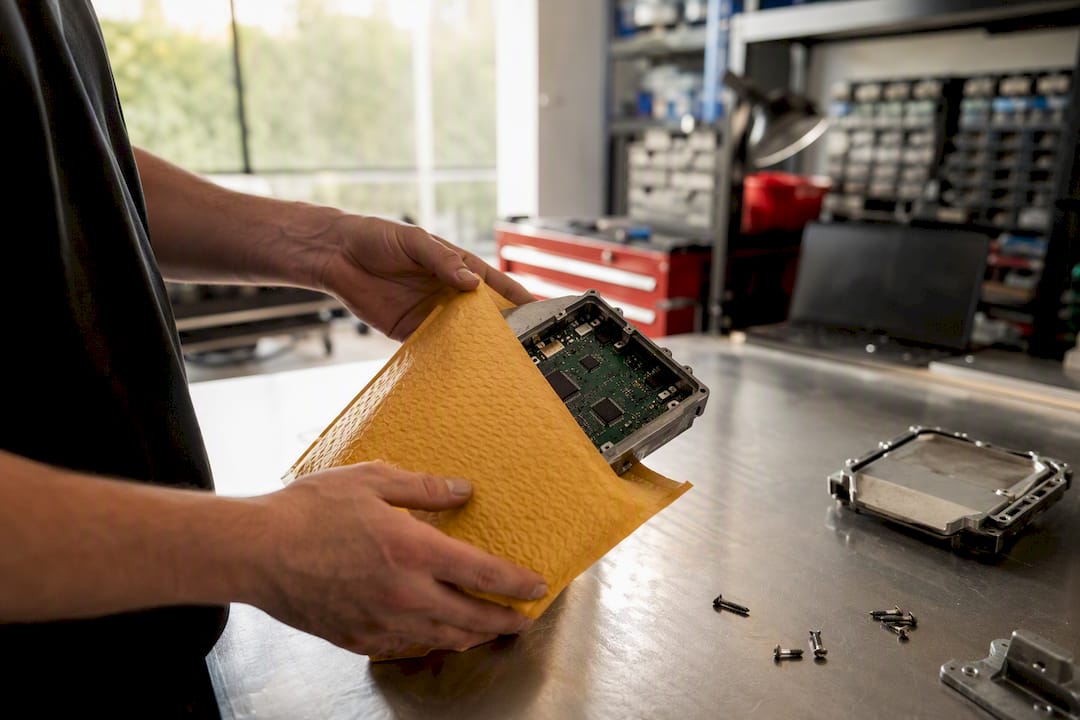
Specialist postal services identify your module from its part number or a clear photo, quote a fixed price upfront, and turn the job around quickly once it arrives, often the same day for straightforward resets. When you're vetting a provider, look for technicians with genuine hands on experience, transparent pricing with no surprise add ons, some form of guarantee on the work, and trade accounts available for garages sending multiple units. That combination separates a credible specialist from someone just flashing a generic tool at your module.
Why documentation matters more than a quick fix
The instinct to make an annoying light disappear is understandable, but skipping the code recording step is the single most common mistake I see people make with this fault. Once you've cleared a DTC without writing it down, you've lost the one clue that would have told a technician exactly what went wrong.
Documented repairs matter for resale too. A buyer's mechanic checking service history will trust a car with a paper trail on its airbag system far more than one with a mysteriously silent warning light. Keep whatever records the workshop gives you.
— John
Getting your airbag module sorted through Airbag Reset UK
If your fault points to stored crash data rather than a simple wiring fix, sending the module off for a proper reset is often the fastest route back to a clean dashboard. Airbagresetuk runs a straightforward postal service for exactly this: send in your module, identified by part number or a photo if you're not sure, and get it back with same-day turnaround for most standard units.
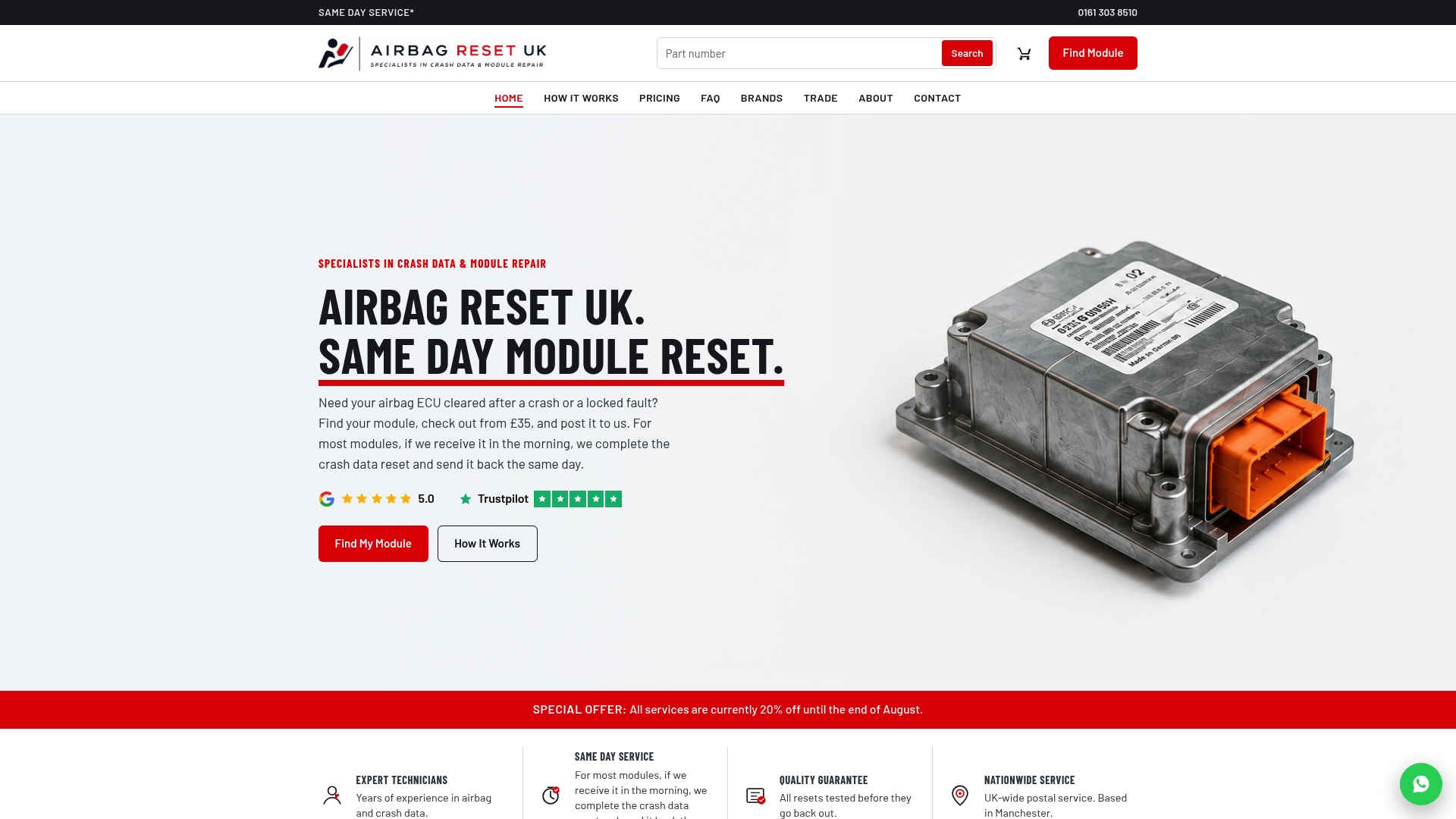
Pricing starts from £35, it's fixed and shown upfront, and Airbagresetuk will price-match a genuine like-for-like quote you've already had elsewhere. That matters if you've been quoted eye-watering module replacement costs by a dealer when a reset was all you actually needed. The service covers cars, vans, and motorhomes, and garages or mobile technicians can set up a trade account for discounted rates on repeat jobs.
If you've had your fault properly diagnosed and know it's a crash-data issue rather than a wiring or connector fault, book your module in for a reset and post it off with the part number noted. You'll get tracking on the way back and a working airbag system without the module-replacement price tag.
Sources
- Airbag light and MOT guidance (Blackcircles)
- Dot
- How to test an airbag safely after a trouble code (Rick's Free Auto Repair Advice)
- Airbag warning light causes and fixes (WhoCanFixMyCar)