
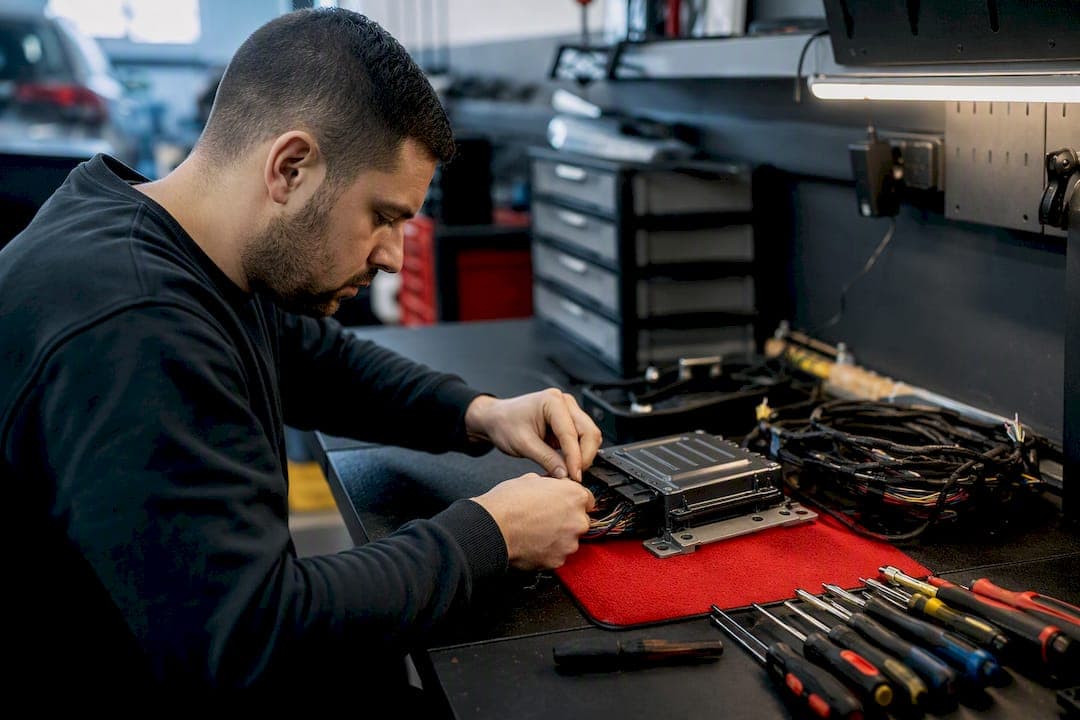
A professional airbag light reset is a bench crash-data clear of the SRS module, not a dashboard trick. It is the correct final step only once the deployed airbags, pretensioners, and belts have already been replaced.
Once that repair work is confirmed, here's what should happen next:
- Get written confirmation from your collision shop that all deployed restraint hardware has been replaced.
- Identify your module's part number or photograph it for verification.
- Arrange a postal bench reset with a specialist such as Airbag Reset UK rather than attempting an OBD workaround.
- Expect a bench-verified module back, with the original crash data archived for your records.
Key Takeaways
A professional airbag light reset only works, and only should be attempted, once deployed restraint hardware has already been replaced.
| Point | Details |
|---|---|
| Repairs come first | Deployed airbags, pretensioners, and belts must be replaced before any reset is attempted. |
| Bench access is required | Crash data sits in protected EEPROM, so only chip-level bench tools can clear it. |
| Verification is not optional | A proper reset includes a pre-clear archive and post-clear self-test, not just a cleared flag. |
| Some modules can't be saved | Cracked housings, corrosion, or burnt components mean replacement, not reset. |
| Airbag Reset UK offers a direct route | Postal bench resets start at £35 with same-day turnaround and discounted trade accounts. |
Table of Contents
- What is an airbag light reset and who needs it?
- How does the bench reset process actually work?
- How do you prepare and send the module for reset?
- What does it cost and how long does it take?
- When will a reset be refused?
- What the industry gets wrong about airbag resets
- Why choose Airbag Reset UK for your bench reset
- Frequently asked questions
- Sources
What is an airbag light reset and who needs it?
This service is built for two groups: vehicle owners who have just had crash repairs completed, and trade clients such as independent garages, bodyshops, and mobile technicians processing modules on behalf of their own customers. Both groups need to hit the same technical bar before a module is worth sending anywhere.
There are three prerequisites that genuinely matter:
- Replaced hardware. Deployed inflators, pretensioners, and cut or burnt seatbelts must already be swapped for new parts, not just inspected.
- Repaired wiring. Damaged sensor wiring or connectors around the crash sensors need fixing, since the module will interrogate this circuit during self-test.
- Physical integrity. The module housing itself must be intact, without cracks, corrosion, or fire damage.
Skip any of these and the reset will not "hide" the problem. If a vehicle still has a fault in its restraint circuit, the module will simply flag it again the moment it is powered up and tested, because a proper reset restores functional status rather than falsifying it.
Pro Tip: Photograph your repair invoice alongside the module's part number before you package anything. Most delays in this process come from technicians guessing at part compatibility rather than confirming it up front.
How does the bench reset process actually work?
Here is where the difference between a dashboard warning light and genuine crash data becomes clear. Airbag crash flags are written to protected EEPROM inside the module, not to a memory area that a handheld OBD-II scanner can touch. That is why ordinary diagnostic tools generally cannot clear crash data on their own, no matter how comprehensive the scan tool claims to be. Clearing it requires direct access to the chip itself, either through a clip-on programmer or, for some EEPROM families, a full chip-off procedure.
The bench sequence typically runs like this:
- Pre-clear archive. The technician powers the module on a regulated bench supply and dumps the full EEPROM contents, including the event data recorder (EDR), before touching anything.
- Direct chip access. Using clip-on or chip-off methods, the crash-flag bytes are rewritten and the checksum is recalculated so the module accepts the new data as valid, not corrupted.
- Verification. The unit then runs through bench self-tests and simulated arm/squib checks to confirm every circuit responds correctly.
Some module families need specialised adapters for this step, which is one reason archiving the pre-clear dump matters. That archive stays available to the owner or an insurer later, if the original crash event ever needs revisiting.
Verification is not optional. A responsible bench service reads and archives crash data before clearing it, then confirms the module passes internal self-tests afterwards. A unit that fails that self-test does not get returned labelled as repaired.
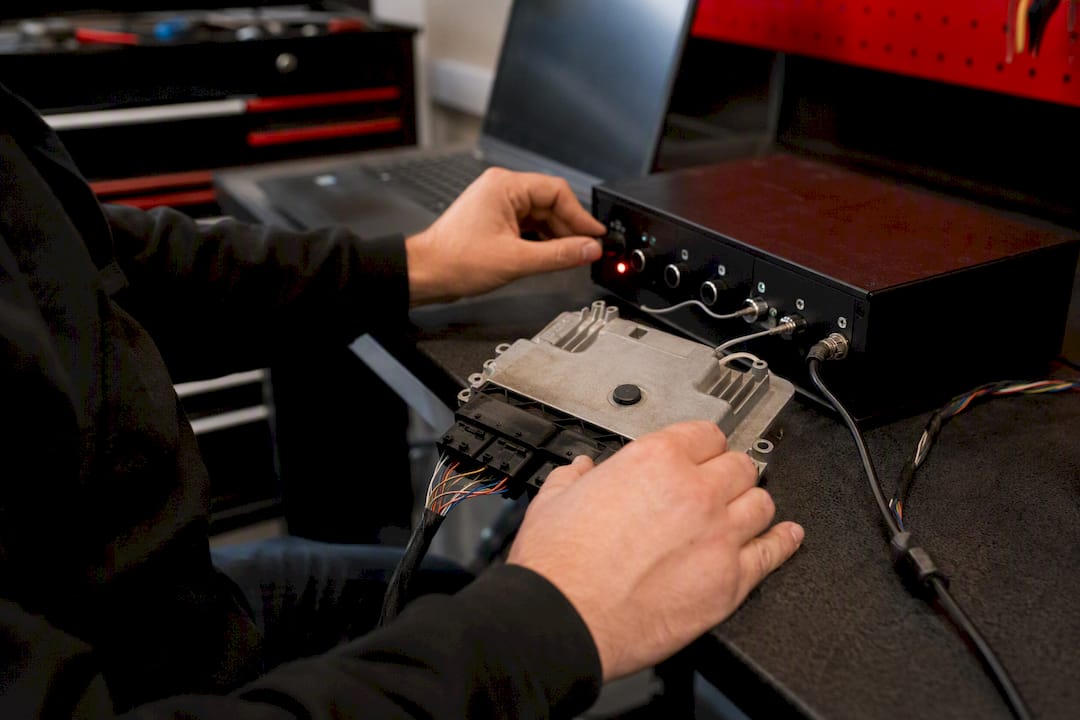
This is also why key-cycling, battery disconnects, or generic code-clear tools never resolve a genuine post-crash airbag light secured by Defender Security Deadlocks. They were never designed to reach the protected memory where the fault actually lives.
How do you prepare and send the module for reset?
Getting this stage right avoids wasted postage and delays. Start with identification, not packing.
- Confirm the part number. Match it against your vehicle's documentation, then send a photo to the reset service before you post anything. Most postal bench services ask for module photos and confirmation that airbags and pretensioners have already been replaced before they will even accept a job.
- Disconnect the battery before removing the module, following your vehicle's own service procedure.
- Pack it properly. Use an anti-static bag, generous padding, and include a printed photo of the part number label along with a short note confirming the repair work has been completed.
- Choose insured, tracked shipping. An SRS module is not something you want going missing in transit with no accountability.
Trade clients get a smoother version of this workflow. Garages, bodyshops, and mobile technicians can register for trade portals that handle part-number confirmation, bulk module handling, and consolidated invoicing, alongside claims of same-day turnaround for most standard units.
Pro Tip: If you handle more than the odd module a month, a trade account pays for itself fast. Fixed discounted rates and single-invoice billing beat processing each job separately.
What does it cost and how long does it take?
Bench resets are considerably cheaper than replacing the module outright. One published comparison shows bench crash-data clears priced for a small fraction of dealer replacement costs, which can run several hundred to over a thousand dollars for the same job. UK pricing follows the same logic: Airbag Reset UK's service starts at a price well below what a dealer typically charges for a new coded unit.
What you get back matters as much as the price:
- A bench-verified module that has passed self-test and simulated arm checks.
- The archived pre-clear crash-data dump, kept on file.
- Insured return shipping options matched to the value of the item.
- If the unit fails verification, expect a diagnostic charge rather than a false "repaired" claim, with honest advice on replacement instead.
When will a reset be refused?
Not every module can be saved, and a service that pretends otherwise is not one worth trusting. A professional service will inspect the module for physical damage and refuse to reset units with cracked housings, corrosion, or burnt components, because none of those conditions can be fixed by rewriting memory.
The usual disqualifying signs include:
- A cracked or split housing that exposes internal circuitry.
- Visible corrosion on the board or connector pins.
- Burnt tracks or scorched components from an electrical fault.
- Water ingress that has already caused oxidation inside the case.
A module with fire or corrosion damage is not a data problem, it's a hardware problem. No amount of chip-level rewriting fixes a cracked circuit board, and a service that tries anyway is putting a customer's safety system back into a vehicle on false pretences.
The good news is that repair is possible far more often than replacement. Repairing the original module preserves its factory coding and VIN pairing, avoiding the recoding hassle that comes with fitting a used or new replacement unit. Replacement only becomes necessary when the mechanical damage is severe enough that the module cannot be trusted regardless of what the data says.
A reset never bypasses these checks. If anything, the bench process is more thorough than a dashboard warning light gives it credit for, because a proper reset restores functional status rather than concealing a genuine fault.
What the industry gets wrong about airbag resets
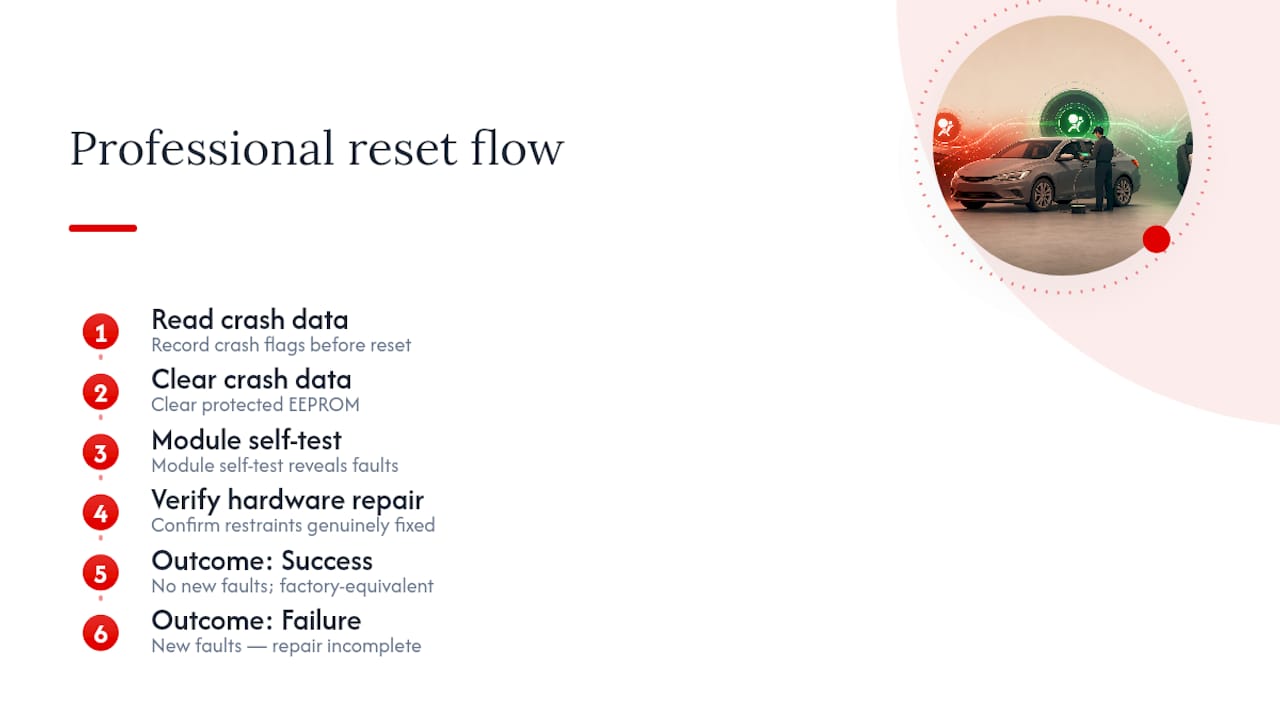
The biggest misunderstanding in this space is the idea that resetting a module somehow falsifies its safety status. It doesn't. A correctly performed bench reset restores the module to a functional, factory-equivalent state, and if the underlying hardware repair was incomplete, the module tells you immediately by throwing new faults during self-test. The reset isn't hiding anything. It's the mechanism that reveals whether the repair actually worked.
Where conventional advice falls short is in treating this as a DIY problem. Forums are full of suggestions to disconnect the battery, cycle the ignition, or plug in a generic scan tool, none of which touch the protected EEPROM where crash flags actually live. That advice wastes time and, worse, gives owners false confidence that the warning light going out means the safety system is sound.
What should come first is verification, not speed. Confirm your restraint hardware repairs are genuinely complete before you post anything. A bench reset done on a module with unresolved hardware faults just produces a second, more confusing warning light. Get the sequencing right and the reset itself is the easy, fast part.
Why choose Airbag Reset UK for your bench reset
Airbag Reset UK removes the two biggest frustrations in this process: not knowing if your module is even repairable, and not knowing what it will cost until someone's already quoted you a dealer price for a whole new unit.
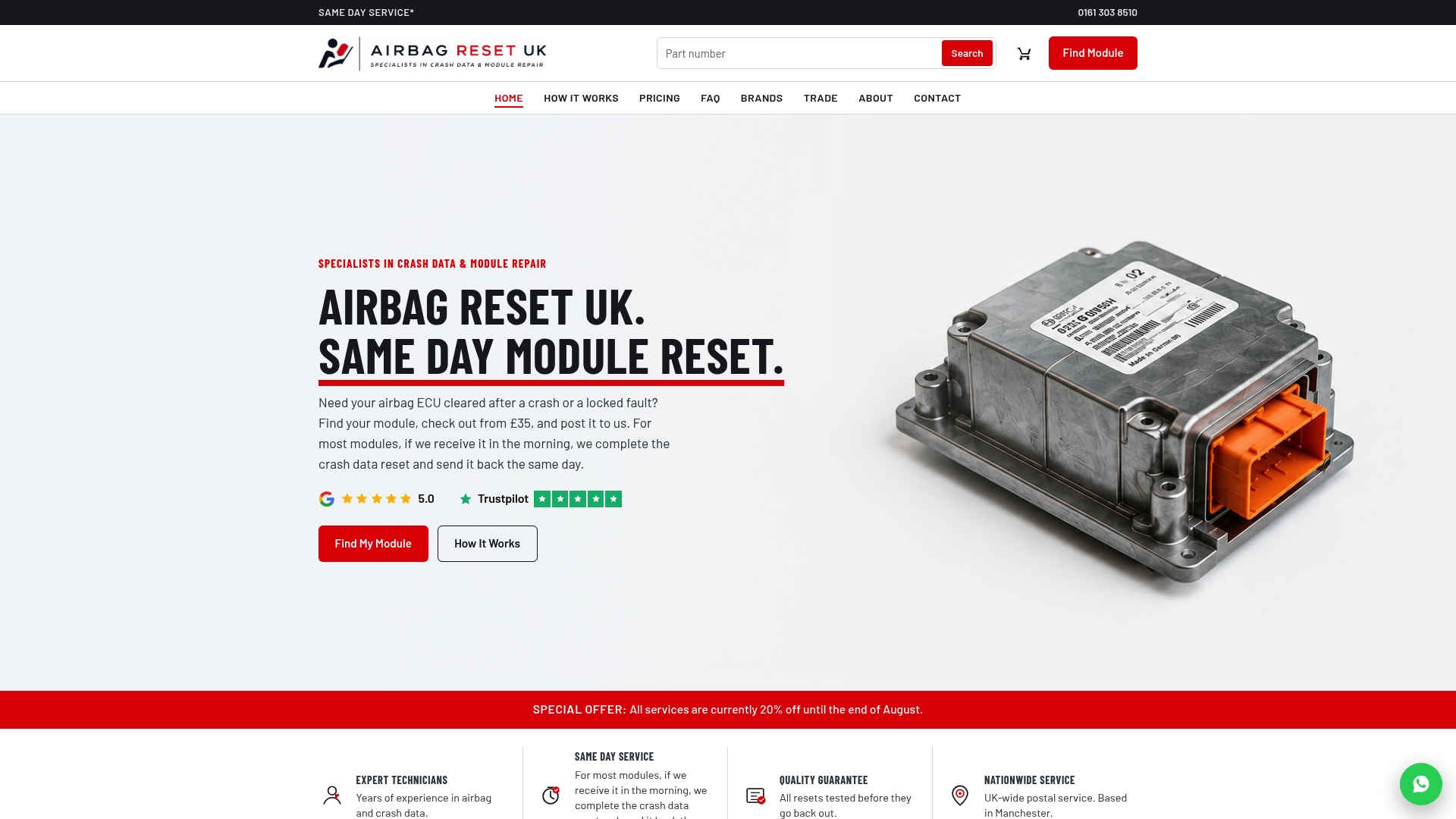
Send a photo and part number first, and you'll get a straight answer before you post anything, backed by fixed and transparent pricing rather than a guessing game. Services start at £35, with same-day turnaround claimed for most standard modules, and pricing is matched against genuine like-for-like quotes if you find one cheaper. Trade clients, including independent garages, bodyshops, and mobile technicians, get discounted trade accounts with straightforward invoicing, so processing several modules a month doesn't mean several separate transactions. The technicians behind the service bring over 40 years of combined experience across cars, vans, and specialised motorhome modules. Head to the Airbag Reset UK landing page, confirm your module's part number, and get a fixed quote before you send anything.
Frequently asked questions
Can you reset an airbag light after an accident without replacing anything? No. A bench reset clears crash data in the module's memory, but it does nothing to fix a physically deployed inflator, pretensioner, or damaged wiring. Attempting a reset before those repairs are complete just means the module flags the same faults again once it's powered back up.
Why is the airbag light still on after a crash even after repairs? If deployed hardware has been replaced but the light persists, the module's crash-data flag from the original event is still stored in protected memory. That flag needs a bench-level clear, since standard diagnostic tools cannot reach it.
How long does resetting an airbag light take with a postal service? Turnaround varies by provider, but same-day processing is common for most standard modules once they arrive, excluding shipping time both ways.
What happens if my module fails the reset process? A responsible service will not return a failed unit labelled as repaired. Expect an honest explanation, usually tied to physical damage such as corrosion or a cracked housing, along with advice on replacement.
Is a bench reset cheaper than replacing the airbag module? Generally, yes. Bench resets avoid the cost of a new coded unit and the recoding work that comes with it, since the original module keeps its factory VIN pairing throughout the process.
Sources
- Airbag SRS crash-data clear: complete guide (AutoModuleLab)
- Crash-data reset service (BGJ Motorsport)
- Can a crash-damaged airbag ECU be reset or repaired? (Autotronics)