
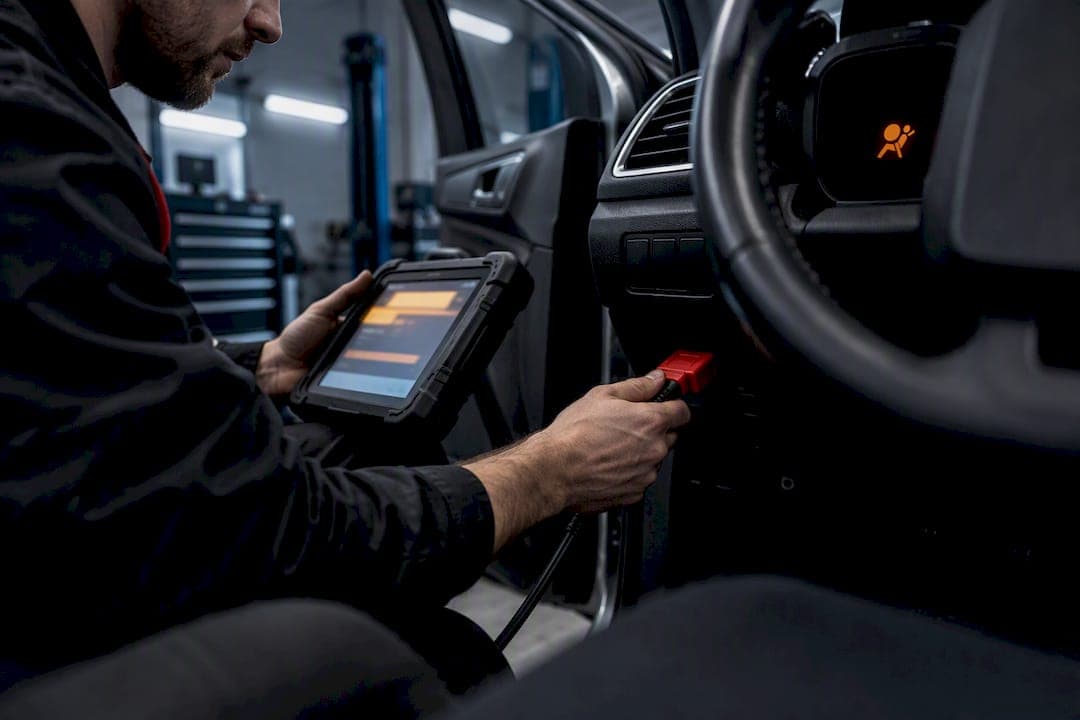
The airbag light won't clear because the SRS (Supplementary Restraint System) has logged a genuine fault, and it will stay lit until that fault is found, fixed, and the module is properly reset. Airbags may be disabled until then. The only reliable next step is a scan with an SRS-capable diagnostic tool to pull the actual fault code, since a plain OBD-II reader usually can't touch the crash-data memory that's keeping the light on.
TL;DR:
- A genuine fault in the SRS module keeps the airbag warning light on until diagnosed and properly reset with specialized diagnostic tools.
- Recent battery events, seat wiring issues, or changes before the light appeared can often cause false alarms that are quickly fixable with simple inspections.
- Correct diagnosis involves distinguishing current faults from stored crash data, which requires an SRS-capable scanner to avoid unnecessary part replacements.
- Common fixes include replacing the clock spring, reconnecting seat sensors, repairing wiring corrosion, or resetting crash data, with repairs costing from minimal to several hundred pounds.
- Module resets are often cheaper and faster than replacing the ECU, but only after fixing any hardware faults to ensure safety and proper system operation.
Table of Contents
- Why the airbag warning light stays on: quick checklist to run now
- How technicians diagnose SRS faults: reading the codes properly
- Common airbag issues and the fixes that actually work
- Airbag module reset options: postal, mobile, or dealer
- Costs, MOT implications, and whether you can still drive
- What years of airbag diagnostics teaches you about this fault
- An editorial view on airbag light problems
- Getting your airbag light sorted without buying a new ECU
- Sources
- FAQ
Why the airbag warning light stays on: quick checklist to run now
Before booking a technician, a few checks can rule out the simplest causes or at least tell you what to describe when you do call one.
- Check for a recent battery event. A jump-start, a flat battery, or disconnecting the battery with the ignition live can leave a stored under-voltage code that lingers until it's scanned and cleared.
- Inspect under-seat connectors and wiring. If a seat has been removed for valeting, repair, or a child-seat fit, the occupancy sensor connector underneath may not have clicked back in properly.
- Test the horn and steering wheel controls. If they've gone dead alongside the airbag light, that's a classic clock spring symptom, not a coincidence.
- Note what changed just before the light appeared. A collision, a seat removal, or battery work narrows the diagnosis considerably before a scanner is even plugged in.
Pro Tip: Write down the exact date and mileage when the light first came on, and anything you were doing to the car that day. That detail alone often points a technician straight to the fault family, saving you a diagnostic fee spent chasing the wrong circuit.
How technicians diagnose SRS faults: reading the codes properly
Diagnosing airbag light problems isn't guesswork when it's done properly. It follows a set sequence: scan, interpret, repair, verify.
The first distinction that matters is current versus stored codes. A current fault means the problem is happening right now, such as a connector that's actually disconnected. A stored fault means something happened in the past, most commonly a crash event or a voltage dip, and the module has kept that record even if the wiring is now fine. This distinction changes the whole repair plan: a current fault needs physical repair, while a stored fault involving crash data usually needs a module reset once the vehicle is confirmed safe.
The tool matters just as much as the interpretation. Ordinary OBD-II code readers are built for engine and emissions systems, and most of them simply can't reach the SRS module's crash-data memory. Clearing that requires an SRS-capable diagnostic tool built to read and clear body/restraint codes specifically.
Fault codes tend to cluster into a few families:
- Occupant classification and seat sensor circuits
- Clock spring and steering column wiring
- Seatbelt pretensioner and buckle switch circuits
- Crash sensor and impact data storage
- Supply voltage and ground faults
Once a repair is made, the standard verification sequence is: clear the codes, cycle the ignition off and on, then rescan. If the light returns immediately, the underlying fault hasn't actually been fixed, and no amount of reclearing will change that.
Common airbag issues and the fixes that actually work
Most persistent airbag light problems trace back to one of five things, and each has a distinct fix rather than a one-size-fits-all reset.
- Clock spring failure. This rotating connector under the steering wheel carries power to the horn, airbag, and often cruise controls. If it's cracked or worn through, replacing it is the fix, and the airbag light should stay off once the new part is fitted and the code is cleared. Occasionally a code returns after replacement, which usually means a second fault was masked by the first.
- Seat occupancy sensors and connectors. These sit under the seat cushion and are notoriously easy to knock loose during seat removal or upholstery work. A visual inspection and firm reconnection often resolves this without any parts cost at all.
- Wiring corrosion or water ingress. Common in footwells after a leaking sunroof seal or a spilled drink, and around under-seat looms exposed to road spray. Minor corrosion can be cleaned and protected; a loom that's rotted through generally needs a section replaced rather than patched.
- Battery and under-voltage events. A weak battery, a jump-start, or disconnecting power mid-ignition can trip a low-voltage code in the SRS module. Stabilise the electrical system first, then scan and clear, because the code won't disappear on its own even once voltage is back to normal.
- Stored crash data. If the module recorded an impact, even a minor one, the light often stays on permanently until the crash flag is cleared with a proper reset. Confirming this is usually the point where a certified module reset service becomes the sensible option rather than a replacement part.
Airbag module reset options: postal, mobile, or dealer
A module reset clears stored crash data from an otherwise sound SRS module. It's a different job from a simple code clear, and it's not something you can do by disconnecting the battery and hoping.
- Postal reset. You remove the module, pack it securely, and send it to a specialist who resets the crash-data memory on the bench and posts it back. This suits modules that are physically intact and just carrying an old crash flag, and turnaround is typically same-day for straightforward units.
- Mobile or on-site reset. A technician comes to you, which matters when the module needs a hands-on inspection alongside the reset, or when the vehicle isn't safely driveable. It costs more than posting a module off, but you get diagnosis and reset in one visit.
- Dealer reset or programming. Some manufacturer-locked systems need dealer-level coding rather than a standalone reset, particularly where the SRS module has to be re-paired with other control units on the network.
Pro Tip: Never let anyone reset a module to mask a fault that hasn't actually been repaired. A reset clears the record, not the fault, and if the airbags themselves are damaged or a pretensioner has fired, that's a replacement job, not a reset job.
Costs, MOT implications, and whether you can still drive
Simple repairs stay cheap. A loose connector or clock spring fault is often a modest job, while a fired pretensioner or deployed airbag runs considerably higher because pyrotechnic parts must be replaced, not reset.
- Loose seat connector: usually a no-cost fix once found
- Clock spring replacement: a moderate parts-and-labour job commonly costing hundreds of pounds.
- Seatbelt pretensioner or airbag sensor: higher cost, and non-negotiable if genuinely faulty
- Module reset for stored crash data: a fraction of the cost of a replacement ECU
MOT inspectors check that warning lamps operate and self-check correctly, and the Gov treats a malfunctioning warning system as relevant to the test outcome. Avoid long or high-speed drives until the fault is diagnosed; a short trip to a workshop is generally considered acceptable, but treat the car as compromised until you know what's wrong. If the light appeared after a collision, contact your insurer before repairs begin.
What years of airbag diagnostics teaches you about this fault
The pattern that comes up again and again is the same: someone clears the code, the light goes off for a day or two, then it's back. That's not a faulty light. It's a fault that was never actually fixed, just silenced temporarily.
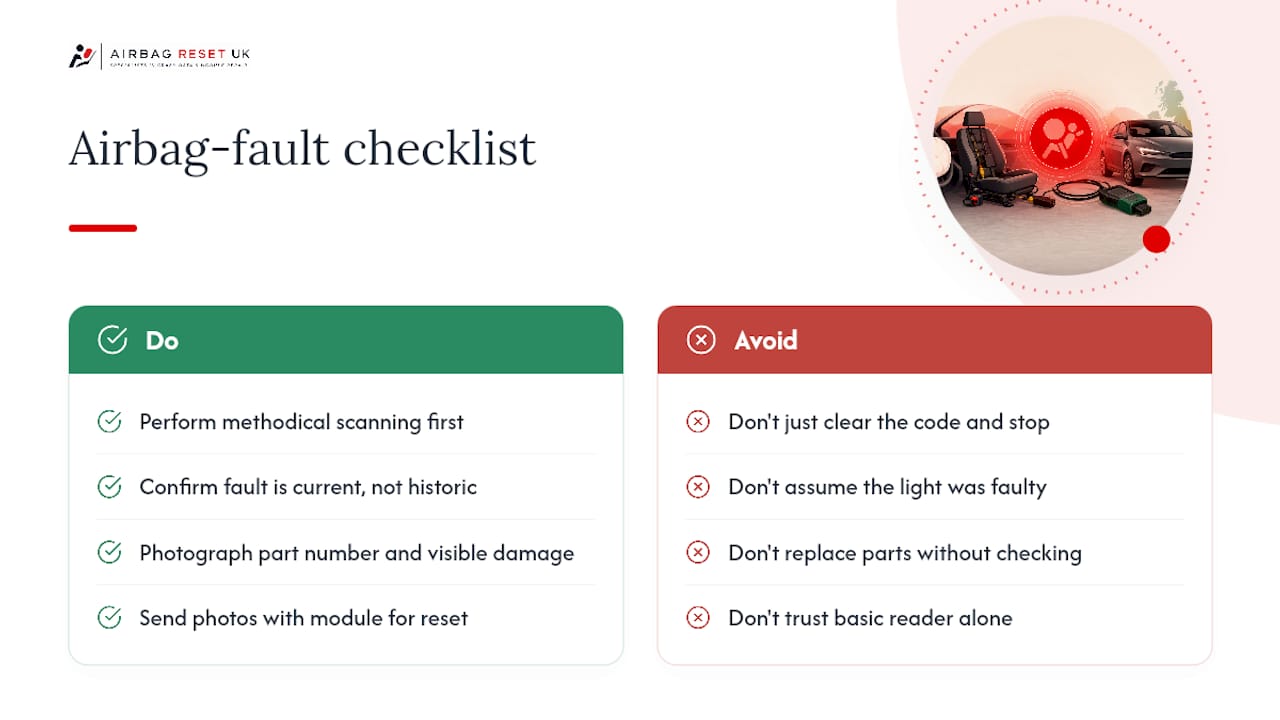
Methodical scanning avoids the most expensive mistake in this whole process, which is replacing a part that was never broken. A stored crash-data flag looks identical to a wiring fault on a basic reader, and plenty of good, working sensors get swapped out because nobody checked whether the fault was current or historic first. If you're sending a module off for a postal reset, photograph the part number and any visible damage before it leaves your hands. Airbag Reset UK works from exactly that kind of information to identify the correct reset process before the module even arrives.
An editorial view on airbag light problems
The conventional advice, clear the code and see what happens, is the exact opposite of what actually works. A code clear with no diagnosis is a coin toss, and every technician who's dealt with repeat visits knows it usually comes back within days.
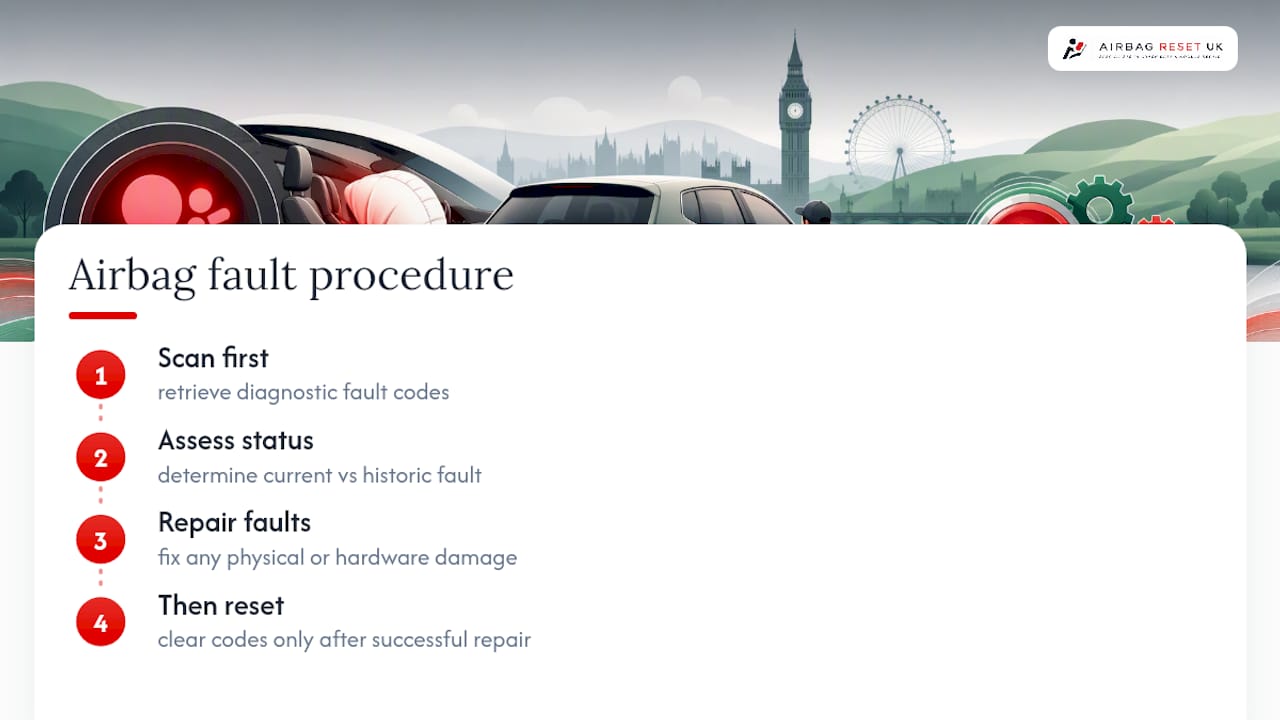
What the evidence in this article actually supports is a strict order of operations: scan first, understand whether the fault is current or historic, repair anything physically broken, and only then consider a reset. Skipping straight to a reset on a car with a genuinely damaged pretensioner isn't just pointless, it's dangerous, because it puts a disabled safety system back on the road looking like it's fine.
Where owners go wrong most often is assuming a reset and a repair are the same thing. They're not. A reset clears a record; it doesn't fix a fault. If your module is sound and the only issue is old crash data sitting in memory, a reset is genuinely the cheapest, fastest, most sensible route. If there's a real hardware fault anywhere in the system, fix that first, every time.
— John
Getting your airbag light sorted without buying a new ECU
If your airbag module is otherwise sound and the only problem is stored crash data, replacing the whole ECU is usually money wasted. Resetting the original unit tends to cost less than replacing it and usually comes with fixed, transparent pricing rather than a guessing game at the dealer.
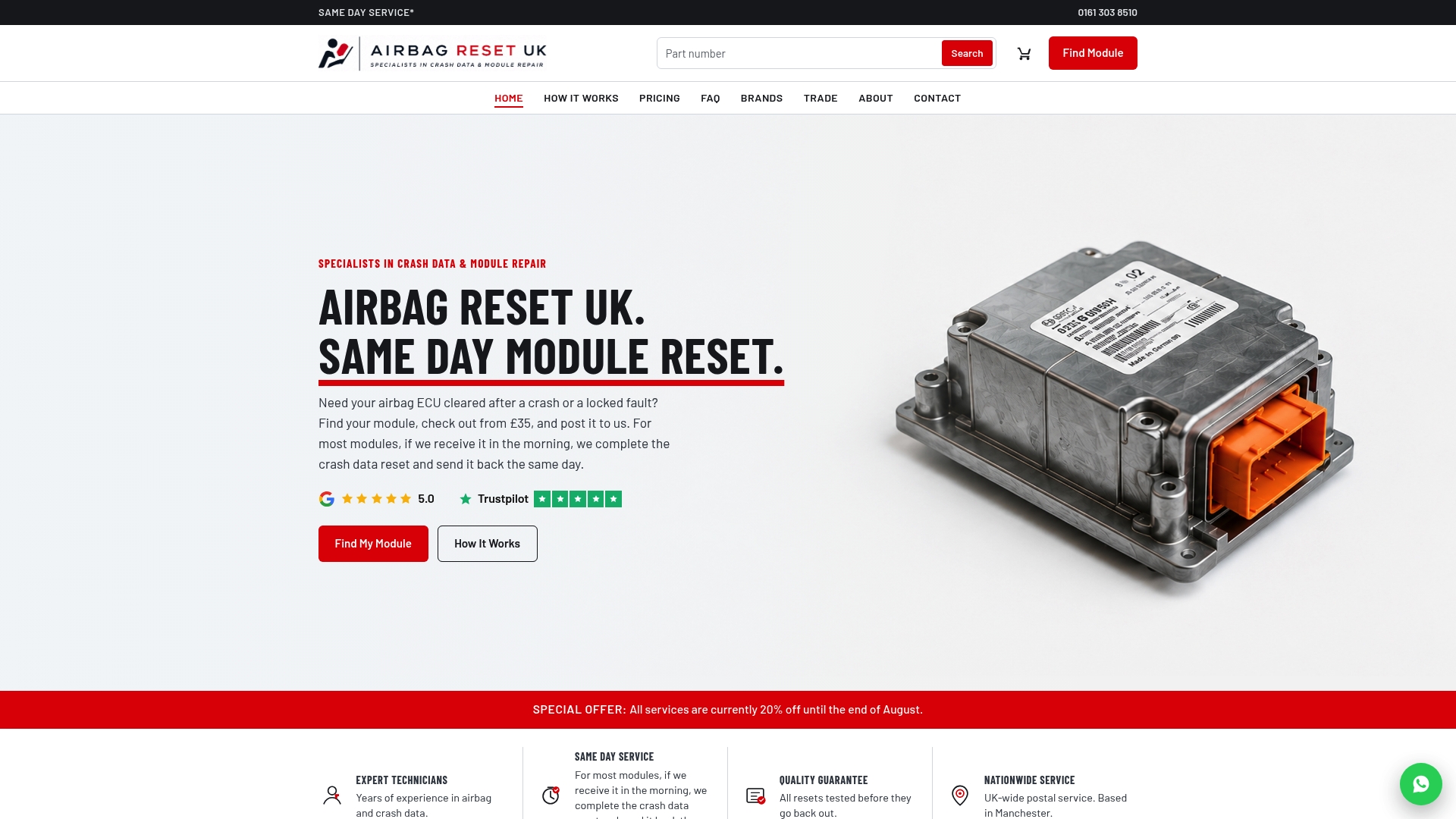
The postal airbag module reset service covers standard cars and vans, with same-day turnaround for most modules received in the morning and price matching against genuine like-for-like quotes. Motorhome owners get their own dedicated path through the motorhome airbag reset service, since those modules often need different handling. If you'd rather have someone come to you, particularly when a hands-on check is needed alongside the reset, the mobile airbag reset option covers that. Whichever route fits, repair any damaged hardware first. Sending a clear photo of the part number or fault code before booking helps confirm the right process for your specific module.
Sources
- Gov
- Airbag warning light reasons — Fixter
- Airbag warning light: why it comes on & how to fix it — WhoCanFixMyCar
FAQ
Can you reset an airbag light yourself?
You can clear some minor stored codes yourself if you have an SRS-capable scanner, but crash-data flags typically need a proper module reset rather than a basic clear. Resetting without fixing the actual fault usually means the light comes straight back.
Is an airbag light an MOT fail?
An airbag warning that fails to self-check correctly is relevant to the MOT inspection manual, and inspectors treat a malfunctioning safety system as a genuine concern. It's safer to assume it can affect your result and get it diagnosed before the test.
What is the most common cause of the airbag light?
Loose or corroded under-seat connectors and clock spring faults account for a large share of cases, alongside stored crash data and low-voltage events after battery work. The only way to know which one applies to your car is a proper diagnostic scan.
Can I still drive my car if the airbag light is on?
Short trips to a workshop for diagnosis are generally considered acceptable, but avoid long or high-speed journeys until the fault is identified, since the airbags may be disabled. If the light appeared after a collision, treat the car as unsafe until it's checked.
How much does an airbag module reset cost?
Airbagresetuk's postal airbag module reset service offers a one-off reset costing between £35 and £46 depending on the module, with the motorhome airbag reset service at £65 and mobile airbag reset starting from £75 for on-site visits.