
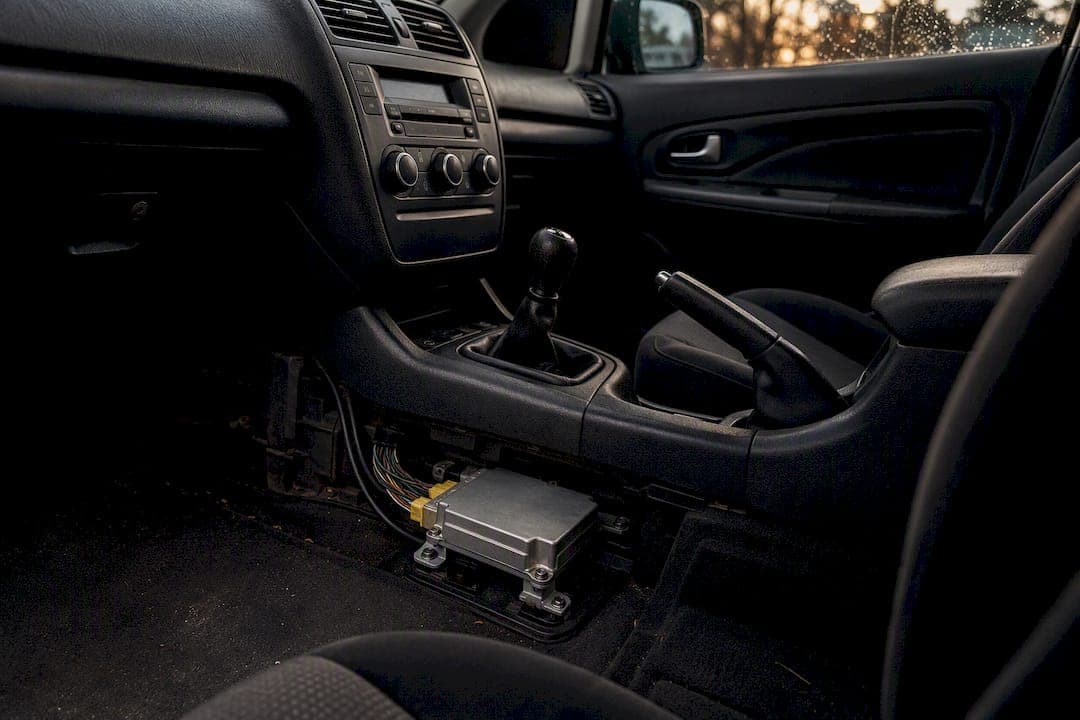
The airbag control module sits at the vehicle's centre in the vast majority of cars, almost always under the centre console, on the floor tunnel, or bolted behind the lower dash. It's positioned there deliberately, not by chance, and once you know where to look, finding it usually takes minutes rather than hours.
Start your search in these spots, in this order:
- Under the centre console, between the front seats
- Bolted to the floor tunnel beneath the carpet
- Behind the lower dash panel or glovebox
- Under the driver's or front passenger seat
- In the passenger-side kick panel
Pro Tip: Peel back a section of carpet near the console base and run your fingers along the floor tunnel. A bolted metal box with a printed SRS label is almost certainly your module. No need to strip the whole interior to confirm it's there.
Key Takeaways
The airbag control module sits near the vehicle's centre in most cars, and confirming its exact position by VIN before removal prevents unnecessary trim damage.
| Point | Details |
|---|---|
| Check the centre first | Most modules sit under the centre console or bolted to the floor tunnel between the front seats. |
| Confirm by VIN | Placement varies by make, model, and trim, so verify with a parts diagram rather than a forum guess. |
| Identify before touching | Look for an SRS label, yellow connector, and printed part number to rule out junction blocks. |
| Respect the discharge wait | Disconnect the battery and wait at least 10 to 15 minutes before handling the SRS connector. |
| Choose the right fix | Airbagresetuk offers a postal crash-data reset from £35 with same-day turnaround for modules that don't need physical replacement. |
Table of Contents
- Common airbag control module locations across cars, vans and motorhomes
- How do you confirm the module location for your exact vehicle?
- How do you identify the airbag control module once you've found it?
- What safety steps come before accessing or removing the module?
- What should you do after you've located or removed the module?
- Where can you send your module for a crash-data reset?
- Where to check next for model-specific detail
- Frequently asked questions
- Sources
Common airbag control module locations across cars, vans and motorhomes
In over 90% of passenger vehicles, the airbag control module lives under the centre console or fixed to the floor tunnel between the front seats. That single fact narrows your search dramatically before you touch a single trim panel.
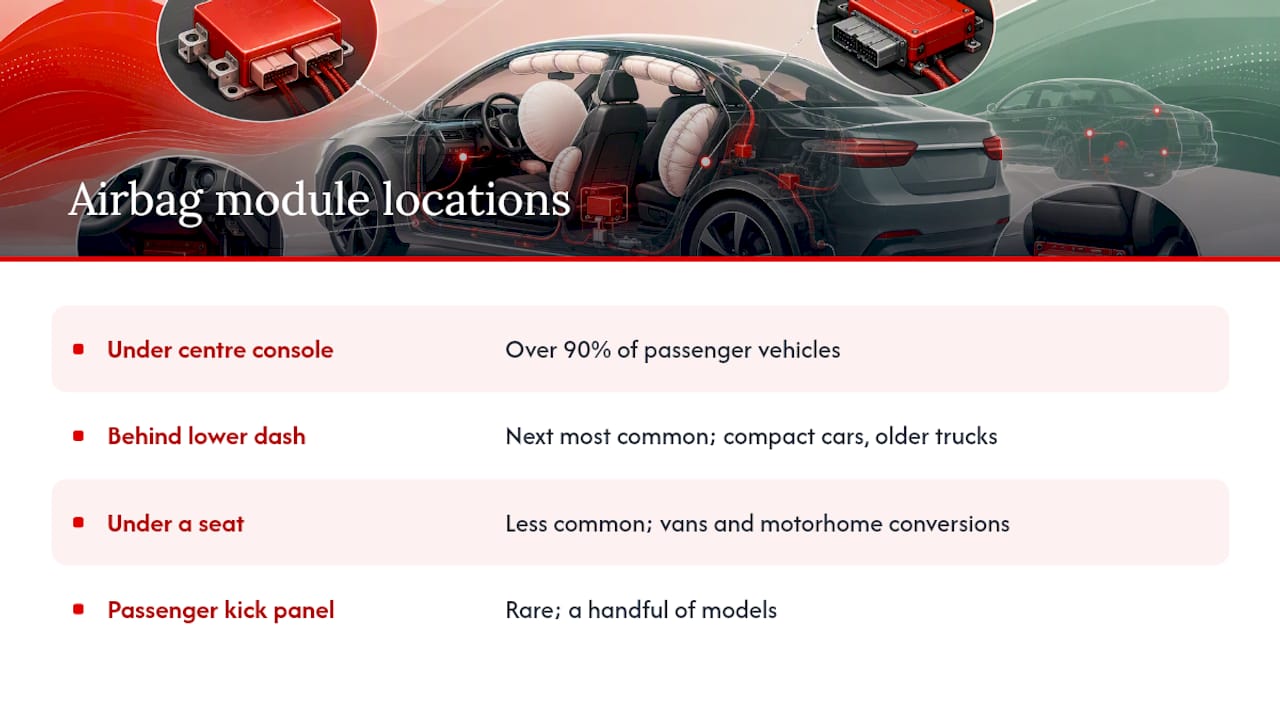
The next most common spot is behind the lower dashboard or under the glovebox, particularly on compact cars and older trucks, where engineers sometimes tuck the module near the radio assembly instead of the console. Getting to it usually means removing the glovebox liner or a lower dash trim panel, both jobs that unclip rather than unbolt.
Less commonly, you'll find it under a seat, particularly on vans and some motorhome conversions where the console area is used for storage instead. A handful of models route it into a passenger-side kick panel, which explains why some owners spend an afternoon hunting before checking their footwell.
Why the centre? Placing the module near the vehicle's geometric middle gives its multi-axis accelerometers the cleanest read on deceleration from any direction, and mounting it to a rigid floor pan keeps readings consistent and stops false triggers from chassis flex. It's also the best-protected zone in most collision types, tucked away from the crumple zones at each end of the car.
Once you've located a candidate box, compare it against workshop manual images or a parts-lookup diagram for your specific model before you assume you've found the right one.
How do you confirm the module location for your exact vehicle?
Guesswork wastes time and risks damage to trim you didn't need to remove. The fastest route to certainty is a VIN lookup through a manufacturer parts portal or a reputable parts-diagram site, which will show the airbag control module (often labelled ACM, ACU, or SRS module) against an exploded diagram of your specific trim level.
Failing that, your owner's manual rarely gives exact placement, but the factory workshop manual usually does, right down to bracket type and mounting bolts. One workshop manual for a Dodge Dakota shows the module bolted to the top of the floor tunnel behind the instrument panel, grounded to the floor at the mounting point. That's the level of detail you want before removing anything.
Useful lookup routes, in order of reliability:
- Factory service manual or OEM parts diagram for your VIN
- Manufacturer or third-party VIN/parts-lookup tool
- Vehicle-specific owners' forums, which often include photos
- A direct query to a dealer parts department or independent repairer
Never assume your neighbour's same-badge car matches yours. Placement varies by make, model, and year, sometimes even between trim levels of the same generation, so confirm with your VIN or part number rather than a forum post about a different year.
How do you identify the airbag control module once you've found it?
Not every metal box behind your dash is the module you're after. Junction blocks, body control modules and fuse arrays all live in similar territory, so check for these specific markers before you touch anything.
- A relatively small, bolted metal or heavy plastic housing, usually not much bigger than a paperback book
- An "SRS," "SRS ECU," or "ACU" label stamped or printed on the casing
- A printed part number or barcode sticker, which you'll need for any reset or replacement order
- A dense wiring harness with a distinctive yellow connector, a colour reserved almost universally for airbag circuits
- Seatbelt pretensioner and crash-sensor wires feeding into the same connector block
The connector itself is usually keyed so it can only be seated one way, and it typically carries more pins than a standard relay connector, reflecting the number of sensors and pretensioners it manages.
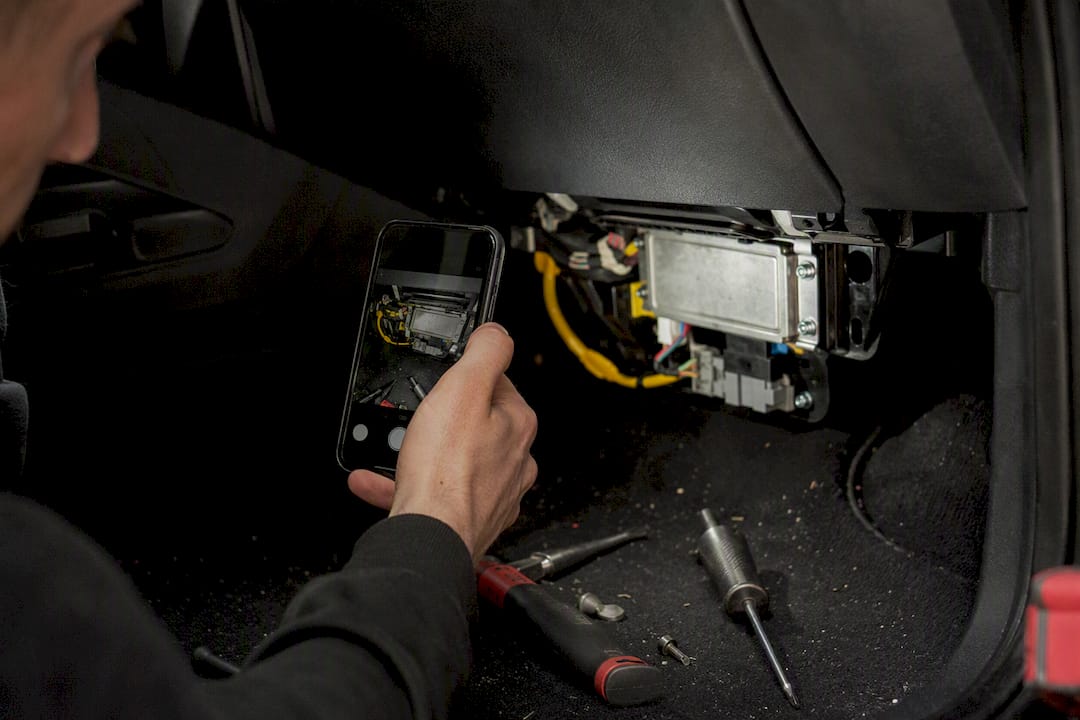
Pro Tip: Photograph the module in place before disturbing it, capturing the part number, the connector orientation, and how the harness routes. If you need a replacement or a reset service later, that photo saves a second trip under the dash.
What safety steps come before accessing or removing the module?
Airbag modules store enough charge to fire a deployment even with the battery disconnected, which is exactly why every credible workshop procedure starts with electrical isolation, not tools. The module's capacitor can hold sufficient charge to deploy the airbags for roughly a second after the battery is removed, which is why manufacturers specify a wait period before you go near the connector.
Follow this sequence, not a shortcut version of it:
- Disconnect the negative battery terminal first, and isolate it completely from the chassis.
- Wait at least 10 to 15 minutes, or longer if your manufacturer's manual specifies a longer interval, to let the module's capacitor discharge fully.
- Put on insulated gloves before handling any connector near the module.
- Move the front seats fully forward to create working space, then remove the console or lower trim panel covering the module.
- Unbolt the module from its floor bracket, typically three or four mounting nuts, a sequence that mirrors what most model-specific DIY guides describe.
- Release the SRS connector using its integrated safety lever. Never pull, cut, or probe the wires directly.
Trim removal and access typically takes 30 to 90 minutes for someone working carefully, depending on how buried the module is and whether the console needs full disassembly or just a few trim screws, as some model guides describe. Professional diagnosis or replacement at a workshop commonly runs from around £80 for a straightforward assessment up to several hundred pounds for parts and labour on a full replacement, while a postal reset service for a module that's merely storing crash data rather than physically damaged tends to sit well below that.
Do not probe the SRS connector pins with a multimeter unless you know exactly what you're testing and why. Airbag circuits aren't forgiving of stray voltage.
What should you do after you've located or removed the module?
Finding the module is only step one. What you do next depends entirely on why you needed to find it in the first place.
- If the airbag light stays on after a minor bump with no physical module damage, you likely just need the crash data cleared, not a replacement.
- If the housing is cracked, corroded, or shows fire damage from an actual deployment, replacement is the only safe option.
- If stored diagnostic trouble codes won't clear with a standard reset, the module may need specialist diagnostic tools beyond a basic OBD scanner.
DIY reset tools exist, but they carry real risk: get the procedure wrong and you can permanently brick a functioning module, and some insurers or jurisdictions expect crash-data resets to be handled by a qualified provider for warranty and compliance reasons. A postal reset service sits between full DIY and a dealer replacement, usually far cheaper than fitting a new unit while still leaving a paper trail. Dealer replacement is the most expensive route but guarantees a factory-fresh module with no reset history to question.
Whichever path you choose, keep your photos and part number on file. Insurers occasionally ask for evidence of what was done to a vehicle's restraint system after an accident, and a clear record saves an awkward conversation later.
A technician's note on common mistakes
The two errors I see most often: people mistake a junction block for the airbag module because both are metal boxes near the console, and people reconnect the battery within minutes instead of waiting out the capacitor discharge. Neither mistake is dangerous if you slow down and check the SRS label first. For garages processing several modules a week, a trade account with a postal reset provider usually works out faster and cheaper than an in-house diagnostic setup.
Where can you send your module for a crash-data reset?
Once you've confirmed the module's location and identified it by its part number, you've got a choice to make: reset it yourself, book it into a dealer, or post it to a specialist. Airbagresetuk exists for exactly this middle option, when a persistent airbag warning light is a data problem, not a hardware failure.
Send your module in with a clear photo of its label and part number, and most jobs get turned around the same day, which beats the typical week-plus wait for a dealer to source and fit a replacement unit. Pricing starts at £35 for standard resets, it's fixed and transparent before you commit, and Airbagresetuk will price-match a genuine like-for-like quote if you've already had one elsewhere. The team also handles vans and motorhome-specific modules, and offers discounted trade accounts for garages and mobile technicians running several jobs a month.
Before you post anything, photograph the module clearly and note its part number down. Then head to the Airbag Reset UK service page to check what to send and get your crash-data clear moving.
Where to check next for model-specific detail
- Your vehicle's factory workshop manual, for exact bracket type and bolt count
- A parts-lookup tool or forum thread specific to your VIN and trim level
- The Airbag Reset UK service page for postal reset instructions once you've identified your module
Match your part number against your VIN before ordering anything or booking a reset, so you're not paying twice for the wrong fix.
Frequently asked questions
Can I reset the airbag module myself? Clearing basic crash-data codes with a capable OBD scanner is possible on some models, but getting it wrong risks bricking the module entirely. A postal reset service handles this without that risk, usually at a similar cost to a decent scan tool.
Can I drive with the airbag module removed or disconnected? No. Driving without a functioning airbag system means no deployment protection in a crash, and most jurisdictions treat a disabled SRS system as a roadworthiness failure worth fixing before you drive again.
What are the symptoms of a faulty airbag module? A persistent dashboard airbag warning light is the main sign, often alongside stored diagnostic trouble codes that won't clear on a standard reset. Physical damage such as a cracked housing or scorching after a deployment is a clear replacement signal, not a reset job.
How long does it usually take to find and access the module? Most owners locate it within minutes once they know to check the centre console first, though full access after seat and trim removal typically takes 30 to 90 minutes depending on the model.
Sources
- Engineerskill
- Dodge Workshop Service and Repair Manuals > Dakota Quad Cab 2WD V8-5.9L VIN Z LDC (2002) > Relays and Modules | Relays and Modules - Restraint Systems | Air Bag Control Module | Component Information | Locations | Page 286
- Where is the airbag module located? - Kevin's Autos