
Bench-level crash data reset can clear the stored fault in most airbag control modules, but not all of them. A module with physical damage, corrosion or a failed hardware component cannot be safely reset and needs replacement instead. VIN-locked units, certain manufacturer configurations and modules tied to occupant classification systems add complexity, and a full system check is always required before the vehicle is fit to drive or pass an MOT.
TL;DR:
- Most airbag control modules can be reset on a bench, but physically damaged or corrosion-affected units require replacement instead.
- Crash data is stored in protected memory with manufacturer locks and checksum verification, making it inaccessible to standard diagnostic tools.
- Proper reset involves detailed steps: reading full memory, verifying data, clearing crash flags, recomputing checksums, and confirming functionality before reinstallation.
- Postal bench resets are cost-effective for intact modules, while dealer replacement is necessary for physically damaged units; mobile support cannot perform full memory edits.
- A thorough verification process, including post-reset tests and documentation, is essential to ensure vehicle safety and compliance with MOT rules.
Table of Contents
- What crash data is and why ordinary scanners can't clear it
- Step-by-step bench remanufacture workflow from module to bench to vehicle
- Choosing between postal bench reset, mobile support and dealer replacement
- What a reset costs and how long it realistically takes
- Confirming a successful reset: reinstallation, checks and MOT rules
- A checklist for vetting a reset provider before you commit
- Handling rules that keep a bench reset safe and effective
- Why the safest route is rarely the fastest-sounding one
- Getting your module reset through our postal service
- Sources
- FAQ
What crash data is and why ordinary scanners can't clear it
When a vehicle's SRS system detects a collision severe enough to trigger deployment, or even a near-threshold event, the airbag control module writes a permanent record into its non-volatile memory. This isn't a simple fault code sitting in the same place as an engine or ABS trouble code. It's a crash flag, often paired with event counters, deployment timestamps and sometimes crash severity data, stored in a protected memory region specifically designed to resist casual erasure.
That distinction matters for anyone reaching for a generic OBD scanner. A standard diagnostic tool can read and clear conventional trouble codes on most vehicle systems, but airbag modules build in checksums and manufacturer-specific locks around the crash data block precisely to stop that kind of casual clearing. Specialist repair sources note that ordinary scanners cannot permanently remove crash flags because the data lives outside the memory addresses those tools are built to touch.
The practical differences show up clearly once you compare the two types of stored data:
- Standard fault codes: readable and clearable by most generic OBD tools, stored in general diagnostic memory.
- Crash flags and event data: held in protected, checksum-verified memory blocks that require direct read/write access.
- Manufacturer locks: some modules bind crash data to the VIN or immobiliser system, adding a further barrier to generic tools.
- Checksum verification: the module checks its own memory integrity on start-up, so a badly cleared flag can leave the module rejecting itself as faulty.
This is why an SRS warning light that stays on after a minor bump, a kerb strike that triggers a seatbelt pretensioner, or a low-speed shunt often can't be resolved with a five-minute scan tool session. The module needs to be addressed at a level most workshop equipment simply isn't built to reach.
Step-by-step bench remanufacture workflow from module to bench to vehicle
A competent bench reset follows a defined sequence, not a shortcut. Skipping steps is where damage, false readiness signals or repeat failures come from.
- Identify the module precisely. Match the part number, hardware revision and software version against manufacturer reference data, and note whether the unit is bound to a specific VIN or immobiliser code.
- Isolate the vehicle safely. Disconnect the battery and observe a waiting interval to let stored capacitor energy dissipate before touching any SRS wiring, in line with HSE guidance on handling airbags and pretensioners.
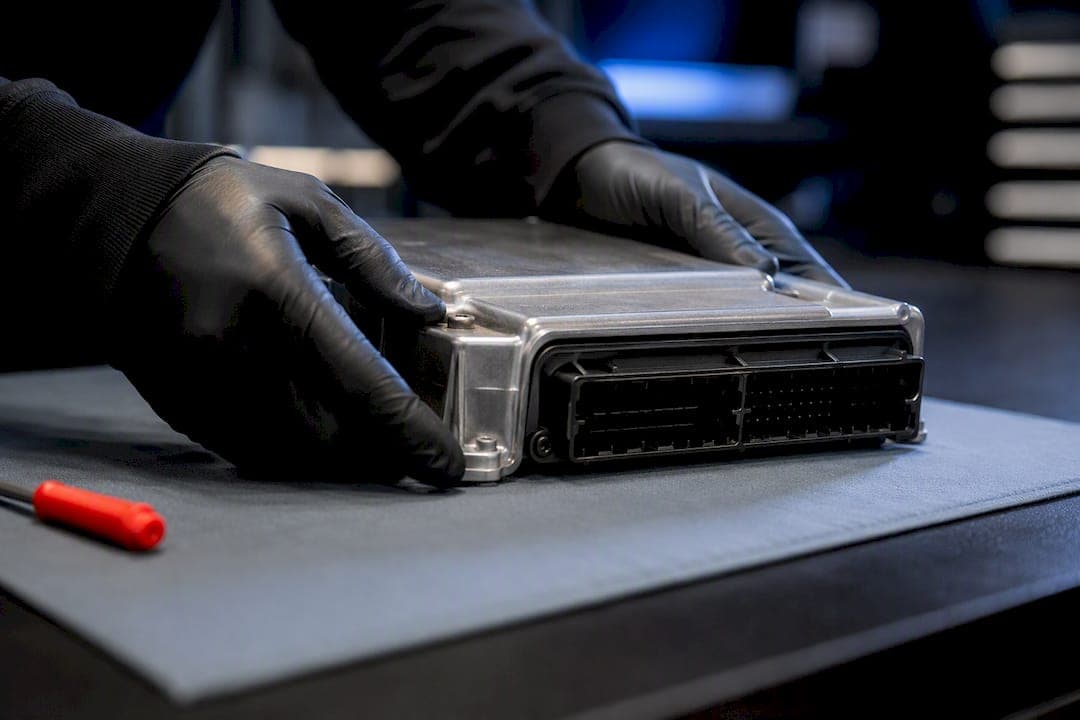
- Remove and bench mount the module. HSE handling rules require the unit to be mounted securely, face up, with room for free inflation should it ever fire unexpectedly, and never carried with the trim face pointing towards the handler.
- Read the full memory dump. Extract the complete module image rather than a partial code read, capturing crash flags, event counters and configuration data as they stand.
- Compare against reference data. Cross-check the dump against known-good values for that part number to confirm which flags are crash-related versus genuine hardware faults.
- Edit the crash flags. Clear the specific protected fields tied to the deployment event, leaving unrelated configuration data untouched.
- Recompute the checksum. The module verifies its own memory integrity on power-up, so an edited block with a mismatched checksum will be rejected or flagged as corrupt.
- Reflash the corrected image. Write the verified data back to the module using bench programming equipment built for that manufacturer's protocol.
- Run bench verification. Power the module through a self-test loop, confirm no stored faults reappear, and check readiness monitors before it ever goes back in a vehicle.
Pro Tip: Always keep a copy of the original memory dump before editing anything. It's the only way to prove what was changed if a warranty question comes up later.
This is fundamentally different from replacing a module outright. A well-executed reset restores the electronics to a pre-crash state without discarding VIN programming or immobiliser pairing, which is often the more disruptive part of a straight swap.
Choosing between postal bench reset, mobile support and dealer replacement
Three practical routes exist once a module needs attention, and each suits a different situation.
Postal bench services work by identifying the module from photos or a part number, shipping it to a workshop equipped with bench programming tools, and returning it once the crash data has been cleared and verified. This route suits owners and independent garages who don't have in-house bench equipment, and it tends to be the most cost-effective option for a module-level fault with no physical damage.
Mobile diagnostic technicians can attend a vehicle and handle on-vehicle scanning, wiring checks and component replacement such as seatbelt pretensioners or clock springs. What they generally can't do at the roadside is the direct memory edit a bench setup performs, since that needs the module removed and connected to dedicated programming hardware.
Dealer replacement becomes the right call when the module itself is physically damaged, water-ingress corroded, or when occupant classification hardware inside the seat has failed alongside the electronics. In those cases, resetting stored data on a broken unit doesn't fix the underlying fault.
- Postal bench reset: cost-effective, no bench equipment needed on-site, best for module-only faults.
- Mobile service: convenient for on-vehicle diagnostics and component swaps, not for memory-level edits.
- Dealer replacement: necessary for physical damage or irreparable modules, generally the most expensive route.
DIY attempts with a consumer OBD reset tool rarely succeed for the same reason generic scanners fail in a workshop: the crash data sits behind a checksum-protected lock that a basic tool was never built to open.
What a reset costs and how long it realistically takes
Bench reset pricing for a standard car module typically starts in the tens of pounds, while dealer replacement of a full module, potentially alongside pretensioners or seat sensors, runs considerably higher once parts and coding are included. Motorhome modules and units with unusual configurations tend to sit at the upper end of the bench pricing scale because of their lower production volumes and less standardised memory layouts.
Bench handling for airbags and pretensioners follows strict safety rules set by the Health and Safety Executive, which requires secure mounting and forbids any attempt to repair or modify the pyrotechnic components themselves, only the electronic data around them.
Turnaround depends heavily on the service route. A postal bench job can often be completed the same day a module is received, provided it arrives with clear identification details, while dealer-sourced replacements may involve backorder waits for parts and separate coding appointments. Trade accounts and garages sending higher volumes typically see faster processing and preferential rates, since the identification and bench setup steps become routine for a given part number.
Documented test logs matter here. A workshop that can show a before-and-after scan report, along with a written warranty on the reset itself, gives a technician or owner something concrete to point to if a query comes up later, whether that's an insurer, a buyer, or an MOT tester.
Confirming a successful reset: reinstallation, checks and MOT rules
A reset isn't finished when the module comes back from the bench. Reinstallation and verification decide whether the fix actually holds.
- Reconnect the module and clear any residual codes stored elsewhere in the vehicle's network, since related modules can hold their own fault memory.
- Watch the SRS warning lamp through a full ignition cycle to confirm it illuminates briefly on start-up and then extinguishes, rather than staying lit or flashing.
- Check for stored frozen frame data in related systems, which can sometimes linger even after the airbag module itself reads clean.
- Run any manufacturer-required initialisation or calibration sequence, since many vehicles need a handshake between the reset module and the body control unit before sensors and pretensioners are fully recognised again.
That last point catches people out often. A correctly reset module can still trigger the SRS lamp until this relearn step is completed, which looks like a failed reset but is actually a configuration mismatch rather than a genuine fault.
This distinction has a direct bearing on the MOT. Guidance in the MOT inspection manual treats an SRS lamp that indicates a genuine system malfunction as a major defect, which means the vehicle fails until the lamp is extinguished and the restraint system is properly restored. An illuminated lamp that simply indicates a passenger airbag has been manually disabled is treated differently and isn't itself a defect, so the reason for the lamp matters as much as the lamp itself.
A checklist for vetting a reset provider before you commit
A few direct questions separate a competent bench service from one to avoid.
- Ask for evidence of bench testing, not just a claim that the module was reset. A before-and-after scan report or test log is the minimum proof worth expecting.
- Confirm VIN and immobiliser data is preserved. A reset should retain existing vehicle-specific programming rather than forcing a re-pairing exercise afterwards.
- Check whether a written warranty is offered on the reset itself, covering the module against repeat faults within a stated period.
- Get clear, itemised pricing upfront, including whether motorhome or unusual modules carry a different rate.
Pro Tip: Treat any offer of a "permanent" crash clear done entirely through a plug-in OBD tool as a red flag: the protected memory that holds crash data simply isn't accessible that way.
Trust signals worth looking for include published references to recognised safety procedures, alignment with HSE-style handling guidance, and the availability of trade accounts, which usually indicates a provider handling enough volume to have a consistent, repeatable bench process rather than an ad hoc one.
Handling rules that keep a bench reset safe and effective
Working on an airbag module, even one that has already deployed a pretensioner, carries real risk if handled carelessly. HSE guidance sets out the core rules: never carry an undeplored unit with the trim face towards you, mount it securely on a bench that allows free inflation in the event of accidental firing, and never attempt to repair or modify the pyrotechnic inflator itself. Those rules exist because the inflator charge remains live and dangerous regardless of what has happened to the module's electronics.

Resetting the original module, rather than replacing it outright, keeps VIN programming, immobiliser pairing and vehicle-specific coding intact in many cases, which avoids a separate dealer coding step that a straight swap would otherwise require.
Practical points worth keeping in mind:
- Never attempt to open, repair or modify an inflator cartridge, whether it has fired or not.
- Store modules face up in a secure location, away from heat sources and foot traffic.
- Preserve the original memory dump before any edit, so the work can be verified or repeated if needed.
- Confirm the reset provider's process includes bench verification, not just a memory edit with no post-check.
A specialist service can operate a UK-wide postal system for this kind of work, offering identification help by part number or photo, a same-day turnaround for most modules, and trade account options for garages processing higher volumes.
Why the safest route is rarely the fastest-sounding one
The most persistent myth in this space is that a reset is a shortcut: plug in a tool, clear a light, move on. It isn't, and treating it that way is how modules get returned to service with mismatched checksums or unresolved hardware faults hiding behind a cleared lamp. The bench workflow exists because crash data is deliberately hard to touch, and that difficulty is a safety feature, not an inconvenience.
Where conventional advice falls short is in treating "reset" and "replace" as interchangeable outcomes of the same problem. They aren't. A reset restores a sound module to service without disturbing VIN programming; a replacement solves a different problem, physical damage, and pretending a reset can fix a genuinely broken module only delays the real fix.
If you take one thing from this, prioritise verification over speed. A provider who hands back documented test logs and a written warranty is worth more than one who promises a same-day turnaround with nothing to show for it afterwards. The lamp going out means little on its own.
— John
Getting your module reset through our postal service
Sending a module to us starts with identifying it, either from the part number stamped on the casing or a clear photo, so we can confirm whether a reset is possible before anything is posted. From there, the process is straightforward.
- Send us the part number or a photo so we can confirm pricing and suitability before you post anything.
- Post the module using our packaging guidance, and most units are turned around the same day we receive them.
- Standard airbag module reset pricing runs from £35 to £46, with motorhome units priced at £65 given their less standardised layouts.
- Trade accounts get discounted rates for garages and bodyshops sending modules regularly.
If you'd rather not remove the module yourself, our mobile airbag reset service starts from £75 and covers on-vehicle diagnostic work a postal job can't reach. Compared with dealer replacement, resetting the original unit through Airbag Reset UK keeps your existing VIN programming intact and avoids a separate coding appointment. Get in touch with your part number to check pricing and start the process today.
Sources
FAQ
How do I reset my airbag module?
A genuine reset requires removing the module and connecting it to bench programming equipment that can read, edit and recompute the checksum on the protected crash data, which ordinary OBD tools cannot access. Most owners send the module to a specialist postal service or have a workshop handle the removal and bench work, since attempting it with consumer diagnostic tools will not clear the stored crash flags.
How much does it cost to have an airbag module reset?
Standard airbag module reset pricing runs from £35 to £46 for most cars and vans, while motorhome modules are priced at £65 given their less standardised configurations. Dealer replacement of a damaged module tends to cost considerably more once parts and coding are included.
Can I pass MOT with an airbag light on?
An illuminated SRS lamp that indicates a genuine system malfunction is treated as a major defect under MOT inspection guidance, so it's important to follow car safety checks for lease cars to ensure your vehicle passes safely and complies with regulations. A lamp indicating only that a passenger airbag has been manually disabled is not itself treated as a defect.
Will my new airbags deploy without module reset?
If the control module still holds an unresolved crash flag or a corrupted memory state, it can prevent the system from arming correctly even with new airbags fitted, since the module governs deployment logic rather than the airbags themselves. A full reset or replacement, followed by proper reinstallation checks, is what confirms the restraint system is ready to function again.