
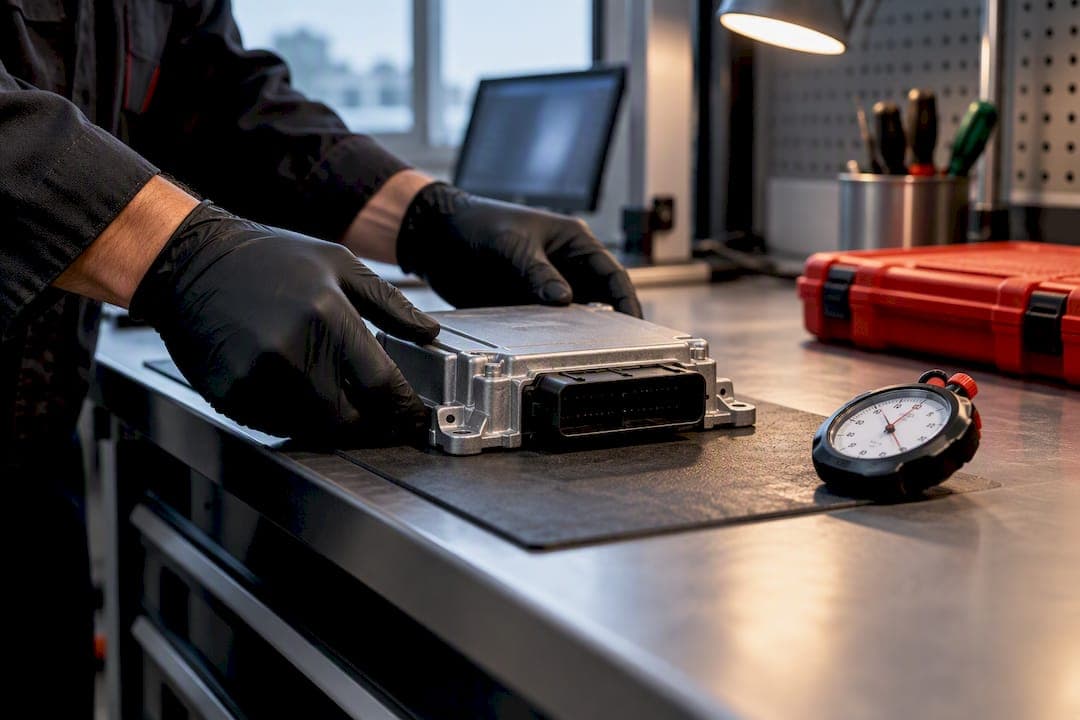
A bench crash-data clear typically takes 30 to 60 minutes of hands-on bench time, and most labs work to a same-day or 24-hour turnaround once your module arrives. Postal services usually add 24 to 48 hours once transit both ways is factored in. Mobile and dealer visits vary more, and the real wildcard is always diagnosis and any physical repairs needed before the module gets touched.
TL;DR:
- The typical bench reset process takes 30 to 60 minutes, but shipping, diagnosis, and additional repairs can extend turnaround to several days.
- Crashes involving hardware damage or multi-stage systems often require longer processes, especially for newer European modules with proprietary security.
- Persistent airbag warning lights after a reset indicate hardware issues or wiring faults, not necessarily a failed reset, requiring further diagnostics.
- Provider reliability depends on clear turnaround estimates, original crash data backup, and realistic timing, not just advertised "same-day" promises.
- Equipment quality and technician experience are crucial, as proper software and skilled handling can reduce actual reset times from several hours to near an hour.
Table of Contents
- Typical airbag reset time windows and why they vary
- What happens during a module reset (and where the time goes)
- Postal, mobile or dealer: how the service type changes your timeline
- Why the airbag light can come back after a reset
- Choosing a reset service: what actually sets your timeline
- How vehicle make and model affect reset time
- When persistent fault codes delay the job
- Why technician skill and equipment quality set the real pace
- What experienced technicians want you to know
- Getting your module reset without the guesswork
- Sources
- FAQ
Typical airbag reset time windows and why they vary
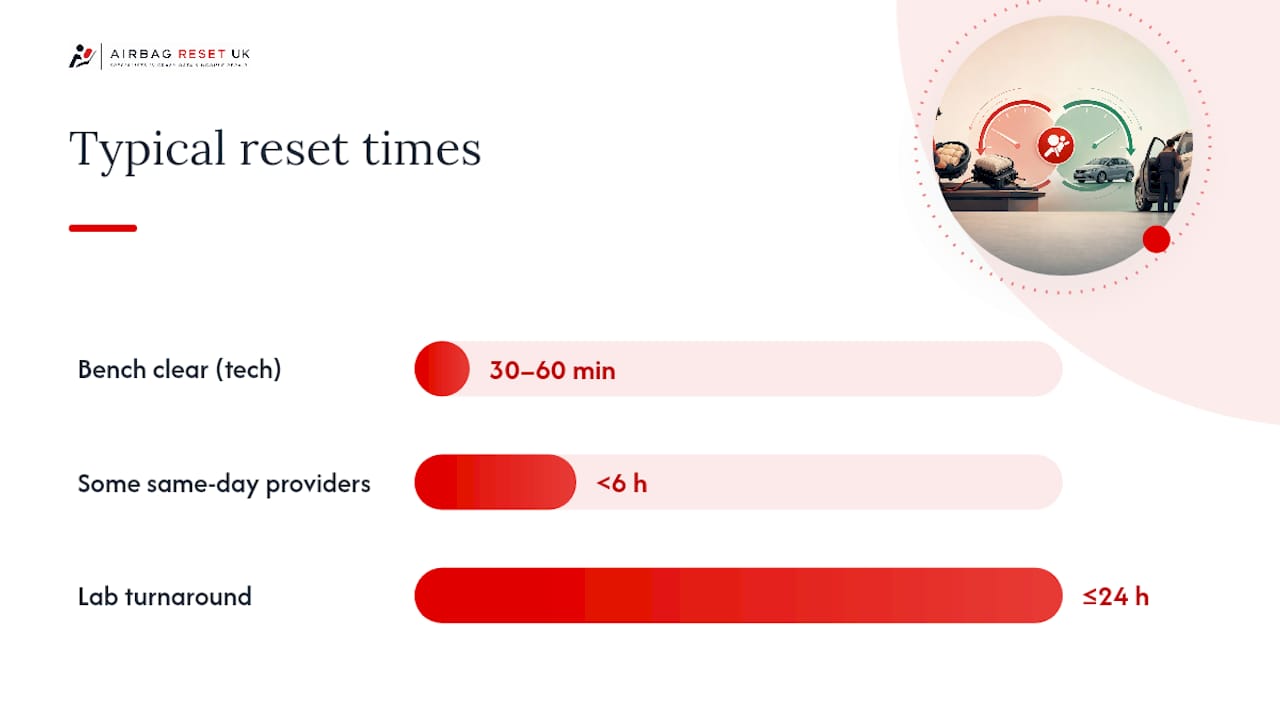
The airbag reset time you get quoted depends almost entirely on which route your module takes to get fixed. On the bench itself, technicians usually finish a crash-data clear in 30 to 60 minutes, and many labs promise a full turnaround within a day of receiving the unit. Send a module in first thing in the morning and some providers report waiting times under six hours on a normal weekday, though that shifts if the workshop is busy or the module needs extra work.
Postal is where the clock stretches. Even a fast bench clear does nothing for you if the module is sitting in a sorting depot. Add first-class postage both directions and a same-day bench job can become a multi-day round trip door to door.
Several things push the timeline further out:
- Hardware replacement needed alongside the reset (seat sensors, clockspring, pretensioners)
- Internal damage from the deployment itself, which can rule out a simple clear entirely
- Backlogs during busy periods, particularly after storms or icy weeks when crash volumes spike
- Shipping slot availability if you're relying on next-day courier services
Pro Tip: A simple bench clear on an undamaged module is a genuinely quick job. It's the diagnosis before it and the postage around it that eat most of the calendar time.
A straightforward rear-end shunt with an intact module might see 45 minutes of bench work and a same-day return. A module that's been fried by a deployment current spike is a different story entirely: that one likely needs replacing, not resetting, which adds days rather than hours.
What happens during a module reset (and where the time goes)
Every reset follows roughly the same sequence, and knowing it helps you understand which stage is actually eating the clock.
- Diagnosis first. A technician needs to establish whether you've got soft fault codes (easy) or permanent crash data written after a real deployment (harder). A basic OBD-II scan tool clears soft codes in minutes, but it cannot touch crash data locked into the module's protected memory.
- Removal and bench access. If crash data is present, the module comes out of the car. Some platforms allow clip-on access to the chip; others need chip-off work, which takes longer and requires steadier hands.
- The bench-clear itself. The technician reads the EEPROM, locates the crash flag, rewrites it, zeroes the related trace bytes, recalculates the checksum, and writes the corrected data back before verifying it. That whole sequence, done properly, runs 30 to 60 minutes.
- Reinstall and self-test. Back in the car, the module runs its own startup check, testing sensor circuits and inflator continuity. This is the moment that tells you whether the fix actually worked.
Pro Tip: Always ask whether a backup of the original crash file is taken before anything is rewritten. It's the single best way to protect yourself if the module needs re-checking later.
Removing and refitting the module on the car itself can add a few hours on top of the bench time, particularly on vehicles where the unit sits somewhere awkward behind the dashboard.
Postal, mobile or dealer: how the service type changes your timeline
The route you choose changes total duration more than anything happening on the bench.
- Postal lab. The electronics work is fast, but you're bound by shipping windows. Morning arrivals stand the best chance of a same-day turnaround; afternoon drop-offs often roll into the next working day.
- Mobile technician. Genuinely useful when the fault is a straightforward reset with no hardware to replace, since the technician comes to you and the whole job can finish in one visit. It has limits: extensive bench diagnostics aren't practical on a driveway.
- Dealer. Usually the slowest option, mainly because of parts ordering lead times and appointment book scheduling rather than the reset work itself.
Pricing generally reflects what's included. An electronics-only reset costs less than a job involving parts and labour, since replacing a clockspring or seat sensor adds both material cost and fitting time on top of the module work.
Why the airbag light can come back after a reset
A properly working self-test lights the airbag warning briefly at startup, then switches off within a few seconds. If it stays on, something in the system still isn't satisfied.
That's usually because a reset clears the software record but doesn't touch physical hardware. If an airbag or seatbelt pretensioner actually deployed, the module will simply reflag the fault the moment it detects the incomplete circuit, because the reset was never meant to replace spent components.
Pro Tip: If the light returns, don't assume the reset failed. Re-scan for fault codes first, check connectors and the clockspring for a loose or damaged connection, and only send the module back if the fault genuinely persists after those checks.
Choosing a reset service: what actually sets your timeline
A few direct questions to any provider will tell you more about your real airbag reset time than any advertised headline figure.
- Ask for a written turnaround estimate, not just "fast" or "same-day" as a vague promise.
- Confirm they back up the original crash data file before writing anything new, and that verification scans happen afterwards.
- Get the price in writing, including whether it covers electronics only or also any parts.
Pro Tip: Treat any provider claiming they can "fix" a deployed airbag through software alone as a red flag. A reset restores the module's electronics; it cannot replace hardware that's already been used.
Walk away from anyone who won't commit to a turnaround window or won't explain what happens to your original crash data before it's overwritten.
How vehicle make and model affect reset time
Not every airbag module is built the same way, and that difference shows up directly in bench time. Older, simpler platforms often allow straightforward clip-on access to the memory chip, which keeps the bench-clear process close to the 30 to 60 minute norm. Newer vehicles, particularly premium European makes, frequently use more tightly integrated modules that demand chip-off work or specialist software licences, both of which add time before the actual clear even begins.
Multi-stage deployment systems complicate things further. A vehicle with several impact sensors and multiple pyrotechnic stages generates more crash data to locate and verify, so the rewrite and checksum recalculation steps take longer than on a basic single-stage system. Some manufacturers also lock their modules behind proprietary security protocols that only certain bench tools can unlock, which is why not every workshop can handle every make.
Motorhomes and larger commercial vehicles bring their own quirks too, often running modules shared with van platforms but wired into different sensor configurations, which can mean extra verification steps once the unit's back in the vehicle. None of this makes the underlying reset dramatically harder. It just means the honest answer to "how long will mine take" is always "it depends what's under your dashboard," not a single fixed number.
When persistent fault codes delay the job
Sometimes a module gets onto the bench and the reset itself goes exactly to plan, only for the same fault code to reappear during verification. That's usually the first sign that the problem sits somewhere other than the module's memory.
A recurring code after a clean rewrite points towards a wiring fault, a corroded connector, or a failing sensor elsewhere in the restraint system, and no amount of rewriting the module's EEPROM will fix a physical break in the circuit. At that point, a technician has to widen the diagnosis, tracing the fault back through the harness rather than simply repeating the bench procedure. This is where a same-day promise can slip, because chasing an intermittent wiring fault takes considerably longer than the reset itself ever did.
Persistent codes after multiple reset attempts are also one of the clearer signs the module has suffered actual internal damage rather than a simple soft-locked crash flag, particularly if the case shows visible stress from a hard impact. In that scenario, a straightforward clear was never going to be appropriate, and the extra diagnostic time is really the system telling you replacement is the safer route. It's frustrating when it happens, but it's far better to find out on the bench than after the module's back in the car.
Why technician skill and equipment quality set the real pace
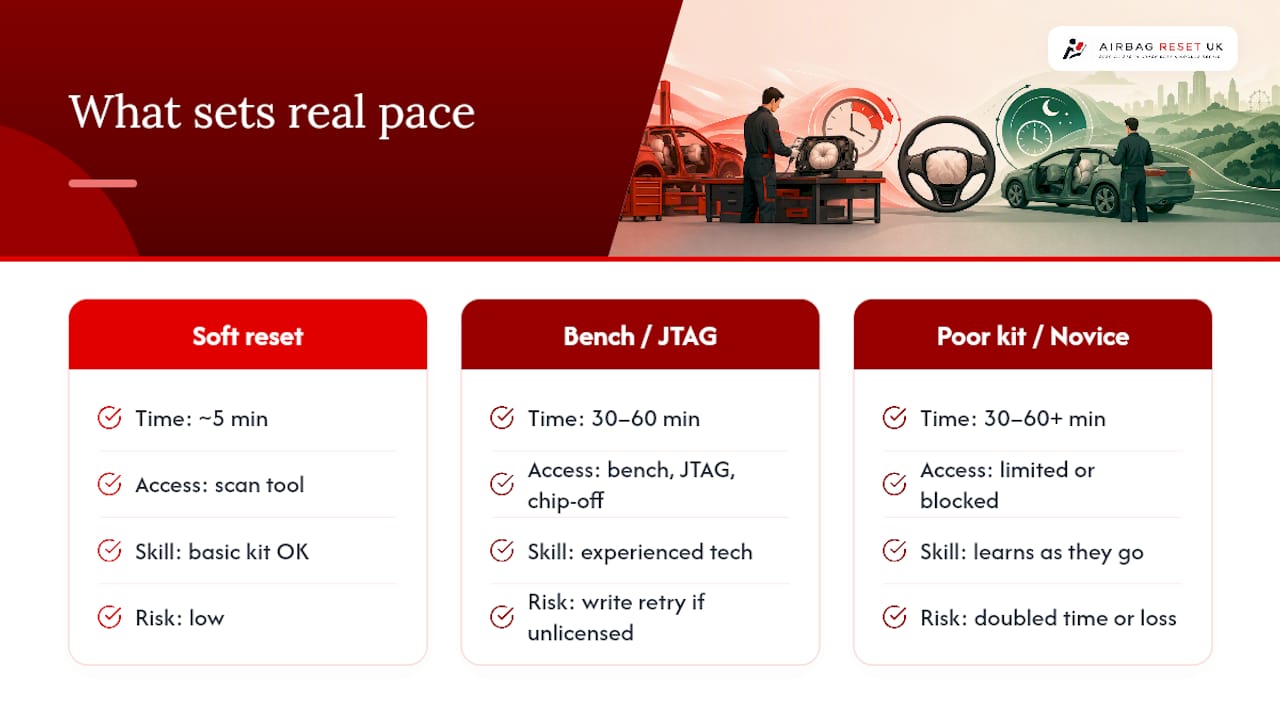
Two labs quoting the same "30 to 60 minute" bench time can still deliver very different experiences, and the gap usually comes down to equipment and experience rather than the procedure itself. A scan tool reset of soft codes can be done in about five minutes with basic kit, but genuine crash-data clearing on protected memory needs proper bench tools, and increasingly, JTAG or chip-off capability on newer modules that lock simpler access methods out entirely.
An experienced technician recognises within minutes whether a module is a clean clear or a lost cause, which saves hours of wasted diagnostic time compared with someone working it out as they go. Equipment matters just as much: a workshop running current, properly licensed bench software handles the checksum recalculation and verification steps cleanly on the first pass, while outdated or unlicensed tools can force a repeat write, which doubles the bench time for no good reason.
This is also where backing up the original crash file earns its place as standard practice rather than an optional extra. A skilled technician who keeps a recovery copy can undo a failed write and start again without needing a second module sent in, whereas a shortcut taken without a backup can turn a 45 minute job into a total loss of the unit. Speed on paper is easy to promise. Speed backed by the right kit and a technician who knows when to stop and diagnose further is what actually delivers it.
What experienced technicians want you to know
Realistic airbag reset time expectations come from workshops with genuine bench history, not marketing copy. Across four decades of combined technician experience, one lesson holds: a reset is a single step in a safe repair, never a substitute for replacing hardware that's already done its job. Fix the mechanical side first. The electronics follow.
— John
Getting your module reset without the guesswork
Airbagresetuk runs a straightforward postal service built around clear pricing rather than vague promises. Most modules that arrive in the morning go through same-day, with standard airbag module resets priced between £35 and £46 depending on complexity, backed by price matching against genuine like-for-like quotes.
Motorhome owners get a dedicated service at £65 for units that need specialist handling, and if you'd rather avoid posting anything at all, mobile technicians start from £75 for on-vehicle resets where the fault allows it. To get moving, send over your module's part number, a photo of the unit, and your vehicle's VIN, either through the site or by WhatsApp, and you'll get a firm price and turnaround before anything's booked. Head to the pricing page to check your module and get started.
Sources
FAQ
How long does it take for an airbag light to go off after a reset?
Once the reset is complete and the module is reinstalled, the light should switch off within a few seconds of ignition as part of the vehicle's normal self-test. If it stays on, that usually points to a wiring or connector fault rather than a failed reset.
How much does it cost to have an airbag reset?
Standard airbag module resets through Airbagresetuk cost between £35 and £46, while motorhome units are priced at £65 and mobile on-vehicle resets start from £75. Pricing depends on module complexity and whether any parts replacement is involved.
How fast do you have to be going to set off an airbag?
Deployment thresholds are set by each manufacturer's crash sensors and vary by vehicle and impact type, so there's no single universal speed. Even relatively low-speed impacts can trigger deployment if the sensors detect the right deceleration pattern.
Can I pass an MOT with an airbag warning light on?
No. A persistent airbag warning light is treated as a safety-related fault and will result in an MOT failure, since it indicates the restraint system may not deploy correctly in a crash. Getting the underlying fault diagnosed and, where appropriate, the module reset before your test is the only way to clear it.