
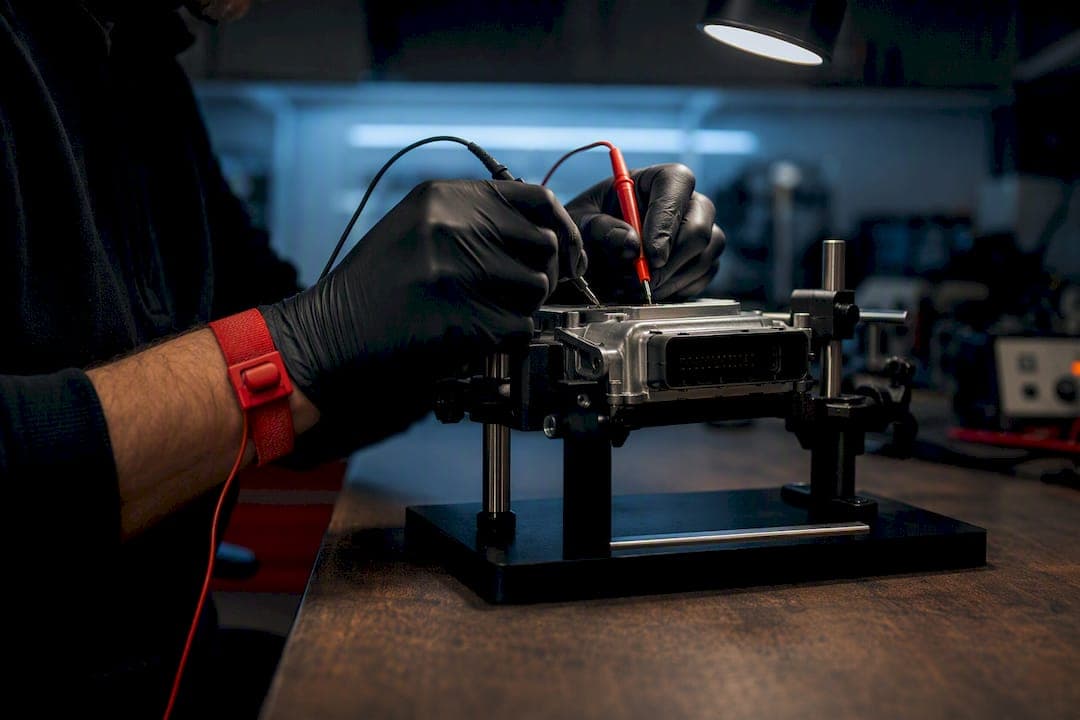
A bench crash-data clear is the correct fix once deployed inflators and pretensioners have already been replaced and the module's casing, connectors and sensors are physically sound. This article covers module-level crash-data reset and repair, not the splicing of physical wiring harnesses. Get the hardware fixed first, then post the module to a specialist bench-reset service such as Airbag Reset UK.
TL;DR:
- A bench crash-data clear is suitable only after replacing inflators, pretensioners, and verified sensors, and when the module shows no physical damage or corrosion.
- The process requires careful archival of the full EEPROM dump before clearing crash flags, with clear step-by-step procedures to avoid bricking the module.
- Crash event codes indicating a fired airbag can be resolved by a bench clear, but wiring, sensor, or hardware faults require prior repair.
- Never attempt firmware rewriting in situ in the vehicle; always use a dedicated bench service with proper archiving, verification, and tracking.
- Choosing a reputable postal service depends on experienced technicians, transparent pricing, secure shipping, and guarantees like archive delivery and verified test reports.
Table of Contents
- What a bench crash-data clear does and when it applies
- Bench reset: the step-by-step process on arrival
- How to check, remove and prepare an airbag module for postal despatch
- [Reading the trouble codes: crash-event vs hardware faults](#reading-the-trouble-codeshttpsblogbandmautocarecomtypes-of-car-diagnostic-tests-2026-owners-guide-crash-event-vs-hardware-faults)
- Risks, safety and legal notes technicians must know
- What to check before choosing a postal bench-reset provider
- Why a postal bench service is usually the smarter route
- How Airbag Reset UK's postal service works
- Sources
What a bench crash-data clear does and when it applies
When an airbag deploys, the SRS control module writes a permanent crash-event flag into its EEPROM and refuses to arm any new inflators until that flag is cleared. The module isn't being cautious for no reason. It's designed to stop a vehicle firing squibs a second time on hardware that may already be damaged. Clearing that flag requires direct EEPROM access, a recalculated checksum, and a rewrite, because the crash-flag storage and bench-level rewrite process sits well below what a standard OBD-II scanner can reach.
A bench clear only belongs on a module that meets a specific set of conditions:
- Airbags, seatbelt pretensioners and any deployed squibs have been replaced with OE or OE-equivalent parts.
- Impact and occupant sensors have been tested and read correctly.
- The module casing shows no cracking, water ingress or heat damage.
- Associated wiring and connectors have been inspected for chafing or corrosion.
It's worth being blunt about what clearing does not do. It does not repair a deployed inflator, and it does not erase or "hide" an accident from anyone checking a vehicle's history properly. Reputable bench services archive the original EEPROM dump, including event data recorder logs, before touching anything, so the crash record still exists on file even after the module is working again.
Bench reset: the step-by-step process on arrival
Once a module lands on the bench, the technician runs through a fixed sequence rather than jumping straight to a rewrite. Skipping steps is exactly how modules end up bricked.
- Visual and part-number check. The module is inspected for physical damage and its part number confirmed against the vehicle it came from.
- Anti-static handling. The board goes onto a static-safe mat and is handled with grounded tools throughout.
- EEPROM read and archive. The full memory dump is read and saved before any changes are made, preserving crash and EDR data.
- Crash-flag location. The technician locates the specific flag bytes for that part number. Chip families and memory offsets differ between manufacturers, so a generic address never applies across models.
- Rewrite and checksum recalculation. The flag is cleared, the checksum or CRC recalculated, and the corrected data written back.
- Verification readback. The module is read again to confirm the write took and the checksum matches.
- Bench arm test. A simulated inflator load checks the module correctly arms its squib drivers before it's approved for return.
Pro Tip: Ask any service for the pre-clear dump on request. If they can't produce it, they didn't archive it, and you've lost the crash record permanently.
A good service ships the module back with verification photos, a short test report, and tracked delivery, alongside the archived dump for your own records.
How to check, remove and prepare an airbag module for postal despatch
Disconnect the battery and leave it isolated for the manufacturer's recommended time before touching the module. If your workshop isn't set up for safe airbag removal, get it done by someone who is. This isn't a job to improvise on a Friday afternoon.
Before boxing anything up, photograph the module's part number label, the connector orientation, any visible casing damage, and the collision repair invoice showing what hardware was replaced. Missing paperwork is the single most common reason a job gets delayed at the bench.
For packing:
- Use an anti-static bag around the module itself.
- Pad it inside a rigid box so the connectors can't flex or crack in transit.
- Include a contact form with vehicle details, part number and a return address.
- Mark the parcel as a general electronic component. Airbag modules that have already had inflators removed are not classed as hazardous freight, but check with your courier if you're at all unsure.
Standard scanners genuinely cannot touch this: only direct EEPROM access clears hard crash-event codes, which is why the module has to travel rather than get cleared in the bay.
Reading the trouble codes: crash-event vs hardware faults
Not every airbag light means a bench clear will fix it. Scanner output splits fairly cleanly into three outcomes, and mixing them up wastes everyone's time and money.
| Code pattern | Likely cause | Does a bench clear fix it? |
|---|---|---|
| Crash-event / deployment flag stored | Airbag or pretensioner has fired; module locked out | Yes, once hardware is replaced |
| Squib loop open or short circuit | Damaged wiring, connector or blown squib | No, hardware repair needed first |
| Sensor circuit fault (impact/occupancy) | Faulty or disconnected sensor | No, sensor repair or replacement needed |
| Internal module hardware fault | Damaged PCB, corrosion, moisture ingress | No, module itself needs replacing |
That first row is the one a postal crash-data clear actually resolves. The other three need hardware attention before the module goes anywhere near a bench programmer. If you're unsure which category you're in, send the full scan log and complete DTC list with the module. It lets the service assess the fault properly before quoting, rather than guessing from a part number alone.
Risks, safety and legal notes technicians must know
Never attempt a low-level EEPROM rewrite with the module still fitted in the vehicle. Bench work exists precisely to remove the risk of accidental deployment and static discharge damaging the board, and doing it in-situ removes none of that risk while adding several more.
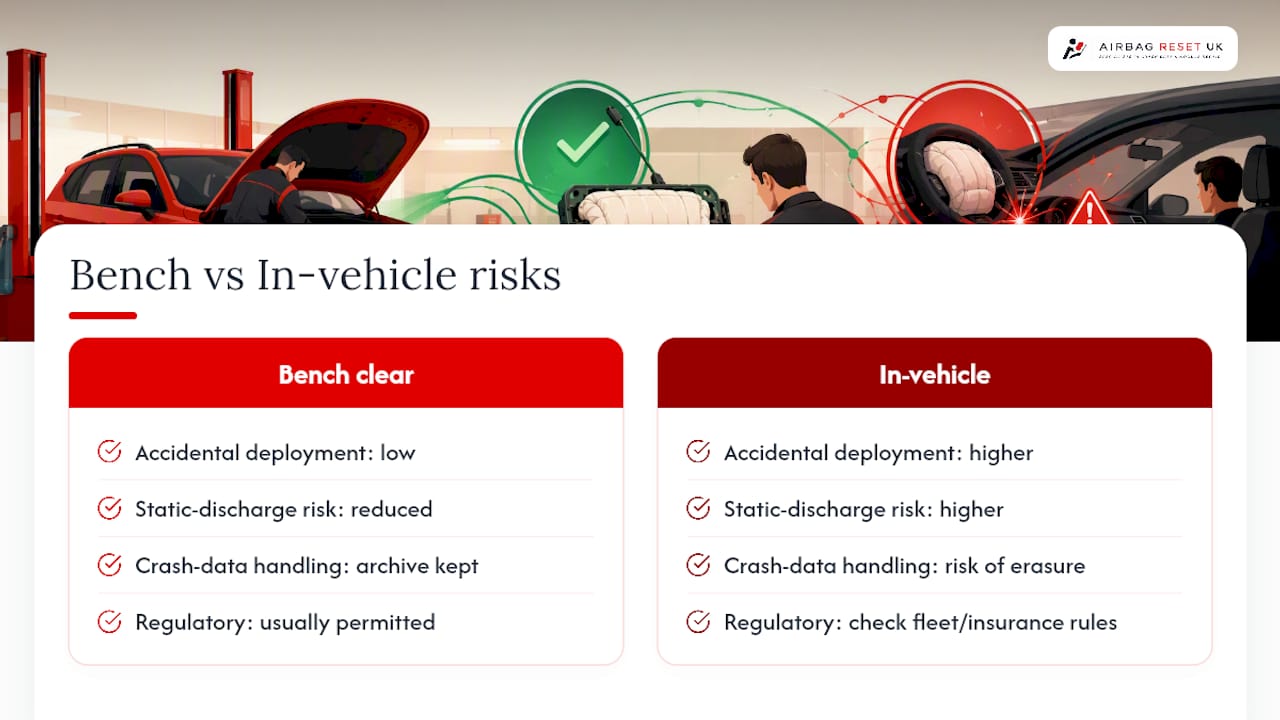
Crash data should always be preserved and archived, not discarded, because insurers and, occasionally, courts rely on it. Concealing a vehicle's crash history at resale by clearing data without keeping a record isn't something any reputable service should support, and it isn't something you want your workshop's name attached to.
Pro Tip: Keep the archived dump alongside your job sheet for every module you send. If a warranty or insurance question comes up eighteen months later, you'll want that file to hand.
A bench clear is legitimate repair work on a privately owned vehicle. It carries no special licensing requirement in most circumstances, but if you're working on fleet vehicles or anything covered by an insurance claim, check your own regulatory or contractual obligations before proceeding. This isn't legal advice, just a prompt to check.
What to check before choosing a postal bench-reset provider
A handful of questions separate the services worth using from the ones that'll cost you a second shipment.
Look for:
- Technicians with genuine hands-on experience across multiple module families.
- A clear policy on archiving and returning pre-clear EDR data.
- Fixed, published pricing rather than "get a quote" vagueness.
- Realistic turnaround times, ideally same-day for common modules.
- Trade discounts if you're sending modules regularly.
- A verification report and photos on return, proving the bench arm test passed.
- Secure, tracked shipping both ways.
| Red flag | Why it matters |
|---|---|
| Refuses to archive crash data | You lose the EDR record permanently |
| Won't confirm part fitment before shipping | Risk of sending the wrong module or wasted postage |
| Offers a "silent" or unverified clear | No proof the module actually arms correctly |
Before you post anything, get part-number confirmation, request a pre-clear read, and ask what the verification report will include on return.
Why a postal bench service is usually the smarter route
Replacing a module outright means sourcing a donor unit, matching VIN and coding, and hoping the seller's history checks out. Bench clearing keeps your original module's factory coding intact, which sidesteps that entire risk. For independent garages and fleets running several jobs a month, trade accounts and same-day turnaround matter more than a marginally cheaper one-off price, because a car sat waiting on a module is a car not earning anyone anything. Price matching against a genuine competing quote is the detail that convinces most trade buyers to commit.
— John
How Airbag Reset UK's postal service works
If the hardware repair is done and you're just waiting on the module, this is the part that gets your customer's car back on the road. There are services that run UK-wide postal crash-data reset and repair service for cars, vans and motorhomes, backed by technicians with extensive combined experience. Same-day turnaround covers most modules, pricing starts from a fixed rate, and some providers offer price matching against genuine like-for-like quotes.
You can send your module's part number or a photo for identification, and teams will confirm fitment and price before shipping. Services offer fixed, transparent pricing for standard and complex modules, and may provide trade account discounts for garages and workshops sending multiple jobs a month, sometimes including specialised motorhome resets. On return, clients typically receive the archived pre-clear dump, verification photos, and a test report showing the module passed its bench arm test. Book your reset or check trade pricing directly through Airbag Reset UK.