
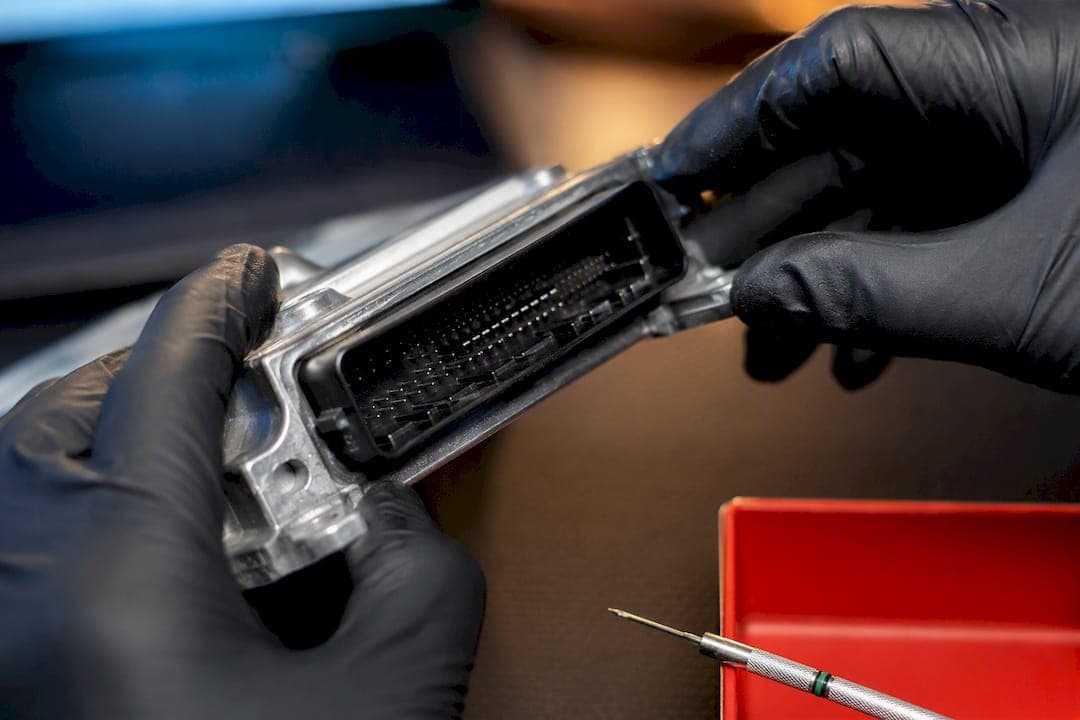
B0051 means the airbag control module (SDM or ACM) has recorded a deployment event, and the fault is latched into memory. A standard scan tool cannot usually clear it. You need a repair path: module reset by a specialist, SDM replacement or wider SRS repairs depending on what actually happened. Do not drive around ignoring the airbag lamp. It is telling you the restraint system may not fire correctly in a second collision.
TL;DR:
- Most B0051 codes stem from actual crash events, but wiring faults and seat wiring alterations can mimic deployment and should be ruled out first.
- Physical inspections for deployed airbags, spent pretensioners, and wiring damage are crucial before considering module reset or replacement.
- Reset services are a viable, lower-cost alternative to SDM replacement if no hardware damage occurred, but they cannot clear codes caused by actual deployment.
- Full verification after repairs involves proper code clearing, relearn procedures, and a test drive to ensure the airbag warning stays off.
- Relying solely on scan tools to clear B0051 risks overlooking underlying hardware damage, so professional diagnostics are essential for appropriate repairs.
Table of Contents
- What the B0051 airbag code actually means
- Common causes and scenarios behind a B0051 fault
- How to diagnose a B0051 airbag fault properly
- Repair and reset options: what actually works
- Verifying the repair before the car goes back on the road
- What workshops actually prioritise when deciding reset versus replacement
- What the conventional advice gets wrong about B0051
- Getting your SDM reset without buying a new module
- Sources
- FAQ
What the B0051 airbag code actually means
General Motors workshop manuals describe B0051 as "Deployment Commanded", meaning the Sensing and Diagnostic Module recorded a crash event severe enough to trigger, or attempt to trigger, deployment. The SDM constantly monitors deceleration signals from crash sensors. When the reading crosses a manufacturer-set velocity threshold, it fires the airbags and pretensioners, then writes that event permanently to its own memory.
That permanence is deliberate. Manufacturer documentation treats the code as latched, not because engineers were careless with the software, but because a system that lets you casually wipe a crash record is a system that lets a dangerously compromised module stay in service. A car that has already used up its pretensioner charges or suffered heat and shock damage to the SDM circuitry cannot be trusted to protect anyone next time.
You will see the same principle across brands, though the detail differs:
- GM and Chevrolet models use B0051 specifically for the deployment-commanded event, tied to the SDM's crash-data log.
- Saab vehicles list B0051 with a family of subcodes covering the deployment loop itself, such as short-to-battery, short-to-ground, open circuit and resistance faults.
That variation matters. The same three-character code can point to a genuine crash record on one platform and an electrical fault on another, so always check the specific workshop manual for the vehicle in front of you before assuming what triggered it.
Common causes and scenarios behind a B0051 fault
Most B0051 airbag codes fall into one of four patterns, and telling them apart early saves hours of unnecessary diagnostic work.
- A genuine collision. Impact severity crossed the SDM's deployment threshold and airbags, pretensioners, or both fired as designed.
- Repeated pretensioner activity without full deployment. Seatbelt pretensioners can fire in moderate impacts that never trigger the main airbags, and the module logs each event.
- Wiring faults in the deployment loop. A short to battery, short to ground, open circuit, or high resistance in the squib circuit can mimic a crash record on some platforms, appearing as a subcode rather than a true deployment.
- Altered occupant or seat wiring. Incorrectly refitted seats, aftermarket seat swaps, or theft-related tampering with occupant sensors can produce readings the SDM interprets as abnormal, occasionally latching a related code.
Forum reports from owner communities, including threads on the Vauxhall Owners Network, back this up with real repair stories where wiring damage rather than an actual crash was the culprit. Treat those as useful colour, not gospel, and confirm with proper diagnostics.
How to diagnose a B0051 airbag fault properly
Work through this in order, and resist the temptation to skip straight to a scan tool.
- Disconnect the battery and follow SRS-safe procedure before touching any deployable component. Airbag systems hold residual energy even with the ignition off.
- Inspect visually first. Check airbag modules for deployment residue, pretensioner straps for signs they have fired, the clockspring for damage, and connectors and seat mounts for looseness or corrosion.
- Read SDM crash data with a capable scan tool. Note every DTC and freeze-frame entry, and pay attention to subcodes such as short-to-battery or open-circuit, since these point to wiring rather than deployment.
- Carry out electrical checks. Measure deployment loop resistance against the workshop manual's spec, confirm battery voltage stays stable during testing, and trace the harness for chafing or heat damage.
- Make the decision. Physical evidence of deployment (fired airbags, spent pretensioners, damaged clockspring) means component replacement. Clean components with only an electrical subcode point towards a serviceable, resettable module.
Pro Tip: A car with multiple logged pretensioner events, even without full airbag deployment, is often treated by manufacturers as having exhausted its SDM's reliable service life. If the history shows repeated pretensioner activations, budget for replacement rather than reset.
If you want a second data point on the sensor side, a mobile diagnostic check can confirm what a generic OBD-II reader is telling you before you commit to a repair path.
Repair and reset options: what actually works
Once you have established whether a real deployment happened, the repair path splits into two clear routes.
If airbags or pretensioners genuinely fired, replace every deployed component: airbags themselves, pretensioners, the clockspring if damaged, and any crash sensors showing physical harm. SDM replacement is frequently required alongside this, since a module that has logged a full deployment is generally no longer considered reliable for future protection.
If there is no physical deployment damage and the module itself is intact, a specialist crash-data reset service becomes the sensible option. This clears the latched B0051 record without the cost of a new SDM, provided the fault genuinely traces back to a recorded event rather than active hardware damage.
- SDM replacement path: a new or refurbished module usually needs VIN-specific programming and a relearn procedure, which adds labour time on top of parts cost.
- Postal reset service: the module is removed, posted, reset, and returned, often with same-day turnaround once received, at a lower cost than a fresh SDM.
- Trade accounts: garages processing several jobs a month typically get discounted rates through trade portals rather than paying standard retail pricing each time.
- When not to attempt a reset: if the SDM housing shows heat damage, corrosion, or physical impact marks, or if deployment components are visibly damaged, replacement is the only safe route.
Ordinary scan tools frequently cannot execute the clear routine on a latched SDM record at all, regardless of whether the fault is genuinely repairable by reset. That is the gap specialist services exist to fill.
Verifying the repair before the car goes back on the road
A B0051 clear is not finished when the lamp goes out. Confirm the fix properly.
- Clear codes with the correct procedure, not a generic reader; an ordinary OBD-II tool can fail silently if crash data is still present in memory.
- Complete any required relearns, such as occupant classification system calibration or clockspring centring, which typically follow a module swap or reset.
- Road test and watch the airbag lamp. It should illuminate briefly at ignition, then extinguish and stay off. A lamp that stays lit or flashes means returning to a workshop before the car goes anywhere near real traffic.
- Keep records. Document every part replaced and every reset performed, since insurers and future buyers will want proof the SRS was properly restored.
Manufacturer guidance is consistent on one point across GM, Saab and most other marques covered by their own workshop manuals: full SRS verification after any repair is not optional, whatever route you took to clear the code.
What workshops actually prioritise when deciding reset versus replacement
Experienced technicians weigh three things before quoting a job: physical evidence of deployment, the electrical health of the SDM itself, and the cost gap between reset and replacement. A module with clean pins, no heat marks, and only an electrical subcode logged is a strong reset candidate. One with fired squibs or corrosion inside the connector is not, whatever the scan tool says.
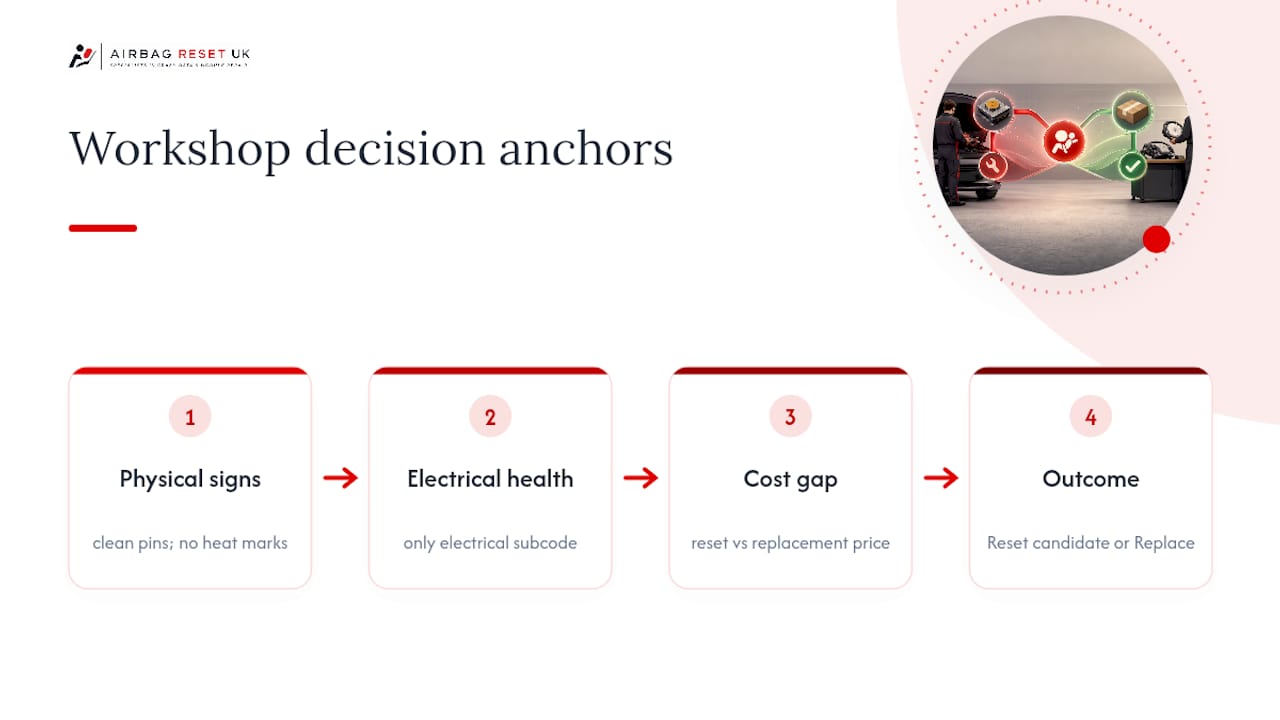
A specialist reset service can be built around that same judgement call, drawing on combined technician experience across cars, vans and motorhomes. For garages packaging a postal job, the practical advice is simple: photograph the part number clearly, note the VIN, and include a brief description of what triggered the code before shipping. That single step avoids most of the back-and-forth that slows a turnaround down.
What the conventional advice gets wrong about B0051
Most guides treat B0051 as binary: either your airbags deployed and you replace everything, or they didn't and you clear the code. Real cases sit in between far more often than that framing suggests. A car with two pretensioner events and no fired airbags is neither a write-off nor a five-minute fix, and treating it as either wastes money or, worse, leaves a compromised module in service.
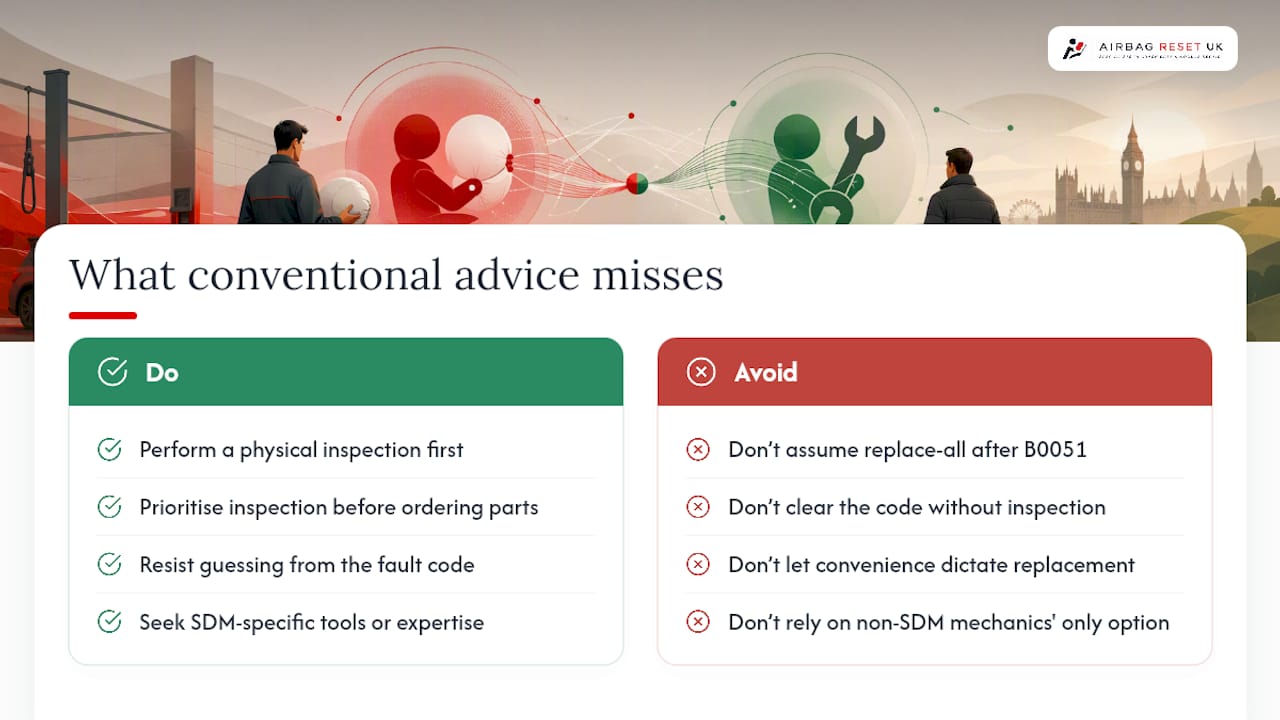
The bigger gap is expectation-setting. Owners are told an airbag light means "go to the dealer," and mechanics without SDM-specific tools sometimes tell customers a new module is the only option because that is the only route they can execute. Neither is automatically true. What should come first is the physical inspection, every time, before anyone commits to a parts bill. Skip that step and you either overspend on a module that never needed replacing, or underspend on a car that genuinely needed new components.
If there is one thing worth prioritising above the rest, it is resisting the urge to guess from the code alone. B0051 tells you something happened. It does not tell you what to do about it until someone has actually looked.
— John
Getting your SDM reset without buying a new module
If the physical inspection comes back clean and the only problem is a latched crash record, specialist reset services can provide a lower-cost route than blanket SDM replacement, and one that does not need a workshop visit at all.
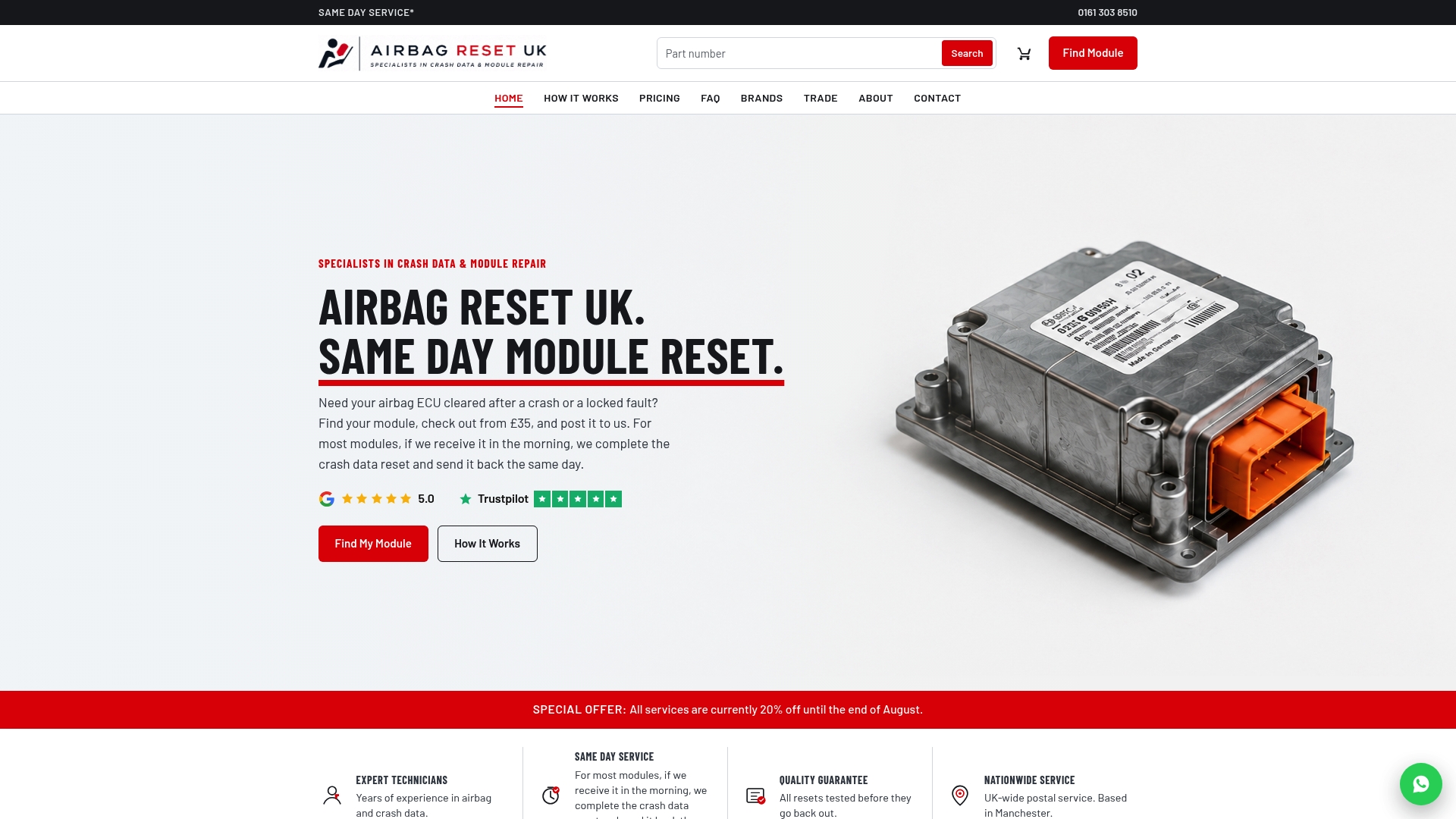
The postal service covers crash data resets for airbag ECUs across cars, vans and motorhomes, often with fast turnaround for most modules once they arrive and transparent pricing. It suits exactly the scenario covered above: no visible deployment damage, module intact, but the airbag lamp stuck on because a scan tool cannot touch the latched record. If your inspection instead shows fired airbags or spent pretensioners, full component replacement remains the right call, and a reset alone will not fix that.
Starting a job is straightforward. Identify the module by part number or send a photo if you are not sure, arrange postage, and the reset service provider handles the rest, potentially including price matching against genuine like-for-like quotes and discounted trade accounts for garages running multiple jobs. Head to the Airbag Reset UK site to check your part number and get a price before you post anything.
Sources
- B0051 — 2011 Chevrolet Colorado 2WD V8-5.3L Service Manual | Operation CHARM
- DTC B0051 9-5 (9650) 2011 | SAAB Workshop Information System Online
- B0051 Airbag Issues — Vauxhall Owners Network
FAQ
What does the B0051 code mean on a Chevrolet?
On Chevrolet and other GM models, B0051 means the SDM has recorded "Deployment Commanded," a latched crash-data entry that a standard scan tool usually cannot clear.
What does the B0018 airbag code mean?
Driver-side airbag deployment loop faults differ from B0051's crash-data record, though both fall under the same SRS diagnostic family and often need manufacturer-specific procedures to resolve.
What does diagnostic code B0052 mean?
Codes similar to B0051 may flag second-stage or side-impact deployment circuit issues depending on the manufacturer, so check the specific workshop manual for the exact fault.
What does the B0012 fault code mean?
Passenger-side airbag deployment circuit faults differ from B0051's crash-data record and may sometimes be addressed through a wiring repair rather than a module reset.
Can B0051 be cleared with a normal scan tool?
Not usually. Because the code is latched crash data rather than a live fault, an ordinary OBD-II reader typically cannot execute the clear routine, which is why specialist reset services or SDM replacement exist.
How much does an airbag module reset cost after a B0051 code?
Postal crash-data reset services start from a modest fee, considerably less than full SDM replacement, provided the module is intact with no physical deployment damage.