
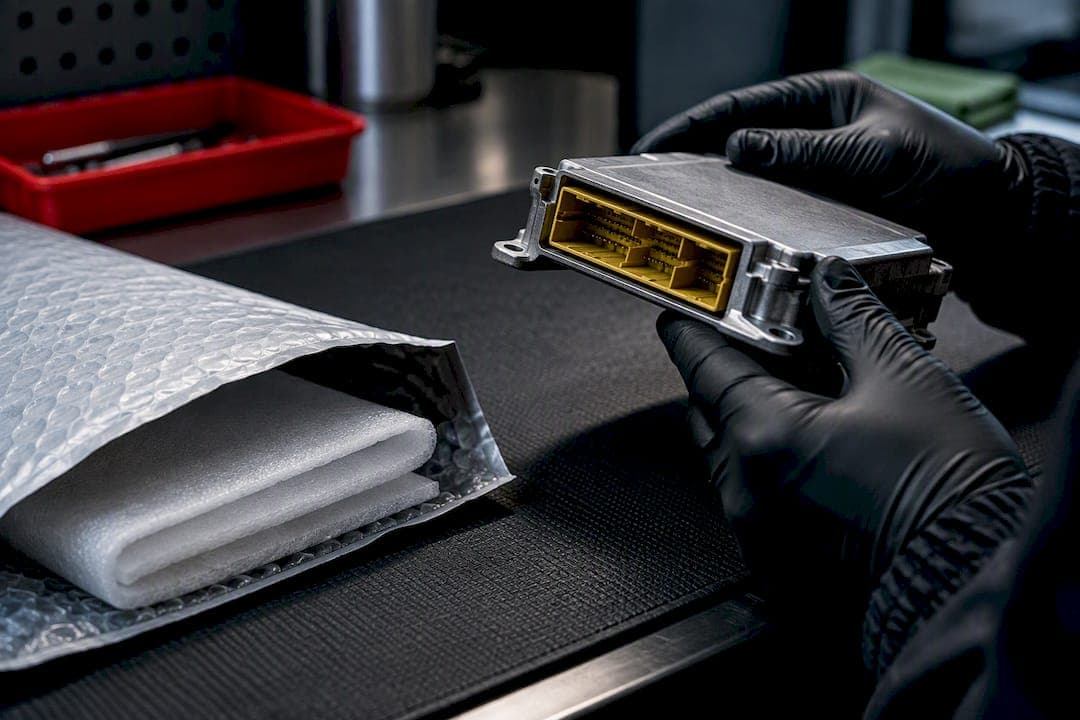
For a crash affected Bosch airbag ECU, the fastest reliable fix is a specialist airbag module reset service, not a handheld OBD-II clear. A properly identified module can usually be reset rather than replaced, clearing the SRS warning light and restoring MOT compliance at a fraction of replacement cost. Turnaround for most units is same-day once received, with typical postal reset pricing starting at amounts published on pricing pages.
TL;DR:
- Most crash-locked Bosch airbag modules can be reliably reset rather than replaced, often within the same day and at a lower cost than new units.
- Correct identification of the module's part number and firmware family is essential, requiring detailed photos and vehicle information before sending it for reset.
- Handheld OBD-II scanners cannot clear permanent crash data stored in the module's memory, which requires specialist EEPROM or firmware-level procedures.
- An illuminated SRS warning light due to a locked module results in a fail on MOT, and unaddressed faults can delay vehicle sale or insurance claims.
- Resetting a physically intact module is generally preferable, but damaged or submerged units must be replaced for safety and compliance reasons.
Table of Contents
- What a Bosch airbag reset service actually does
- Which Bosch modules are serviceable and why part numbers matter
- How to send a module, expected turnaround and typical costs
- Why an illuminated SRS light matters for MOT and safety
- What diagnostic tools can and cannot do for a locked module
- Reset or replace: the practical case for keeping the original module
- How Airbag Reset UK can help
- Sources
- FAQ
What a Bosch airbag reset service actually does
A crash data reset clears the memory that recorded deployment or near-deployment events, then reinitialises the module to its factory state so it stops throwing fault codes. Where the housing and circuit board are undamaged, a competent technician can also carry out minor repairs, such as reflowing a dry joint, before the reset. What the service will not do is repair or replace the airbags, seatbelt pretensioners or crash sensors themselves: those are physical safety components, separate from the electronic control unit.
A reset typically resolves:
- A persistent SRS warning light after an accident where the airbags did not deploy, but the module locked itself
- Fault codes left behind after a minor bump that triggered sensor readings without an actual deployment
- Warning lights following a battery disconnect or wiring fault that the module misread as a crash event
Before any work starts, a reputable provider checks the module's part number or asks for a photograph of the label to confirm it is the correct type and that the reset will actually apply to that firmware version. Skipping this step is the most common reason a reset fails.
Which Bosch modules are serviceable and why part numbers matter
Bosch airbag control units carry a manufacturer part number, generally in the 0285 or "0 285" series, which maps directly to a specific firmware build and memory chip. Two modules that look identical on the outside can use different chip families such as the 95160, 95320 or 95640, and each needs its own handling. Sending the wrong firmware file to the wrong chip is the fastest way to end up with a module that will not initialise at all.
Reliable ways to identify a module before sending it:
- Photograph the printed label on the module casing, including any barcodes
- Read the full part number rather than a partial one from memory
- Send the registration or vehicle details alongside the part number so the provider can cross-check compatibility
Pro Tip: If the label is worn or partly missing, send close-up photos from several angles rather than guessing the number, since one digit can put the reset on entirely the wrong firmware family.
How to send a module, expected turnaround and typical costs
Getting a module reset by post is a straightforward process, and most of the delay comes from postage rather than the actual work.
- Identify the module and photograph the part number label
- Contact the provider with the part number or photo to get confirmation of compatibility and a fixed quote
- Pack the module securely and post it using a tracked, insured service
- Wait for the reset and dispatch back, with most units returned the same day they arrive
Modules that reach a workshop in the morning are commonly turned around and posted back the same day, which matters if a vehicle is off the road waiting on the part. Standard postal resets typically start at £35, a figure that reflects the client's own published pricing for straightforward units; more complex modules, those needing physical repair, or units requiring extra firmware handling cost more. VAT and return postage are worth confirming at quote stage so there are no surprises. Include a note with the vehicle registration, a contact number and a brief description of the fault when packing the module, and keep the tracking reference until it is safely back.
Why an illuminated SRS light matters for MOT and safety

An illuminated SRS Malfunction Indicator Lamp is classed as a major defect under the MOT inspection manual, which means the vehicle automatically fails its test until the fault is cleared. This is not a bureaucratic technicality: it exists because an airbag system that cannot confirm its own readiness is not something an inspector can pass on trust.
The reason crash data locks in the first place is deliberate rather than a fault in itself. Bosch's own description of its airbag control unit as the central safety controller for crash sensing explains why the memory locks after an event: an unreliable module should not be allowed to fire again without confirmation that it is safe to do so.
A vehicle with an illuminated SRS warning light will not pass its MOT, regardless of whether the airbags themselves are intact.
This matters particularly for lease returns and insurance repairs, where a locked module left unresolved can hold up a handover or a sale.
What diagnostic tools can and cannot do for a locked module
Fault codes generally split into two types. Soft codes are minor faults that clear themselves once the underlying issue, such as a loose connector, is fixed. Hard codes, including crash data, are written permanently into the module's memory and are designed to resist a simple clear.
This is why a handheld scanner so often fails to fix the problem:
- Most consumer and workshop OBD-II tools can read fault codes but cannot clear a genuine hard crash code
- Permanently clearing crash data usually requires EEPROM level access or a firmware-aware procedure rather than a generic reset command
- A garage can reasonably attempt diagnostics in-house to confirm the fault is genuinely crash-related, but once it is, the module is better sent to a specialist than repeatedly cleared and re-triggered
Repeated failed clear attempts can sometimes make a module harder to work with later, so it is worth stopping and sending it out once a hard code is confirmed.
Reset or replace: the practical case for keeping the original module

Where a Bosch module is otherwise sound, resetting it is usually the better call than sourcing and encoding a replacement. It costs less, avoids the wait for a compatible part, and skips the extra step of programming a new unit to the vehicle. Industry repair guidance backs this up, noting that replacement units often bring their own reprogramming requirements and cost more overall. Reusing a working module also means one less electronic unit heading for scrap, which is a small but genuine benefit given how many are discarded unnecessarily after minor incidents.
The caveat matters, though. If a module has been physically damaged, submerged or exposed to fire, no reset will make it safe again, and replacement is the only responsible option. The judgement call between reset and replace should always start with an honest look at the hardware, not just the warning light.
— John
How Airbag Reset UK can help
Once you know the fault is genuinely crash data rather than physical damage, getting it resolved is mostly a matter of logistics. Airbag Reset UK runs a UK-wide postal service for cars, vans and motorhomes, built around fixed pricing and a same-day turnaround for most modules received in the morning.
- Airbag module reset starts at £35, with price matching available against genuine like-for-like quotes
- A dedicated motorhome airbag reset service covers the larger, less common modules found in leisure vehicles
- Mobile airbag reset is available from £75 for garages or fleets that need collection rather than a postal exchange
- Trade accounts offer discounted rates for independent garages and bodyshops processing modules regularly
To get started, send a photo or part number over WhatsApp or by phone for a compatibility check and fixed quote, then book through the pricing page or the main Airbag Reset UK site.
Sources
Technical and legal claims in this article draw on the MOT inspection manual, Bosch's own airbag control unit page, and repair guidance from MyAirbags and Simplysolved. For lease-return safety checks, see this leasing maintenance guide.
- Gov
- Airbag control unit – Bosch Mobility Solutions
- How to reset an air bag light the right way – MyAirbags Guides
- Simplysolved
FAQ
Can you reset an airbag control module?
Yes, a Bosch airbag control unit can usually be reset if the crash data lock is the only issue and the hardware itself is undamaged. The process clears the recorded event and reinitialises the module, though physically damaged units need replacement rather than a reset.
What tool can I use to reset the airbag module?
Standard handheld OBD-II scanners can read codes but typically cannot clear genuine hard crash codes stored after an accident. A permanent clear usually needs EEPROM or firmware-aware equipment, which is why most owners send the module to a specialist rather than attempting it with a generic scan tool.
How much does it cost to have an airbag module reset?
Standard postal resets start at £35, with more complex modules or those needing repair costing more. Motorhome resets are priced separately, and mobile or on-site services start from £75.
Will my new airbags deploy without module reset?
If the original module is still locked from a previous crash event, it may not allow the system to arm correctly even with new airbags fitted. Clearing the crash data through a reset, or fitting a properly reset replacement, is what restores the system to a working state.