
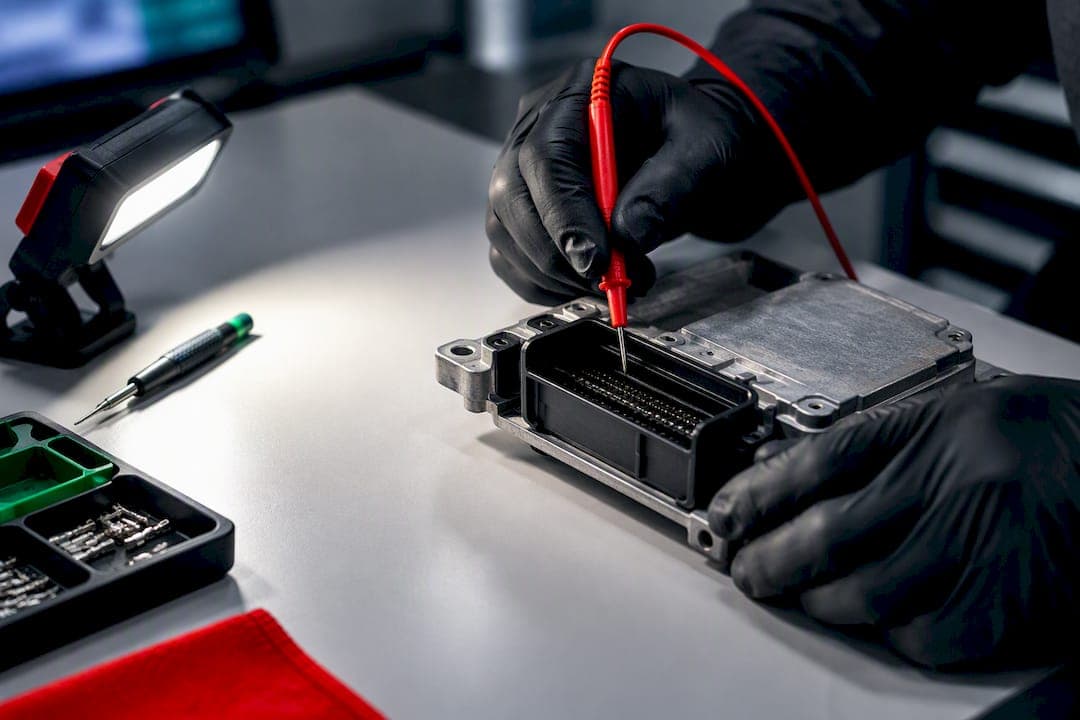
Diagnosis should always come before a reset. An illuminated SRS warning light means something in the airbag system has failed its self-check, and a reset without repair only hides that fault temporarily, risking an MOT failure and leaving the safety system compromised. When crash data exists, the fix usually needs a bench-level reset carried out by a specialist, not a quick clear with a handheld tool.
TL;DR:
- Soft fault codes can often be cleared after repairs, but crash data stored in hard codes requires a specialist reset; disconnecting the battery won't erase crash memory.
- Common wiring issues such as loose under-seat connectors, worn clock springs, or low battery voltage are frequent causes of warning lights and may not need module replacement.
- A crash-affected module can often be reset if undamaged, with physical signs of damage or EEPROM failure making reset impossible and replacement necessary.
- Bench resets are done with the module removed using specialized equipment, offering a faster, cheaper alternative to replacing and reprogramming the ECU in most cases.
- Proper diagnosis before resetting avoids unnecessary costs and ensures the fault is fully addressed, especially since an illuminated SRS light causes MOT failure.
Table of Contents
- What an airbag ECU stores and why that matters
- Common causes of an airbag warning light and how to triage them
- Reset versus replacement: when a crash-damaged ECU can be repaired
- Bench reset vs in-vehicle reset: how each works and their limits
- A professional diagnostic workflow: read, repair, clear, verify
- MOT and safety implications of an illuminated SRS light
- Deciding whether to DIY or use a specialist service
- How a postal bench reset service actually works
- Balancing safety, cost and convenience
- Airbag Reset UK: postal bench reset services and how to use them
- Sources
- FAQ
What an airbag ECU stores and why that matters
An airbag ECU, also called an SRS module, logs two distinct types of fault. Soft codes cover intermittent problems such as a loose connector or a wiring fault that comes and goes. Hard codes are different: they record permanent crash data, written to non-volatile memory the moment a deployment event or a severe impact is detected.
That distinction matters because non-volatile memory does not clear itself. Disconnecting the battery, pulling a fuse or waiting overnight will not touch it, contrary to a common assumption among owners trying a manual reset.
- Soft codes usually point to sensors, connectors or wiring, and can sometimes clear once the fault is repaired.
- Hard codes represent stored crash data and need a proper reset procedure, not a battery disconnect.
- Clearing history without repairing the underlying fault leaves the vehicle's safety systems unverified.
Common causes of an airbag warning light and how to triage them
Before assuming the module itself has failed, it is worth ruling out the parts around it. Under-seat wiring loosens with regular seat movement, the clock spring wears with steering use, and low battery voltage can trigger a false SRS fault on some platforms.
- Loose or corroded under-seat connectors are one of the most common triggers and are often a simple repair.
- A worn clock spring can interrupt the connection to the steering wheel airbag and needs replacement.
- Seatbelt pretensioner faults or a confirmed deployment event point towards module-level work.
- Low voltage or a weak battery can cause intermittent SRS warnings that clear once charging is stable.
- Communication faults between modules (via CAN bus) suggest a wider electrical issue, not just the airbag system.
If the fault clears after a repair and a proper diagnostic recheck, no reset is needed. If it persists, or the vehicle has been in a collision, the module itself is the next thing to examine.
Reset versus replacement: when a crash-damaged ECU can be repaired
Whether a crash-affected module can be safely reset, rather than replaced, depends on its physical condition. A unit that has suffered no water ingress, fire damage or structural crushing, and whose EEPROM state is still recoverable, is usually a good candidate for a bench reset. Physical damage to the circuit board or a failed EEPROM chip generally rules that out.
- Inspect the module for visible damage: cracked casing, corrosion or heat marks are warning signs.
- Confirm the fault is crash data rather than a wiring issue elsewhere in the vehicle.
- Check whether the EEPROM is intact; technical notes on module handling warn that some EEPROM ageing faults are irreversible.
- If the unit is sound, a bench reset is typically faster and cheaper than sourcing a replacement.
- If replacement is unavoidable, budget for re-encoding and extra labour, since a new module rarely works without being matched to the vehicle.
Pro Tip: Photograph the module and its part number before removal. It speeds up identification and avoids ordering the wrong replacement.
Replacement is not always straightforward. A new or used module often needs re-programming to the vehicle, adding cost and time that a reset on the original unit avoids when the hardware itself is undamaged.
Bench reset vs in-vehicle reset: how each works and their limits
Bench resets happen with the module removed from the vehicle and connected to specialist equipment outside the car. This controlled setup lets a technician confirm correct orientation, use the right resistors or OEM tools for a bench connection, and access the EEPROM directly to clear stored crash data safely.
In-vehicle reprogramming is possible on some modern platforms using factory-level diagnostic tools, but it remains uncommon. Most after market and even dealer-level tools cannot write to the crash-data area while the module is still connected in the car, which is why handheld OBD-II scanners typically cannot clear hard codes.
- Bench work requires the module held in the correct orientation; incorrect handling can create new internal faults.
- Transport and handling should avoid static discharge and physical shock to the connector pins.
- In-vehicle resets are limited to specific manufacturer tools and specific fault types, not general crash data.
A professional diagnostic workflow: read, repair, clear, verify
A safe diagnostic sequence follows a fixed order, and skipping steps is where most DIY attempts go wrong.
- Run a full system scan across the SRS and related modules, and save the report before touching anything.
- Record freeze frame data and separate current codes from historical ones, since only current faults need repair.
- Check related systems such as ABS and the body control module, and confirm battery voltage is stable before running any tests.
- Where safe, use active or bidirectional tests to confirm sensor and wiring operation, never to bypass or disable safety logic.
- Repair the identified fault, then clear the codes and complete a short road test to confirm the warning does not return.
This mirrors the approach recommended in professional scanner guidance, which stresses that clearing codes before repair destroys the diagnostic context a technician needs. Skipping straight to a clear means losing the freeze frame data that explains what actually happened.
MOT and safety implications of an illuminated SRS light
An illuminated SRS malfunction indicator lamp is treated as a failure item under MOT inspection guidance. That means the vehicle cannot pass until the fault is properly diagnosed and cleared, not just masked.
It is worth separating this from the passenger airbag status lamp, which indicates whether the passenger airbag is active or deactivated and is a different signal from the SRS warning light, as government testing guidance clarifies. Do not attempt to bypass or disconnect the light before a test: get a proper diagnosis first.

Deciding whether to DIY or use a specialist service
A handheld scanner is genuinely useful for reading current codes, checking connector security, and ruling out simple wiring faults. Its limits show up quickly once crash data or a persistent hard code is involved, since most consumer tools cannot touch that memory.
- DIY scanning is appropriate for reading codes and checking accessible connectors on a soft-fault warning.
- A bench reset or workshop visit becomes necessary once crash data, deployed components or a persistent code are confirmed.
- Ask any service about turnaround time, warranty terms, support identifying your part number, and whether trade pricing is available.
How a postal bench reset service actually works
A postal bench reset follows a defined sequence: send a photo or the part number for identification, the module is assessed on the bench, and the crash data is cleared where the hardware allows it. A reputable service provider typically offers same-day turnaround for most modules received in the morning, published pricing bands, and may offer price-match guarantees against genuine like-for-like quotes.
- Identification is done from a photo or part number before the module is sent.
- Turnaround is typically same-day for modules arriving in the morning.
- Pricing is fixed and published rather than quoted case by case.
- A reputable provider should be able to explain its process, warranty terms and what a completed job report includes.
Balancing safety, cost and convenience
Diagnose before you reset. That single rule avoids the two most expensive outcomes: paying for a replacement module you did not need, or clearing a fault that reappears days later because the underlying wiring issue was never fixed. A reset only closes the loop once the cause is known and, where crash data is involved, once a bench specialist has confirmed the unit is safe to clear.
Cost matters, but reliability matters more here. Run through the checklist above before booking anything.
— John
Airbag Reset UK: postal bench reset services and how to use them
Getting an original airbag module reset rather than replaced usually costs less and avoids the extra labour of re-encoding a new unit to your vehicle. Airbag Reset UK runs a UK-wide postal service built around that idea: send in the module, get it assessed on the bench, and have crash data cleared where the hardware is sound.
- Airbag module reset starts at £35 to £46 as a one-off cost, with fixed pricing and price matching against genuine quotes.
- Motorhome airbag reset is a specialist £65 one-off service for larger vehicle modules.
- Mobile airbag reset is available from £75 one-off for on-site work.
- Trade accounts offer discounted rates for garages, bodyshops and mobile technicians handling modules on behalf of customers.
Send a photo or part number for identification, and most modules received in the morning go out the same day. Check pricing and booking to get started.
Sources
For further reading, the MOT inspection manual covers SRS test failures, Autoliv's bench handling notes cover module orientation risks, and vehicle electrical work more broadly is covered in guidance on CAN bus modifications and MOT compliance.
- Gov
- Using a diagnostic scanner: How do I fix airbag warning light issues? – THINKCAR
- How to reset an airbag light the right way — MyAirbags blog
- Airbag computer (Autoliv) technical notes — IMMO-TOOLS
FAQ
How do I reset an airbag ECU?
A reset should only follow a full diagnosis, since clearing codes without fixing the root cause usually brings the light straight back. Soft faults may clear after repair and a standard scan tool procedure, while stored crash data generally needs a bench-level reset by a specialist.
Can an OBD2 scanner clear airbag codes?
A handheld OBD2 scanner can read and often clear soft codes linked to sensors or wiring faults. It typically cannot clear hard crash-data codes stored after a deployment or severe impact, which need bench-level tools instead.
Can I pass an MOT with an airbag light on?
No. An illuminated SRS warning light is treated as a failure item under MOT inspection guidance, and the vehicle will not pass until the fault is diagnosed and properly cleared.
How can I diagnose an airbag system fault?
A proper diagnosis runs a full system scan, records current and historical codes, checks related modules and battery voltage, then repairs the identified fault before clearing codes and road testing. This sequence, recommended in professional diagnostic guidance, preserves the data a technician needs rather than erasing it prematurely.