
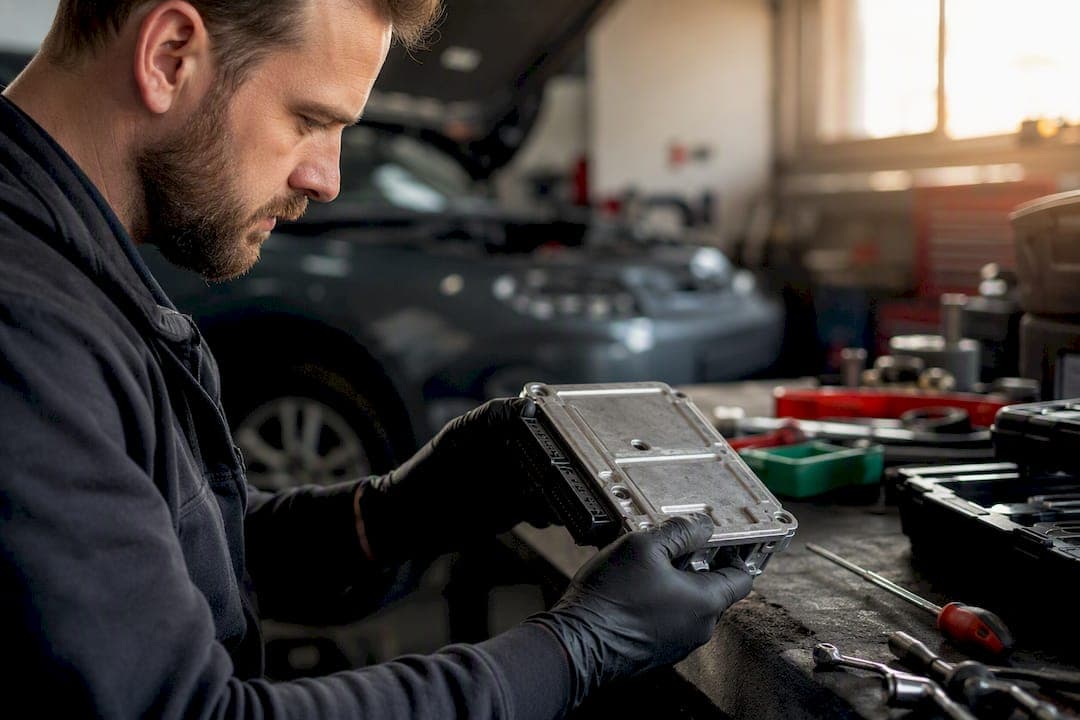
A flashing or illuminated airbag light usually means the car's SRS (supplementary restraint system) has detected a fault, and the airbags may not fire in a crash. This isn't a glitch to shrug off. Don't drive long distances until it's checked, and don't take the car for an MOT with the light still showing.
A few things to do straight away:
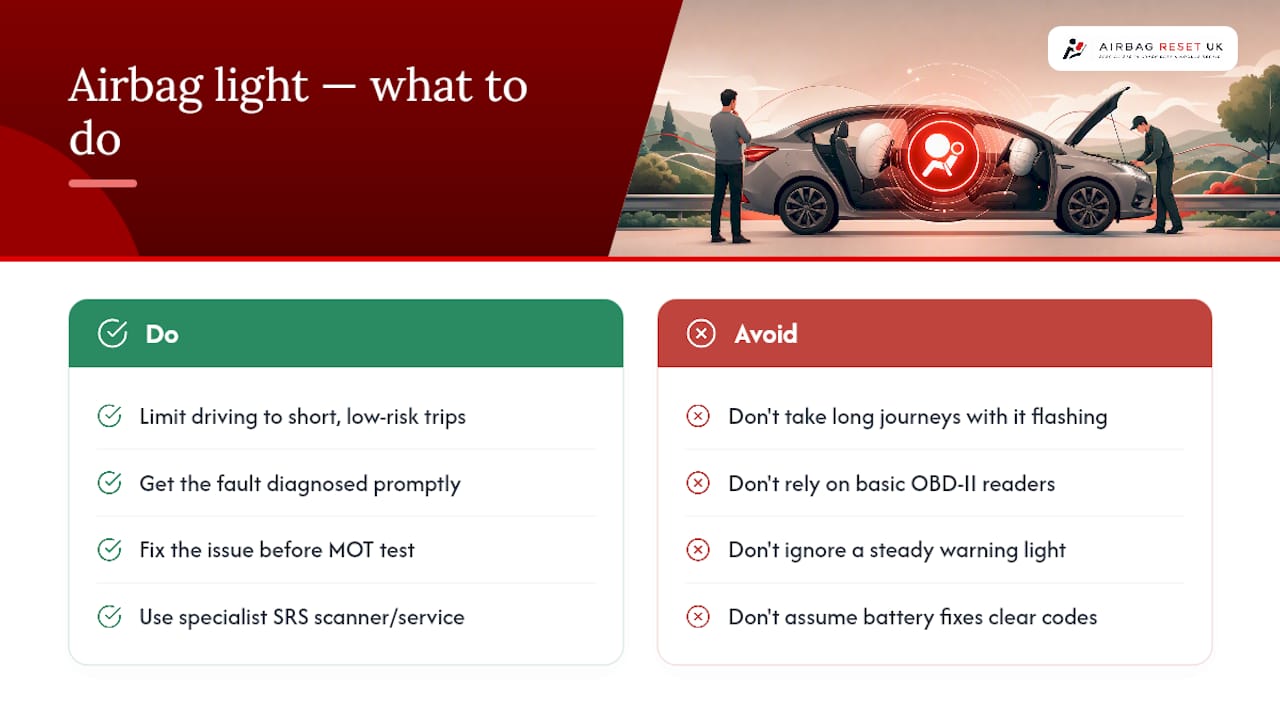
- Book a professional SRS diagnostic before any long journey.
- Avoid the MOT test centre until the fault is identified.
- Skip the quick-fix code readers. Most can't touch the SRS module properly.
- If the module has stored crash data, a specialist reset service such as Airbag Reset UK is usually the fastest, cheapest route back to a clean bill of health.
Key Takeaways
A flashing airbag light signals a detected SRS fault that may disable airbag deployment, and the fix depends on whether the problem is physical or stored in the module's memory.
| Point | Details |
|---|---|
| Know the normal check | Expect a 3 to 6 second bulb check at startup; anything beyond that signals a fault. |
| Rule out the cheap causes first | Test battery voltage, seat connectors, and occupancy sensors before assuming the worst. |
| Understand the MOT risk | An illuminated SRS light is commonly an MOT failure reason, not just a safety concern. |
| Match the fix to the fault | Physical faults need repair; stored crash data needs a module reset or replacement. |
| Use a specialist for module resets | Airbagresetuk offers postal crash-data resets from £35 with same-day turnaround for most modules. |
Table of Contents
- What a normal airbag bulb check actually looks like
- Common causes of a flashing or illuminated airbag warning light
- Why a flashing airbag light is a genuinely different problem
- Do-this-now checks you can safely run yourself
- How professionals actually diagnose and fix the fault
- When a postal crash-data reset is the right call
- The gap between what most drivers assume and what actually fixes the fault
- Sort a flashing airbag light without the replacement-module price tag
- Frequently asked questions
- Sources
What a normal airbag bulb check actually looks like
Turn the key or press the start button, and the airbag light should flash on for roughly 3 to 6 seconds as part of the ignition self-check. Then it goes out. That's the system telling you it's tested itself and found nothing wrong.
Two very different problems get mistaken for each other here:
- The startup flash: normal, brief, and expected every single time you start the car.
- Persistent flashing while driving, or a light that never switches off: not normal, and a sign the SRS has flagged a fault.
Sometimes the bulb check itself fails for boring reasons. A blown dash bulb, a loose fuse, or low battery voltage at cranking can all make the check behave oddly without the SRS itself being at fault. That's worth ruling out early, because it's the cheapest possible explanation.
Common causes of a flashing or illuminated airbag warning light
Airbag lights don't flash for one single reason. Some causes are trivial. Others mean your airbags genuinely won't fire. Here's the rough order of likelihood, from what workshops see most often to the rarer but more serious culprits.
-
Clock spring failure. The clock spring sits behind the steering wheel and carries the electrical connection to the horn, airbag, and often cruise controls, even as the wheel turns. Years of lock-to-lock steering wear the ribbon inside it, and once it frays or breaks, the airbag light flashes, the horn may stop working, and sometimes cruise control drops out too. A steering wheel airbag light paired with a dead horn is close to a textbook clock spring diagnosis.
-
Seatbelt buckle and pretensioner faults. Seatbelt and airbag light warnings often appear together because the buckle switches and pretensioners feed into the same SRS circuit. A worn buckle switch or a pretensioner that's degraded over time will trip the system.
-
Seat occupancy sensor problems. The mat or sensor under the passenger seat that detects an occupant can throw false faults, especially if it's been damaged by spilled liquid or a badly fitted seat cover.
-
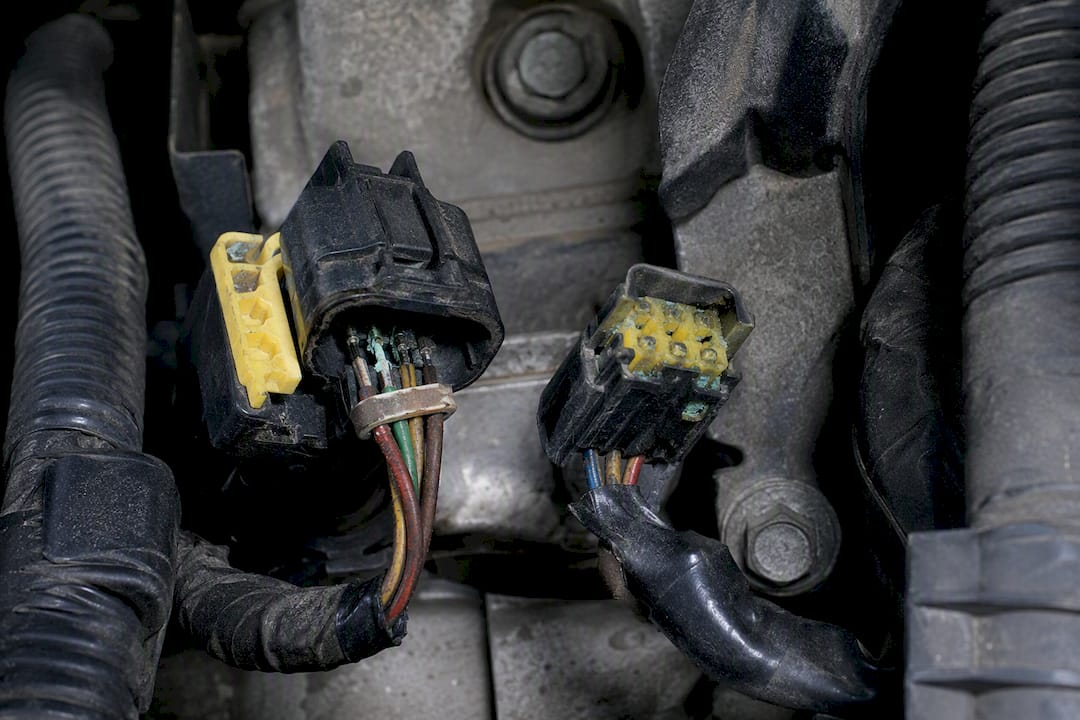
Loose or corroded connectors under the seats. These yellow SRS connectors take a beating from wet shoes, spilled drinks, and general wear. Corrosion or a connector that's simply worked loose is one of the most common, most fixable causes going.
-
Depleted backup battery or low vehicle voltage. The SRS module runs its own backup power source in many vehicles, and a weak main battery or failing alternator can trigger what's known as a soft fault. Low voltage is a genuinely common trigger and often the first thing worth ruling out.
-
Impact sensors damaged by minor collisions or potholes. A kerb strike or a hard pothole hit can jolt a crash sensor enough to register as an impact event, even with no visible damage.
-
Water-damaged or corroded SRS control module. Flooding, a leaking sunroof drain, or a submerged footwell can corrode the module itself, which is a more serious and often more expensive problem than a loose connector.
-
Previous crash with incomplete repairs. If the car has been in an accident and the pretensioners, clock spring, or sensors weren't replaced properly, the module may still be flagging that unresolved crash data, sometimes long after the bodywork looks fine.
-
Open recalls or manufacturer service actions. Certain models have documented SRS-related recalls. Checking with the manufacturer using your registration or VIN costs nothing and rules out a known fault.
Pro Tip: If the airbag light appeared right after you had seat covers fitted, a valet, or a car wash, check the seat connectors and occupancy mat first. That timing is rarely a coincidence.
Why a flashing airbag light is a genuinely different problem
An airbag light that flashes, rather than simply glowing steadily, tends to signal that the SRS has gone into a deliberate lockout. It isn't misbehaving. It's protecting you from an unpredictable deployment, and in doing so it may switch off the very system you'd need in a crash.
Experts who work on these systems describe it plainly: the flashing light is a calculated fail-safe response, not an electrical annoyance. The module disables deployment specifically to prevent accidental inflation, which means driving with it lit leaves you and your passengers without the protection you're relying on.
That's the safety case. There's also a legal and practical one. An illuminated SRS warning light is commonly treated as a reason to fail the MOT test, because it indicates a safety system isn't functioning as intended. Turning up for your MOT with the light on is asking for a failed test, on top of the underlying safety risk you're already carrying.
Do-this-now checks you can safely run yourself
Before anyone touches SRS wiring, park up, switch off, and give any capacitors in the system time to discharge. This isn't optional caution. It's the same advice professional guidance gives before any SRS inspection, because these components can retain enough charge to deploy an airbag even with the engine off.
With that out the way, a few checks are genuinely safe and might solve the problem outright:
-
Test the battery voltage and charging system. A weak battery or failing alternator is one of the most common triggers for a soft fault in the SRS module. Charge or replace the battery if it's reading low, then see if the light clears on its own after a few drive cycles.
-
Check the seat connectors. Look under the front seats for the yellow SRS connectors. Confirm they're seated properly and free of corrosion. Don't force or disconnect anything you're not confident about.
-
Rule out occupancy sensor interference. Aftermarket seat covers, heavy items left on the passenger seat, or a spilled drink on the sensor mat can all confuse the occupancy detection and trigger a fault.
-
Inspect fuses and look for water ingress. A blown fuse is cheap to fix. Water damage in the footwell or under the seats points to a bigger job.
Pro Tip: If a low battery caused the fault, don't assume recharging alone clears it. A depleted battery can leave a stored soft-code in the SRS module that only a proper SRS service can reset, even once your voltage is back to normal.
What you shouldn't do is start unplugging airbag units, cutting into wiring, or using a generic OBD-II reader to "clear" the light and hope it stays off. None of that fixes stored crash data, and some of it risks an accidental deployment.
How professionals actually diagnose and fix the fault
A generic code reader from the boot of your car won't get near the real problem. Workshops use an SRS-capable scan tool to pull manufacturer-specific 'B' codes, which point to the exact circuit at fault: clock spring, a specific seat connector, an impact sensor, or the module itself. This is one area where a specialist diagnostic service with the right scanning equipment earns its fee. Consumer-grade readers often can't access SRS data at all, which is exactly why clearing the light yourself so often fails.
Once the code points somewhere, the repair follows a fairly consistent path:
- Inspect and test the flagged circuit: connector, sensor, fuse, or clock spring.
- Repair or replace the faulty component. Clock springs and corroded connectors are usually straightforward swaps.
- If the module itself holds stored crash data or a persistent soft-code, it needs a professional reset or, in some cases, replacement.
- Clear the codes only after the repair is done, never before.
- Run a system check and test drive to confirm the light stays off.
| Step | What happens | Typical driver |
|---|---|---|
| Scan | SRS-capable tool reads B-codes | Identifies the exact faulty circuit |
| Repair | Connector, sensor, fuse, or clock spring fixed | Physical fault resolved |
| Module check | Crash data or soft-code assessed | Decides reset vs replacement |
| Clear | Codes wiped after repair only | Confirms the fix has held |
| Verify | Test drive and recheck | Light stays off under normal use |
Turnaround ranges from a same-day fix for a straightforward connector issue to a few days if a module needs sending away for a specialist reset. Cost is driven mainly by which component is at fault. A clock spring or connector repair sits at one end; a module reset or replacement sits at the other, which is exactly the gap that postal reset services exist to close.
When a postal crash-data reset is the right call
If the diagnosis comes back pointing at the SRS module itself, rather than a connector or clock spring, sending it away for a specialist reset is often faster and considerably cheaper than a full module replacement. This is where Airbag Reset UK fits into the picture: a UK-wide postal service built specifically around clearing stored crash data from airbag ECUs in cars, vans, and motorhomes.
What to expect from the process:
- Identify your module by part number or a photo, then post it in.
- Same-day turnaround for most modules once received.
- Pricing starts from £35, with price matching against genuine like-for-like quotes.
- Trade accounts with discounted rates for garages and mobile technicians.
- Backed by over 40 years of combined technician experience across the team.
This route makes sense when the fault is genuinely module-side: hard crash codes, stored post-collision data, or a module confused by a historic fault it can't self-clear. It's not the answer to a corroded seat connector or a failed clock spring. Those need physical repair first, and some water-damaged modules are beyond reset entirely, needing board-level repair or full replacement instead. A specialist can tell you which situation you're in before you commit to sending anything.
The gap between what most drivers assume and what actually fixes the fault
Most people treat a flashing airbag light like any other dashboard warning. Plug in a cheap reader, clear the code, hope it doesn't come back. That instinct is understandable and almost always wrong. The SRS module isn't like your engine ECU. It stores crash data in non-volatile memory specifically so it can't be casually wiped, and a basic reader simply doesn't have the access to touch it.
The conventional advice, "just get a diagnostic," is fine as far as it goes, but it undersells how binary the outcome usually is. Either the fault is physical, a connector, a clock spring, a sensor, and a workshop repair sorts it. Or the fault is sitting in the module's memory, in which case no amount of connector cleaning will help, and you're choosing between a full module replacement and a specialist reset.
What I'd prioritise first: get the proper SRS scan before spending a penny on repairs. It tells you which of those two situations you're actually in, and it stops you paying replacement prices for a problem a reset could solve in a day.
Sort a flashing airbag light without the replacement-module price tag
If your diagnostic comes back pointing at the SRS module itself rather than a connector or sensor, Airbagresetuk gives you a fixed-price way through it that a full module swap simply can't match. Instead of paying dealer prices for a brand-new unit, you post your existing module in and get it back the same day in most cases, crash data cleared and ready to refit.
The service covers cars, vans, and motorhomes, with pricing from £35 and price matching against any genuine like-for-like quote you've already had. Garages and mobile technicians get their own discounted trade rates too, so if you're a workshop dealing with this regularly, it's worth setting up an account rather than paying standard pricing each time. Identify your module by part number or a quick photo, and you'll know straight away whether a reset is the right fix for your situation. Start by checking your module against the postal reset service and get a price before you commit to anything.
Frequently asked questions
Is it safe to drive with a flashing airbag light?
Driving short distances at low risk may be unavoidable, but you should avoid long journeys until it's diagnosed. The light flashing means the SRS has likely disabled the airbags, so you're driving without that protection until the fault is fixed.
Will a flashing airbag light fail my MOT?
Almost certainly, yes. An illuminated SRS warning is commonly treated as an MOT failure because it shows a safety system isn't functioning correctly. Get the fault diagnosed and resolved before your test date.
Can I clear the airbag light myself with a code reader?
A basic consumer OBD-II reader usually can't access the SRS system properly, and even if it clears the light temporarily, stored crash data or a genuine fault will bring it straight back. Specialist scanning is needed to read the actual B-codes.
What's the difference between a clock spring fault and a seatbelt fault?
A clock spring problem typically comes with a dead horn or dropped cruise control alongside the airbag light, because all three run through the same connector behind the steering wheel. A seatbelt fault usually stays isolated to the seatbelt and airbag warning together, without affecting the horn.
When does the airbag light flash then stay on permanently?
That pattern often means the system completed its self-check, found a persistent fault, and switched to a steady warning rather than continuing to flash. Either way, it indicates the SRS has logged a fault that needs professional attention.
Does a low battery really affect the airbag system?
Yes. The SRS module is sensitive to voltage, and a weak battery or failing alternator can trigger what's called a soft fault. Charging or replacing the battery sometimes helps, but a stored soft-code often still needs clearing through a proper SRS service.