
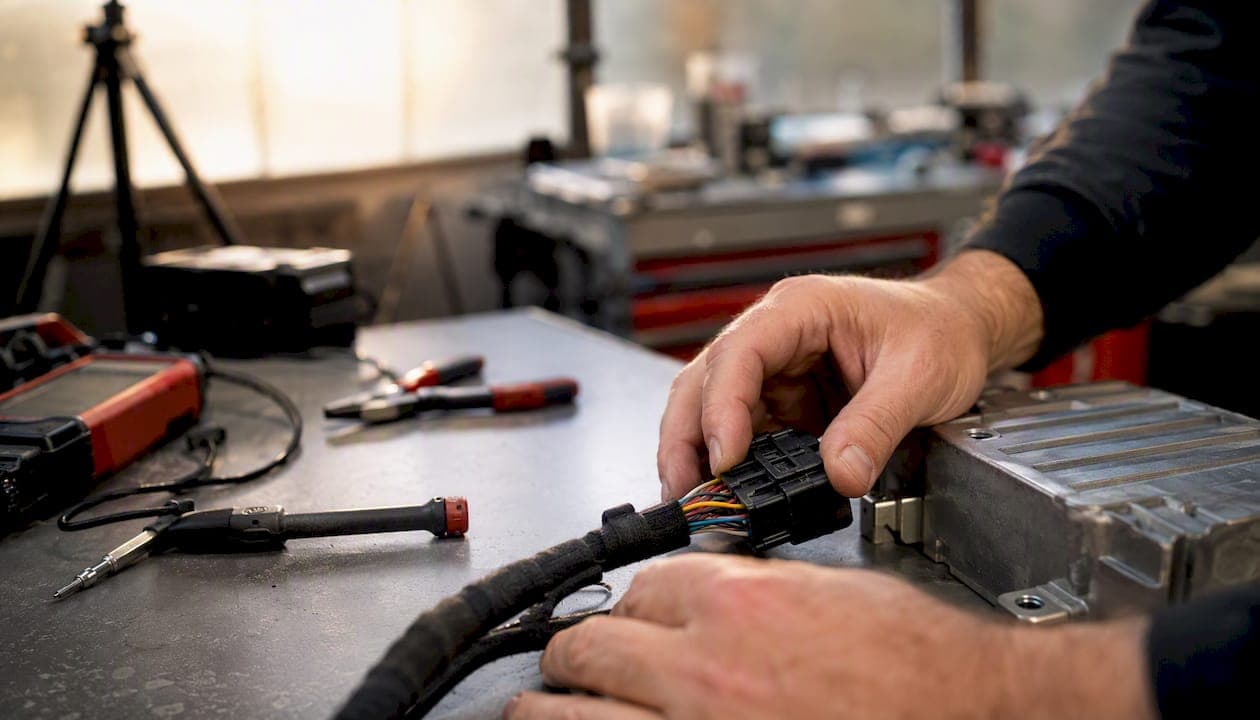
A dashboard airbag light doesn't always mean you need a new restraints control module. If the fault is a simple stored code, an SRS-capable scanner can clear it in minutes. If the module has recorded a crash event or a deployment, clearing the code won't work, because Ford's restraints control module stores that crash-event data permanently and treats it differently to an ordinary fault. In that case you need a specialist crash-data reset, or a replacement module.
Ford's own owner documentation is blunt about this: if the restraints indicator flashes or stays lit, the car should go to an authorised service point because the system may not fire correctly in a real crash. A postal reset specialist such as Airbag Reset UK exists precisely for the second scenario, when a module needs proper crash-data clearing rather than a quick scan.
Before you touch anything, run through this:
- Disconnect the battery and leave it disconnected long enough to let onboard capacitors discharge.
- Never probe or force the yellow SRS connectors. They're colour-coded for a reason.
- Check for any visibly deployed airbags, cut seatbelts, or fired pretensioners. These need physical replacement first, not a reset.
- Have your VIN and module part number ready before you start diagnosing.
Pro Tip: A generic £20 OBD‑II code reader will often show you a fault exists but won't tell you whether it's a wiring glitch or genuine crash data. Spend the money on a tool with proper SRS module access, or skip straight to a specialist.
Key Takeaways
A Ford airbag module reset only succeeds long-term when the underlying cause, transient fault or genuine crash data, is correctly identified before any clearing attempt begins.
| Point | Details |
|---|---|
| Know your fault type | A simple DTC clear works for sensor glitches; stored crash data needs a specialist reset instead. |
| Use the right scanner | Generic OBD‑II readers can't reach restraint-specific crash memory in the RCM. |
| Replace hardware first | Deployed airbags and fired pretensioners must be physically replaced before any reset is valid. |
| Watch for a returning light | A fault that reappears straight after clearing usually signals stored crash data, not a glitch. |
| Consider a postal specialist | Airbag Reset UK offers same-day postal resets from £35 with price-match pricing, often cheaper than dealer replacement. |
Table of Contents
- Step-by-step Ford airbag module reset checklist
- Why clearing codes doesn't always clear the crash data
- Which professional reset route actually makes sense?
- Safety, MOT and record-keeping essentials
- If you'd rather send it to specialists: how Airbag Reset UK helps
- Frequently asked questions
- Sources
Step-by-step Ford airbag module reset checklist
Doing this yourself is realistic for a lot of Ford owners, provided you're methodical and honest about your limits. Here's the sequence that mirrors what independent Ford technicians actually follow when they work through a reset in three steps.
What you'll need:
- An SRS-capable OBD‑II scanner (not a basic emissions reader; it must read and clear restraints codes specifically)
- Insulated hand tools and a trim removal tool for centre console or seat panels
- A torque wrench or spec sheet for reconnecting mounting bolts correctly
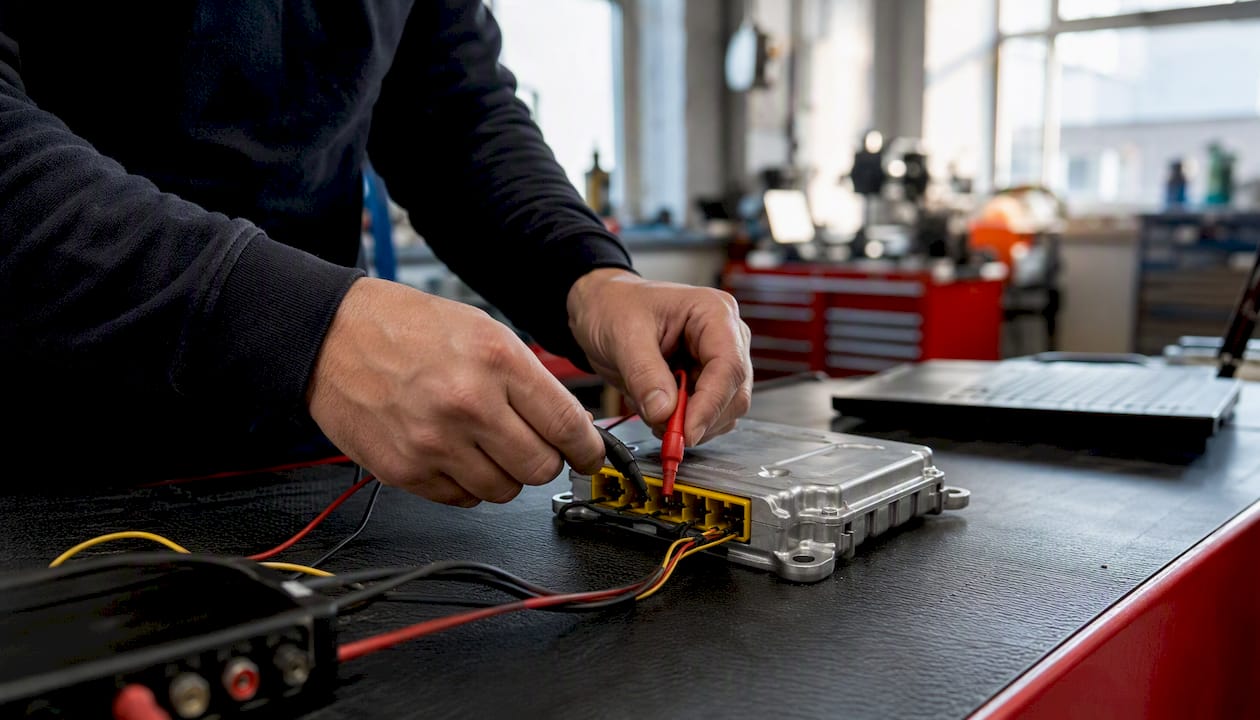
- A multimeter, if you suspect a wiring or connector fault rather than a module fault
The process:
- Disconnect the negative battery terminal and wait a minimum of 10 minutes. Airbag systems hold residual charge in capacitors specifically so they can fire even if the battery is destroyed in a collision, so don't assume the car is "dead" just because the engine won't start.
- Locate the restraints control module. On most Fords this sits under the centre console or beneath a front seat, though placement shifts between models and generations, so check your specific chassis before assuming a location.
- Remove the relevant trim and inspect the connectors and wiring harness for corrosion, scorching, or a loose pin before you assume the module itself has failed.
- Reconnect the battery and run an SRS-specific scan to read the stored diagnostic trouble codes (DTCs).
- If the codes point to a simple sensor glitch, a loose connector, or a software gremlin rather than a deployment event, clear the fault codes through the scanner.
- Reinstall trim, reconnect everything to the correct torque spec, and run a full ignition cycle. Drive the car a short distance and recheck for the warning light.
If the light returns immediately or the scanner still shows the same DTC after a clear, that's your signal. It usually means the code isn't a transient fault, it's crash-event data the tool can't touch, and continuing to poke at it risks masking a genuine safety issue rather than fixing one.
Pro Tip: If the module doesn't respond to the scanner at all, or throws a communication error, stop. That's often a sign the RCM has been damaged in a way that needs professional bench testing, not more time with a torque wrench.
Why clearing codes doesn't always clear the crash data
A fault code clear and a crash-data clear are two entirely different jobs, even though they look identical on a dashboard. A fault code clear wipes a transient error, a sensor hiccup, a software flag, from the module's active memory. Crash-event data is different: it's a permanent record the module writes the moment sensors detect a deployment-level impact, and ordinary OBD‑II tools simply cannot remove it.
You're likely looking at stored crash data if:
- The airbag light returns straight after a code clear, sometimes within the same drive cycle.
- The DTCs specifically reference deployment loops or occupant restraint events rather than a sensor or wiring code.
- Airbags, pretensioners, or seatbelt buckles show physical signs of having fired.
Pro Tip: Generic scan tools read generic OBD‑II data. Restraint-specific crash memory usually needs either specialist reset software or a lab that works exclusively with SRS modules.
Which professional reset route actually makes sense?
Three realistic paths exist once DIY has hit its limit. A main dealer can fully reprogram or replace an RCM, which is the right call if the car needs a brand-new module coded to the vehicle's VIN. An independent workshop is well suited to on-vehicle diagnostics such as chasing a wiring fault or a failed clock spring. A postal reset lab is built specifically for crash-data clearing on modules that don't need physical replacement.
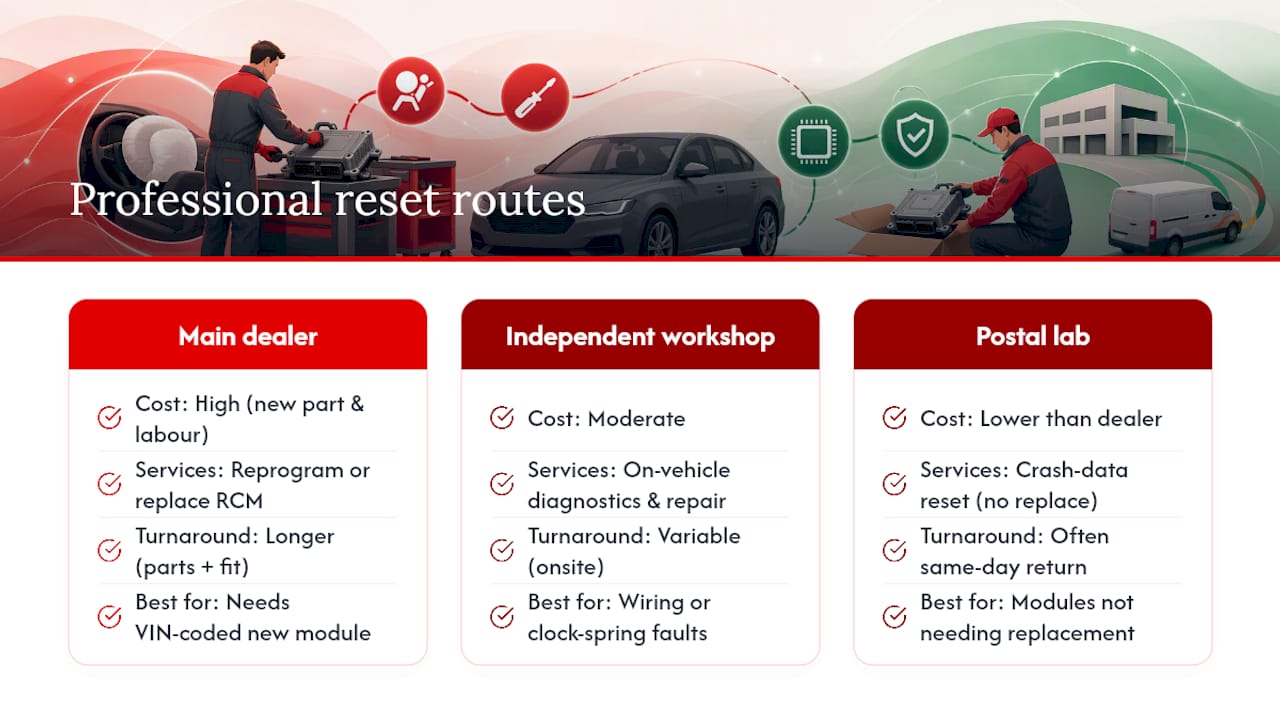
A postal service works like this: you identify the module by part number or a photo, disconnect and package it carefully, and post it off. Many labs return a tested, reset module the same day it arrives. Dealer replacement tends to cost considerably more than a postal reset for the same outcome, because you're paying for a brand-new part and dealer labour rather than a reset on your existing one.
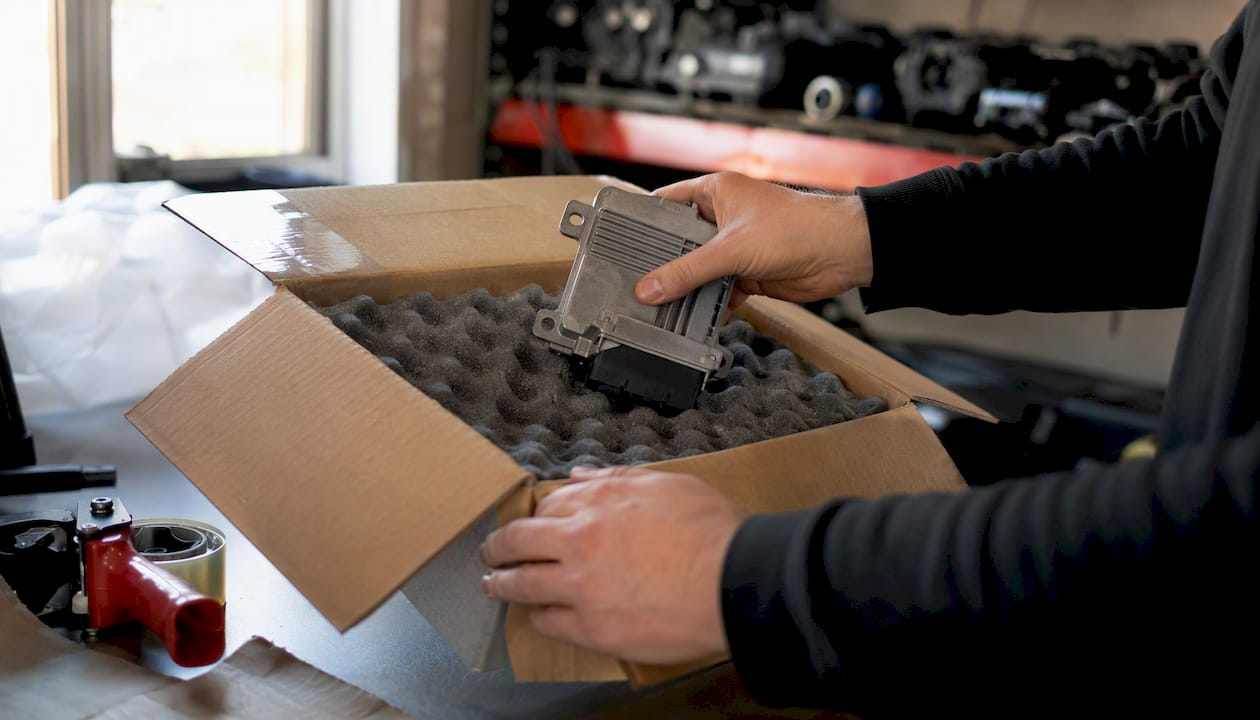
Before posting, note down the part number stamped on the module, photograph the connector and mounting points so reinstallation is easy, and wrap it to protect the connector pins during transit.
Safety, MOT and record-keeping essentials
Don't drive with a known SRS fault, full stop. Airbags and pretensioners that have already deployed must be physically replaced before any reset is meaningful, because dealer guidance is explicit that a cleared code means nothing if the restraint hardware itself is spent.
A persistent airbag warning light can also affect an MOT or equivalent safety inspection, so if you're unsure how your local test treats an active SRS fault, check the current guidance rather than assuming it'll pass.
- Keep photos of the module before removal and after reinstallation.
- Keep the invoice or job reference from any reset or replacement.
- Store this paperwork with the car's service history. It matters at resale and at your next inspection.
Pro Tip: A buyer's mechanic checking history will ask about any airbag work. Having dated photos and a reset invoice answers that question in seconds instead of raising doubt.
Technician perspective: what an experienced tech looks for
Most modules that land on a bench only need a simple code clear, not a full crash-data wipe. The real headaches are damaged connectors, corrosion, and mismatched part numbers, not the reset itself. That's exactly why reputable labs test a module off-vehicle before declaring it fit to reuse.
If you'd rather send it to specialists: how Airbag Reset UK helps
If your Ford's module has recorded a genuine crash event, or you'd simply rather not gamble on a DIY attempt with a safety system, a postal reset is the sensible route. Airbag Reset UK runs exactly this service: send in your part number or a photo for identification help, package the module following their guidance, and post it off. Most jobs are turned around the same day they arrive, tested, and sent straight back.
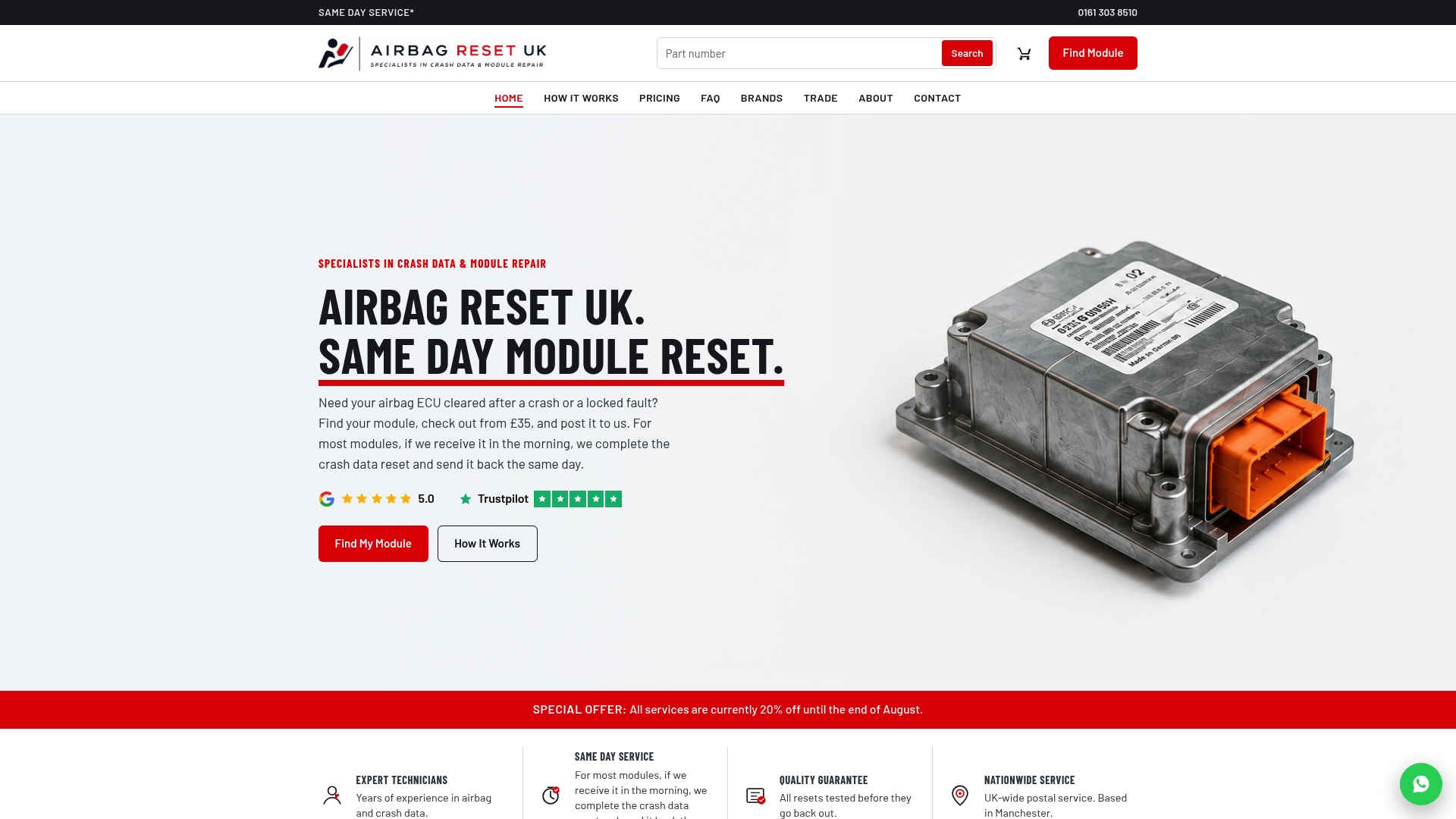
Pricing starts at a competitive fixed rate for both standard and more complex modules, with a price-match guarantee against any genuine like-for-like quote you've already had. That usually works out considerably cheaper than a dealer replacing the whole unit, and garages or workshops handling this regularly can set up a trade account for discounted rates across multiple jobs. Motorhome owners aren't left out either. Airbag Reset UK handles those modules as a specialism in their own right.
Ready to stop guessing whether your module needs replacing? Get your part number or a clear photo ready and request a quote through Airbag Reset UK to find out exactly what a reset will cost before you commit to anything.
Frequently asked questions
Can I reset my Ford's airbag module myself? Yes, if the fault is a simple stored code. An SRS-capable scanner can clear it after you've checked wiring and connectors. If crash data is present, DIY tools won't remove it.
Does a new airbag module need programming? Usually, yes. Replacement RCMs on most modern Fords need to be coded to the vehicle's VIN, which typically means a dealer or a specialist with the right software.
Why does my airbag light stay on after I've cleared the code? That almost always means the module has stored genuine crash-event data rather than a transient fault, which a standard scan tool can't touch. It needs a specialist crash-data reset or a replacement.