
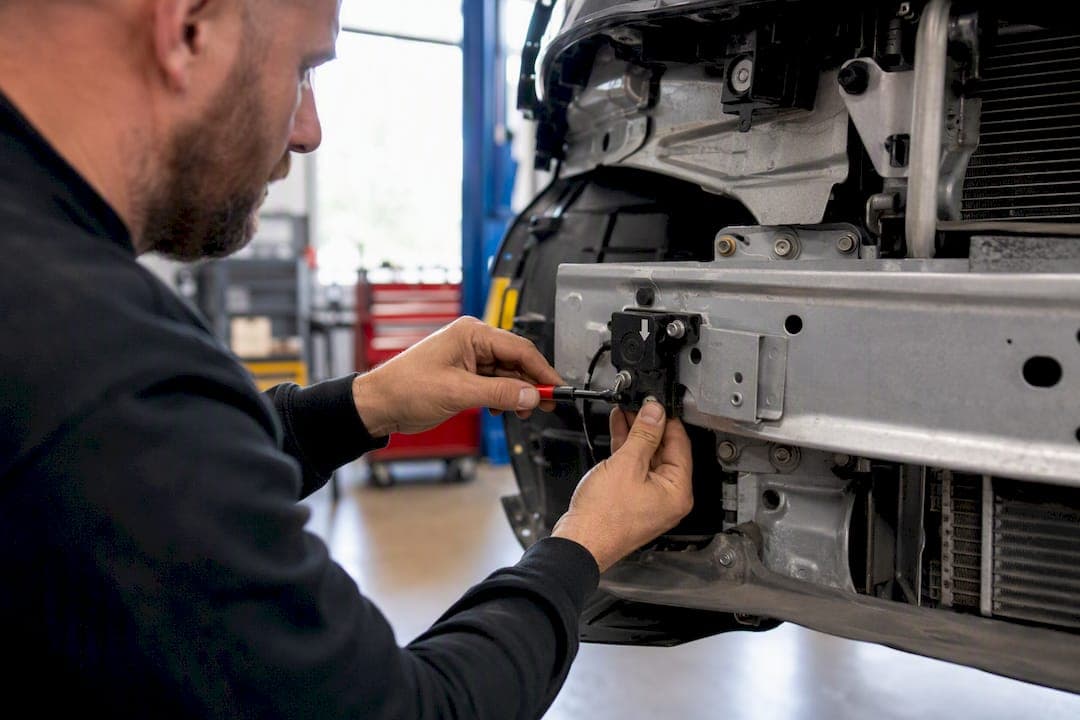
Most vehicles carry front impact sensors behind the bumper beam or on the radiator support, side impact sensors at the base of the B-pillars or inside the doors, and a centre airbag sensor assembly under the dashboard or centre floor console. Before you touch any of them, disconnect the battery, wait for the SRS capacitors to discharge (typically several minutes), and photograph every connector before you unplug it. Exact positions vary by make, model and year, so treat this as a starting point and check your vehicle's own service manual, or hand the job to a professional, before doing any restraint system work.
Key Takeaways
Impact sensor locations follow predictable patterns by function, front sensors near the crumple zone, side sensors near the point of intrusion, and a centre unit that combines their signals to authorise airbag deployment.
| Point | Details |
|---|---|
| Front sensors mount forward | Look at the bumper beam, radiator support or headlamp bracket, and longitudinal frame rails. |
| Side sensors sit close to intrusion points | Check B-pillar bases, door cavities, sill trim and wheel-arch liners depending on body style. |
| Centre unit makes the final call | Deceleration and safing sensors under the centre floor must agree before squibs fire. |
| Location varies by make, model and year | A facelift or platform change can relocate a sensor even within the same model line. |
| Reset differs from a code clear | A genuine crash-data reset clears stored ECU memory, which a basic code clear does not touch. |
| Airbagresetuk handles the reset step | Postal service with same-day turnaround for most modules once sensor faults are ruled out. |
Table of Contents
- Why impact sensor location depends on crash type
- Front impact sensor locations with OEM examples
- Where do side and curtain sensors mount?
- What does the centre airbag sensor assembly do?
- How to spot and access your impact sensor
- How can you tell if an impact sensor is faulty?
- Replacement, repair and safety precautions
- Resetting an airbag sensor versus replacing it
- Do sensor locations change by make and model?
- Acceleration sensors versus pressure sensors: does the type change the location?
- What happens when a sensor is mounted or aligned incorrectly?
- What standards govern where sensors go?
- What technicians wish more owners knew before they start
- Sorting a persistent airbag light after the sensor checks out
- Sources
Why impact sensor location depends on crash type
An impact sensor is really just an accelerometer with a job: detect a sudden change in velocity and tell the airbag control unit how hard and how fast to react. That single function explains almost every placement decision a manufacturer makes. A sensor built to catch a head-on collision sits somewhere in the crumple path at the front of the car. A sensor watching for a side impact sits as close to the point of intrusion as engineers can get it, because side crashes leave far less structure to absorb energy before it reaches the occupant.
Technical summaries on airbag sensor design describe front sensors as typically mass-type or electrical deceleration units, sited in the engine bay where they intercept impact energy earliest. Modern cars run several of these simultaneously, not one central detector, and a related component, the seat-belt buckle sensor, feeds the same control unit information about whether the belt is latched so deployment force can be adjusted accordingly, as Littelfuse's buckle sensor datasheet explains.
The main sensor types you'll encounter:
- Front impact sensors — detect frontal and offset collisions, usually mounted low in the engine compartment
- Side impact sensors — react to lateral crashes, mounted close to the door or pillar structure
- Curtain sensors — trigger roof-mounted airbags during rollover or severe side impacts
- Centre airbag sensor assembly — the decision-making hub that combines all peripheral inputs
Front impact sensor locations with OEM examples
Front sensors cluster around four spots: the bumper beam itself, the radiator support or headlamp bracket, the longitudinal frame rails running back from the bumper, and occasionally the area just behind the bonnet latch panel. Where exactly depends on how the manufacturer engineered the crumple zone.
Tesla's own documentation for the Model 3 places the centre front impact accelerometer on the front end carrier, and its service manual walks through the removal sequence: unbolt the sensor, disconnect the connector, note the orientation before it comes free. Toyota takes a similar approach on the Sienna, mounting front sensors on the radiator supports as part of a three-sensor frontal system detailed in its Sienna service documentation. Audi's Q5 diagrams show front sensors fixed to the headlamp housing brackets, according to Audi's own repair guide.
Whichever mount your car uses, look for a small orientation arrow moulded into the sensor housing, usually pointing forward or outward. Note the bolt pattern before removal and photograph the connector orientation. Getting the sensor back in reversed, even by a few degrees, can throw off how the control unit reads deceleration data.
Where do side and curtain sensors mount?
Side impact sensors sit wherever the manufacturer can get them closest to the door skin without exposing them to routine knocks. On the Audi Q5, Audi's service diagrams put them inside the passenger doors and around the wheel housing areas. Toyota mounts its side sensors at the bottom of the centre pillars on the Sienna, right where a B-pillar meets the sill.
Common mounting spots across most vehicles:
- Base of the B-pillar, often hidden behind lower trim
- Inside the door cavity, bolted to the door's structural frame
- Behind the lower sill trim panel
- Tucked behind the wheel-arch liner on some platforms
Three-door cars and vans often shift side sensors further back toward the C-pillar or rear quarter panel, since there's no B-pillar in the usual place to host one. Getting to any of these means removing sill covers or door trim, and that almost always means popping plastic retaining clips. Buy a few spares before you start. They snap more often than they survive a second removal.
What does the centre airbag sensor assembly do?
The centre airbag sensor assembly is the control room. Toyota's Sienna documentation places it under the centre floor, beneath the instrument panel, a position mirrored by most manufacturers because it keeps the unit protected and central to all four crash directions.
Inside that housing you'll typically find a deceleration sensor, a safing sensor, and diagnostic circuitry. The deceleration sensor measures how fast the car is slowing. The safing sensor acts as a second check, confirming the deceleration reading is genuine and not a pothole or a slammed door. Only when both sensors agree does the unit authorise the squibs (the small pyrotechnic charges) to fire. That two-sensor handshake is why a jolt rarely sets off an airbag on its own.
How to spot and access your impact sensor
Finding the physical component is usually easier than people expect once you know what you're looking for: a small rectangular or cylindrical housing, a part-number label stuck to the casing, and a moulded arrow indicating forward orientation. Owners commonly report finding front sensors tucked near the bonnet latch or radiator support, and side sensors near the B-pillar base, which lines up neatly with what the OEM manuals describe.
- Disconnect the negative battery terminal and leave the car for the time your manual specifies, usually several minutes, so the SRS capacitors discharge fully.
- Locate the sensor using your service manual's diagram, then photograph it in place before touching anything.
- Note the part number printed on the housing label.
- Photograph the connector and its locking tab orientation before disconnecting it.
- Take basic measurements or bracket references if you're sourcing a replacement part.
Pro Tip: Photograph everything twice, once wide to show the surrounding trim and once close on the connector. You'll thank yourself when reassembling six weeks later after the replacement part finally arrives.
How can you tell if an impact sensor is faulty?
The clearest symptom is a persistent airbag warning light that won't clear on its own. That's usually the control unit flagging a stored crash-data code, either from a genuine fault or from data logged during a previous impact that's never been reset.
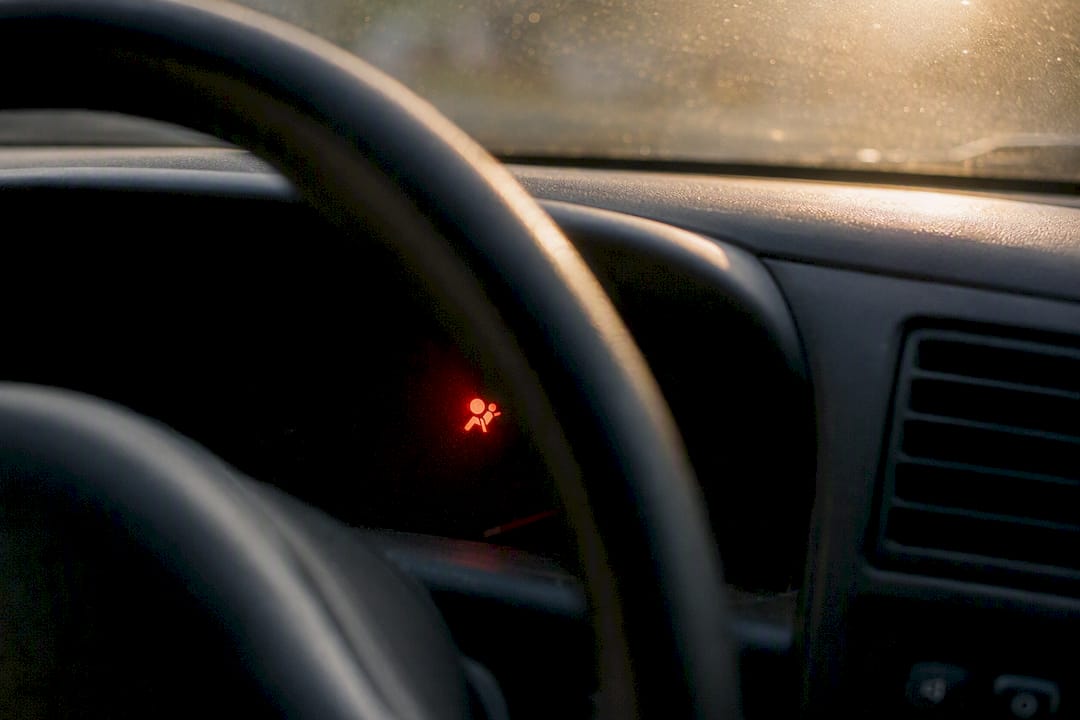
Start with the basics: inspect the connector for corrosion, check the wiring loom for chafing near the mounting bracket, and look for obvious impact damage to the sensor housing itself. An OBD-II scan capable of reading SRS-specific codes will usually tell you whether the fault sits with a sensor, a wiring fault, or logged crash data sitting in the control unit's memory.
This is the fork in the road. Toyota's service guidance notes that many faults after low-speed incidents clear with a proper crash-data reset rather than a physical sensor swap, but confirming that requires reading the actual codes and checking squib continuity first, something an OEM-level diagnostic tool handles far more reliably than a generic reader.
Replacement, repair and safety precautions
Once you've diagnosed the fault, you're usually choosing between three routes: replacing the physical sensor, replacing the whole airbag control module, or clearing the stored crash data through a reset service. Which one applies depends entirely on what the diagnostic codes actually show.
A few non-negotiables apply regardless of which path you take:
- Treat every airbag component as a live pyrotechnic device until you've confirmed the system is de-energised
- Torque mounting bolts to the figures your service manual specifies, since under-tightened sensors can shift and skew readings
- Use OEM or OEM-equivalent parts; generic sensors calibrated for a different vehicle can misread deceleration thresholds
- Expect sensor or module replacement to cost noticeably more than a crash-data reset, though exact prices vary by vehicle and part availability
Anything involving disassembly of pyrotechnic components, or uncertainty about what a code actually means, is worth handing to someone who does this daily rather than guessing.
Resetting an airbag sensor versus replacing it
Clearing a warning light and resetting crash data are not the same job. A basic code clear just switches the light off. It doesn't touch the crash record stored in the airbag control unit's memory, and on most vehicles that record will trigger the light again within a handful of drive cycles.
A genuine reset clears that stored crash memory at the ECU level, which is appropriate when diagnostics confirm the sensors and wiring are intact and the only problem is historic crash data sitting in the module. If a sensor has failed physically, corrosion has damaged the connector, or squib continuity fails, replacement is the only real fix.
If a reset looks like the right call, note the module's part number, photograph the ECU before removal, and package it securely for despatch. A postal reset service works precisely because most of the diagnostic groundwork happens before the module ever leaves your hands.
Do sensor locations change by make and model?
Yes, and the differences are bigger than most owners expect. Compare the three OEM examples already covered: Tesla mounts its front accelerometer on the Model 3's front end carrier, Toyota puts the Sienna's front sensors on the radiator supports as part of a three-sensor array, and Audi fixes the Q5's front sensors to the headlamp housing brackets. Three manufacturers, three distinct mounting philosophies, all solving the same problem.
Year changes matter too, sometimes within the same model line. A facelift that redesigns the front bumper structure or introduces a new crumple-zone design often relocates the sensor bracket entirely, even when the badge on the boot stays identical. Manufacturers rarely publicise these mid-cycle changes outside the service manual, which is exactly why a 2019 diagram can be useless for a 2022 build of the same nameplate.
Body style creates further splits. Vans and motorhomes, built on commercial platforms, frequently relocate side sensors rearward because there's no conventional B-pillar to host one, or because the wheelbase and door configuration differ from the passenger-car version they're based on. Three-door hatchbacks show the same pattern, shifting side sensor mounts toward the C-pillar or rear quarter.
The practical upshot: never assume a sensor location from a similar-looking vehicle, a forum photo, or even last year's model. Confirm against your specific vehicle's build year and trim using the manufacturer's own diagram wherever you can get hold of one.
Acceleration sensors versus pressure sensors: does the type change the location?
It does, because the physics behind each sensor type dictates where it needs to sit. Acceleration-based sensors, the most common type across the industry, measure the rate of deceleration and work best mounted directly to rigid structural members, frame rails, pillars, floor pans, where the crash force transmits cleanly without being dampened by trim or soft panels.
Pressure-based sensors work differently. Rather than measuring deceleration directly, they detect the rapid change in air pressure inside a sealed cavity, commonly inside a door, as the panel deforms during a side impact. That's precisely why door-mounted side sensors on cars like the Audi Q5 sit inside the door cavity itself rather than bolted to the door's outer skin. The sealed air pocket needs to compress fast enough to register before the door reaches the occupant.
This distinction matters practically. If you're troubleshooting a door-mounted pressure sensor, a torn or poorly resealed door skin after bodywork can throw off future readings even if the sensor itself tests fine electrically, because the pressure chamber it relies on is no longer sealed correctly. Acceleration sensors don't have that vulnerability, but they're more sensitive to loose mounting bolts, since any play in the bracket introduces vibration noise the control unit has to filter out. Knowing which sensor type sits in a given location tells you what kind of fault to look for first.
What happens when a sensor is mounted or aligned incorrectly?
Misalignment is one of the least understood risks in airbag repair, largely because it doesn't always throw an obvious fault code. A sensor bolted back at the wrong angle, even a few degrees off its designed orientation, can still function electrically while feeding the control unit skewed deceleration data.
The consequence shows up only in a real crash. A front sensor rotated off-axis might under-read a genuine frontal impact, delaying deployment past the window where the airbag does any good, or it might over-read a minor bump and trigger an unnecessary deployment. Neither outcome announces itself during a routine drive.
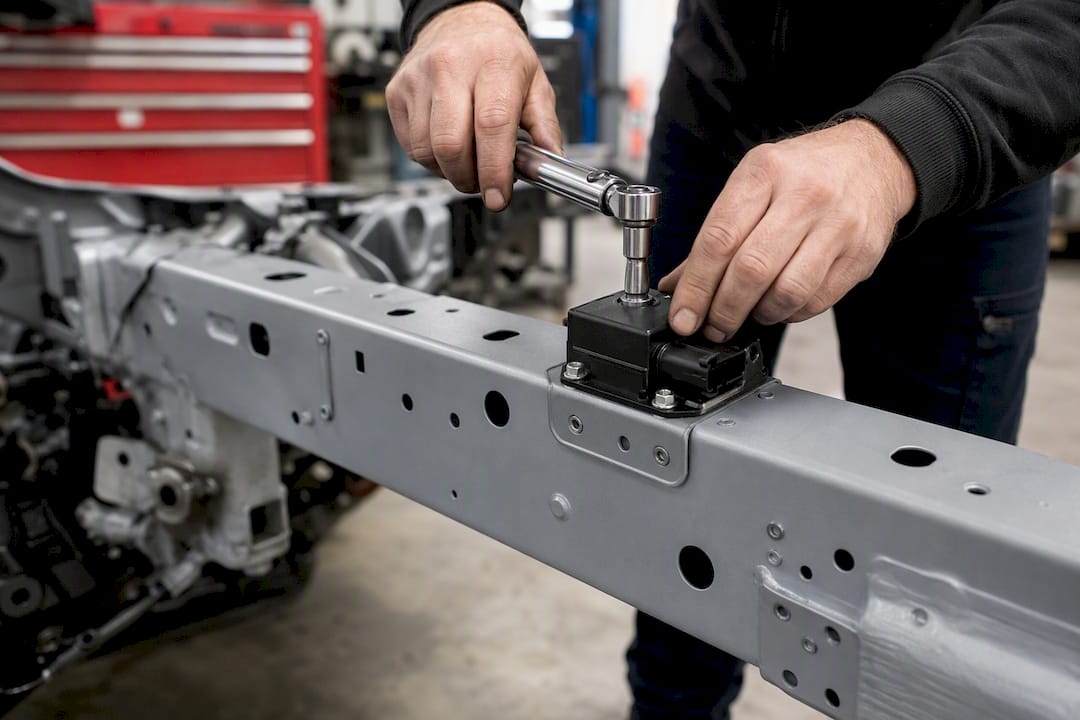
This is why OEM orientation arrows and specified torque values aren't a formality. Tesla's own removal procedure treats bolt torque and connector seating as precise steps, not rough guidance, because the accelerometer's accuracy depends on rigid, correctly oriented contact with the structure it's bolted to. A loose mount introduces vibration the sensor misreads as impact energy. An over-tightened one can crack the housing.
Aftermarket or salvage-yard sensors carry a related risk. A sensor pulled from a different trim level or model year might look identical and bolt into the same holes, but its internal calibration threshold can differ. That's part of why OEM-equivalent parts matter more here than in most areas of car repair. Get the mounting wrong, or fit the wrong calibration, and you won't find out until the one moment the system actually needs to work.
What standards govern where sensors go?
Sensor placement isn't left to individual engineers' judgement. It's shaped by crash test protocols and regulatory frameworks that dictate how a vehicle must perform in specific, standardised impact scenarios, which in turn dictates where a sensor has to sit to detect those exact scenarios early enough.
Frontal offset and full-width crash tests, side impact and pole tests, and rollover assessments each simulate a distinct real-world crash geometry. A manufacturer designing to pass a side pole test needs a sensor positioned to detect that narrow, concentrated intrusion pattern fast, which is a large part of why side sensors cluster so tightly around the B-pillar base and door cavity rather than being spread more generally around the body.
Deployment timing itself is regulated too. Airbags have to fire within milliseconds of a qualifying impact, and that timing requirement flows backward into sensor placement: the sensor has to be close enough to the likely impact zone that its signal reaches the control unit with enough runway left to trigger deployment before the occupant's body reaches the airbag's intended position. Push a sensor too far from the crash zone and the physics simply doesn't leave enough time.
None of this is static, either. Crash test standards get revised, and vehicle redesigns that shift sensor mounts often trace back to an updated test requirement rather than a styling change. It's another reason a facelifted model can relocate its sensors even when the exterior looks barely different, and another reason to treat your specific vehicle's service manual as the only reliable source, rather than assuming last year's diagram still applies.
What technicians wish more owners knew before they start
Hidden brackets catch people out constantly. A sensor that looks like it should lift straight off after two bolts often has a third fastener buried behind a wiring loom or a trim clip nobody mentions until you're already stuck. Corroded connectors are the other regular surprise, especially on sensors that live near wheel arches.
Photograph and label everything before you touch it. It costs thirty seconds and saves an afternoon. And if a code won't clear, or you're not certain whether you're looking at a sensor fault or logged crash data, that's the moment to stop and get a proper inspection or a reset done rather than guessing your way through it.
— John
Sorting a persistent airbag light after the sensor checks out
If you've traced a stubborn airbag warning light back to stored crash data rather than a failed sensor, replacing parts won't fix it. That's exactly the gap Airbagresetuk closes: a postal crash-data reset service built specifically for cars, vans and motorhomes where the sensors and wiring are sound but the control unit is still holding onto historic crash information.
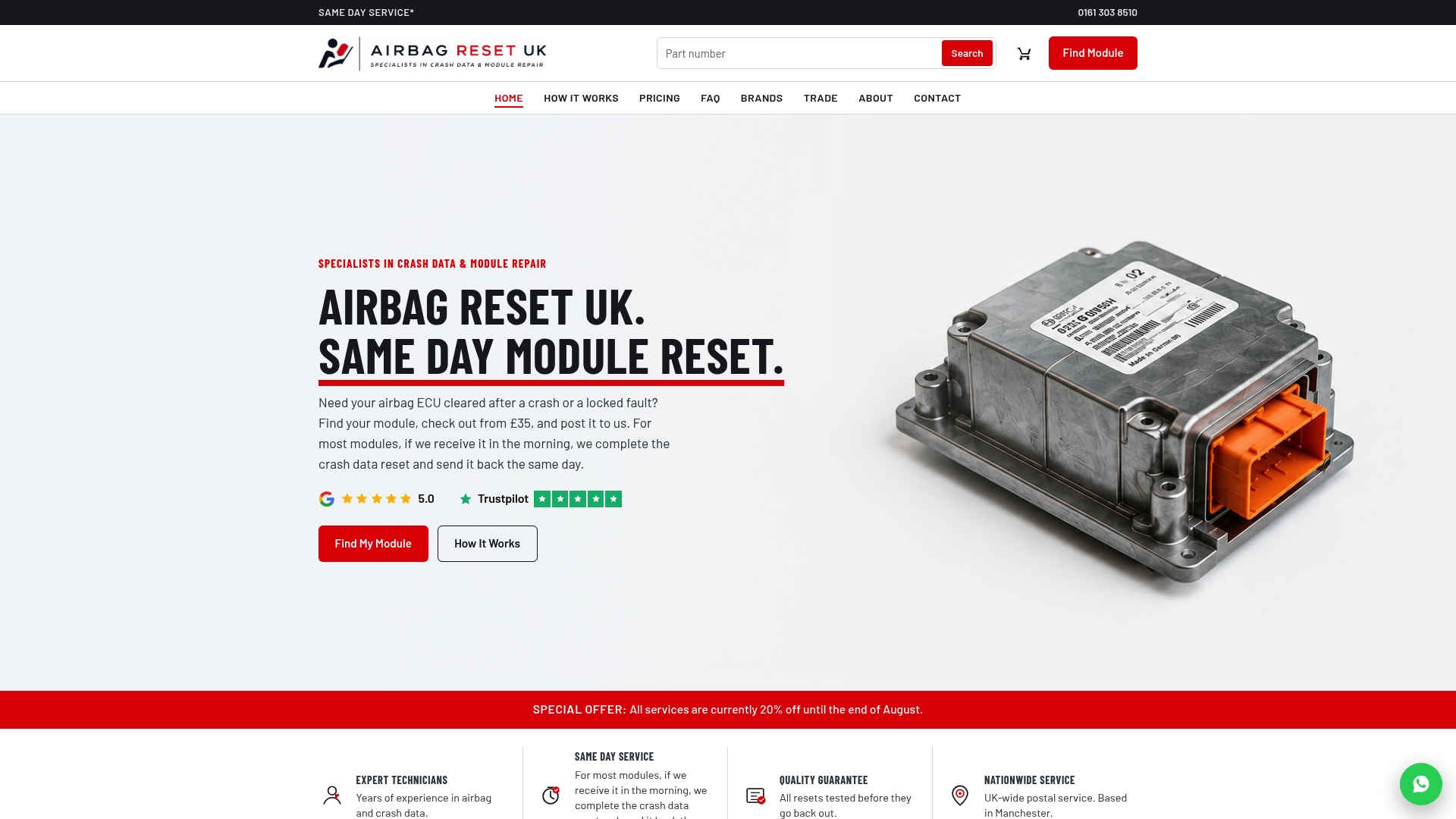
Pricing is competitive with quotes matched against genuine like-for-like alternatives, so you're not paying a premium just for convenience. That's backed by over 40 years of combined technician experience across standard and more complex module types, including the motorhome-specific resets that fewer specialists handle at all. Garages and mobile technicians processing modules regularly can also access discounted trade rates.
To get started, note your module's part number, take a clear photograph of the ECU, and head to the Airbagresetuk postal reset service to check pricing for your specific module and arrange despatch.
Sources
- Tesla Model 3 service manual — front impact sensor remove/replace
- Toyota Sienna service manual: airbag system description
- Audi Q5 (2011) — impact sensor locations (service manual extract)
- Airbag sensor: components, working and typical locations