
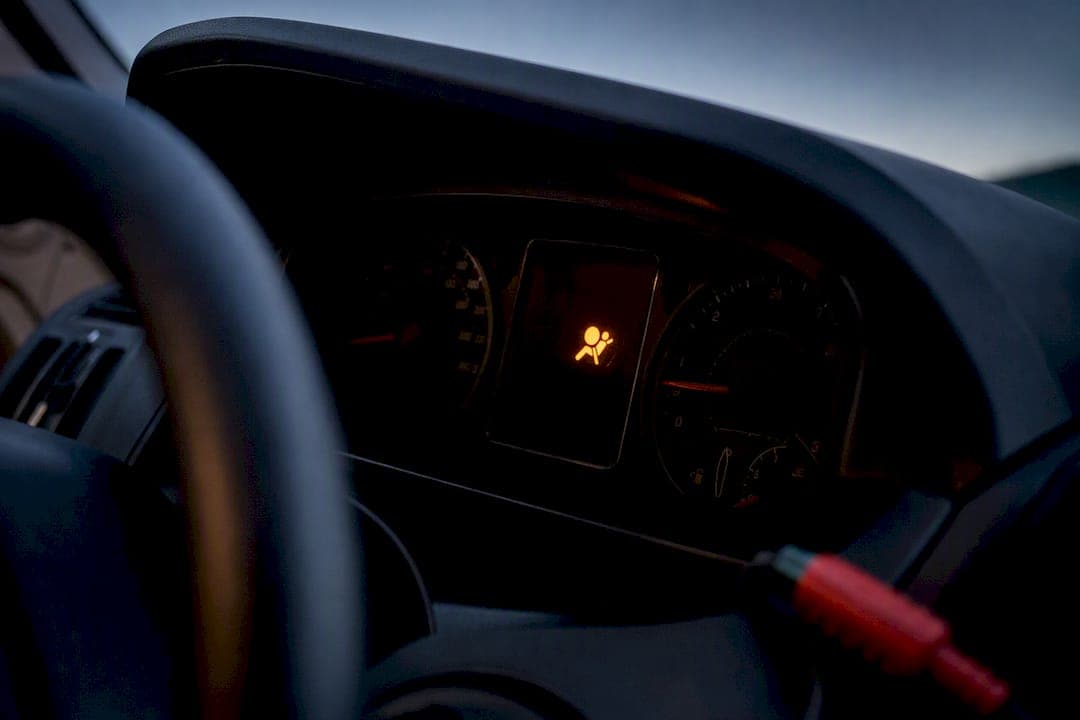
A motorhome airbag light that won't go out means part of the restraint system has failed a self-check, and the airbags or seatbelt pretensioners may not fire correctly in a crash. It will also fail the MOT outright. Start by checking the battery voltage and the yellow connectors under the front seats, then book an SRS-capable diagnostic scan within a day or two rather than letting the fault sit unresolved.
TL;DR:
- Low battery voltage below 12.4V is a common trigger and should be addressed by proper charging or replacing the battery if it’s over four years old.
- Loose or partially seated yellow connectors under the front seats are a frequent cause of the warning, often due to seat swiveling or cleaning.
- Generic OBD-II scanners usually cannot read airbag module faults, requiring specialized software like Multiecuscan or DiagBox for accurate diagnostics.
- The most common causes of persistent airbag warning lights are voltage issues and corroded or loose connectors, which are often fixable without professional help.
- Resetting the airbag module often involves addressing the root cause rather than full replacement, with specialist services offering same-day resets at a lower cost.
Table of Contents
- Step-by-step checklist for a motorhome airbag light
- Low-risk DIY fixes worth trying first
- Why won't my OBD reader show an airbag fault?
- What actually causes a persistent airbag warning?
- When should you call in a specialist?
- Why resetting often beats replacing the module
- How Airbag Reset UK handles a motorhome module
- Sources
- FAQ
Step-by-step checklist for a motorhome airbag light
Fiat Ducato and Peugeot Boxer based motorhomes throw this warning for a handful of predictable reasons, and working through them in order saves you from paying for parts you don't need.
- Check battery voltage first. A weak battery or a recent jump start is the single most frequent trigger. Anything reading below 12.4V at rest is worth investigating before you touch anything else.
- Test or charge the battery properly. If voltage is low, put it on a proper charger overnight rather than a quick boost. A failing alternator will drag voltage down again within days, so check charging output too.
- Inspect the yellow connectors under both front seats. These SRS connectors sit exactly where they get knocked during seat swivelling, cleaning, or fitting swivel bases. A loose or partially seated connector is one of the most common causes of a persistent light.
- Check the seatbelt buckle sensors. Weight sensors and buckle switches under the cushions can trip a fault if debris or moisture has got into the connector.
- Log everything. Note your VIN, the ECU part number if visible, and any recent events (jump starts, seat removal, a minor knock). A technician works faster with this in hand.
- If the light persists, get the codes read properly. A basic engine scanner will not show you SRS faults, so this step needs the right tool.
Pro Tip: Take a photo of the airbag ECU part number before you call anyone. It's usually stamped on a label on the module casing, and quoting it accurately can shave real time off a diagnostic phone call.
Low-risk DIY fixes worth trying first
Most motorhome owners can safely attempt a handful of checks before booking any professional time, and they solve the problem more often than you'd expect.
- Pull each front seat forward or tilt it (engine off, key removed) to expose the yellow SRS connector, then unclip and reseat it firmly until you hear the click. Don't use pliers or force it, the locking tab is plastic and snaps easily.
- Wipe down the seatbelt buckle housing and check the connector pins for corrosion or a green residue, which points to moisture ingress.
- Test battery voltage with a multimeter with the engine off. Expect 12.6V or above on a healthy, charged battery; below 12.2V generally means it needs charging or replacing.
- If the battery is more than four or five years old and won't hold charge overnight, replace it rather than repeatedly recharging it.
Do not open the steering wheel, remove the airbag module cover, or attempt to disconnect the airbag unit itself. Reseating a seat connector is generally safe; anything involving the module's internals or crash-data storage is specialist territory only.
Why won't my OBD reader show an airbag fault?
Most cheap OBD-II readers and phone dongles only talk to the engine ECU, not the SRS module, which is why the light stays on despite a "no fault found" result.
- Generic Bluetooth or Wi-Fi dongles paired with free apps typically can't access the airbag ECU on Fiat and PSA-based vehicles at all.
- Proper SRS access on a Ducato or Boxer usually needs software like Multiecuscan or dealer-level DiagBox, both of which read the restraint module directly.
- A correct diagnostic sequence runs: read the stored SRS codes, inspect the specific circuit or connector the code points to, confirm the physical repair, then clear the code and verify it stays off during a test drive.
- Simply disconnecting the battery to force a reset rarely clears a stored SRS fault permanently. The code often returns within a few miles because the underlying trigger, not just the memory, needs addressing.
- If the code points to stored crash data or a module-level fault rather than a wiring issue, clearing it needs a specialist reset rather than a DIY code wipe.
What actually causes a persistent airbag warning?
Ranking causes by how often they turn up saves you time and money, because the fix for a flat battery and the fix for a crash-data flag are worlds apart in cost and complexity.
- Voltage events. A weak battery or tired alternator is consistently near the top of the list, and it's the most reversible fault on this list: fix the charging issue, clear the code, and it often stays clear for good.
- Loose or corroded under-seat connectors. The simplest fix, and the most common one specifically in motorhomes given how often seats get lifted for storage access underneath.
- Clock spring failure. Look for extra symptoms here: horn not working, cruise control buttons dead, steering wheel controls unresponsive. This needs a garage, since the clock spring sits behind the wheel.
- Stored crash data or a B0100-49 pattern. Fiat Ducato and Peugeot Boxer owners repeatedly report this exact fault code tied to a TRW D219 module issue, and it's documented across owner forums as a recurring, recognisable pattern rather than a one-off glitch.
- Wiring corrosion, sensor failure, or pretensioner faults. Less common, but usually pricier to fix since they involve tracing a specific circuit rather than swapping a connector.
Battery and connector issues resolve most non-crash cases without any specialist intervention at all. The B0100-49 pattern is different: it's a module-level fault that a code clear alone won't fix permanently.
When should you call in a specialist?
Escalate once you've done the basic checks and the light is still on, or if any of the following apply: the fault traces back to stored crash data, the module has visible water damage, or fixing it would mean removing the steering wheel.
A specialist diagnostic or reset service reads the crash data actually stored in the module, repairs or resets the unit rather than replacing it outright, and returns it with a documented verification that the fault has cleared. Expect the process to take a day or two once the module reaches the workshop, with cost depending on whether it's a straightforward reset or a more involved repair.
Before you call anyone, have these ready:
- Your vehicle's VIN
- The airbag ECU part number (or a clear photo of the label)
- A brief history: any recent knocks, jump starts, or seat work
Pro Tip: Always ask what the service actually verifies before sending your module off. A reputable provider will confirm they've cleared the stored fault, not just reset a warning light that could reappear within days.
For a wider view of how technicians approach warning-light diagnosis generally, this diagnostic checklist for electrical faults walks through a similar structured process, even though it's written for a different fault type.
Why resetting often beats replacing the module
Replacing an airbag ECU outright is usually the most expensive route, and it's frequently unnecessary. Most Ducato and Boxer modules are entirely salvageable once the underlying fault (voltage, a connector, or stored crash data) is addressed and the unit is properly reset.
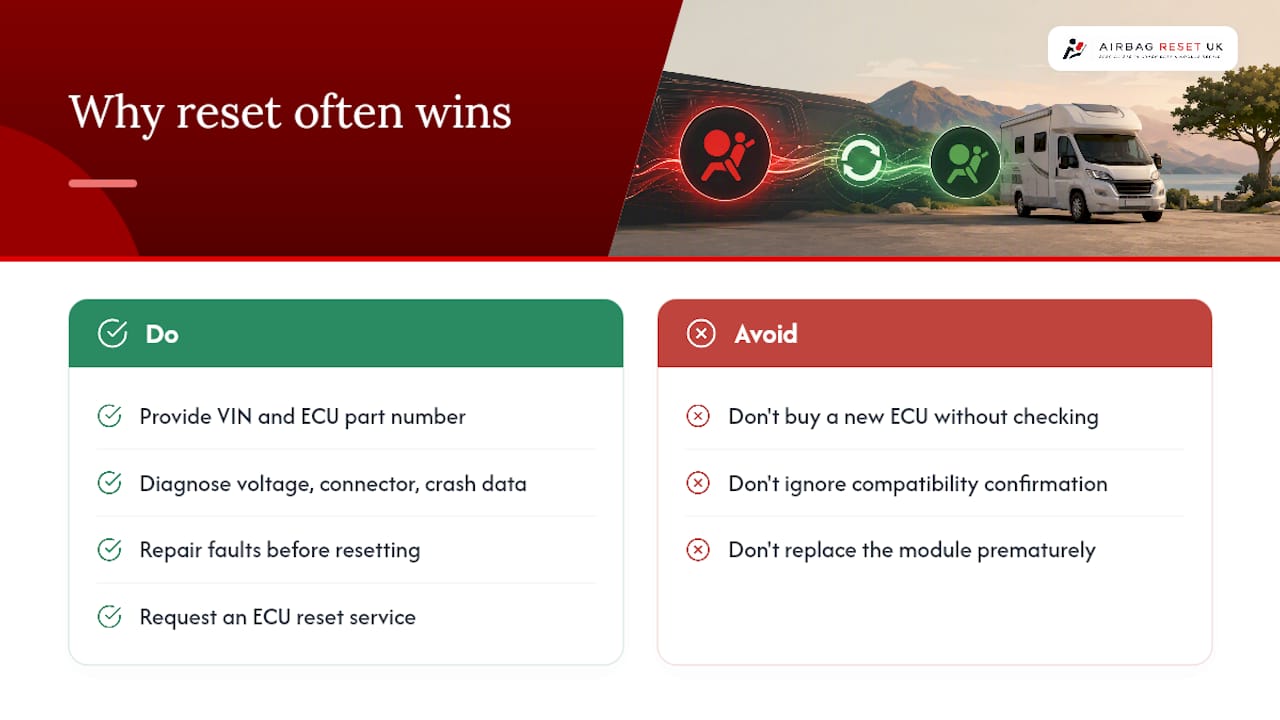
Providers who ask for your VIN and ECU part number up front aren't being fussy. That information lets them confirm compatibility before your module even arrives, which is where turnaround time gets won or lost.
Buying a brand-new ECU when a reset would have done the job is one of the most common, and most avoidable, expenses motorhome owners fall into.
— John
How Airbag Reset UK handles a motorhome module
If your checks haven't cleared the light, or the fault traces back to a B0100-49 pattern or stored crash data, sending the module off beats guessing with replacement parts. Airbag Reset UK runs a straightforward postal service for exactly this: you identify the ECU by part number or a photo, send it off, and most modules go through on a same-day turnaround.
The motorhome airbag reset service costs £65 and covers the specific module patterns common to Ducato and Boxer based vehicles, including the TRW D219 fault discussed above. If you'd rather not remove the module yourself, the mobile airbag reset option, from £75, sends a technician to you instead. Standard car and van airbag module resets start at £35 to £46 through the pricing page, and Airbag Reset UK will price match against a genuine like-for-like quote. Providing a photo of your part number can help get a clear answer on cost and turnaround before you commit to anything.
Sources
For MOT rules on SRS faults, GOV.UK's inspection manual for other equipment sets out exactly why an illuminated warning light is a failure item. Owner forum threads like the one on MotorhomeFun are worth a read for real-world accounts of the B0100-49 pattern, and Airbag Reset UK's pricing page covers current costs for standard resets.
FAQ
How Do I Reset the Airbag Warning Light on My Fiat Ducato?
Fix the underlying fault first, whether that's charging the battery or reseating a connector, then clear the code with an SRS-capable tool such as Multiecuscan or DiagBox. If the fault is a stored crash-data or module-level issue, a specialist reset service is usually needed rather than a simple code clear.
What Is the Most Common Cause of the Airbag Light?
Voltage problems, a weak battery or a faulty alternator, are among the most frequent triggers, closely followed by loose or corroded under-seat connectors. Both are generally straightforward and inexpensive to fix once identified.
Is It Illegal to Drive With an Airbag Warning Light On?
Driving with the light on isn't itself a criminal offence in the way drink driving is, but it means your restraint system may not work correctly in a crash. It's a genuine safety risk, and it will fail your MOT regardless of how the vehicle otherwise drives.
Can I Pass MOT With an Airbag Light On?
No. An illuminated SRS warning light is an automatic MOT failure under UK testing rules, because it signals the restraint system isn't functioning as designed. The fault has to be resolved and the light cleared before the vehicle can pass.