
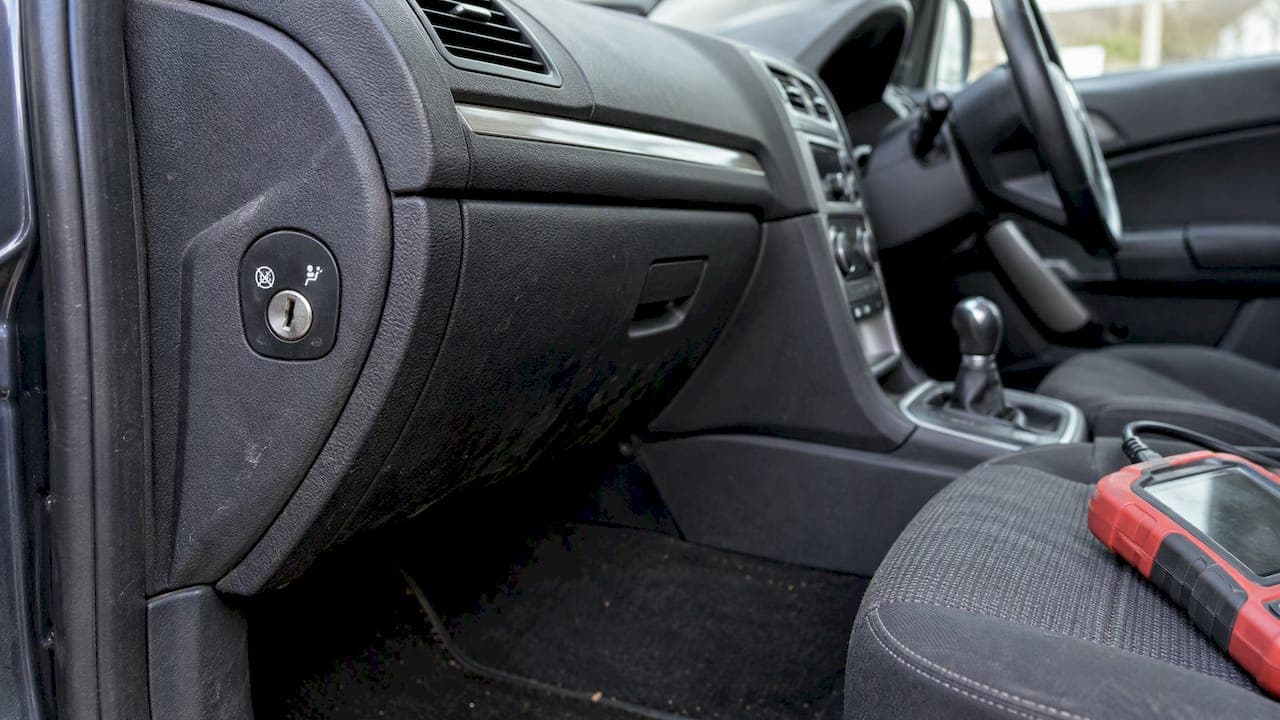
If the passenger airbag status light or the SRS warning lamp stays on after the ignition self-test, treat it as a fault that needs diagnosing with an SRS-capable scan tool and do not ignore it. A lit SRS malfunction lamp signals a genuine system problem rather than a normal "airbag off" indicator, and driving with it on means the airbag and pretensioner systems may not deploy correctly in a crash.
TL;DR:
- Faulty passenger airbag warning lights often originate from corrosion or dirt in the deactivation switch contacts or from wiring issues under the seat.
- Using an SRS-specific scan tool is essential to accurately diagnose the fault code and determine if the problem is wiring, switch, or control module related.
- Common DIY solutions include cleaning switch contacts, reseating connectors, and replacing visibly damaged switches, but complex issues may require professional intervention.
- Crash data stored in the control module often causes persistent faults that only a specialist reset can resolve, with postal reset services costing from £35 and most completed same day.
- Ignoring SRS warning lights risks failure of the airbag system in a crash and can also invalidate insurance or MOT inspections.
Table of Contents
- Common causes of passenger airbag switch faults and warning lights
- How to diagnose a passenger airbag switch fault
- DIY fixes and when replacement or professional repair is needed
- Expert note: airbag control module crash data and module reset options
- A practical perspective for DIY enthusiasts
- How a specialist postal airbag module reset service can help
- FAQ
- Sources
- Authoritative sources and manuals
Common causes of passenger airbag switch faults and warning lights
Most passenger airbag faults trace back to a handful of components, and working through them in order saves time before you spend money on parts.
- Worn or dirty deactivation switch contacts: years of use corrode the switch that lets owners manually disable the passenger airbag, and dirty contacts send an intermittent or false signal to the control unit.
- Seat-occupancy mat or occupant classification sensor faults: the mat under the passenger seat that detects weight and position can fail from spilled liquids, wear or a damaged connector, confusing the system about whether the seat is occupied.
- Damaged or loose under-seat wiring: seat sliding mechanisms flex the wiring loom constantly, and chafed insulation or corroded connectors are among the most common culprits behind a persistent fault.
- Airbag control unit issues: low system voltage, a blown fuse, a failed relay or stored crash data in the control module can all trigger the same warning lamp as a simple switch fault.
- Reported fault codes linked to the switch circuit: owner forums frequently associate codes such as B00D5 with the passenger airbag deactivation switch circuit, though the underlying cause is often wiring rather than the switch itself.
Because several of these causes produce an identical warning light, you need a scan tool rather than guesswork to narrow things down.
How to diagnose a passenger airbag switch fault
Work through these checks in order, starting with the simplest and cheapest.
- Run the ignition self-test: turn the key to the "on" position without starting the engine and watch the SRS light. Manufacturer guidance for most vehicles describes the lamp illuminating for several seconds, often around four to seven seconds, before switching off; if it stays lit, flashes, or never comes on at all, the system needs attention.
- Read stored fault codes with an SRS-capable scanner: a generic OBD-II reader often cannot access airbag codes, so use a tool that specifically supports SRS systems and note any code referencing the passenger switch circuit.
- Interpret the code as a starting point, not a diagnosis: a code such as B00D5 points towards the passenger switch circuit but frequently turns out to be a connector or wiring fault under the seat rather than the switch itself.
- Inspect and reseat under-seat connectors: pull back the carpet or trim where needed, check for corrosion, and firmly reconnect anything that looks loose. Where you have a multimeter and know the circuit, continuity checks on accessible wiring can confirm a break.
- Test the physical switch: check the deactivation switch for cracks, looseness in its mounting, or a sticky action, and confirm it changes state when operated.
- Log everything: note whether the fault is constant or intermittent, photograph connectors before and after reseating, and keep a written record of each test.
Pro Tip: Clear the fault code after each repair attempt and run the self-test again before moving to the next step, so you know exactly which fix resolved the problem.
DIY fixes and when replacement or professional repair is needed
Some passenger airbag faults are genuinely simple to fix at home, while others need specialist tools or carry real risk if handled incorrectly.
- Clean and lubricate switch contacts: a light electrical contact cleaner often restores a sluggish or intermittent deactivation switch without replacing anything.
- Reseat connectors and check fuses and relays: a loose plug or a blown fuse can mimic a far more serious fault, and both are quick to check.
- Replace a visibly broken switch: if the switch housing is cracked or it fails a continuity test, swapping it for a like-for-like part is usually straightforward.
- Seat-occupancy mat or wiring harness replacement: these jobs involve stripping back seat trim and working around pyrotechnic components, so they're best left to someone with the right experience unless you're confident with automotive electrics.
- Crash data in the control module: if your scan tool shows stored crash data rather than a simple circuit fault, clearing the code with a generic tool rarely fixes the underlying problem, and the fault tends to return.
Never attempt to open, dismantle or bypass an airbag unit, seatbelt pretensioner or the control module's pyrotechnic circuits. If you're ever unsure whether a component is live, stop and get professional help rather than risk an unintended deployment.
Expert note: airbag control module crash data and module reset options
Crash data is the record an airbag control unit stores after a deployment event or a hard impact that triggers its sensors, and once that data is logged, many modules lock themselves into a fault state that a code clear won't resolve. The light comes back within a few ignition cycles because the module is designed to flag that it has "seen" an event, whether or not any airbags actually fired.

Restoring normal behaviour after this usually means the module itself needs resetting, which typically involves physical removal, specialist software and an authorised procedure rather than a five-minute code wipe.
Before choosing a reset service, it's worth asking:
- What's the turnaround time, and is same-day service genuinely available?
- Does the service need the part number or photos to confirm compatibility before you send anything?
- Is pricing fixed upfront, and does it vary by module complexity?
- Is there a warranty on the reset work itself?
Some providers, including Airbag Reset UK, advertise fixed pricing, module identification support and same-day turnaround for most units sent in, which gives a useful benchmark when comparing options.
A practical perspective for DIY enthusiasts
If you can isolate the fault to a dirty switch or a loose connector, fixing it yourself is usually the cheapest and fastest route. Once crash data shows up, or the fault keeps returning after a code clear, a professional diagnostic or module reset tends to work out cheaper than guessing with replacement parts. Keep every receipt, the old part if you swap one, and a written record of what you tested, since this matters for both MOT history and resale value.
— John
How a specialist postal airbag module reset service can help
When a scan reveals crash data locked into the control unit, or a replacement module simply costs more than the fault justifies, a postal reset service is often the more sensible next step rather than buying a new ECU outright. We handle this by taking your module through the post, confirming its identity from the part number or a few photos, and resetting it so the original unit goes back to normal operation.
Our airbag module reset service starts at £35 for standard units, with most jobs turned around the same day they arrive. For larger vehicles, our motorhome airbag reset service covers modules those general guides rarely mention, priced at £65. If your vehicle can't easily move, our mobile airbag reset option brings the work to you, from £75.
Before you send anything, it helps to have:
- The module's part number, found on the unit itself or in your vehicle documents.
- Clear photos of the module and its connectors.
- A short description of when the fault first appeared and what you've already tried.
| Service | Starting price | Typical turnaround |
|---|---|---|
| Airbag module reset | £35 | Same day for most units |
| Motorhome airbag reset | £65 | Specialist handling |
| Mobile airbag reset | From £75 | On-site |
We also offer discounted trade accounts for garages and workshops processing modules regularly. If you'd like to check whether your module qualifies, visit Airbag Reset UK to get started.
FAQ
How much does it cost to fix an airbag fault?
Costs vary widely depending on whether the fault is a simple switch or wiring issue versus a module needing a crash data reset. A postal module reset service starts at £35 for standard units, while physical parts such as switches or sensors are priced separately by the supplier.
Is it safe to drive with the passenger airbag light on?
It depends on which light you mean. An illuminated SRS malfunction lamp indicates a genuine system fault and the vehicle should be checked before continuing to drive, whereas a passenger airbag "disabled" indicator simply shows the airbag has been switched off deliberately and is not itself a defect.
How much does it cost to replace a passenger airbag sensor?
Sensor and occupancy mat prices vary by vehicle make and model, and fitting often requires removing seat trim around pyrotechnic components. It's worth getting a quote from a dealer or specialist before assuming replacement is cheaper than a module reset.
How do I reset the passenger airbag light?
If the fault is a simple switch or connector issue, clearing the code with an SRS-capable scanner after the repair often resolves it. If the light returns because the control module holds stored crash data, a generic code clear usually won't work and the module typically needs a specialist reset procedure instead.
Sources
Authoritative sources and manuals
For further verification, consult the MOT inspection manual guidance on SRS indicators, your vehicle's owner manual for self-test behaviour, and a workshop manual or authorised dealer where symptoms are unclear.