
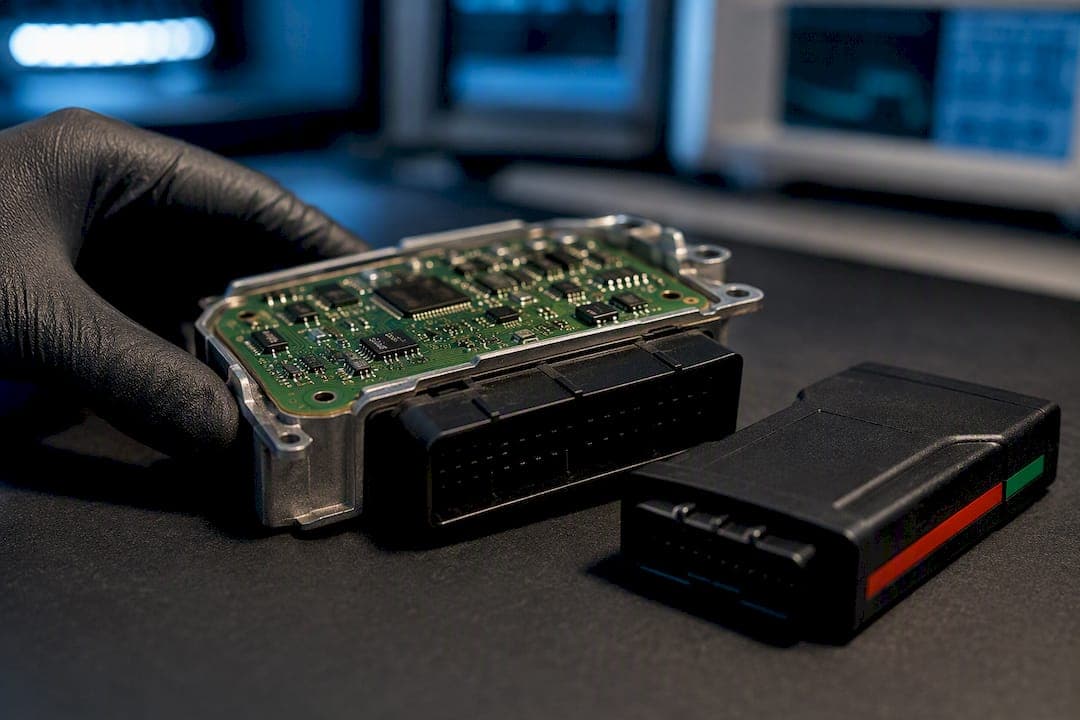
Yes, crash data stored after a Renault airbag deployment can normally be erased from the airbag ECU, but only once any physical safety repairs are complete. Basic diagnostics come first: check the obvious wiring and sensors before assuming the module itself is at fault. If airbags deployed, get the pretensioners and sensors replaced before anything else. Once repairs are confirmed, prepare the module and send it to a trusted postal reset service.
TL;DR:
- Crash data reset requires physical repairs to be complete, including replacement of pretensioners and sensors, before erasing the crash flag.
- Standard OBD-II tools cannot erase Renault crash data, which is stored on EEPROM and needs specialized ECU-level access to clear.
- Before paying for a reset, perform basic checks such as battery voltage, wiring, and proper DTC reading with a dedicated SRS scanner to rule out wiring faults.
- A professional reset involves identifying the correct module, backing up EEPROM data, and using the precise reset procedure for that part number to avoid damage.
- Properly verifying that all safety components are replaced and conducting full diagnostics after a reset prevents masking live faults and ensures safety.
Table of Contents
- What is a Renault crash data reset and why can't a code reader clear it?
- What should you check before paying for a crash data reset?
- How does a professional crash data reset actually work?
- How do you prepare your module for a postal reset?
- What does a fair price and turnaround actually look like?
- What must the garage verify after the reset before refitting the module?
- Why choose a specialist postal reset service?
- Where the conventional advice on airbag resets gets it wrong
- How do you book a Renault airbag reset with Airbagresetuk?
- Sources
What is a Renault crash data reset and why can't a code reader clear it?
Crash data is the permanent record an airbag ECU writes the moment it detects a collision severe enough to trigger deployment. It logs sensor readings, deployment status, and a locked fault flag, all stored in the module's EEPROM chip. This is not the same as a routine fault code that clears itself once the underlying issue is fixed. It is a deliberate, tamper-resistant record designed so a written-off vehicle cannot simply have its airbag light switched off and be sold on without disclosure.
That is precisely why a standard OBD-II scanner will not touch it. Cheap and mid-range diagnostic tools can read live fault codes and clear "soft" faults, things like a temporary voltage drop or a loose connector triggering a warning. But crash data sits behind a different layer of the ECU's firmware. Vendor documentation for Renault-specific reset tools such as Renolink confirms that erasing a genuine crash flag needs specialised ECU-level functions, not generic diagnostic commands. Without the right access method, the module will keep throwing the same warning light no matter how many times you clear it.
This distinction matters practically, because it determines what you should even be paying for:
- Soft fault codes: temporary, often caused by wiring or connector issues, and clearable with standard diagnostic equipment.
- Locked crash data: a permanent EEPROM entry written after deployment, requiring specialist bench tools or ECU-specific software.
- Airbag Renault ECU reset: the process of erasing that locked flag once physical repairs are verified complete.
A reset should only happen after the pretensioners, sensors, and any deployed airbags have been physically replaced. Clearing the crash flag on a module that still sits behind broken hardware just masks a live safety fault. That is not a reset, it is a false reassurance for whoever drives the car next.
What should you check before paying for a crash data reset?
Plenty of persistent airbag warning lights have nothing to do with a genuine crash event. Sending a module off for a reset when the actual problem is a loose connector wastes time, delays your repair, and sometimes means paying twice. Run through these checks first:
- Battery voltage – a weak or dying battery can trigger false SRS warnings on start-up. Confirm it holds a steady 12.4V or above before assuming ECU failure.
- Clock spring and steering wheel harness – the rotary connector behind the steering wheel wears out with mileage and is a well-documented cause of intermittent airbag lights on Renault Trafic, Megane, and Scenic models.
- Seatbelt stalk connectors – corrosion or a loose pin here is a common trigger for SRS faults that have nothing to do with a crash.
- Passenger weight sensor – a fault here throws a specific code and is often mistaken for a deeper ECU problem.
- Read the actual DTC with an SRS-capable tool – a basic OBD reader might show a generic airbag light with no detail. A proper SRS scanner distinguishes between a live crash flag and an active wiring fault, which changes your entire repair path.
Independent industry reporting has found that technicians commonly misdiagnose internal ECU error codes that turn out to be wiring or sensor faults rather than genuine module damage. Long-running owner forum discussions tell the same story repeatedly: persistent lights fixed by a repaired connector or a replaced clock spring, not a new ECU.
Pro Tip: If the airbag light flickers rather than staying solidly lit, that is usually a strong sign you're dealing with a wiring fault, not locked crash data. A genuine post-deployment fault code stays on permanently and won't clear with a battery disconnect.
How does a professional crash data reset actually work?
The process starts with identification, not tools. Every Renault airbag module carries a part number, usually printed on a label on the casing, and that number determines which reset procedure and software variant applies. Fit the wrong reset method to the wrong module variant and you risk corrupting the EEPROM entirely, turning a fixable job into a scrapped module. This is one reason DIY resets using mismatched cloned software cause more damage than they solve.
Once the module and part number are confirmed, a competent technician follows a fairly consistent sequence:
- Back up the EEPROM before touching anything. This preserves the original data in case anything goes wrong during the reset and gives a traceable record of the job.
- Connect via a bench programmer or ECU-specific interface rather than the vehicle's OBD port. Because crash data lives at EEPROM level, direct chip-level access is usually the only reliable route in.
- Erase the crash flag using the correct function for that module's firmware revision, not a generic "clear all codes" command.
- Reprogram or restore configuration data where the module's calibration needs realigning after the erase.
- Verify the result by reading DTCs again to confirm no crash flag remains, then running power-cycle tests to check the module behaves correctly across ignition on/off, cold start, and warm start scenarios.
That verification step is where a lot of cheaper or rushed services fall short. A module that reads clean immediately after erasing can still throw a fault on the second power cycle if the reset wasn't applied correctly for that specific variant. Model-specific repair guides, including detailed Renault Trafic fault code sequences, set out exactly this kind of staged diagnostic checking before and after any code clearing. Skipping it is how modules end up going back and forth in the post twice.
How do you prepare your module for a postal reset?
Getting this right the first time avoids the single biggest cause of delay: a module that arrives with no context, wrong information, or damage from a rushed removal.
- Photograph the ECU and its part number label before removal. This confirms the exact variant and gives the reset service everything needed to quote accurately and start work the moment it arrives.
- Isolate the battery before disconnecting the module. This is basic practice but skipped more often than you'd think, and it protects both you and the connector pins from a stray short.
- Handle the clock spring and wiring harness carefully during removal. These parts are more fragile than the ECU itself and a cracked connector tab turns a straightforward job into an extra repair.
- Pack the module securely in anti-static wrapping inside a padded box. Airbag ECUs contain sensitive electronics and rough handling in transit is an avoidable risk.
- Complete the service form fully: VIN, symptoms observed, whether airbags physically deployed, and confirmation that any necessary safety repairs (pretensioners, sensors) have been completed. This single step avoids the most common cause of a reset service asking for clarification mid-job.
Garages and mobile technicians sending modules regularly should ask about a trade account. Discounted rates and a simpler repeat process make sense once you're doing this more than once or twice a year, rather than working through standard retail pricing each time.
What does a fair price and turnaround actually look like?
Pricing for a standard Renault crash data reset typically sits in a modest bracket for straightforward EEPROM erasure, with costs climbing for more complex jobs. Several factors push the price up:
- EEPROM corruption or partial data loss, which needs more careful bench work than a straightforward erase.
- Locked or cloned units, where mismatched firmware from a previous repair attempt complicates the reset.
- Rare or commercial-specific modules, such as those found in vans and motorhomes, which see lower volume and need more specialist handling.
Commercial listings for postal reset providers commonly advertise turnaround windows of 24 to 72 hours for standard modules, with same-day handling achievable when a module arrives early in the day and needs no special attention. Delays usually come down to incomplete paperwork, an unusual part number needing extra research, or a module that arrives with physical transit damage.
Before committing to any provider, ask three direct questions: what warranty backs the reset, how they verify the module before it goes back in the post, and what happens if the reset doesn't hold once it's refitted. A service confident in its own work will answer all three without hesitation, and a fair one will offer a refund or re-attempt rather than leaving you to chase a fault twice.
What must the garage verify after the reset before refitting the module?
A reset module is only as safe as the repair work sitting behind it. Before refitting, confirm that the pretensioners, impact sensors, and any deployed airbags have actually been replaced, not just that the warning light has gone quiet. Clearing crash data on a car with unrepaired hardware creates a false sense of safety: the dashboard goes silent while the actual protection system remains compromised.
Once the module is back in the vehicle, run a full SRS diagnostic scan rather than a quick glance at the dashboard. Look specifically for:
- No permanent DTCs remaining after a complete diagnostic cycle, not just after the first read.
- Clock spring continuity confirmed where the steering wheel or column was disturbed during the repair.
- Seatbelt pretensioner circuits reading correctly, since these are wired through the same SRS network as the airbags.
- A full power-cycle test, checking the warning light behaviour through cold start, warm start, and a battery disconnect and reconnect.
Comprehensive Renault dashboard warning guides are consistent on this point: any red or persistent SRS warning after a repair needs immediate re-inspection rather than being written off as a lingering software quirk.
Pro Tip: Never hand a vehicle back to a customer on the strength of a clear dashboard alone. Insist on a printed or logged diagnostic report showing zero active and zero permanent SRS codes. It takes two minutes and it's the difference between a documented repair and a guess.
Why choose a specialist postal reset service?
Getting the workflow right, backup, erase, verify, in that order, is what separates a reliable reset from a gamble. Airbagresetuk brings over 40 years of combined technician experience to that exact workflow, built specifically around Renault modules across cars, vans, and motorhomes.
What that experience translates to in practice:
- Same-day turnaround on most standard modules, so a straightforward job doesn't sit waiting in a queue.
- Pricing from £35, with fixed, transparent quotes rather than vague estimates that creep up mid-job.
- Price matching against genuine like-for-like quotes from other providers.
- EEPROM backup before every erase, DTC verification after, and power-cycle testing to confirm the reset holds before the module goes back in the post.
- Trade accounts for garages and bodyshops that need discounted, repeatable turnaround on multiple jobs.
That combination, technical rigour paired with straightforward pricing, is what a postal reset service should look like when it's done properly.
Where the conventional advice on airbag resets gets it wrong
Most guides on this topic treat a crash data reset as a purely mechanical task: plug in a tool, erase a flag, done. That framing misses the part that actually matters, which is sequencing. The order of operations, repair first, verify the repair, reset second, is where the real risk sits, not in the erase procedure itself.
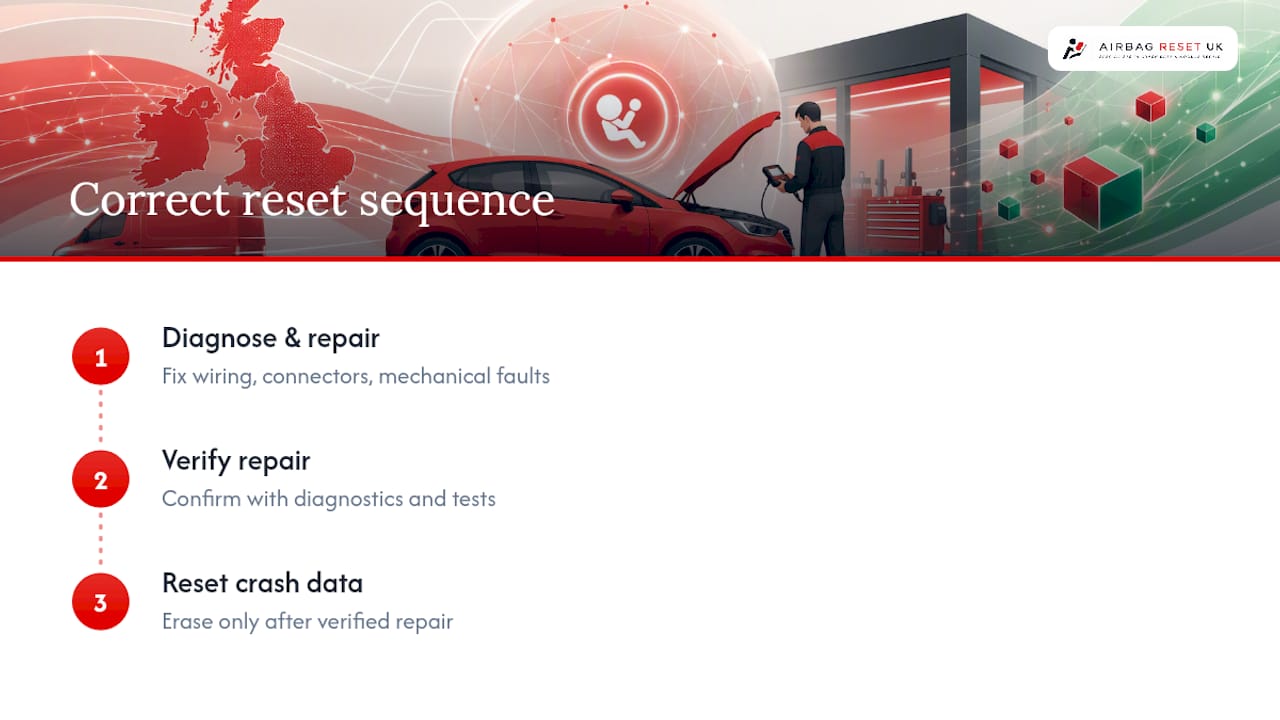
The overlooked point is this: a technically perfect reset performed too early is more dangerous than no reset at all, because it removes the warning that something is still wrong. I'd argue the industry underplays how often intermittent lights get treated as crash data by default, when forum evidence and trade reporting both point to wiring and connector faults as the more common culprit. Chase the cheap fix first. A ten-minute check on the clock spring or a seatbelt stalk connector can save a module from an unnecessary trip through the post entirely.
What should change is the order readers approach this in: diagnose properly, repair fully, then reset. Anyone selling you a reset before confirming those first two steps isn't doing you a favour.
— John
How do you book a Renault airbag reset with Airbagresetuk?
Booking is deliberately simple, because the technical work is where the complexity should sit, not the paperwork. Identify your module's part number from the label or a clear photograph, pack it securely with anti-static wrapping, complete the service form with your VIN and a note on any safety repairs already carried out, then post it or arrange a courier collection.
Every module gets an EEPROM backup before anything is touched, so there's a traceable record of the original data throughout the job. Standard resets carry a warranty, and most jobs turn around the same day they arrive. Garages and bodyshops sending modules regularly can set up a trade account for discounted rates without repeating the quote process each time. If you've already had a genuine quote elsewhere, mention it, Airbagresetuk price matches like-for-like offers rather than asking you to pay more for the same job.
Head to the Airbag Reset UK booking page to check current pricing for your part number and get your module moving today.
Sources
- Renault airbag reset guide using Renolink
- Renault Trafic 2 - 04 airbag fault code - AirbagCode
- Airbag and service light on and off | Independent Renault Forums