
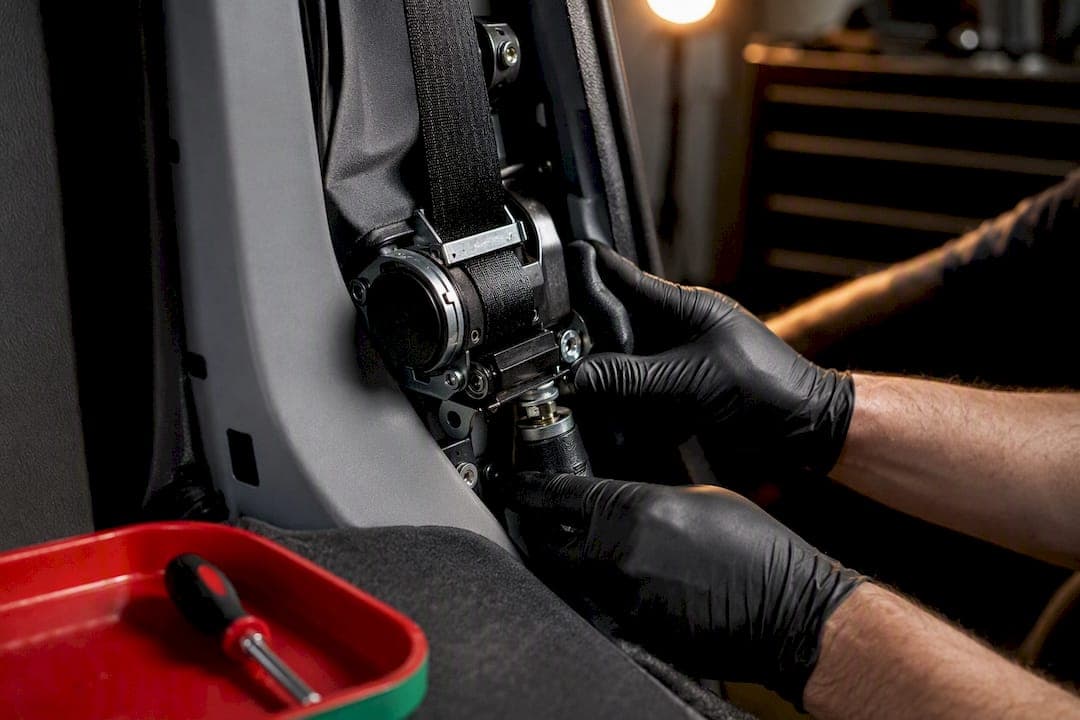
A seat belt pretensioner fault means the pretensioner circuit or a linked SRS component has failed, or the module is holding stored crash data from a previous impact. Either way, part of your restraint system may not fire correctly in a crash. Avoid long or motorway-speed journeys, get an SRS-capable diagnostic scan booked as soon as you can, and expect that fixing it properly may involve replacing a part and then having the airbag ECU's crash data reset.
TL;DR:
- A pretensioner that has deployed cannot be reused and must be replaced, often costing several hundred pounds depending on the part and make.
- Fault codes like B0031 and B0212 indicate circuit malfunctions and should be confirmed with a proper SRS-capable diagnostic scan before any repairs.
- Corroded wiring, damaged connectors, or previous water ingress are common non-mechanical causes that can trigger the warning light without the pretensioner firing.
- Resetting the crash data in the airbag module requires dedicated equipment after parts are replaced, and skipping this step leaves the warning illuminated.
- Driving with an active pretensioner fault is unsafe and may affect vehicle inspection results and insurance, so prompt professional diagnosis and repair are strongly advised.
Table of Contents
- What are the symptoms of a seat belt pretensioner fault?
- What causes a seat belt pretensioner fault?
- How do technicians diagnose a pretensioner fault?
- What does a pretensioner repair cost?
- Is it safe to drive with a pretensioner fault?
- When should you call a professional?
- Where do postal crash-data reset services fit in?
- An editorial view on fixing pretensioner faults properly
- Sources
What are the symptoms of a seat belt pretensioner fault?
The dashboard is usually the first clue. Most cars show a persistent airbag or SRS warning light, sometimes paired with a text message like "SRS fault" or "Restraint system fault" on the instrument cluster. Some models flash the light briefly at startup, which is normal, then leave it on solidly, which is not.
Physical symptoms often go hand in hand with the warning light:
- A belt that locks up and won't extend smoothly
- A loud click from the buckle or retractor when you pull the belt
- Poor retraction, leaving the belt slack across your chest
- A belt that feels like it's caught even when nothing is trapped
Timing matters more than most drivers realise. A light that appears immediately after a collision, however minor, almost always points to a deployed pretensioner or crash data logged by the module. A light that appears after the car has been through a flood, a car wash with a jet washer near the sill, or heavy rain suggests water ingress into a connector. An intermittent light that comes and goes with no obvious trigger tends to mean a loose connector or chafed wire rather than a fired device, and that distinction changes the whole repair plan.
Pro Tip: Write down exactly when the light came on, whether it flickers or stays solid, and whether it followed an impact or a wash. That single detail often tells a technician more than the fault code itself.
What causes a seat belt pretensioner fault?
Most pretensioner faults trace back to one of four things, and knowing which one you're dealing with saves time and money before you even book a workshop.
- A deployed pretensioner. These are pyrotechnic, single-use devices, and even a low-speed shunt can trigger one without deploying the airbags. Once fired, it cannot be reset or reused, only replaced, as confirmed by technical guidance on pretensioner failure.
- Damaged or corroded wiring. The harness running under the seat rail takes a battering from moisture, road grit, and repeated seat movement, and connectors there are a common failure point.
- A fault stored in the airbag or SRS control module. Sometimes the hardware is fine, but the module has logged crash data or an internal fault flag that keeps the light on regardless.
- Less common causes. Water damage from a flooded footwell, a botched previous repair, or an ECU software glitch can all mimic the same warning light with none of the obvious mechanical symptoms.
The same source notes that damaged wiring and connector faults sit right alongside deployed pretensioners as the leading causes across most makes, which is why a proper scan matters more than guesswork. If your car has never been in a collision, wiring and connectors are the more likely culprit; if it has, assume a deployed pretensioner until a scan proves otherwise.
How do technicians diagnose a pretensioner fault?
A proper diagnosis starts with a scan, not a screwdriver. Technicians connect an SRS-capable diagnostic tool, which is different from a basic OBD reader, and pull stored fault codes directly from the airbag module.
Common examples include:
- B0031 and related circuit codes, which point to a seat belt pretensioner circuit malfunction, as detailed in this breakdown of B0031
- B0212, another pretensioner circuit code that behaves similarly and often surfaces in the same diagnostic window, explained further in this B0212 guide
- B0080/B0086-series codes, which can indicate related restraint circuit issues depending on the manufacturer
After pulling codes, a technician moves to a visual inspection: checking connectors under the seat, looking for chafed loom insulation, checking for water ingress near the buckle wiring, and confirming the pretensioner cartridge itself hasn't fired. Resistance testing follows, sometimes using diagnostic resistors to isolate whether the fault sits in the wiring or the device itself. This is a controlled testing step only. A resistor left permanently in place to trick the module into thinking a pretensioner is connected is not a repair, it's a bypass, and it defeats the point of the safety system, as diagnostic workflow guidance makes clear.
Pro Tip: Ask the workshop to print or photograph the exact fault codes before any repair starts. If crash data is flagged, you'll know a bench module reset is likely needed once the physical repair is done.
What does a pretensioner repair cost?
Costs split roughly into three categories, and which one applies depends entirely on what the scan finds.
- Pretensioner replacement. Needed when the device has fired or tested faulty. Parts and labour can range from the lower hundreds to several hundred pounds depending on make, model, and whether the part is OEM or aftermarket, according to cost examples cited alongside common fault codes.
- Wiring or connector repair. Often the cheapest fix, sometimes resolved without replacing any major component if the fault is a corroded pin or a chafed wire under the seat.
- Bench crash-data reset. Once the physical repair is confirmed, the module often still holds a stored crash flag that a standard OBD tool cannot clear. A bench reset erases that record and restores the module's self-test, but it's a final step, not a fix on its own.
Here's the bit that trips people up: replacing the pretensioner or the belt assembly alone frequently doesn't clear the SRS light. The module remembers the crash event, and only a dedicated reset removes that flag, a point spelled out clearly in ANCEL's guidance on pretensioner repair and warning lights. Skip the reset and you'll have a perfectly good new pretensioner sitting under a warning light that never turns off.
Is it safe to drive with a pretensioner fault?
A solid, unblinking airbag or SRS light usually means part of your restraint system is offline, and pretensioners work in tandem with the airbags to hold you against the seat in the first milliseconds of a crash. Without that function, you're relying on the belt's ordinary retractor alone.
Practical guidance is straightforward:
- Avoid long trips or motorway driving until the fault has been checked
- Get the car into a workshop with proper SRS diagnostic equipment before doing extensive mileage
- Treat the light as urgent rather than cosmetic, particularly if it appeared after any kind of impact
Safety guidance around restraint system faults is consistent on this point: driving with the light lit is not something to put off. There's also a paperwork side to this. An unresolved SRS fault can affect an MOT outcome if the restraint system is found to be defective, and it can complicate a sale too, since most buyers or dealers will run a check that flags an active warning light. If you're weighing up insurance implications of a car with unresolved safety faults, it's worth reading wider guidance on vehicle compliance and insurance considerations before assuming it's a non-issue.
When should you call a professional?
Some checks are fine to do yourself: noting when the light came on, checking whether the belt visibly locks or feels slack, and photographing any obvious damage under the seat rail if you can access it safely. Everything beyond that belongs with a workshop.
- Pretensioner replacement requires the correct part for your make and model, plus proper fitting, since it's a safety-critical restraint component.
- Bench module resets need specialist equipment that goes beyond a typical high street OBD reader, and not every garage has it.
When you call around, ask directly: does the workshop have an SRS-capable scanner, can they read and clear stored crash data, do they have bench reset facilities, and is there a warranty on the work? Be wary of anyone offering to "bypass" the SRS light permanently, fit a resistor as a lasting fix, or who won't show you the actual fault codes pulled from the scan.
Pro Tip: If a garage can't tell you the exact code they found, get a second opinion. A legitimate repair always starts with a code you can see and understand.
Where do postal crash-data reset services fit in?
A bench crash-data reset clears the stored crash record and unlocks the SRS module, but it doesn't replace a fired pretensioner or a deployed airbag. Those are physical, single-use parts that have to go back on the car first, as confirmed by Automodulelab's explanation of the reset process. The correct order is always parts first, reset last.
Once the physical repair is done, a postal reset service becomes the practical final step, particularly for owners who've already sourced or fitted a replacement pretensioner and just need the module cleared. Airbagresetuk offers exactly that workflow: a postal service for cars, vans, and motorhomes, same-day turnaround for most modules, and pricing starting from £35, backed by over 40 years of combined technician experience...
An editorial view on fixing pretensioner faults properly
Most advice online treats a pretensioner fault as either a parts problem or a reset problem, and that binary framing is where owners get misled. It's rarely one or the other. The research consistently shows a two-stage process: replace whatever fired, then clear the module's memory of the event. Skip stage one and a reset service is just hiding a genuine safety defect. Skip stage two and you've spent money on a new part with the warning light still glaring at you.
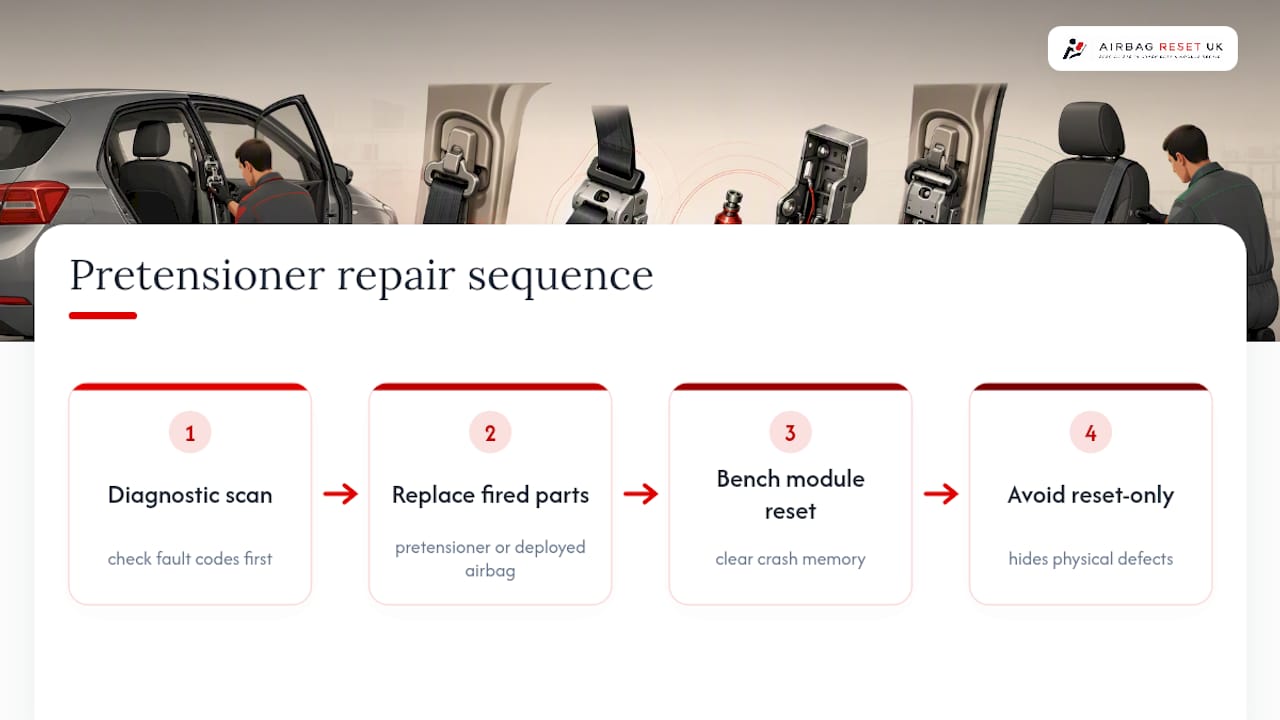
Where conventional advice falls short is in treating the warning light as the problem itself, rather than a symptom worth interrogating. The timing of when it appeared, whether it's solid or intermittent, tells you more about the likely fix than the light itself ever will.
If you take one thing from this, prioritise the diagnostic scan before spending a penny on parts. Codes like B0031 or B0212 exist precisely so you don't have to guess, and a workshop that won't show you those codes isn't one worth trusting with a restraint system that's meant to keep you alive.
— John
Sources
For the exact meaning of fault codes like B0031, the GeekOBD fault code reference and Car Code Finder's B0212 breakdown are the most useful starting points. For understanding the reset process itself, Automodulelab's guide to SRS module resets explains the hardware-then-reset sequence in detail. For general diagnostic caution, particularly around resistor testing, Ricks Free Auto Repair Advice is worth bookmarking before attempting anything yourself.
- B0031 - DTC B0031 - Seat Belt Pretensioner Circuit Malfunction in Common Vehicles | GeekOBD
- Seatbelt Pretensioner Failure: Symptoms, Causes, and Repair — Ricks Free Auto Repair Advice
- Seatbelt Pretensioners, Airbags, and the SRS Module… | Automodulelab
- Seat Belt Pretensioner Repair: Reset, Deployment & SRS Warning Light F | ANCEL
- B0212: Causes, Fixes & Cost | Car Code Finder