
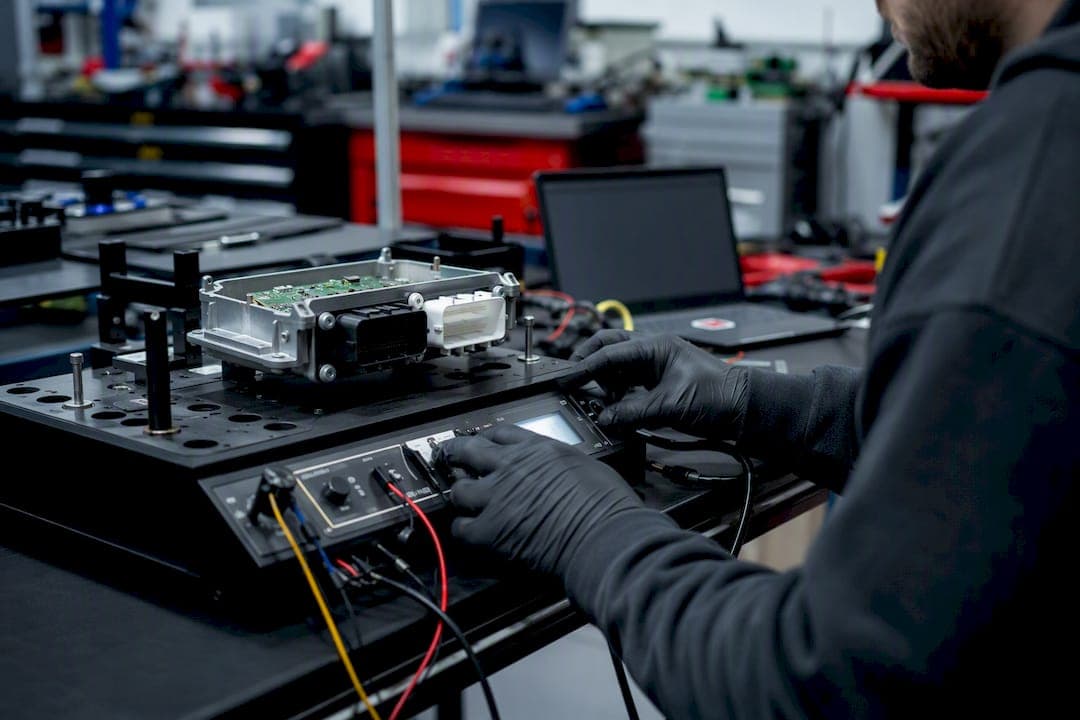
Yes, crash data stored in a Volvo SRS or restraint control module can be reset, but only if the module is still readable. A dealer scanner like VIDA will show you the fault codes; it will not delete the deployment history sitting in the module's memory. That takes a bench-level reset.
Before you do anything else:
- Pull a full diagnostic report and note every code showing.
- Write down the module's part number and your VIN.
- Don't run repeated soft clears through a generic scan tool. It rarely works and can mask a real fault.
- If the module has visible physical damage or throws hard internal fault codes, plan for repair or replacement rather than a reset.
Key Takeaways
A readable Volvo SRS module can almost always have its crash data permanently cleared through a bench-level reset, but standard scanners cannot do this alone and vehicle-side repairs must happen first.
| Point | Details |
|---|---|
| Diagnose before sending | Save a full SRS report and record the module's part number and VIN before choosing a route. |
| VIDA alone won't clear it | Standard scanners read fault codes but can't remove internal EEPROM crash records. |
| Bench reset preserves pairing | A proper reset keeps VIN and software revision intact, avoiding dealer reprogramming. |
| Fix hardware faults first | Blown squibs, damaged sensors, and wiring issues need repair, not just a data reset. |
| Choose Airbagresetuk for speed | Same-day bench turnaround, fixed pricing starting from a modest fee, and a price match policy on genuine quotes. |
Where to check pricing and service details
For pricing, turnaround, and trade account details, visit Airbagresetuk directly. Vendor listings describing common Volvo part-number families and bench procedures are also worth a browse before you ship anything.
Table of Contents
- How to check if your Volvo crash data reset is even possible
- Why crash data survives a scanner clear
- What are your options for resetting Volvo accident data?
- Preparing and shipping your module for a postal reset
- What a Volvo data reset procedure actually clears
- Checking everything works after reinstall
- Why a professional bench reset beats guesswork
- Why the DIY instinct on this one usually backfires
- Frequently asked questions
- Sources
How to check if your Volvo crash data reset is even possible
Not every module is a candidate. Some read perfectly and just need their memory cleared; others have cooked themselves in the crash and need parts, not software.
Work through this before you send anything anywhere:
- Scan and save a full SRS report. Use a proper diagnostic tool capable of reading Volvo restraint systems, not just a generic OBD reader, and export or photograph every code shown.
- Confirm the module still communicates. If it responds to the scanner at all, that's a good early sign it's readable rather than dead.
- Record the part number off the label. Volvo modules typically fall into a handful of common families, and the vendor doing your Volvo crash data reset will want this before they quote you.
- Inspect the car itself. Check whether airbags actually deployed, whether seatbelt pretensioners fired, and look at impact sensors, CAN wiring, and seat occupancy sensors for obvious damage.
- Flag any hard internal codes. Codes such as SRS-00D1, SRS-00D5, or CFFF usually point to internal module failure rather than something a crash-data clear will fix.
Pro Tip: Photograph every code on screen before you clear anything, even accidentally. A vendor doing your reset needs to see exactly what the module was showing on arrival, not your memory of it.
Why crash data survives a scanner clear
A Volvo restraint module doesn't just log a fault code when it deploys; it locks itself. After a crash it records deployment history, pretensioner firing counters, PACOS (passenger occupant classification) data, pyrotechnic battery disconnect events, and a lockout flag that stops the airbags firing again on a compromised system.
That lockout is the whole point of the design. It's a safety feature, not a bug, and it's exactly why a standard OBD tool or even VIDA usually can't clear it. These are internal EEPROM records, sitting below the level most diagnostic software can touch. Removing them properly means:
- Reading and backing up the module's existing data first.
- Rewriting the EEPROM to clear the crash records and lockout flag.
- Preserving the original VIN pairing and software revision so the module still recognises itself as "this car" when reinstalled.
Done correctly, bench reset services preserve VIN pairing and the module's software revision, which means the unit stays plug-and-play and avoids dealer-level reprogramming in most cases. Done badly, on a module with actual hardware faults, you're just masking a problem that will come straight back.
What are your options for resetting Volvo accident data?
You've broadly got four routes, and they land in very different places on cost and turnaround.
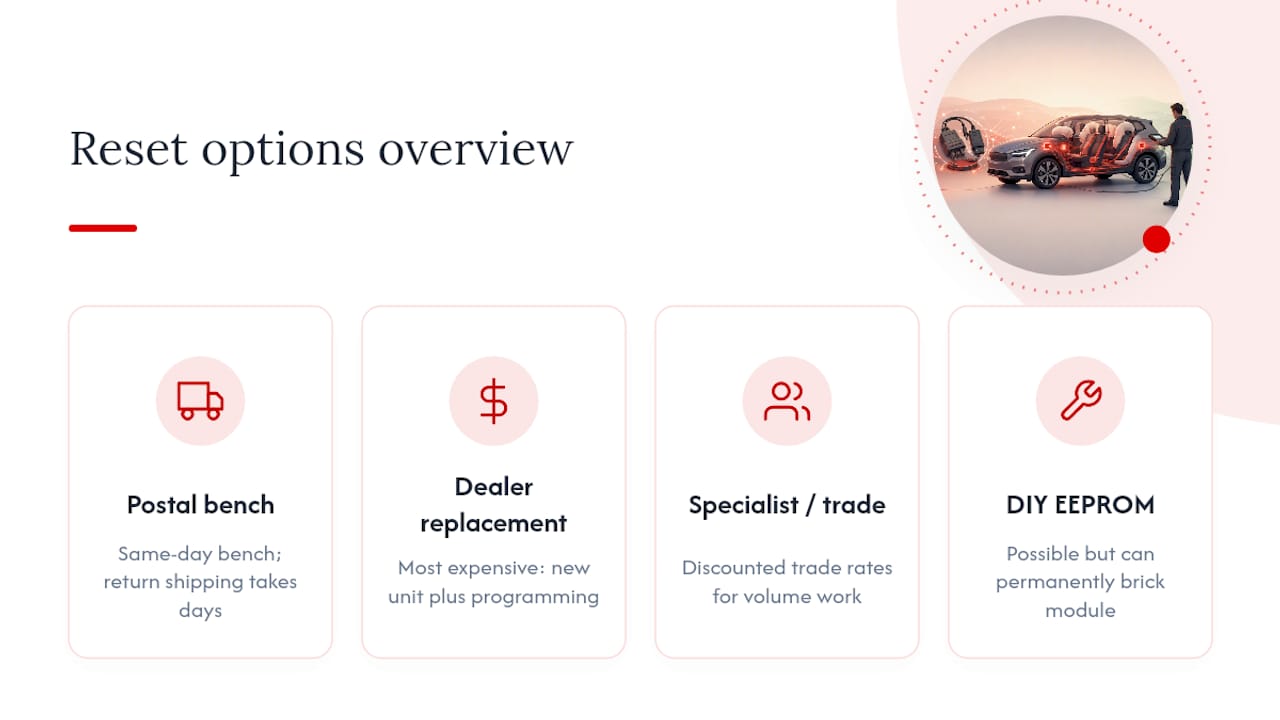
Postal bench reset services. You send the module off, a technician backs it up, clears the crash records on a bench rig, and posts it back. Postal bench reset services commonly offer same-day bench turnaround with return shipping taking a few extra days depending on courier. Pricing is typically fixed and starts well below dealer rates for most standard modules.
Dealer replacement. Sometimes necessary, particularly on newer platforms or where Volvo's own diagnostic system flags something a bench technician can't touch. It's almost always the most expensive route, since you're paying for a new unit plus dealer-level programming labour, not just a memory clear.
Specialist repair shops and trade accounts. If you run a bodyshop or independent garage, trade accounts on postal reset services give you discounted rates on volume work, which matters if you're processing several modules a month rather than one.
DIY EEPROM writes. Technically possible if you have the right hardware, the correct chip dump for that module family, and know what you're doing. For anyone without that experience, it's a good way to brick a working module permanently.
Vendors doing this work daily describe intake, inspection, bench communication, a pre-reset read, the reset itself, post-reset verification, and return shipping as the standard sequence for any market listing offering this service. Skip a step and you risk sending back a module that looks fine but fails on the road.
What actually moves the price: the module family, whether there's additional physical repair needed alongside the reset, and whether you want any warranty backing the work. A straightforward, readable module on a common part number is a fast, low-cost job. A module with a fried connector or corrosion damage adds time and cost regardless of who does the reset.
Preparing and shipping your module for a postal reset
Getting this right the first time saves a week of back-and-forth with whoever's doing the reset.
- Disconnect the battery and wait at least 10 to 15 minutes before touching anything near the airbag system. This lets residual capacitor charge dissipate.
- Locate the module. On many Volvo P3 platform cars it sits under the centre console, accessible once you've slid the seats fully back and removed two T30 Torx screws.
- Photograph everything before disconnecting it. Get clear shots of the label showing the part number, the connectors, and their orientation.
- Note your VIN and the part number on a sheet that travels with the module, not just in your phone.
- Include your saved diagnostic report. This is the single biggest thing that speeds up a quote and turnaround.
- Pack it properly. An anti-static sleeve, then solid cushioning inside a rigid box. These modules are electronics, not spare parts you can rattle around in a jiffy bag.
- Ship tracked and insured. Given the (admittedly modest) cost of the unit and the inconvenience of losing it in transit, tracked delivery is worth the extra couple of pounds.
Pro Tip: Write your VIN directly on a slip of paper inside the box as well as on the outside paperwork. Labels get separated from parcels more often than you'd think.
Once it arrives, expect the vendor to check it communicates, run a pre-reset read, perform the EEPROM rewrite, verify post-reset, then post it straight back.
What a Volvo data reset procedure actually clears
A bench reset removes the internal memory that's causing your warning light and stopping the system resetting itself. It does not fix anything mechanical.
What gets cleared:
- Crash-event records and deployment history
- Pretensioner firing counters
- Rollover flags
- PACOS occupant classification memory
- The lockout flag preventing the system from rearming
What it doesn't touch:
- Blown squibs or physically deployed airbags
- Damaged impact sensors or wiring faults
- Seat occupancy sensor failures
- Cracked or faulty instrument cluster (DIM) issues
If any of these vehicle-side problems exist, resetting the module without repairing them first just guarantees the fault returns, sometimes within a mile of driving. If your SRS light comes back after reinstall, the module reset almost certainly isn't the problem. Look at connectors, sensors, and anything that physically fired in the crash.
Checking everything works after reinstall
Reconnect the battery, then turn the ignition to position II without starting the engine. The SRS lamp should illuminate briefly and then go out within a few seconds; that's the expected self-test behaviour on a healthy system.
- Run a full SRS scan and compare the results directly against your original pre-reset report.
- Confirm no new codes have appeared and none of the old crash codes have returned.
- Take the car for a short test drive, paying attention to the dash for any flicker of the SRS light.
- If anything looks off, get the vehicle back to a workshop rather than driving on with an unresolved warning.
Most reputable vendors offer a recheck if the light returns shortly after reinstall, though the usual culprit at that point is a blown squib, poor connector seating, or a damaged impact sensor rather than a failed reset. Bring your diagnostic evidence; it speeds up any warranty conversation considerably.
Why a professional bench reset beats guesswork
Airbagresetuk's technicians bring more than 40 years of combined experience to Volvo restraint module work, which matters when you're dealing with EEPROM-level repairs that don't tolerate mistakes.
- Same-day bench turnaround for most modules, so your car isn't sitting off the road for a fortnight.
- Fixed pricing starting from £35, with a price match against genuine like-for-like quotes.
- Every job includes a pre-reset backup and post-reset verification, with the original VIN and software revision preserved throughout.
- Trade accounts with discounted rates for garages, bodyshops, and mobile technicians handling multiple jobs.
A module that goes in readable should come back readable, with a clean crash history and nothing else changed. That's the entire job.
Private owners get a straightforward fixed-price fix without a dealer bill. Garages get a repeatable process they can quote confidently to customers.
Why the DIY instinct on this one usually backfires
The conventional advice floating around forums is to "just clear it with a scanner" or attempt a cheap EEPROM programmer bought online. Both underestimate what's actually stored in these modules and overestimate how forgiving the hardware is.
The uncomfortable truth is that most people attempting a DIY reset aren't actually trying to save money. They're trying to avoid the hassle of sending a part away and waiting. Fair enough, but a bricked module costs far more in replacement parts than a same-day bench service ever would.
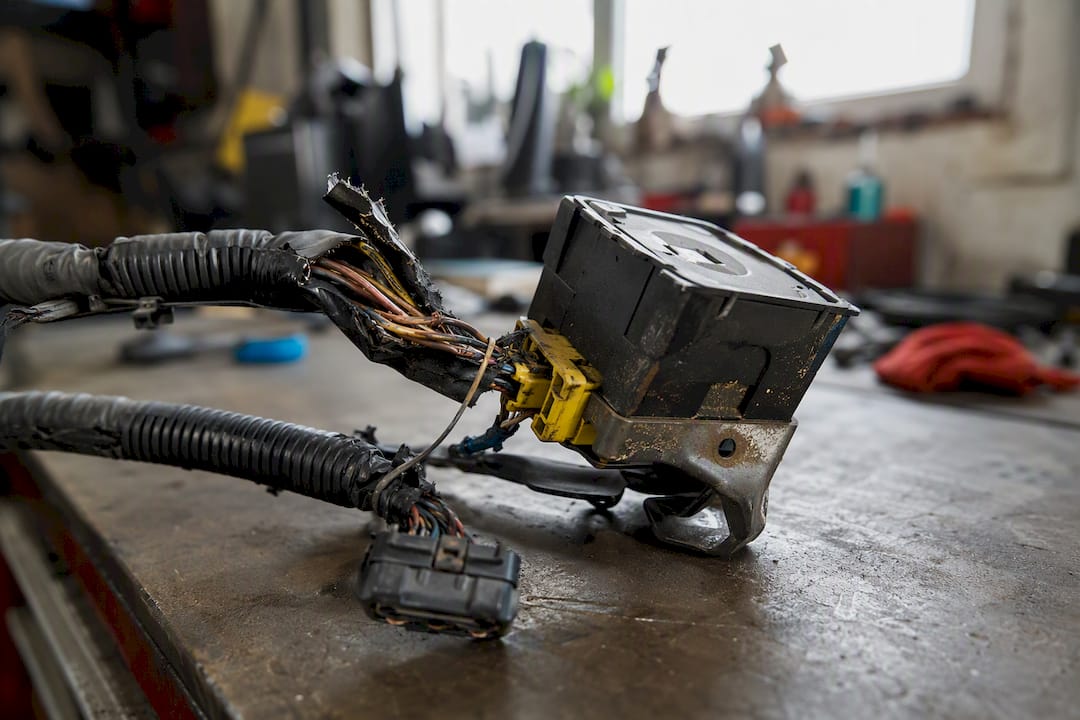
What gets skipped most often isn't the reset itself, it's the diagnostic groundwork beforehand. Owners send a module off without checking whether pretensioners actually fired, then wonder why the light returns a week later. That's not a reset failure. That's an unrepaired vehicle-side fault wearing a reset job's blame.
If there's one thing worth prioritising above all else here, it's documentation. A saved diagnostic report and a clear part number turn a guessing game into a same-day job for a competent bench technician.
Get your Volvo crash data reset sorted without a dealer bill
If you've read this far, you know the fix isn't a magic scan tool, it's a proper bench reset. That's exactly what Airbagresetuk does, and it's built specifically around avoiding the two things that make dealer routes painful: the wait and the invoice.
Send in your VIN, the module's part number, a couple of photos of the label and connectors, and your saved diagnostic report. Pack the module in an anti-static sleeve with solid cushioning and post it tracked. Most jobs get a same-day bench turnaround once the unit arrives, with pricing starting from £35 and a price match against any genuine like-for-like quote you've already got. Every module gets a pre-reset backup and post-reset verification before it's shipped back, with your original VIN and software revision intact. Head to Airbagresetuk to get a quote and start your order today.
Frequently asked questions
Can a Volvo crash report reset be done without removing the module? No. Bench-level EEPROM work requires the module to be out of the car and connected to dedicated rig hardware, which is why postal reset services exist in the first place.
Will a Volvo crash data reset fix the SRS light if an airbag actually deployed? Only partly. The reset clears the stored crash records, but any deployed airbag, fired pretensioner, or damaged sensor still needs physical replacement before the light stays off for good.
How long does resetting accident data Volvo modules typically take? Most bench services turn the module around quickly after it arrives, with total time from posting to return usually within a few days including courier transit.
Is a Volvo airbag module repair the same as a reset? Not quite. A reset clears the stored memory on a working unit; repair covers cases where there's actual hardware damage, such as failed connectors or internal circuit faults, that needs fixing before or instead of a reset.
What if my module shows an internal fault code like SRS-CFFF? That usually points to hardware failure rather than something a reset can solve, and you should expect to discuss repair or replacement rather than a straightforward crash-data clear.