
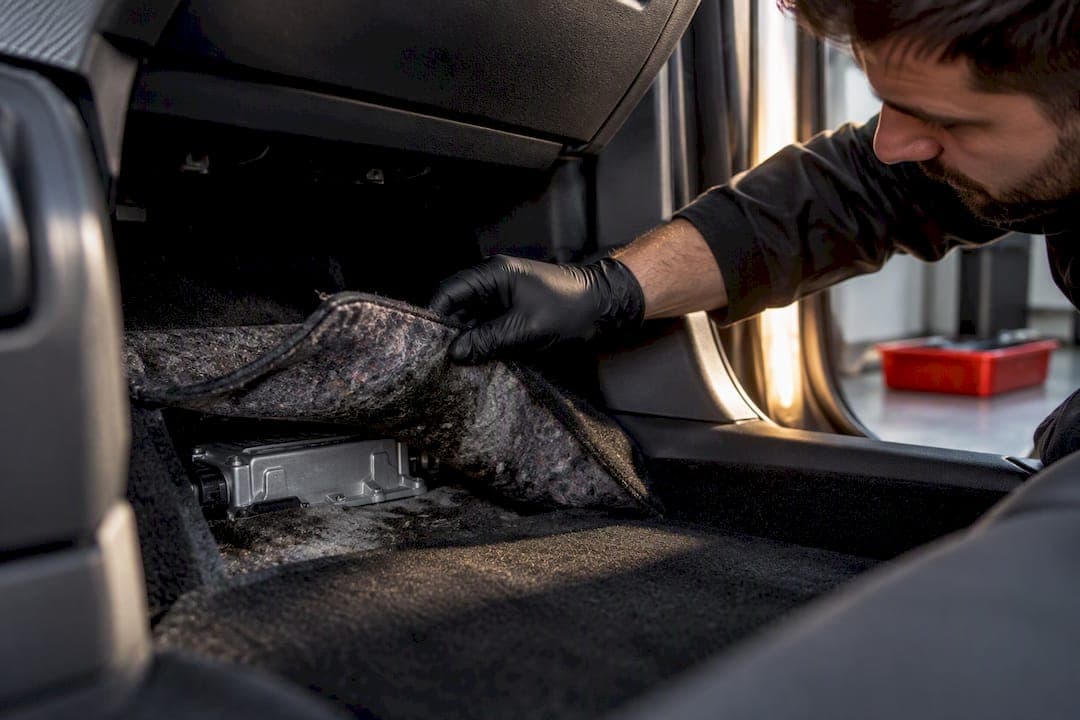
Yes, water can render an airbag module unsafe: stop driving if the SRS malfunction lamp is on, or if the interior was submerged, and get a professional scan before touching anything. Photograph the module label and any damp trim as evidence. Then book a full SRS diagnostic and visual inspection before anyone attempts a reset, repair, or replacement.
TL;DR:
- Water damage often causes slow electrical breakdowns that may appear weeks or months later, making moisture-related faults difficult to detect visually.
- Moisture trapped beneath acoustic padding or hidden areas can cause corrosion and intermittent faults, even if the surrounding surface appears dry.
- Repairing the ingress source, such as a failed seal or blocked drain, is essential before resetting or replacing the module to prevent recurring issues.
- Resetting the module is only safe when it is confirmed dry, free of corrosion, and the fault is limited to stored crash data after proper inspection.
- Cost and time for repairs vary widely depending on access complexity, with full replacement sometimes exceeding £1,000 for extensive damage.
Table of Contents
- What an airbag control module actually does
- How water and retained moisture damage the module electrically
- Symptoms and quick checks that suggest water damage
- The diagnostic workflow a technician should follow
- Reset, repair, or replace: how to make the safe call
- What the repair actually costs and how long it takes
- What to do right after water exposure
- Why a specialist reset service fits when the diagnosis is clear
- Where this information comes from
- The industry's blind spot on water damage
- Getting your module sorted through Airbag Reset UK
- Sources
- FAQ
What an airbag control module actually does
The airbag control module, sometimes called the ACM or SRS ECU, runs the deployment logic for every airbag and pretensioner in the vehicle. It reads crash sensors in real time, decides whether a collision meets the threshold for deployment, and logs crash data the instant it fires. It also runs constant self-checks on wiring, sensors, and connectors, which is why a fault anywhere in that chain lights the SRS malfunction indicator lamp (MIL).
Under MOT inspection manual guidance, an SRS MIL that shows a genuine system malfunction is a major defect, while a lamp indicating the passenger airbag has been deliberately disabled is not treated the same way. Confusing the two leads to misdiagnosis, so the specific lamp behaviour matters before any conclusion is drawn.
This is also why clearing stored crash data on its own is never a fix. The module might stop reporting a fault without the underlying corrosion, moisture, or sensor damage being resolved, which leaves a vehicle that looks fine on the dashboard but is not actually safe.
How water and retained moisture damage the module electrically
Water reaching an airbag module rarely causes instant, obvious failure. More often it creates a slow electrical breakdown that shows up weeks or months later, which is why so many water-damaged modules pass a quick glance.
Electrically, moisture on a printed circuit board creates short paths between traces that were never meant to touch, and it corrodes connector pins and solder joints over time. This produces exactly the kind of intermittent fault that is hardest to diagnose: a warning lamp that comes and goes, or a fault code that clears itself after a key cycle.
Mechanically, water finds its way past door seals, sunroof drains, and blocked air-conditioning drains, then sits under the carpet or beneath acoustic padding where it is out of sight. A manufacturer service bulletin on retained moisture documents exactly this problem: moisture trapped beneath acoustic padding caused corrosion to a sensing and diagnostic module even after the surrounding carpet appeared dry, and the fix required removing the padding to inspect and, where necessary, replace the module.
That bulletin is worth taking seriously because it shows surface dryness tells you almost nothing. A module can look untouched while the padding directly beneath it is holding water against the housing.

Symptoms and quick checks that suggest water damage
A handful of signs should push water damage to the top of the list of suspects rather than treating a fault as routine electrical noise.
- A persistent or intermittent SRS malfunction lamp, especially one that appears after rain, a car wash, or a flood event.
- Diagnostic trouble codes pointing to specific crash sensors, wiring circuits, or the module itself rather than a single obvious sensor.
- Odd behaviour after a key cycle, such as the lamp clearing itself and returning days later.
- Damp or discoloured carpet, a musty smell, or visible mould under the seats or door sills.
- Corrosion deposits or a white, powdery residue on metal trim near the footwells.
If any of these appear, photograph the affected areas and get a scan done before doing anything else. Clearing codes before a full inspection removes the evidence a technician needs to work out whether the fault is genuinely resolved or simply hidden.
The diagnostic workflow a technician should follow
A proper water-damage assessment follows a fixed sequence, and skipping steps is how modules get reset or replaced when the real problem, a leak, is still sitting in the footwell.
- Stop using the vehicle if the SRS lamp is on or the interior has been submerged.
- Photograph the module, its part number label, and any visible water damage before disturbing anything.
- Run a full SRS scan across every module and sensor, not just the airbag ECU.
- Strip back the relevant trim to inspect the ECU housing, connectors, and wiring for corrosion or moisture.
- Probe beneath the carpet and acoustic padding for retained moisture, since surface dryness is unreliable.
- Identify and repair the ingress source, whether that is a blocked drain, a failed seal, or a cracked windscreen surround.
- Decide between reset, repair, or replacement based on what the inspection actually found.
Technicians use an SRS-capable scan tool to read live data and stored faults, a multimeter to check continuity and resistance at connectors, and moisture probes or simple conductivity tests to confirm dampness under trim that looks dry to the eye.
Pro Tip: Always fix the leak before fitting or resetting a module. A repaired module returned to a wet footwell will usually fail again within weeks.
Reset, repair, or replace: how to make the safe call
Deciding between these three options comes down to what the inspection finds, not what is quickest or cheapest.
A reset is appropriate when the module is dry, shows no corrosion on the board or connectors, and the only issue is stored crash data from a minor event, provided the ingress source has already been fixed. Resetting a module that is still sitting in a damp environment simply invites the same fault to return.

A repair suits cases of localised corrosion on connector pins or specific PCB traces, or a damaged sensor and harness section that a skilled technician can rework without replacing the whole unit. This is a middle path that keeps the original module in service where the damage is contained.
Replacement becomes necessary when PCB damage is widespread, when a manufacturer bulletin calls for it, or when the fault touches a safety-critical circuit that cannot be reliably repaired. In these cases, fitting a new or refurbished module is the only way to restore confidence in deployment timing.
Whatever route is chosen, clearing crash data is not the same as resolving the safety issue behind it. A full SRS diagnostic and functional test after any intervention, reset, repair, or replacement, confirms the system is actually working rather than just quiet.
What the repair actually costs and how long it takes
Costs vary widely because access complexity drives labour time as much as the part itself. A module tucked under the centre console with several trim panels to remove takes longer to reach than one sitting in an open footwell, and that time shows up directly in the bill.
- Diagnostic scans and inspection typically form the bulk of the initial visit cost, separate from any repair work.
- Component and labour costs together mean full replacement in complex cases can exceed £1,000, particularly where sensors, clock springs, and multiple modules need attention.
- A postal crash-data reset for a module that is dry and fault-free aside from stored data is a far cheaper route than component replacement, with turnaround ranging from same-day to a few days depending on the provider and postal service used.
Labour and access complexity are the biggest swing factors in cost. According to industry cost guidance, repair and replacement pricing depends heavily on how many components are affected and how much dismantling is required to reach them.
What to do right after water exposure
Acting quickly and in the right order protects both safety and your ability to get a fair repair quote.
- Stop driving immediately if the SRS malfunction lamp is on or the cabin has been flooded.
- Photograph the module label, the wet areas, and any visible corrosion before drying anything out.
- Do not clear any fault codes yourself: this destroys evidence a technician needs.
- Book a professional SRS scan and visual inspection as soon as possible.
- Once repaired, insist on a full SRS diagnostic and functional check, and keep the paperwork for MOT and resale records.
Prevention matters just as much as the fix. Clear air-conditioning and sunroof drains regularly, check door and boot seals for perishing, and if a vehicle has ever been flooded, check for retained moisture under the carpet rather than assuming a dry surface means a dry car. Removing and replacing acoustic padding that has held water is often the only way to stop repeat corrosion.
Why a specialist reset service fits when the diagnosis is clear
Once a technician confirms a module is dry, free of corrosion, and only holding stored crash data, a specialist postal reset is often the most direct route back to a working dashboard. A specialist postal service provides a UK-wide solution for cars, vans, and motorhomes, with same-day turnaround for most modules received in the morning and fixed pricing for a postal crash-data reset, backed by experienced technicians.
- Photograph the module's part number label clearly before packaging it, since identification depends on this.
- Package the module securely and send it using the address and instructions on the pricing page.
- Expect a diagnostic report and confirmation that crash data has been cleared once the work is done.
- If inspection shows corrosion, sensor damage, or an unresolved leak, on-vehicle repair or replacement is the right call instead of a reset.
Where this information comes from
Guidance in this article draws on the GOV.UK MOT inspection manual, the Matters of Testing blog on SRS lamp interpretation, an OEM service bulletin on retained moisture, and cost data from Willand Service Centre.
The industry's blind spot on water damage
Most advice on this topic treats a cleared warning lamp as the finish line. It isn't. The real risk in a water-damaged airbag module is not the fault code you can see, it's the moisture you can't, sitting under acoustic padding long after the carpet feels dry. That single fact, drawn straight from manufacturer bulletins on retained moisture, is the one piece of conventional wisdom that deserves more scepticism.
The second thing I'd push back on is the instinct to replace first and ask questions later. Replacement is sometimes unavoidable, but a dry module with only stored crash data doesn't need a new part, it needs the ingress fixed and the data cleared properly. Skipping straight to a new ECU because it feels like the safer choice often means paying for a part that was never the problem.
If you take one thing from this: find the leak before you touch the module. Everything else, reset, repair, or replacement, only holds up once that's done.
— John
Getting your module sorted through Airbag Reset UK
Once a scan and inspection confirm your module is dry and the fault is limited to stored crash data, sending it away for a proper reset is usually quicker and cheaper than replacing the whole unit. This service is often handled through a straightforward postal service covering cars, vans, and motorhomes, with fixed pricing for a postal crash-data reset and same-day turnaround for most modules that arrive in the morning.
If your module is in a motorhome, there's a dedicated motorhome reset service priced at £65. If posting the module isn't practical, a mobile reset service starting from a mobile reset service available for a somewhat higher fee brings the work to the vehicle instead. Airbag Reset UK also price matches genuine like-for-like quotes, so if diagnostics point to a reset rather than a replacement, it's worth checking pricing before committing to a new module. Once you've confirmed your module qualifies, visit the pricing page to get started.
Sources
- Gov
- Program bulletin: Material over sensing and diagnostic module retaining moisture (OEM service bulletin)
- Airbag replacement costs in the UK | Willand Service Centre
- Matters of Testing: Does removing a passenger seat result in a fail?
FAQ
How much does it cost to replace an airbag module?
Full replacement costs vary with labour access and parts required, and industry cost guidance shows that complex cases involving multiple sensors or a clock spring can exceed £1,000 once labour and components are combined. Simpler jobs with easy access cost considerably less, so a proper inspection is the only way to get an accurate figure.
Can I drive with an airbag module removed?
Driving with the module removed or disconnected leaves the airbag and pretensioner system unable to deploy in a collision, and an illuminated SRS malfunction lamp signalling a genuine system fault counts as a major MOT defect. It should be treated as a vehicle that is not roadworthy until the module is refitted and the system passes a full scan.
How much does an airbag module cost?
A postal crash-data reset for a module that is dry and only holding stored data starts at starting at a modest fixed price for a postal crash-data reset through Airbag Reset UK's pricing, while a replacement module and fitting can run considerably higher depending on parts and labour complexity. The right figure depends entirely on whether the existing module can be reset or needs replacing.
How much does it cost to fix a faulty airbag?
Cost depends on whether the fault is limited to stored crash data, which suits a low-cost reset, or involves corroded connectors, damaged sensors, or a compromised circuit board, which needs repair or replacement. Cost guidance for airbag repairs shows labour and access complexity drive most of the variation between a straightforward job and an expensive one.
What should I do immediately after my car floods?
Stop driving if the SRS malfunction lamp is on, photograph the module label and any wet trim, and avoid clearing any fault codes yourself. Book a professional SRS scan and visual inspection before deciding whether a reset, repair, or replacement is the right next step.