
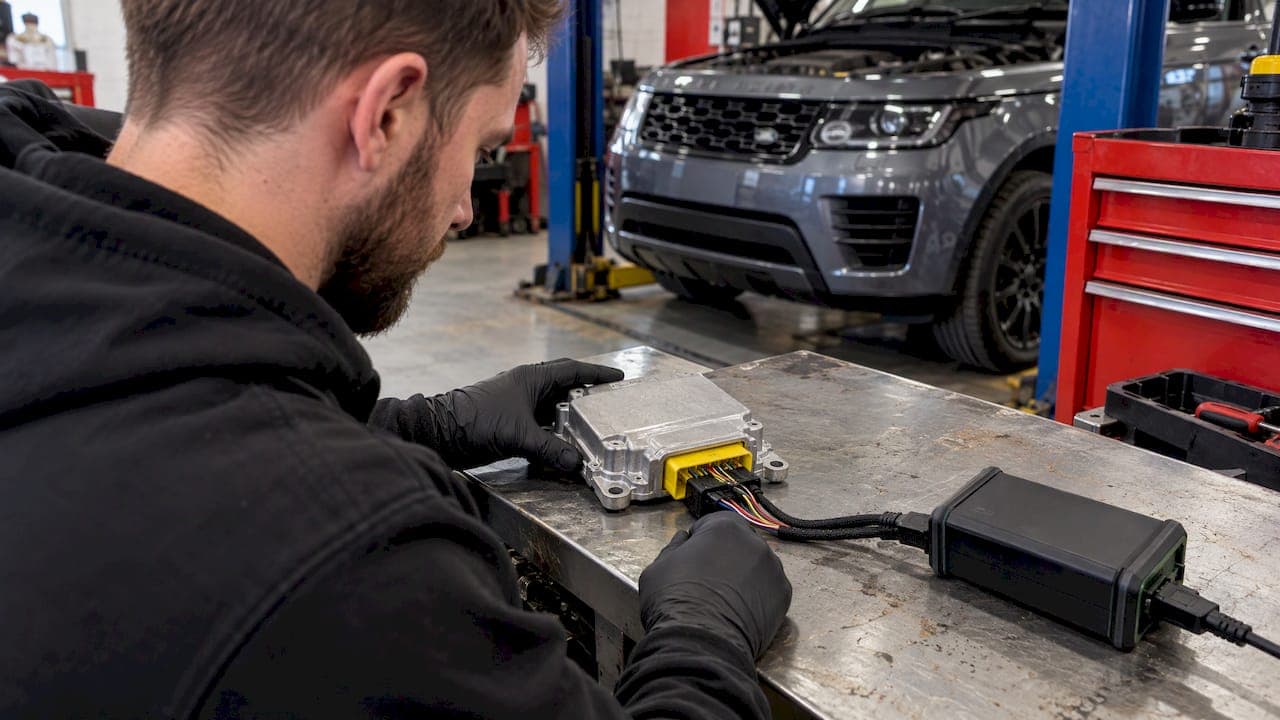
A Land Rover crash data reset clears the stored impact record from the airbag control module (the RCM or SRS ECU), so the original unit can work again instead of being replaced. It is done on the bench by a specialist, usually by post, and the module then goes back in the car. At Airbag Reset UK, standard modules are priced at £35 to £46, and most jobs received in the morning are turned around the same day. The reset only covers the module's memory: every deployed or damaged restraint part still has to be dealt with first.
TL;DR
- After an impact that fires the airbags, the Land Rover restraints module logs a crash event and the SRS warning lamp stays on until that record is dealt with.
- Dealer software for newer models generally offers replacement as the only fix, while a specialist bench reset clears the crash data on your original unit.
- Reset the module only after the deployed airbags, pretensioners, sensors and damaged belts have been replaced or checked.
- An SRS warning lamp that signals a malfunction is a Major defect at MOT, so the light must be out before the test.
- Our airbag module reset is priced at £35 to £46, with a postal service across the UK and same-day turnaround on most modules received in the morning.
Table of Contents
- Why the airbag light stays on after an accident
- Reset, repair or replace: what actually applies to your Land Rover
- What to replace or inspect before the reset
- Not every SRS light is a crash
- The reset process step by step
- What a Land Rover crash data reset costs
- Model pages
- After the reset: checks and the MOT
- Our perspective
- Send your Land Rover module for reset
- FAQ
- Sources
Why the airbag light stays on after an accident
Land Rover's restraints control module does more than fire the airbags. Its job includes impact detection and recording, firing the airbags and seatbelt pretensioners, self-testing, and storing fault information in non-volatile memory. Non-volatile means the record survives disconnecting the battery. That is why swapping the airbag, clearing codes with a basic scanner or pulling the battery does not make the light go away.
According to the LR3/Discovery 3 workshop manual, the module logs a crash fault after each impact severe enough to cause airbag deployment, and up to three crashes or impacts can be logged from a single event, such as a front, a side and a rollover. Once the third fault is logged the SRS lamp comes on and the manual calls for the module to be replaced.

Older models behave in a similar way. The Freelander workshop manual describes the airbag control unit entering a crash locked mode after deployment, with the SRS lamp lit, and says that mode cannot be cleared with the TestBook or T4 tools of that era.
So the warning light after an accident is not a stubborn bulb. It is the module doing what it was designed to do: remembering a crash and refusing to declare the system healthy until someone qualified deals with it.
Reset, repair or replace: what actually applies to your Land Rover
There are three routes, and the right one depends on what the module has stored and what the crash did to the rest of the system.
| Route | What happens | When it fits |
|---|---|---|
| Crash data reset | The stored crash event is cleared from your original module's memory | Module is electrically sound; deployed parts have been replaced |
| Module repair | Internal fault on the board, such as a failed output, is repaired as well as reset | Module reports hardware faults beyond the crash flag |
| Replacement | A new or used module is fitted and configured | Module is physically damaged, or reset is not possible |
Why does replacement come up so often? Jaguar Land Rover's own diagnostic software is split by era: SDD for vehicles before 2017 and Pathfinder for 2017 onwards. One independent tool maker explains that, for a crash-locked module, Pathfinder's only answer is replacement. That is a dealer policy outcome rather than proof that the module is beyond saving. A bench reset reads the module's memory directly and clears the crash flag, so the unit you already own can return to service once the physical parts have been dealt with.
If you are unsure whether yours is a candidate, send us the part number from the module label or a photo of it. We help with identification by phone or WhatsApp, which matters because Land Rover used several different modules across the same model name.
What to replace or inspect before the reset
Clearing crash data does not repair a crash. Land Rover's own SRS guidance is component- and event-dependent, and the module is only one item on the list.
For the 2024 Defender, SRS service information says that if the front airbags deploy, the following are replaced:
- the deployed driver and passenger airbag modules and any applicable fly leads;
- the deployed front buckle pre-tensioner, plus the installed rear pre-tensioners and the driver's retractor;
- the clockspring;
- any front impact sensors that are faulty or physically damaged;
- the module itself, if three crashes or impacts are stored.
The same guidance says a seat belt that has taken severe impact strain, or has frayed webbing, should be replaced. The 2020 Range Rover Sport SRS information makes the same two points about the module's three-impact threshold and damaged front impact sensors. These documents describe those specific models, and procedures differ by model and year, so follow the workshop manual for your own vehicle.
Two practical notes from the manuals:
- Wait after deployment. The LR3 manual warns that parts of a deployed airbag module get hot enough to burn, and advises waiting 30 minutes before touching it.
- Do not fit donor modules to test. The Defender workshop manual states that diagnosis by substituting a module from another vehicle is not acceptable and can cause additional faults, and that a new component has to be configured with approved diagnostic equipment.
A sensible order is: have the car assessed, replace the deployed and damaged parts, then reset the module, then confirm the system self-checks clean.
Not every SRS light is a crash
On newer Range Rover, Range Rover Sport and Discovery models, an SRS light can also come from something much less dramatic. One parts guide notes that under-seat wiring faults are a common cause on 2013-on cars of those families, and that an SRS-capable scanner is needed to read the fault. If there was no accident, read the fault codes first. A reset only makes sense when the module holds a crash record or a locked state.

The reset process step by step
This is how a postal job runs with us.
- Identify the module. Find the part number on the label of the airbag ECU, or take a clear photo of it. Tell us the model and year. If the label is unreadable, we can help you work it out by phone or WhatsApp.
- Prepare the car safely. Before any SRS work, the Defender guidance requires the ignition key to be removed and the battery disconnected (earth lead first), then a 10-minute wait before touching anything. The module's location varies by model: on the Defender, for instance, it sits under the floor console. Use the workshop procedure for your car, or have a garage remove the module.
- Post it to us. Pack the module in anti-static protection with something rigid around it, and include your name, phone number and vehicle details.
- We reset it. Most modules received in the morning go back the same day.
- Refit and check. A garage or technician refits the module, and the system is checked with an SRS-capable scanner.
If you would rather not remove the module yourself, our mobile airbag reset service comes from £75.
What a Land Rover crash data reset costs
The published prices on our site are:
| Service | Price |
|---|---|
| Airbag module reset | £35 to £46, one-off |
| Motorhome airbag reset | £65, one-off |
| Mobile airbag reset | From £75, one-off |
Pricing is fixed and transparent, and we match genuine like-for-like quotes. Compare like for like: a quote that includes the return postage, same-day handling and help identifying the module is a different thing from a bare reset with a longer wait.
Compare that with the alternative. Replacing a module means buying a unit, then having it configured with approved equipment, and your car waits on both. Resetting the original is cheaper and usually faster, provided the module itself is sound. Garages and bodyshops that send regular work can ask about a discounted trade account.
Model pages
We list Land Rover models individually so you can check what applies to yours:
- Range Rover and Range Rover Sport
- Discovery and Discovery 4
- Freelander, Evoque and Velar
If your model is not among them, use the unlisted Land Rover page, or send us the part number. Our Land Rover overview is the best starting point if you are not sure which page is yours.
After the reset: checks and the MOT
When the ignition goes on, the system runs a bulb check and the lamp should go out. The Freelander manual puts this at about five seconds, and says a lamp that stays lit means a fault has been found and repair is needed. On the Defender the indicator shows for about six seconds during the bulb check at the start of each ignition cycle. If the light comes back on after a reset, something else in the system is still faulty: a connector, a sensor or a deployed part that was missed.
For the MOT, the official DVSA manual is clear. An SRS warning lamp showing a system malfunction is a Major defect, which means a fail. A lamp that only indicates the passenger airbag has been switched off is not a defect, and dashboard warning messages are not defects in themselves, though a tester may use them to confirm the lamp is lit because of a malfunction.
Before the test, a quick checklist:
- the SRS lamp lights briefly at ignition, then goes out;
- there are no stored SRS fault codes when scanned with an SRS-capable tool;
- the seat belts retract and latch normally;
- every deployed airbag cover and trim piece has been replaced.
Our perspective
Most of the Land Rovers that reach us are not scrap. The owner has been told the module must be replaced, and the quote is out of proportion to the car's value or the repair's real need. When the unit itself is healthy, the only thing wrong is a stored crash record.
That is why we reset the original module whenever it is safe to do so. It saves owners from buying an unnecessary ECU, and it keeps the car's own configuration intact. We do not pretend a reset replaces the physical repair: the airbags, pretensioners and sensors that the crash used still need to be dealt with by a competent workshop first.
Our technicians bring more than 40 years of combined experience, and the pricing is fixed and published so you know the cost before you post anything. If you are unsure which module you have, talk to us before you buy anything. A photo of the label is often enough.
John
Send your Land Rover module for reset
If your Land Rover's airbag light is on after an accident and the physical repairs are done, our postal service gets the original module cleared and back to you, usually the same day it arrives if it reaches us in the morning. Start with the airbag module reset pricing page, or send a photo of the part label and we will confirm that your module can be reset.
For a broader explanation of why modules lock, read our guide on resetting a locked airbag module.
FAQ
Can a Land Rover airbag module be reset after an accident?
Often yes, when the module is electrically sound and has not been physically damaged. The stored crash data is cleared on the bench and the original unit goes back in the car. Dealer software for newer models may only offer replacement, which is why many owners come to a specialist instead.
How much does a Land Rover airbag module reset cost?
Our standard airbag module reset is priced at £35 to £46, as published on our pricing page. Motorhome resets are £65 and the mobile service starts from £75. We also match genuine like-for-like quotes.
Will the car pass its MOT after a crash data reset?
It can, provided the SRS lamp goes out and stays out. The DVSA manual treats a lamp showing a system malfunction as a Major defect. Make sure all deployed parts have been replaced and the system scans clean before the test.
Do I need to replace the airbags before resetting the module?
Yes. Deployed airbags, pretensioners, damaged front impact sensors and any damaged belts need replacing or checking according to the workshop procedure for your model. The reset clears the module's memory only, so it comes after the physical repair.
What information do I need to send?
The part number from the module label, or a clear photo of it, plus your model and year. If you cannot read the label, contact us by phone or WhatsApp and we will help identify the unit.
Sources
- Land Rover LR3/Discovery 3 workshop manual, page 45
- Land Rover Defender SRS description
- Land Rover Freelander diagnostics, system description
- 2024 Land Rover Defender SRS service information
- 2020 Land Rover Range Rover Sport SRS service information
- Defender workshop manual, airbag supplementary restraint system
- JLR Pathfinder diagnostic software overview
- Range Rover, Discovery and Sport airbag guide
- DVSA MOT inspection manual, other equipment