
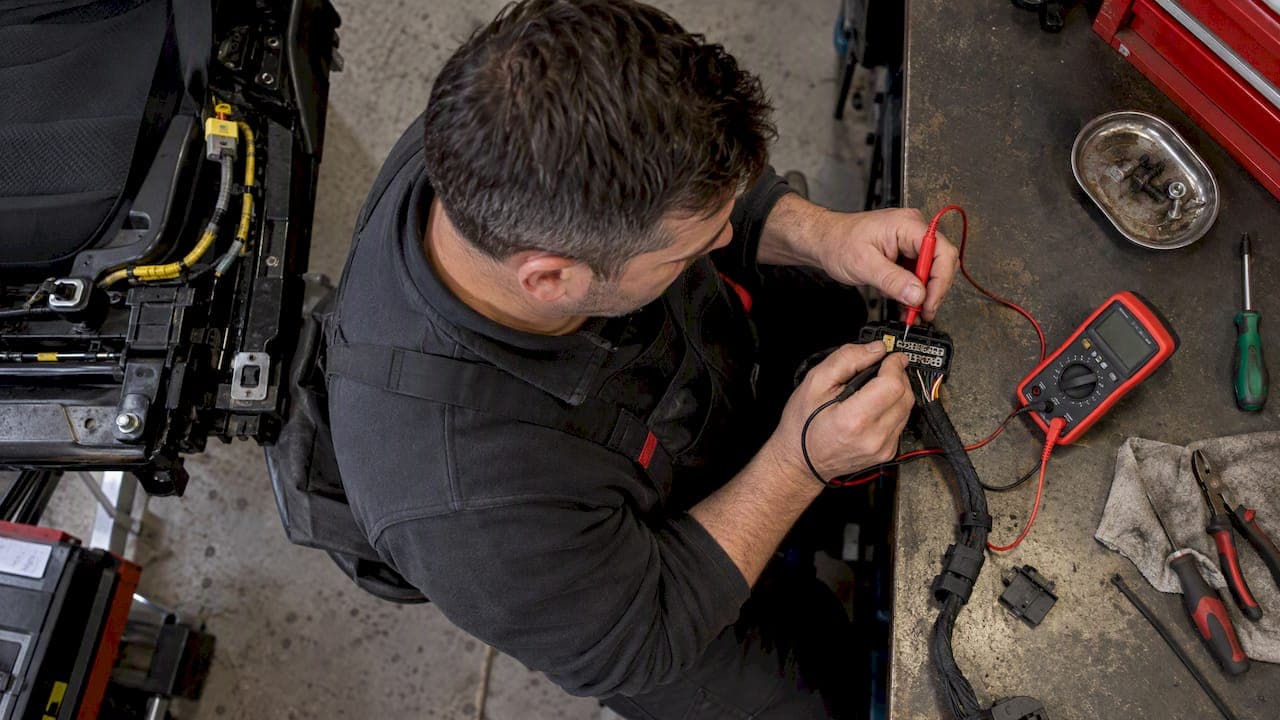
An airbag warning linked to a CAN bus fault most often means a communication error caused by a faulty SRS module or a physical-layer issue. The first job is to scan for SRS and CAN fault codes, then run basic multimeter checks on the bus itself. If the warning stays lit, note that an illuminated SRS light is treated as a major defect at MOT until the fault is traced and cleared.
TL;DR:
- With the battery disconnected, healthy CAN resistance is roughly 45 to 65 ohms; lower or higher readings suggest a termination or wiring fault.
- With the ignition on and network traffic settled, each CAN line should sit near 2.5 volts, within a 2.0 to 4.0 volt range.
- Communication codes call for checking wiring, termination, and grounds; internal module codes point toward hardware failure, while isolating a node helps confirm the cause.
- A crash data reset suits an undamaged module that passes network checks; replacements or modules repaired at the circuit board level may also need reprogramming.
- An illuminated SRS warning counts as a major MOT defect, and standard bench resets start at £35 once wiring faults are ruled out.
Table of Contents
- Symptoms and common causes of a CAN-linked airbag fault
- Step-by-step physical checks before you suspect a module fault
- Reading fault codes to pin down the failing component
- Choosing between a reset, a repair or a replacement module
- How we handle CAN-linked airbag faults at Airbag Reset UK
- How CAN bus communication affects airbag system operation
- Interpreting common CAN bus fault codes linked to airbags
- Why reprogramming after a reset prevents the fault returning
- Author perspective and recommended next steps
- Get your airbag module reset without the guesswork
- FAQ
- Sources
Symptoms and common causes of a CAN-linked airbag fault
A CAN bus problem rarely shows up as just one light. Watch for a persistent SRS warning alongside other dashboard alerts such as ABS, traction control or instrument cluster glitches, since these modules often share the same communication network. Intermittent faults that come and go, especially after recent wiring or module work, point strongly towards a physical-layer cause rather than a failed component.
Common triggers include:
- A faulty airbag or SRS module that can no longer send or receive data correctly.
- Wiring damage or chafing, particularly near door sills, seat rails or steering columns where looms flex repeatedly.
- Missing or duplicated terminating resistors, which unbalance the bus.
- Poor or corroded grounding points affecting the whole network, not just one circuit.
- A mismatched baud rate or an incompatible aftermarket device plugged into the diagnostic port.
Recent component changes are a frequent culprit. Disconnecting the battery, swapping a steering wheel, fitting a replacement instrument cluster or working near the fuse box can disturb a connector or ground strap just enough to introduce a fault that was not there before. Forum reports and workshop experience consistently describe this exact pattern: a job unrelated to the airbag system leaves a loose connector, and the SRS light appears days or weeks later once corrosion or vibration finishes the job.
Step-by-step physical checks before you suspect a module fault
Most CAN bus problems are physical, not electronic, so the sensible order is to test the wiring and connections before condemning a module. Technical guidance on CAN bus troubleshooting consistently points to three checks that resolve the majority of cases: bus resistance, idle voltage and grounding.
- Disconnect the battery and measure resistance between CAN_H and CAN_L at the diagnostic port. A healthy network reads roughly 45 to 65 ohms, reflecting two 120 ohm terminators wired in parallel.
- Interpret the reading: below 45 ohms usually signals a short circuit or an extra terminator; above 65 ohms suggests a missing or open terminator somewhere on the network.
- Reconnect the battery, start the ignition and let traffic settle, then measure CAN_H and CAN_L against ground. Expect each line close to 2.5 volts, within a 2.0 to 4.0 volt working range.
- Check ground continuity at the airbag module and nearby chassis points, looking for corrosion, loose bolts or a local ground shift affecting only one circuit.
- Isolate the suspect node by unplugging the module you believe is faulty and re-running the resistance and voltage tests; a reading that corrects itself points to that component rather than the wiring.
- Stop and call a professional once you have identified a likely module fault or found damage beyond a simple connector repair, particularly where airbags have deployed.
An application note on high-speed CAN physical-layer problems recommends exactly this sequence, testing termination, then voltage, then grounding, before isolating individual transceivers.
Pro Tip: Test with the engine running and accessories on, since some intermittent faults only appear once the network is under load.
Reading fault codes to pin down the failing component
A generic scan tool will usually show SRS fault codes and flag CAN communication errors, but some manufacturer-specific module codes only appear with dealer-level or bench diagnostic equipment. Codes generally fall into two broad categories worth distinguishing early:
- Communication fault codes, which point to a bus-level problem such as wiring, termination or grounding, matching the physical tests above.
- Module internal error codes, which suggest the airbag control unit itself has failed internally and is unlikely to respond to wiring repairs.
Once you have a code, match it against the relevant physical test rather than jumping straight to parts. A communication fault that clears after isolating one module confirms that module as the cause; one that persists after every node is isolated points back to shared wiring or a ground issue.
Intermittent faults deserve a second pass. Log the code, clear it, drive the vehicle or recreate the conditions that triggered it, then rescan. Re-checking after isolating each suspect node helps confirm whether the fault has genuinely gone or simply stopped reporting for now.
Choosing between a reset, a repair or a replacement module
Once testing points to a specific cause, the decision is usually straightforward. A reset to clear stored crash data makes sense when there is no physical damage and the module has tested healthy through the checks above. Repair or replacement becomes necessary when airbags have actually deployed, when a transceiver has failed internally, or when there is visible damage to the circuit board itself.
A practical decision checklist:
- Scan for SRS and CAN fault codes to see what the system is reporting.
- Run the physical-layer tests: bus resistance, idle voltage and grounding.
- Isolate the suspect node and retest to confirm the source.
- If the module is undamaged, a bench reset of the crash data is usually appropriate.
- Rescan after any fix to confirm the warning has genuinely cleared, not just gone quiet.
- Escalate to repair or replacement only where physical damage or an internal fault is confirmed.
Bear in mind that an SRS warning light left on is a major defect at MOT, so resolving the underlying cause before your test date avoids an avoidable failure. Bench resets are a well-established route for clearing crash data from an otherwise healthy module, often turning around in a day where replacement parts and reprogramming can take considerably longer.
How we handle CAN-linked airbag faults at Airbag Reset UK
Once you have scanned the system and ruled out an obvious wiring fault, a postal bench reset is often the quickest way to clear stored crash data without buying a new module. You send us the airbag ECU, we identify it from the part number or a photo, reset the stored crash data on the bench and post it back, usually the same day for jobs received in the morning.
A few practical points from how we run this service:
- Pricing for a standard airbag module reset starts at £35, with price matching available against genuine like-for-like quotes.
- Our technicians bring over 40 years of combined experience working on crash data resets across cars, vans and motorhomes.
- Motorhome modules, including common Ducato, Relay and Boxer fault codes in the B0100-49 range, are a regular job for us and have their own dedicated service.
- Send us your scan results and any fault codes alongside the module, since they help confirm the reset is the right fix before we start.
How CAN bus communication affects airbag system operation
The airbag control module does not work in isolation. It shares crash sensor data, seatbelt status and sometimes seat occupancy information with other modules over the CAN bus, and it relies on that same network to report its own health to the instrument cluster. When the bus itself is degraded, whether through poor termination, a failing transceiver or a chafed wire, messages can arrive corrupted, late or not at all.
The airbag module typically responds to this by flagging a communication fault and lighting the SRS warning, even though the airbags themselves may be entirely functional. This is why a CAN-linked airbag fault so often turns out to be a wiring or network issue rather than a problem with the airbags or sensors directly. The module is reporting that it cannot reliably exchange data, not that it has detected a crash-related failure.
This distinction matters for diagnosis. A fault that clears once bus resistance and idle voltage are corrected confirms the airbags were never the problem. One that persists despite a clean physical layer suggests the module's own transceiver has failed internally, which is a different repair path entirely. Treating the CAN network as a shared nervous system, rather than troubleshooting the airbag module as an isolated component, is what keeps diagnosis efficient.
Interpreting common CAN bus fault codes linked to airbags
Reading the code is only the first step. Translating it into the correct physical test is what actually fixes the fault.
Start by separating the code into its broad type. A code describing a loss of communication with the airbag module, sometimes shown as a missing message or a bus-off condition, points straight back to the physical-layer checks: resistance, idle voltage and grounding. A code describing an internal fault within the module itself, by contrast, suggests the hardware has failed and no amount of wiring repair will clear it.
Next, cross-reference the code against when it appears. A fault that only shows after the vehicle has been running for a while, or only under load, often points to a loose connection or marginal ground rather than a dead component. A fault present from the moment the ignition is switched on is more likely a hard fault such as a severed wire or a failed module.
Finally, always clear the code and re-scan after each physical test rather than relying on the original reading. Clearing a communication fault, running the engine for a few minutes and rescanning tells you immediately whether your fix worked or whether the fault has simply gone quiet, which is a common and misleading pattern with intermittent wiring issues.

Why reprogramming after a reset prevents the fault returning
Clearing crash data from an airbag module resolves the stored fault, but it does not automatically update the module's software. Where a fault was caused or worsened by outdated calibration data, rather than purely physical wiring, a software update or reprogramming step after the reset reduces the chance of the same warning reappearing.
This matters most after a module swap between vehicles, a battery replacement that triggers a relearn requirement, or a repair that touches the airbag control unit directly. Reprogramming aligns the module's software with the rest of the vehicle's network, including the exact CAN message structure other modules expect to see. Skipping this step on a module that needs it can leave low-level communication mismatches that resurface as the same CAN-linked airbag fault within weeks.
Not every reset requires reprogramming. Where the module has simply logged old crash data and tested healthy on the physical layer, a straightforward reset is often all that is needed. Where a module has been replaced, repaired at component level, or moved from another vehicle, treat reprogramming as part of the job rather than an optional extra, since it is what prevents the fault from quietly returning once the vehicle is back on the road.
Author perspective and recommended next steps
Scan first, test the physical layer second, isolate the suspect node third, then reset or repair. Skipping straight to a new module wastes money on faults that wiring or grounding usually explains. Keep your scan results and test readings on file; they double as useful evidence for an MOT retest or for a buyer at resale.
— John
Get your airbag module reset without the guesswork
Once you have scanned the system, checked the physical layer and ruled out a wiring fault, a postal reset is often the simplest way to clear stored crash data and get the SRS light off before your next MOT. We work on cars, vans and motorhomes, and most modules received in the morning go back out the same day.
Before you send anything in, it helps to have:
- The part number from the module itself, or a clear photo if you are unsure.
- Your scan results and any fault codes you have already recorded.
- Confirmation of which vehicle and module type you are dealing with, especially for motorhome units.
Standard airbag module resets start at £35 with price matching against genuine quotes, and motorhome-specific resets, including common B0100-49 faults on Ducato, Relay and Boxer base vehicles, are handled through our motorhome airbag reset service. For workshops or technicians who would rather have someone come to them, our mobile airbag reset option is available too. If your checks have already confirmed the module itself is the problem, sending it to us is the quickest route back to a clear dashboard and a pass-ready MOT. For wider context on how vehicle inspections support road safety, this overview of inspection practices is a useful read, and if MOT logistics or test slots are part of your concern, this guide to test car requirements covers what inspectors look for.
FAQ
What are the symptoms of a faulty CAN bus?
A faulty CAN bus typically shows as multiple warning lights appearing together, such as SRS, ABS and traction control, rather than a single isolated fault. Symptoms are often intermittent at first, worsening after vibration, temperature changes or recent wiring work near the affected modules.
What does it mean when it says airbag fault?
An airbag fault message means the SRS module has detected either an internal problem or, commonly, a communication error with the rest of the vehicle's network. It does not necessarily mean the airbags have been damaged or deployed, since a wiring or grounding issue can trigger the same warning.
What is a CAN bus in a Mercedes?
A CAN bus is the shared electronic network that lets modules such as the engine control unit, instrument cluster and airbag control unit exchange data, and the principle works the same way across most modern vehicles including Mercedes models. It relies on correct termination, stable voltage levels and solid grounding to carry messages reliably between components.
How to fix CAN bus communication fault?
Fixing a CAN bus communication fault starts with checking bus resistance, idle voltage and grounding with a multimeter, since most faults are physical rather than electronic. Once the physical layer tests healthy, isolating the suspect module and retesting usually confirms whether a reset or a repair is the right next step.
Sources
- Gov
- A practical CAN bus troubleshooting guide – Influx Technology
- Application note AN-ANI-1-115 – Common high-speed CAN physical layer problems
- Basics of debugging the controller area network (CAN) physical layer – TI application note