
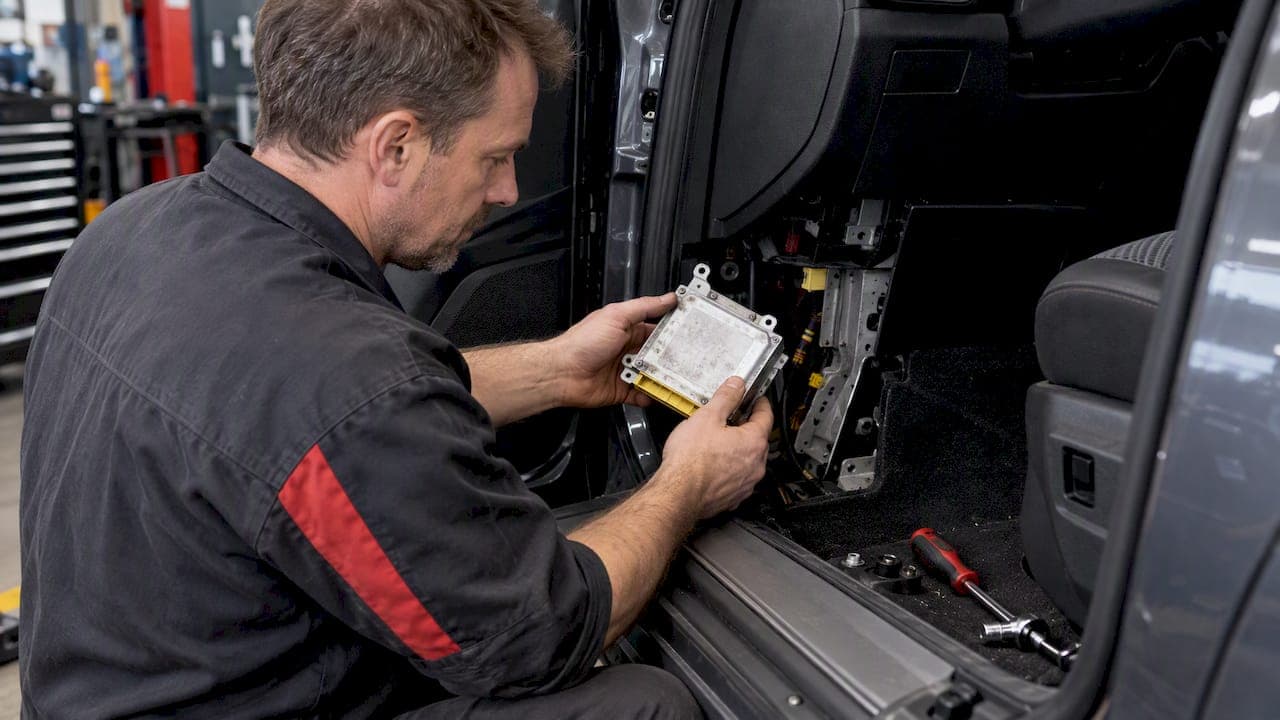
Coding configures an airbag module to your specific vehicle, while a crash data reset clears the recorded crash event so a module can be safely reused. If you've fitted a replacement module, you almost certainly need coding. If your airbag light stayed on after a repair because the original module recorded a deployment or near-deployment event, you need a crash data reset, carried out only once physical repairs are complete. An illuminated SRS warning light is treated as a major defect at MOT and must be resolved before the car can pass.
TL;DR:
- A replacement module needs coding for the VIN, options, and sensor setup; some makes also require firmware programming because new units arrive with defaults.
- With no recent part changes, a persistent SRS light warrants a crash data check; ordinary code clearing cannot erase crash flags, which require bench access.
- After deployment, replace every deployed airbag, pretensioner, and sensor before resetting crash data; the original module can be reused only if it remains serviceable.
- Standard resets start at £35; motorhome service costs £65, while mobile collection starts at £75, and morning arrivals usually turn around the same day.
Table of Contents
- What crash data is and how the airbag module records it
- What coding means for airbag modules and how it differs from programming, adaptation or relearn
- Practical checklist: differences between coding and crash data reset
- When to ask for coding, when to ask for a crash data reset, and when you might need both
- How each process is performed: in-vehicle capability, bench resets and typical service routes
- Safety, workshop cautions and the MOT consequence of an SRS warning
- How Airbag Reset UK handles crash data reset and coding needs
- A recommended workflow for owners and repairers
- Getting your module reset without buying a new one
- FAQ
- Sources
What crash data is and how the airbag module records it
When an impact crosses a set threshold, the airbag control unit logs the event permanently: deployment status, sensor readings in the milliseconds around the crash, and often a lockout flag that stops the module arming again. This crash event memory is separate from the everyday diagnostic trouble codes (DTCs) a scan tool clears with a simple "clear codes" command. A basic code erase might switch the SRS light off temporarily, but the crash flag usually remains and the light returns.
Typical symptoms technicians see include:
- A permanent SRS warning light that won't clear with a standard diagnostic reset.
- A module that reports "crash data present" or similar on specialist diagnostic software.
- Airbags, seatbelt pretensioners or sensors that fail to rearm after a minor incident was recorded by the module.
What coding means for airbag modules and how it differs from programming, adaptation or relearn
Coding sets the configuration values a module needs to work with your particular vehicle: VIN, options fitted, market variant and crash sensor count. It's distinct from programming, which writes or updates the module's firmware and calibration data, and from adaptation or relearn routines, which teach the module values it needs to learn from the vehicle itself rather than have typed in. The iCarsoft knowledge hub explains coding as configuration rather than a software write, while manufacturers sometimes blur the labels in their own tool menus.
Useful distinctions to keep in mind:
- Coding: sets vehicle-specific parameters so the module recognises what it's fitted to.
- Programming: installs or updates firmware and calibration data on the module itself.
- Adaptation or relearn: lets the module learn working values through a guided routine.
Because terminology overlaps between manufacturers, it's worth checking what a routine actually achieves rather than trusting the name shown on screen.
Practical checklist: differences between coding and crash data reset
Use this to work out which service your vehicle actually needs.
- Goal: coding configures a module to the vehicle; a crash data reset clears a recorded crash event so the original module can be reused.
- Trigger: coding follows a module replacement; a reset follows an SRS light caused by a recorded crash event, not a fresh part.
- Removal requirement: coding is often done in-vehicle; a reset frequently needs the module removed for bench access.
- Tool level: coding usually needs manufacturer-level diagnostic software; a crash reset needs specialist bench equipment designed for locked memory.
- Typical provider: coding is commonly a dealer or franchised workshop job; a crash data reset is often handled by a specialist bench service.
- Outcome: coding gives you a correctly configured new module; a reset gives you a working original module without buying a replacement.
Pro Tip: Save your diagnostic scan session before and after the work, and check that no SRS-related codes return once the car has been road-tested.
When to ask for coding, when to ask for a crash data reset, and when you might need both
The right process depends on what happened to the car, not just what the warning light says.
- Replacement module fitted: this almost always needs coding, and sometimes programming too, since the new unit arrives without your vehicle's settings.
- Airbags or pretensioners deployed: repair and replace every deployed component first, then have the original module crash data reset if it's still serviceable rather than scrapped.
- Sensor or seatbelt pretensioner replaced without a deployment: this often needs an adaptation or relearn routine, and occasionally coding, depending on the part.
- Persistent SRS light with no recent part changes: check for crash data first, since that's a common cause a simple code clear won't fix.
How each process is performed: in-vehicle capability, bench resets and typical service routes
Many crash data resets need the module removed because the crash flag sits in protected EEPROM memory that in-vehicle tools often can't touch. Coding, by contrast, is frequently done through the vehicle's diagnostic port once the replacement module is fitted.
A typical workflow looks like this:
- The damaged vehicle is repaired, with deployed airbags, pretensioners and sensors replaced with new parts.
- The airbag module is removed, or a specialist in-vehicle session is run where the platform allows it.
- Crash data is cleared on a bench rig, or the replacement module is coded to the vehicle using manufacturer-level software.
- The module is refitted, the system is tested, and the SRS light is confirmed clear.
OEM procedures can be strict about this. An OEM campaign document for an airbag control unit recoding job specifies a minimum tool software release, a required voltage range during the session, and a fixed coding time, alongside documented pre and post checks. Skipping those steps risks a partial repair or a damaged control unit.
A reset turns a written-off-sounding fault into a working part again, which is why many owners send modules to a bench specialist rather than replace them outright.
Safety, workshop cautions and the MOT consequence of an SRS warning
Airbag modules and pretensioners are pyrotechnic devices, and they're handled accordingly. HSE guidance on storing and handling airbags sets out practical rules: carry modules with the trim cover facing away from the body, never place them face down, and mount them securely during bench testing.
- Never attempt to repair or modify an airbag module yourself.
- Store and transport undeployed units upright, away from heat sources, following HSE storage advice.
- Complete all physical repairs, including replacing deployed parts, before any crash data is cleared.
An illuminated SRS warning light is treated as a major defect under MOT guidance, so the car will fail its test until the fault is properly resolved.
Pro Tip: Keep your repair invoice and part numbers together. A bench specialist resetting crash data will usually want evidence that deployed components were already replaced.

How Airbag Reset UK handles crash data reset and coding needs
We run a postal crash data reset service for cars, vans and motorhomes, with a quick turnaround for most modules received in the morning. Pricing starts at £35 for a standard airbag module reset, with a dedicated £65 option for motorhome airbag reset work and a mobile collection service from £75 where that suits better.
Our team has extensive technician experience, which is important when a module is locked after a crash event and the owner is trying to avoid an unnecessary replacement ECU. If your SRS light stayed on after a repair, or a module shows crash data that an ordinary code clear won't shift, a bench reset is usually the quicker and cheaper route back to a working car.

A recommended workflow for owners and repairers
Fix the physical damage first: replace deployed airbags, pretensioners and sensors before touching the module's crash data. Only then should you code a replacement unit or reset the original. Keep your diagnostic logs and part numbers to hand when you contact a postal reset service, and if you're a trade customer, ask about faster turnaround paths through a trade account.
— John
Getting your module reset without buying a new one
If your airbag light won't clear after a repair, our postal service lets you send the module in rather than replace it outright. 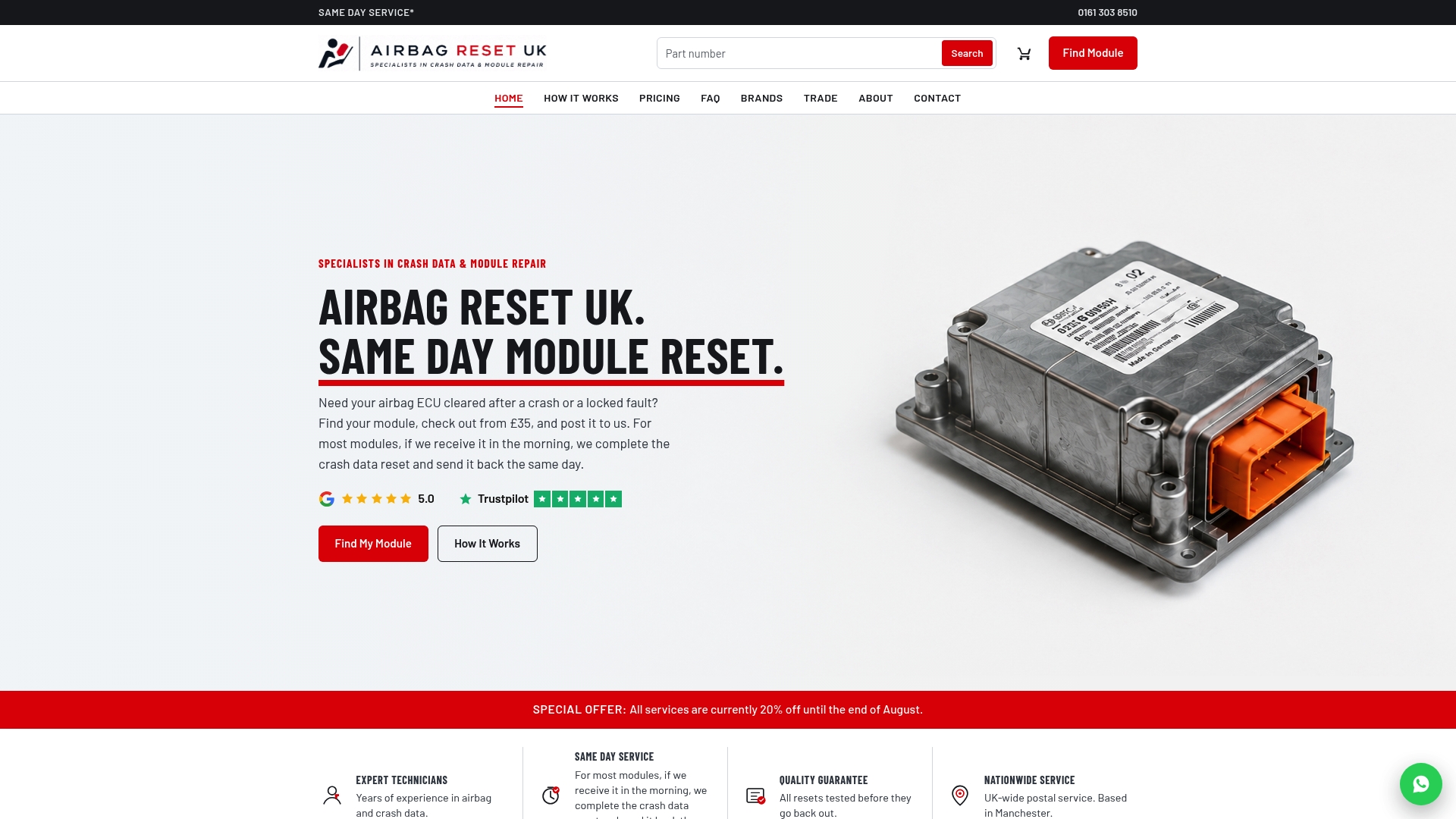
- Photograph the module and note its part number before sending it, which speeds up identification and quoting.
- Standard resets start at £35 through our airbag module reset service, with most jobs turned around the same day they arrive.
- We offer pricing competitive with other providers, so there's no need to assume a dealer replacement is your only option.
For specific fault codes thrown up during diagnostics, a reference like TuningBot's DTC code library can help you confirm what your scan tool is reporting before you send a module off.
FAQ
How do I clear airbag codes in my car?
A standard diagnostic tool can clear simple fault codes, but a permanent SRS light after a crash usually means crash data is stored in the module and won't clear with a basic code erase. In that case the module needs a specialist crash data reset, typically done on a bench rather than through the dashboard connector.
How do you remove crash data from an airbag module?
Crash data removal generally requires specialist bench equipment that can access the module's protected memory, since standard in-vehicle tools often can't reach locked crash flags. This is why most crash data resets involve removing the module and sending it to a specialist rather than clearing it in the car.
Does a new airbag module need to be programmed?
A replacement airbag module typically needs coding to match your vehicle's VIN, options and sensor configuration, since new units commonly arrive with default or all-zero settings according to the Ross-Tech wiki. Some replacements also need firmware programming, depending on the make and model.
How much does it cost to get an airbag module reprogrammed?
Coding and programming costs vary by manufacturer and tool requirements, so dealer quotes differ widely. A crash data reset, by contrast, starts at £35 through our pricing page, with motorhome units priced at £65 and mobile collection available from £75.
Sources
- ECU coding vs adaptation vs relearn vs programming — iCarsoft knowledge hub
- Storing and handling airbags and seat belt pretensioners safely — HSE
- Static
- Airbag coding — Ross‑Tech wiki