
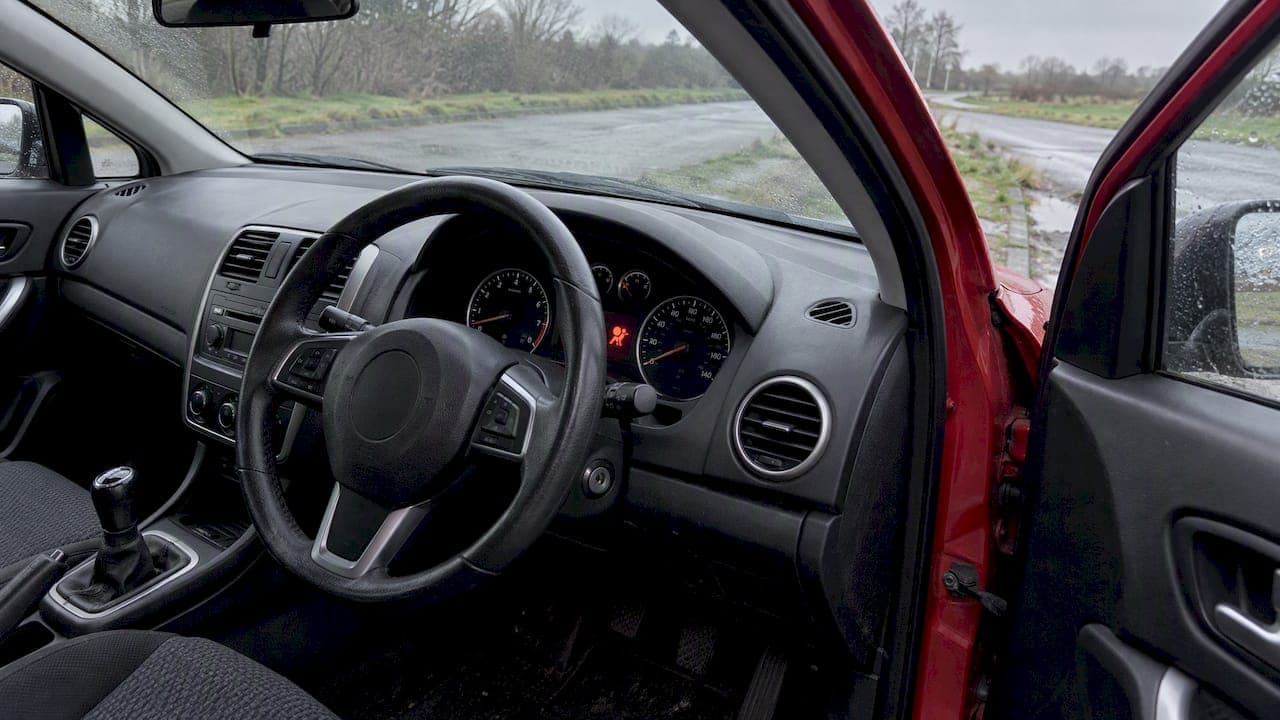
You can usually start and drive a car with the airbag light illuminated, but an illuminated SRS warning means one or more restraint components may be disabled. Check whether it is the passenger-airbag indicator or a genuine system fault, and if it is the latter, arrange a diagnostic without delay rather than waiting for the problem to worsen.
TL;DR:
- A passenger airbag off lamp usually confirms deliberate deactivation, while an SRS warning that stays lit, flashes, or persists after startup signals malfunction.
- A genuine SRS malfunction is a major MOT defect and causes an automatic failure; a deliberately disabled passenger airbag is treated differently.
- Check the startup self test, passenger airbag switch, seat belt buckles, and visible under seat connections, but never test squib circuits with a standard multimeter.
- A technician reads SRS specific codes before deciding whether to repair wiring or sensors, clear stored crash data, or replace a failed module.
Table of Contents
- What the airbag or SRS light actually means
- Can you safely keep driving? risks and what a non-deploying airbag means
- Common causes the top guides cite
- Practical diagnostics: what you can check safely and what you must not attempt
- MOT and legal implications plus typical repair costs and timelines
- How the fault is fixed: diagnostic to reset to repair to replace
- Authoritative technician perspective: what experience teaches you
- Perspective: err on caution when the airbag light stays lit
- How our postal airbag module reset service can help
- FAQ
- Sources
What the airbag or SRS light actually means
Your supplemental restraint system (SRS) covers more than the airbags themselves. It includes seatbelt pretensioners, impact sensors positioned around the body, a clock spring that carries electrical signals through the steering column, and a central airbag control unit that decides when and how everything fires. Every time you turn the ignition on, this network runs a brief self-test, and the warning light should flash for a few seconds before switching off.
Two very different dashboard signals get confused constantly:
- A passenger-airbag "off" lamp simply confirms that the front passenger airbag has been deliberately deactivated, often because a child seat is fitted, and it is not a fault on its own.
- An SRS malfunction indicator that stays lit, flashes while driving, or fails to switch off after the self-test points to a genuine fault somewhere in the system.
The distinction matters for more than peace of mind. Under the MOT inspection manual, an SRS warning light indicating a malfunction is classed as a major defect and results in an automatic fail, while a passenger airbag intentionally switched off is not treated the same way.
Can you safely keep driving? risks and what a non-deploying airbag means
If the fault behind the warning light means an airbag or pretensioner will not fire, the consequence only becomes apparent in a crash, when the very systems designed to limit injury simply do not respond. That is the uncomfortable part of this warning: the car drives completely normally right up until the moment the SRS was needed.
General automotive guidance recommends avoiding driving where possible once the airbag light stays on, and booking a diagnostic check as soon as you can, because airbags and seatbelts remain the primary line of protection in a collision, as reflected in advice from FixMyCar.
A short, familiar local run at low speed carries less exposure than a motorway trip, but neither is risk-free, and the safer habit is to treat any genuine SRS fault as something to resolve quickly rather than something to drive around indefinitely. A few situations call for extra caution:
- Long motorway journeys, where impact speeds and injury severity both increase.
- Heavy traffic or congested routes, where rear-end and multi-vehicle collisions are more common.
- Carrying passengers, particularly children, where every restraint needs to work as intended.
Before deciding how to proceed, check whether the passenger-airbag switch is set correctly and note whether the light behaves consistently or flickers, since both details help a technician narrow down the cause quickly.
Common causes the top guides cite
Airbag warning lights rarely come from one single source, and the list below covers the faults technicians see repeatedly.
- Clock spring failure. The ribbon cable that carries signals through the steering column wears out over time, especially on vehicles with high mileage or frequent full-lock manoeuvres.
- Seat or occupancy sensor faults. Pressure mats and connectors under the seats can corrode, loosen, or fail outright, particularly after a seat has been removed and refitted.
- Stored crash data. Even a minor bump can trigger the airbag ECU to log a crash event, and the light often stays on until that stored data is cleared, regardless of whether any airbag actually deployed.
- Battery and wiring issues. A weak, aging, or recently disconnected battery can cause voltage dips that the SRS module interprets as a fault, as can damaged or chafed wiring anywhere in the harness.
- Water ingress and corrosion. Connectors under seats and within door sills are exposed to moisture, and corrosion here is a common, if less obvious, trigger.
Practical diagnostics: what you can check safely and what you must not attempt
A handful of checks are safe for any driver to carry out before booking a specialist. Watch the self-test sequence at startup and confirm the light switches off within a few seconds rather than staying lit or flashing. Check whether the passenger airbag has been switched off deliberately, and confirm seatbelt buckles click in fully and that nothing looks obviously loose or disconnected under the seats.
What you should never attempt yourself is testing the airbag's squib circuit with a standard multimeter. These circuits are designed to fire with a very small electrical current, and an ordinary meter can push enough current through to trigger accidental deployment. The HSE guidance on handling airbags and pretensioners is explicit that these components must only be handled by trained personnel following the manufacturer's procedures, using controlled, low-current equipment rather than general-purpose tools.
Beyond the visual checks, diagnosing the actual fault code requires an OBD-II scan tool capable of reading SRS-specific codes, something most generic code readers cannot do. Our guide to diagnostic steps that avoid an unnecessary module purchase walks through this in more detail.

Pro Tip: Note down exactly when the light comes on, whether it is constant or intermittent, and what you were doing at the time, as this speeds up diagnosis considerably.
MOT and legal implications plus typical repair costs and timelines
An SRS malfunction light that stays on is treated firmly by MOT testers, so it is important to follow UK test car requirements and instructor checks to avoid cancellations. Per the GOV.UK inspection manual, a malfunction indicator showing a genuine fault is a major defect and the vehicle fails outright, regardless of how the car otherwise performs. A passenger airbag switched off deliberately is a separate case and is not treated as a fault in itself.
Costs vary depending on what is actually wrong:
- A diagnostic fee to read the SRS code and identify the fault, usually the first and cheapest step.
- A bench crash-data clear or reset, appropriate when the module itself is sound but is holding stored crash data or a resolved fault code.
- Module replacement, needed only where the control unit itself has failed rather than simply logged data.
Timelines follow the same pattern: a bench reset can often be completed on the same day a module is received, while a replacement part depends on parts availability and can take considerably longer. Our breakdown of diagnosis costs before committing to a reset covers this trade-off in more depth.
How the fault is fixed: diagnostic to reset to repair to replace
Fixing an SRS fault properly follows a logical sequence rather than guesswork. A technician starts by reading the stored SRS codes with proper diagnostic equipment, which identifies whether the issue sits in a sensor, the wiring, or the control module itself.
Where the module has simply logged a crash event or an already-resolved fault, a bench crash-data clear resets it without needing a full replacement. This is performed off the car, on a bench, because it requires direct, controlled access to the module's memory rather than the limited access available through the vehicle's own wiring loom.
- Codes and crash data are read first to confirm whether a reset is actually appropriate.
- A genuine reset clears the stored fault from the control unit rather than simply switching the light off.
- Manufacturer-specific procedures and low-current testers are used throughout to avoid accidental deployment.
This is also why DIY code erasure rarely solves the problem long-term. Our article on why some airbag lights refuse to clear explains why stored crash data often survives a simple code clear and reappears within days.
Authoritative technician perspective: what experience teaches you
Across more than 40 years of combined technician experience in this field, a handful of patterns repeat constantly. Crash data tends to persist in the airbag ECU long after the component that triggered it has been fixed or replaced, which is why the light so often returns even after a seemingly successful repair. Intermittent lights, in particular, are rarely random, usually tracing back to a specific connector, a seat sensor, or a clock spring nearing the end of its life.
None of this changes the handling rules. Squib circuits are never tested with general-purpose tools, and an undeployed airbag is never stored or handled outside the manufacturer's own guidance.
Pro Tip: If the light comes and goes rather than staying constant, treat it the same way as a permanent fault, intermittent faults still indicate a real problem that can worsen.
Perspective: err on caution when the airbag light stays lit
My view after looking at how this fault actually plays out: the light is not a nuisance warning, it is the one dashboard alert where the consequence of ignoring it only shows up at the worst possible moment. Check the passenger airbag switch first, rule out the simple explanation, and if the fault is genuine, book a diagnostic rather than hoping it clears itself. Skip the motorway trip until you know what you are dealing with.
— John
How our postal airbag module reset service can help
We offer crash-data reset services for various vehicles through a postal system, aiming to complete most modules the same day if received in the morning. Pricing is transparent from the outset, starting at £35 to £46 for standard airbag module resets, with a fixed rate for motorhome airbag resets, and we price match against genuine like-for-like quotes.
If you would rather not post the module, our mobile airbag reset service starts at a competitive price. Trade accounts are available for garages and workshops at discounted rates. Send us the part number or a photo of your module for an identification check, and we will confirm pricing before you ship anything, via our pricing page.
FAQ
Can Autozone clear airbag lights?
Retail parts shops in some markets can read generic engine codes, but clearing a genuine SRS fault typically requires SRS-specific diagnostic equipment and, in many cases, a proper crash-data clear on the control module itself. A code cleared without addressing the underlying fault or stored crash data usually returns within days.
What does it mean when the airbag warning light is illuminated?
A lit airbag or SRS light means the control unit has detected a fault somewhere in the restraint system, which can disable one or more airbags, pretensioners or sensors. An SRS malfunction indicator is classed as a major MOT defect and will fail the test if a tester finds a genuine fault rather than a deliberately disabled passenger airbag.
How expensive is it to fix an airbag light?
Costs depend on the cause: a diagnostic check is usually the cheapest step, a bench crash-data clear or reset costs less than replacing the module outright, and full replacement is reserved for cases where the control unit itself has failed. Our airbag module reset service starts at £35.
What does the SRS light on my dashboard mean?
SRS stands for supplemental restraint system, covering airbags, seatbelt pretensioners and the sensors and control unit that manage them. A lit SRS light means the system has detected a malfunction and one or more of these components may not function correctly in a collision.
Sources
- Gov
- Storing and handling airbags and seat belt pretensioners safely - HSE
- Airbag Warning Light: Why It Comes On & How to Fix It | FixMyCar