
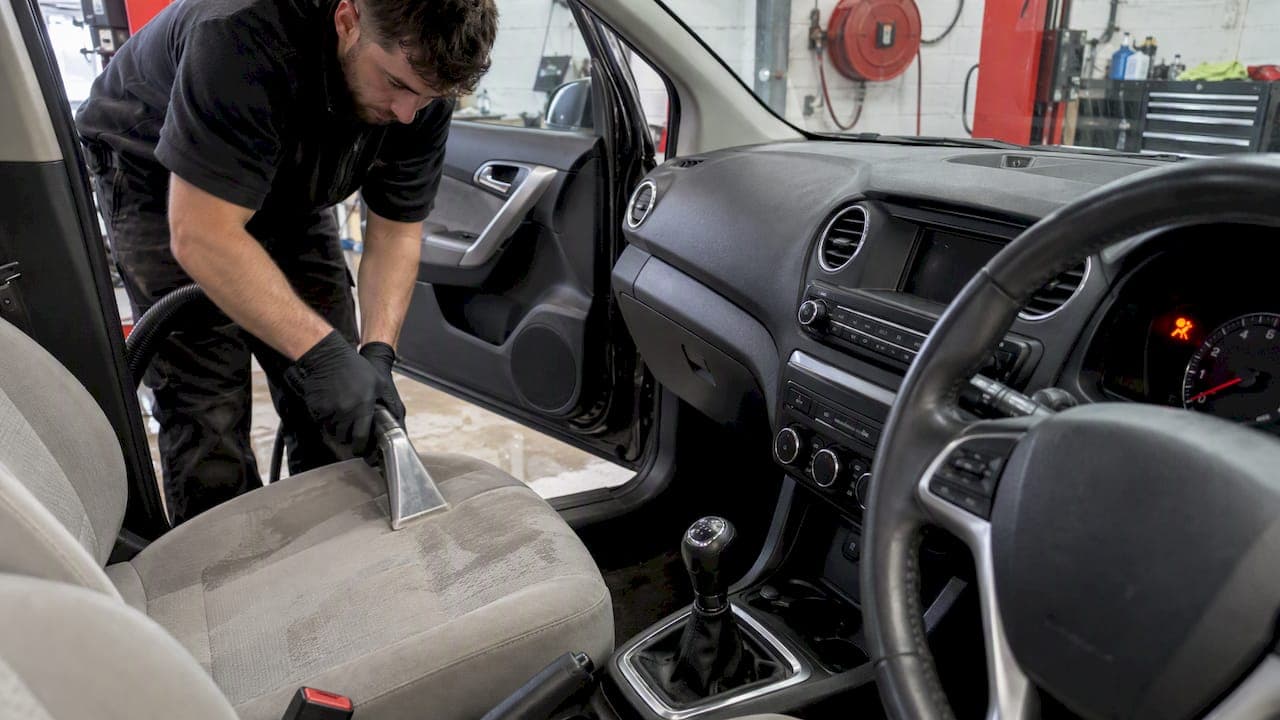
If the airbag light came on after you shampooed, steamed or sponged a seat, the likeliest cause is moisture in the passenger seat's occupant-detection mat, or a connector under the seat that was knocked loose while you worked. Moisture often clears once the cushion dries fully. A disturbed connector or a fault that has been stored in the airbag control unit will not, and the light then needs a proper scan and, in some cases, a crash data reset.
This guide explains what is going on under the upholstery, what to do in the first hour, what the MOT says about it, and what the UK costs look like if you need a garage.
TL;DR
- Wet or damp seat foam can trip the passenger occupancy sensor and switch on the airbag light. Dry the seat with natural air only, never a hair dryer or heat gun.
- Sliding a seat back and forth while cleaning can also pull a connector under it loose, which is a very common cause of the light.
- An airbag light that indicates a system fault is a major defect at MOT, so do not leave it.
- Drying does not always clear the light. If it stays on, you need an SRS-capable scan to read the fault, not a basic engine code reader.
- If the module has stored a fault that will not clear after the cause is fixed, we can reset it by post, from £35.
Table of Contents
- Why cleaning a seat can switch the airbag light on
- The other common culprit: a connector disturbed under the seat
- What to do in the first hour
- Is it safe to drive, and will it pass an MOT?
- If the light stays on after the seat is dry
- Why you cannot just reset the light
- Our view: dry first, diagnose second, replace last
- Need the module reset? Here is how our postal service works
- FAQ
- Sources
Why cleaning a seat can switch the airbag light on
Most modern front passenger seats contain a sensor that tells the airbag system whether someone is sitting there. It lets the car decide whether the passenger airbag should be live, and it often drives the "passenger airbag off" lamp. That sensor sits in or just under the seat cushion, exactly where spilled drink, shampoo and steam end up.
A 2018 manufacturer service bulletin filed with the US safety regulator describes the pattern plainly: moisture in the seat cushion, including after a spill is cleaned up with water or cleaning liquids, can set fault code B1760 and light the airbag warning. That bulletin is an American document for specific vehicles, so treat the code number as an example rather than a universal rule. The mechanism, however, is common across makes.
Other manufacturers say the same thing in their own words:
- Kia's owner guidance says that after cleaning the interior with steam or detergent, you should dry the passenger seat properly and check the passenger airbag "OFF" and airbag warning lights, because moisture can affect the occupant-detection system.
- A 2022 BMW service document explains that the front-passenger occupancy mat uses a capacitive sensor, and that the system sets a fault when moisture is detected on the mat. Technicians are told to look for spills, leaks and other moisture sources.
In plain terms: the mat measures a tiny electrical change when a body presses on it. Water changes that reading, the airbag control unit decides the sensor is not behaving, and it lights the warning.
Why the passenger seat, and why not the driver's
The driver's seat generally has no occupancy mat, so a wet driver's seat is less likely to trigger the light through the mat. It can still cause trouble through the seat-belt buckle switch, the side airbag wiring or the seat-position sensors, all of which live low down near the runners. If the light came on after you cleaned the driver's side, look at wiring rather than the cushion first.
The other common culprit: a connector disturbed under the seat
Cleaning rarely stops at the cushion. To vacuum properly, most people slide the seats fully forward and back, tilt the backrest or even remove the seat. Under each front seat there is a yellow-sheathed connector, usually for the side airbag, belt pretensioner or occupancy sensor. Pulling or flexing it can leave it half-seated.
One UK motoring site lists a loose or corroded connector under a front seat, disturbed by sliding the seat on its runners, as the single most common cause of the airbag warning light. The Motor Ombudsman also lists faulty seat-belt switches and damaged clock springs among the usual suspects, which is why a light after cleaning is not always a moisture problem.
How to tell the two apart without tools:
| Clue | Points to moisture | Points to a disturbed connector |
|---|---|---|
| Cause of cleaning | Steam, shampoo or a spill on the cushion | Seat moved, tilted or removed |
| Which seat | Usually passenger | Either front seat |
| Light behaviour | May fade as the seat dries | Stays on, or comes and goes with bumps |
| Other symptoms | Passenger airbag lamp behaving oddly | Seat-belt light on as well |
The table is a guide, not a diagnosis. Both faults can exist at once, and the only way to know is to read the stored code.
What to do in the first hour
Start with the steps that cost nothing and risk nothing.
- Stop adding moisture. Do not spray more cleaner or run the steam cleaner over the seat again.
- Mop up what you can. Blot, do not rub, with dry microfibre cloths or towels. Press, lift, repeat.
- Dry with natural air. The service bulletin advises drying a damp cushion with natural air, for example parking in a sunny spot with the windows slightly open, and says not to use a heat gun or hair dryer, which can damage the sensors. A dehumidifier in a garage, with the car doors open, also helps.
- Give it time. Seat foam holds water far longer than the surface suggests. Allow a day or two in cold weather before judging the result.
- Check the obvious. Make sure nothing is stuffed under the seats, that the seat rails are clear and that the seat belts latch and retract normally.
- Restart the car. Switch off, wait a minute and start again. The system runs a self-check at every start, so a cleared fault will let the light go out.
If the seat was soaked rather than damp, or if the spill was sugary or milky, bacteria and mould can follow the moisture. Our friends in the car-care trade have a useful guide on safe interior mould removal for UK cars, which is worth reading before you seal a damp seat back up.
What not to do
- Do not unplug seat connectors with the battery connected. Manufacturers specify a waiting period after disconnecting the battery before anything in the airbag circuit is touched, as one UK guide points out.
- Do not poke or cut into the seat cover to dry the mat. The mat is calibrated, and folding or damaging it can create a fault of its own.
- Do not tape over the warning lamp or pull its bulb or fuse. That hides a safety warning without making anything safer.
Is it safe to drive, and will it pass an MOT?
A lit airbag light means the system has logged a fault and may not deploy properly in a crash. The Motor Ombudsman advises taking the car to an independent garage or franchised dealer for this reason, because the airbags may not deploy in a crash. A flashing light is generally treated as more serious than a steady one.
The MOT rules are clear. The DVSA inspection manual says that an SRS malfunction indicator lamp showing a system malfunction is a major defect, whereas a lamp that only shows the passenger airbag has been switched off is not a defect. A major defect means a fail, and the vehicle cannot legally be driven away on an old certificate if it is considered dangerous.
So a lamp that stays on after cleaning is not something to carry into your next test. Sort it before the MOT, not at the test station. Our guide on avoiding MOT failure with an airbag light goes through the diagnostic costs in more detail.
If the light stays on after the seat is dry
When the cushion is genuinely dry and the light is still on, stop guessing. The manufacturer guidance is that drying and functional testing should come before any parts are replaced, and that a persistent light needs a professional SRS diagnostic scan to establish whether a code needs clearing or a component is damaged.
What a proper scan involves
A standard engine code reader usually cannot see the airbag system. A garage needs a scan tool that reads SRS faults, so it can see which circuit or component has complained. The usual sequence is:
- Read the stored SRS fault codes and any freeze-frame data.
- Inspect connectors, the seat, the occupancy mat and any areas where work was recently done.
- Repair the actual fault: re-seat or replace a connector, dry or replace the mat.
- Clear the code and test the system again, confirming the light stays out.
Working systematically like this avoids replacing expensive parts on a hunch. It is also why we suggest reading our airbag diagnostics steps before anyone buys a new module.
What it costs in the UK
Figures from a 2026 This is Money guide to warning-light costs give a sense of the range:
| Job | Typical cost quoted |
|---|---|
| Diagnostic plug-in at a high-street chain | £39.95 to £54.99 |
| Airbag cable-connection repair | From £139 |
| Sensor repair | £540 to £768 |
| Airbag replacement | £1,440 to £2,160 |
These are the prices reported by This is Money and will vary by car and garage. The takeaway is the gap: a loose connector is a small job, a replaced sensor or airbag is a large one, so confirm the fault before authorising anything.
Why you cannot just reset the light
It is tempting to look for a trick to switch the lamp off. The trouble is that the light is the symptom. A guide to the airbag warning light notes that the fault code returns as soon as the system runs its self-check unless the underlying problem has been fixed. Resetting only makes sense once the wet mat has dried, the connector has been re-seated or the damaged part has been repaired.
There is one case where a reset is the genuine fix. After a moisture or low-voltage event, the control unit may keep a fault stored even when the cause has gone. Likewise, if the car has had a minor impact, the module may hold crash data that stops it working until it is cleared. In those cases the light stays on even though everything physical is fine, and a scan tool clear on the car does not always work. That is where a crash data reset on the module itself comes in. If your light is stubborn, our guide to an airbag light that won't clear lists the UK checks and options, and our piece on an airbag light with no codes covers the case where a scan shows nothing at all. If the light comes and goes, read what an intermittent airbag light means.

Our view: dry first, diagnose second, replace last
We handle airbag modules every day, and the pattern with seat-cleaning cases is consistent. Most people assume the worst, that the expensive module or the passenger sensor has died, and some are quoted for a replacement before anyone has read a code. In our experience that is rarely where the money needs to go.

Our advice runs in this order. First, let the seat dry properly and check the connectors are seated. Second, get the SRS code read with a tool that can see it, so you know whether you are dealing with a sensor, a wire or the control unit. Third, only if the module itself is holding a stored fault or crash data, send it for a reset. Our whole approach is to reset the original unit when it is safe to do so, so you do not buy an unnecessary replacement ECU.
Two cautions from the bench. Do not take the airbag system apart yourself: mishandling it can set off a deployment, and the work belongs with trained people. And do not accept a reset as a substitute for repair. If the wiring or mat is faulty, the light will come back, and the airbag will not be there when you need it.
— John
Need the module reset? Here is how our postal service works
If a scan shows the control unit is holding a stored fault or crash data, you do not need a new one. You post us the module, and most are turned round the same day when they arrive in the morning. Our airbag module reset runs from £35 to £46, depending on the module, with fixed pricing. If you are unsure which module you have, send us the part number or a photo and we will help identify it by phone or WhatsApp. We also price-match genuine like-for-like quotes.
Other options: motorhome modules are handled at £65 on our motorhome airbag reset page, and our mobile airbag reset service starts from £75. Garages and bodyshops can ask about discounted trade accounts. If you would like to know more before posting anything, see our price guide to airbag ECU resets or start at Airbag Reset UK.
FAQ
Can a spilled drink really set off the airbag light?
Yes. Liquid in the passenger seat cushion can disturb the occupancy mat, and manufacturer bulletins record moisture as a cause of airbag fault codes. Dry the seat with natural air and give it time. If the light stays on once it is dry, get the fault code read.
How long should I wait for the seat to dry before worrying?
Seat foam can hold moisture for days, especially in cold or damp weather, so allow a day or two with the windows slightly open. If the light is still on after that, or if it is flashing, do not keep waiting. Book an SRS scan.
Will the light go off by itself?
Sometimes. If the cause was only moisture, the system's self-check at start-up can clear the warning once the mat reads normally. If a connector is loose or the module has stored the fault, the light will not go out until the problem is dealt with and the code is cleared.
Can I use a hair dryer to speed things up?
No. The manufacturer guidance warns against heat guns and hair dryers because they can damage the sensors. Use natural air, a sunny spot and open windows, or a dehumidifier in a garage.
Does a reset cost much?
For a standard airbag module, our postal crash data reset is £35 to £46. Motorhome modules are £65, and mobile resets start from £75. That compares well with the hundreds of pounds quoted for sensor repair or replacement, though a reset is only the right answer once the cause of the fault has been put right.
Sources
- NHTSA service bulletin on seat moisture and airbag fault code B1760 (2018)
- Kia owner's manual: cleaning the interior and the passenger airbag lamp
- NHTSA service document on the BMW passenger occupancy mat (2022)
- DVSA MOT inspection manual: other equipment
- The Motor Ombudsman: Getting to know airbags
- This is Money: dashboard warning lights and repair costs
- MOT Files: airbag warning light guide
- Diamondbrite: interior mould removal for UK cars