
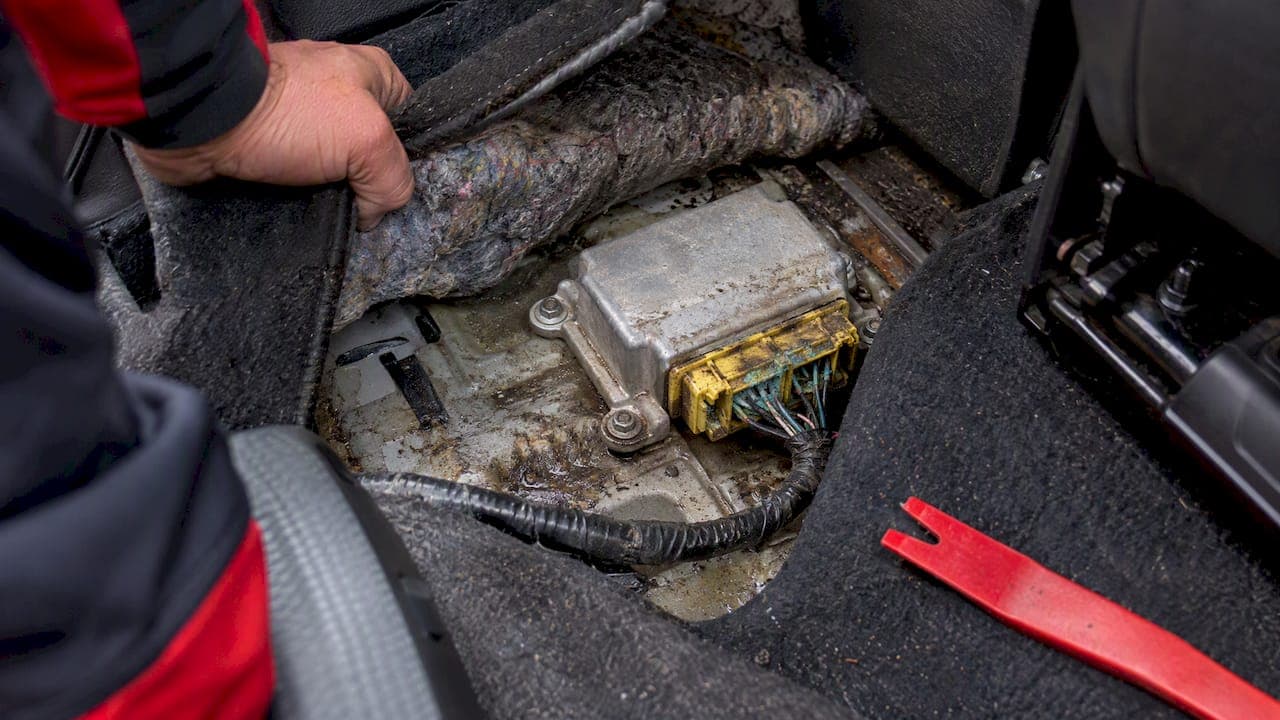
Corrosion often causes permanent damage inside an airbag module, so repair is only sometimes possible and should never be assumed. In the UK, an illuminated SRS warning lamp is treated as a 'Major' defect under DVSA MOT inspection guidance, meaning an automatic test failure. Book a proper diagnostic scan and inspection before assuming a reset will clear the fault.
TL;DR:
- Damp, musty carpet near a low mounted module, recurring fault codes, or lost scan tool communication warrant inspection, but none alone confirms corrosion.
- Technicians should check connector pin tension, resistance, continuity, power, and ground before blaming the module, since a corroded connection can mimic internal failure.
- Cleaning may work when oxidation stays on terminals and the sealed case and circuit board remain intact; board damage or water inside calls for replacement.
- A replacement module needs VIN specific programming with manufacturer level tools; without configuration data, even a sound unit can leave the warning lamp on.
- Fixing leaks, clearing drains, replacing waterlogged padding, and fully drying carpets help prevent repeat damage; a reset cannot address the moisture source.
Table of Contents
- What corrosion does to an airbag control module and why that matters
- How to spot corrosion and the common symptoms it causes
- How technicians diagnose suspected corrosion: step-by-step tests and checks
- Can a corroded module be repaired? Criteria, safety considerations and likely outcomes
- Practical next steps: inspection, cost drivers, and preventing recurrence
- What years of corrosion cases teach you about airbag faults
- How we can help once the module is confirmed sound
- FAQ
- Sources
What corrosion does to an airbag control module and why that matters
The airbag control module, sometimes called the SDM (sensing and diagnostic module) or ACM, is the brain behind crash detection. It reads signals from impact sensors, decides whether a collision meets the threshold for deployment, and fires the airbags and seatbelt pretensioners when needed. Every connection inside that unit needs to work reliably, because a delayed or failed signal defeats the entire point of the system.
Corrosion attacks the module in several ways. Moisture reaching the connector pins causes oxidation, which increases electrical resistance and can interrupt the signal path between the module and the rest of the car. Left long enough, that same moisture can creep past the connector shell and reach the printed circuit board inside, corroding solder joints and etching away copper traces. Once the board itself is affected, the damage is rarely cosmetic: it changes how current flows through the circuit, which can alter sensor readings or stop the module communicating at all.
Compromised electronics inside the module do not always announce themselves with a dramatic failure. A corroded trace might still pass current most of the time, only to fail at the exact moment a crash sensor sends its signal, which is the worst possible outcome for a safety system. A manufacturer bulletin covering General Motors vehicles describes this pattern directly: moisture trapped beneath carpets soaks into the acoustic padding, sits against the module, and causes the kind of corrosion that leads to malfunction rather than a clean failure, as noted in the GM technical bulletin on the issue.
Module placement makes this worse in many vehicles. SDMs are commonly mounted under a front seat, in the centre tunnel, or low in the floor pan, which are exactly the areas where water collects after a leak. Any carpet that stays damp for an extended period puts the module at risk, even if the leak itself seems minor.

How to spot corrosion and the common symptoms it causes
Corrosion inside or around an airbag module tends to produce a mix of dashboard warnings, diagnostic anomalies, and visible physical signs. None of these on their own confirmations corrosion, but together they build a strong case for inspection.
- A persistent SRS or airbag warning lamp that stays lit after the ignition cycle, sometimes with a "Service Airbag" message on the dash.
- Multiple stored crash or fault codes that do not correspond to an actual collision, or codes that keep returning after being cleared.
- Loss of communication between the scan tool and the module, often described as a "module not responding" or "no communication" result.
- Intermittent faults that appear only when the car is cold, damp, or driven over rough roads, which points to a loose or corroded connection rather than a dead component.
- Visible green or white deposits on connector pins, rust on the module housing, warped seals, or damp and musty-smelling carpet near where the module sits.
These physical signs rarely appear in isolation. A blocked sunroof drain, a failed door seal, or a leaking windscreen surround lets water travel further into the cabin than most owners expect, and once carpet and underlay stay wet, the module sitting beneath them is next in line. Spotting mould or damp patches near the footwell is often the first real clue, even before any dashboard warning appears.
How technicians diagnose suspected corrosion: step-by-step tests and checks
A reliable diagnosis follows a sequence rather than a single check, because corrosion can affect the wiring, the connector, or the module itself in different combinations.
- Read airbag-specific diagnostic trouble codes and readiness status with an OEM-capable scan tool, noting whether the module responds at all or returns communication errors.
- Carry out a visual inspection of the module case, connector shells, and surrounding trim or carpet padding, looking for discolouration, pitting, or dampness.
- Check contact resistance and continuity at the connector pins with a multimeter, and confirm that power and earth feeds reach the module at the correct voltage.
- Where bench equipment is available, run bench tests and inspect stored crash data to see whether the module's internal circuits respond correctly under controlled conditions.
Our guidance on diagnosing water-damaged airbag modules sets out this workflow in more detail for technicians working through a suspected corrosion case.
A code clear is not a diagnosis. Clearing a stored fault without checking the hardware underneath it can mask a wiring or module problem that returns within days, and in a safety system that gap matters more than almost anywhere else in the car.
Pro Tip: Always check connector pin tension and resistance before assuming the module itself is faulty: a loose or corroded pin can mimic an internal module fault on a scan tool.
Can a corroded module be repaired? Criteria, safety considerations and likely outcomes
Repair is realistic when the damage is limited to the surface. Minor oxidation on connector terminals, with the module's internal board and sealed housing still intact, can often be cleaned and restored to full function. This is the scenario where a professional crash-data reset makes sense, clearing stored fault codes once the hardware has been confirmed sound.
Replacement becomes the safer route once corrosion has reached the internal circuit board, once water has entered the sealed case itself, or once connector pitting is severe enough to affect multiple pins. At that point, the electrical integrity of the unit cannot be guaranteed, and an airbag module is not somewhere to accept uncertainty. If the circuitry controlling deployment timing is compromised, the consequence in a real collision is a system that fires late, fires incorrectly, or does not fire at all.

A fresh or salvage replacement module is not an instant fix. It arrives without the vehicle's crash history or configuration data, so it needs VIN-specific programming using OEM-level tools before the SRS system will function correctly. Our article on what a crash-data reset actually involves explains why this programming step is unavoidable, and why fitting a replacement without it leaves the warning lamp lit regardless of how sound the new hardware is.
Practical next steps: inspection, cost drivers, and preventing recurrence
Once corrosion is suspected, get a proper diagnostic scan before anything else, and avoid attempting a DIY reset without proof that the hardware underneath is intact. Our piece on diagnosing versus resetting an airbag ECU covers why skipping that step risks an MOT failure further down the line.
Costs tend to come from three places: diagnostic labour to confirm the fault, the module itself plus VIN programming if replacement is needed, and any carpet removal or leak repair required to stop water reaching the area again.
Preventing a repeat failure means addressing the moisture source, not just the symptom.
- Clear sunroof and door drains so water has somewhere to go instead of pooling in the cabin.
- Check door, boot, and sunroof seals for perishing or gaps that let rain in.
- Remove acoustic padding that has trapped moisture rather than reinstalling it wet.
- Dry carpets fully and use a dehumidifier or proper drying procedure before refitting trim.
Our partners at Diamondbrite cover safe interior removal and mould prevention in more depth, which is worth a look once the leak itself has been traced and fixed. A specialist reset service becomes the right next step once a workshop has confirmed the module's hardware is sound and the only outstanding issue is stored crash data.
What years of corrosion cases teach you about airbag faults
Water intrusion can cause corroded modules, and the fault can keep coming back unless the leak itself gets fixed, not just the symptom on the dashboard. Workshops lean toward replacement whenever there is visible corrosion on the internal board, because a module controlling airbag deployment is not the place to gamble on a partial repair. Where the hardware checks out sound, identifying the module correctly and getting the crash data cleared properly is usually all that is needed.
— John
How we can help once the module is confirmed sound
Once a workshop has confirmed your module's hardware is intact, our postal crash-data reset service clears the stored fault without the cost of a full replacement, with pricing from £35.
If you are not sure which part number you have, send us a photo or the part number itself and we will help identify it. A badly corroded module with internal board damage will still need replacing rather than resetting, which is something we will flag honestly rather than take payment for a job that will not solve the problem. For vehicles that cannot easily be moved, our mobile airbag reset covers on-site work, and motorhome owners can find details on our motorhome airbag reset page.
FAQ
How do you take out an airbag control module?
Access varies by vehicle, but the module is commonly found under a front seat, in the centre console area, or mounted to the floor pan or transmission tunnel. Always disconnect the battery and wait for the manufacturer's specified discharge time before touching any airbag wiring, since the system can retain enough charge to trigger deployment.
How much does it cost to replace an airbag system?
Costs depend on whether the module alone needs replacing or whether sensors, wiring, or the airbags themselves are also affected, plus the VIN-specific programming a replacement module requires. A professional reset on an intact module, where repair rather than replacement is appropriate, starts at £35.
Can you drive with an airbag module removed?
Driving with the airbag module removed or disconnected leaves the SRS system non-functional, and the warning lamp will stay lit as a result. Under DVSA MOT guidance, an illuminated SRS lamp is a 'Major' defect, so the car will fail its MOT test in that state.
Can airbag wires be repaired?
Minor connector corrosion or a damaged section of wiring can often be cleaned, repaired, or spliced by a competent technician, provided the repair restores full continuity and resistance to specification. Wiring that has been exposed to prolonged water intrusion alongside the module itself should be checked carefully, since corrosion rarely stays confined to one component.
What should you check before choosing an airbag reset service?
Look for clear, fixed pricing shown upfront rather than a quote given after the module arrives, along with a realistic turnaround time and a willingness to identify your module from a part number or photo before you commit. A service that tells you honestly when a module needs replacing rather than resetting is one worth trusting over one that promises a fix for every unit regardless of its condition.