
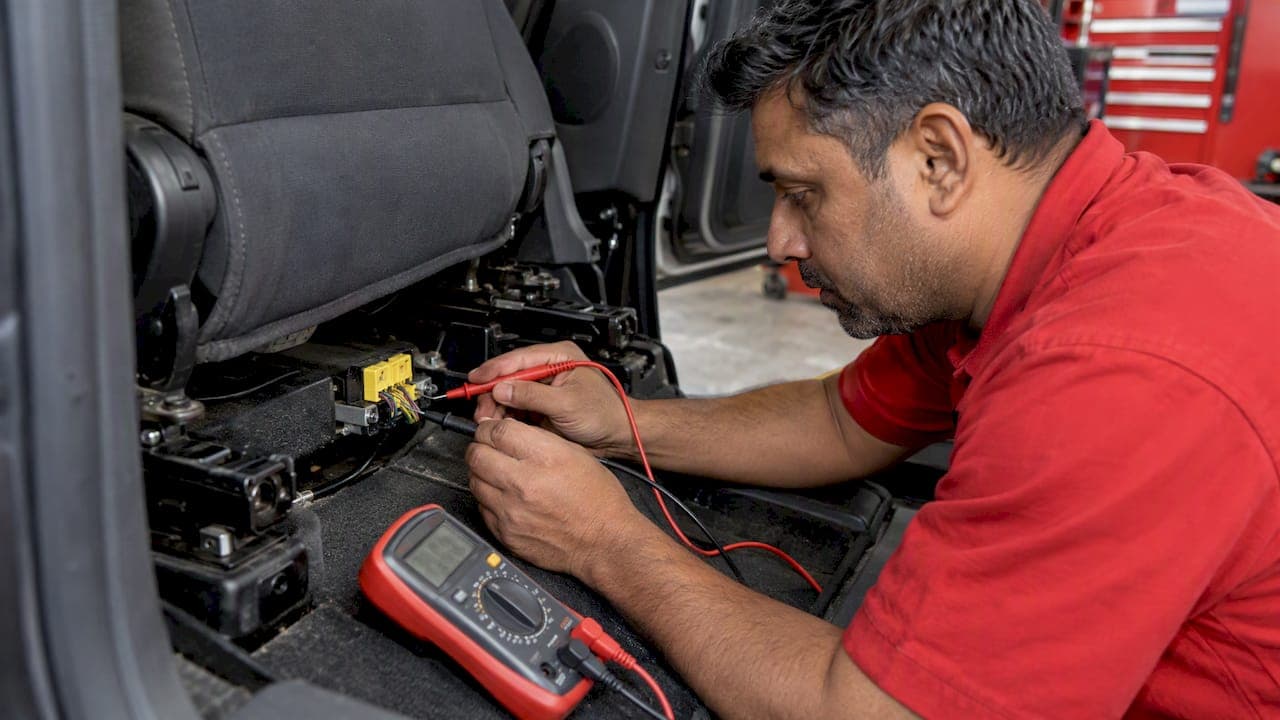
An airbag module power fault means the SRS control unit is not getting a stable supply or a clean earth, or it has stored a low-voltage event it cannot clear. The usual culprits are a weak battery, a blown SRS fuse, a poor earth or damaged wiring. The module itself is less often to blame. Work through those in order before you buy a replacement unit, because a new ECU will not cure a fault that lives in the wiring.
This guide shows you what the fault really is, what to check, what is safe to do yourself, and what to do when the module needs professional attention.
TL;DR
- A "power fault" is often a symptom of low or unstable voltage, a blown fuse or a bad earth, not a dead airbag computer.
- Check the battery, the SRS fuse, the earth points and the connector before condemning the module.
- A lit SRS lamp is a major MOT defect, so the fault cannot be left alone.
- If the module is stuck with stored crash or fault data, a postal reset from £35 often avoids buying a replacement.
Table of Contents
- What an airbag module power fault actually is
- The most common causes
- Check the battery first
- Then the SRS fuse and the wiring
- A safety note before you touch anything
- When the module itself is the problem
- Your options compared
- What this means for your MOT
- Our perspective: reset the original when it is safe to
- Postal reset and repair with Airbag Reset UK
- A sensible order of work
- FAQ
- Sources
What an airbag module power fault actually is
The airbag control module (also called the SRS module, SRS ECU or restraint control module) watches crash sensors and decides when to fire the airbags and seatbelt pretensioners. To do that it must be powered and earthed at all times, and it runs a self-test every time you start the car.
If the supply voltage dips, the earth is weak or a connector loses contact, the self-test can fail. The module then logs a fault code, switches on the SRS warning lamp and may disable the system. Different manufacturers word the code differently: "supply voltage too low", "control unit power supply", "internal fault" or simply "no communication". The root issue is the same: the module is not seeing what it needs to see.
That is why a scan tool reading "power fault" does not tell you the module is broken. It tells you where to start looking.
The most common causes
Technical guidance on SRS diagnosis notes that these faults are frequently misdiagnosed: they usually come from unstable battery voltage, with dips below roughly 10 to 11 volts during cranking, or from poor ground connections, rather than a failed control module.
| Cause | Typical clue | Who can fix it |
|---|---|---|
| Weak or ageing battery | Lamp appears after slow starts or short journeys | You or a garage |
| Recent battery change or jump start | Lamp came on straight after the battery work | You, then a scan tool clear |
| Blown SRS fuse | Lamp on constantly, module will not communicate | You (find the cause first) |
| Corroded or loose earth | Fault comes and goes with bumps or damp weather | Garage |
| Damaged seat or yellow connector wiring | Fault after seat removal, trim work or water ingress | Garage |
| Water or corrosion inside the module | Under-seat or footwell damp, repeated faults | Module repair |
| Stored crash or low-voltage data | Lamp stays on after the wiring checks out | Module reset or repair |
The last two rows are where a specialist module service earns its keep. The rest are cheap checks.
Check the battery first
Airbag modules are sensitive to supply voltage. A battery that starts the engine can still sag far enough during cranking to upset the SRS self-test.
- Have the battery tested under load. Most tyre and battery fitters will do this quickly.
- Look at the terminals for white or green corrosion and make sure the clamps are tight.
- Check the alternator output with the engine running, because an alternator that undercharges produces the same symptoms as a tired battery.
- If you have recently changed the battery, ask whether the fault code was cleared afterwards. The lamp can stay on because the stored low-voltage code was never erased.
A lamp that appears directly after a battery change is one of the most common reader questions about this fault. Often the module simply logged the supply interruption. A scan tool that can talk to the SRS module may clear it. If it comes straight back, the fault is still active and needs tracing.
Then the SRS fuse and the wiring
Find the SRS or airbag fuse in your handbook. The guidance above says SRS fuses are commonly in the 10A to 30A range, but always use the rating printed in your fuse box diagram and never fit a higher one to make a fault go away.
A fuse that has blown once may be a one-off. A fuse that blows again points to a short in the wiring, and a fresh fuse will only blow again. Our guide on what to do when an airbag fuse keeps blowing explains how to check the wiring before putting another fuse in.
The same technical guidance describes checking wiring harness continuity, with readings expected to be under 2 ohms, before deciding the control module is at fault. That needs a multimeter and some know-how, which is why most owners hand this step to a garage.

Earths and connectors
SRS modules usually sit under the front seats, under the centre console or behind the dash. Those spots collect spilt drinks, damp carpets and the odd phone charger cable. Look for:
- Corrosion or green deposits on the module connector or earth strap.
- Bent or pushed-back pins, especially if the connector has been unplugged before.
- Damp carpet or underlay near the module.
- Seat wiring that has been trapped, stretched or cut after trim or seat work.
If the module reports no communication at all, our checklist for a no communication airbag module walks through what to rule out before sending it away.
A safety note before you touch anything
Airbag systems contain explosive inflators. Repair guidance for modern vehicles warns that incorrect repair techniques can cause an accidental SRS deployment, and that the manufacturer's disable procedure must be followed exactly. So:
- Do not probe airbag connectors with a multimeter. You can set off a squib circuit.
- Do not unplug SRS connectors with the ignition on or the battery connected unless the manufacturer's procedure says so, including the waiting time.
- Leave anything beyond the battery, fuse and visual checks to a garage with SRS diagnostic equipment.
If you are unsure, stop at the visual checks and book a diagnostic.
When the module itself is the problem
Once the battery, fuse, earths and wiring are sound and the fault persists, the module is the likely cause. That can mean:
- Stored crash data. Even a minor impact can be recorded, and some modules lock themselves and keep the lamp on until the data is cleared.
- A corrupted memory or lost communication after a voltage spike or jump-start mishap.
- A failed internal component, such as a power supply stage or a damaged track from water ingress.
The tempting response is to order a replacement ECU. That is expensive, and a used module from a scrapyard carries someone else's data and may be locked to another vehicle's configuration. Resetting or repairing the original unit is frequently the cheaper and quicker route, provided the unit can be safely restored.
If you want a sense of what a garage diagnostic might add on top, see our breakdown of airbag light diagnosis costs. If the lamp refuses to go out even after the obvious fixes, read why an airbag light won't clear.
Your options compared
| Route | What it involves | Things to weigh |
|---|---|---|
| Clear the code with a scan tool | Quick if the cause was a one-off voltage dip | Fails if the fault is live or the module is locked |
| Garage diagnostic and wiring repair | Finds shorts, bad earths and connector faults | Diagnostic time costs money, and it may still end with the module |
| New or used replacement module | Fit and, for some makes, coding | Highest cost, risk of mismatched or crashed used units |
| Postal crash data reset or repair | Module removed, posted, reset and returned | Needs a day or two without the module, wiring must be sound first |
| Mobile service | Technician comes to you | Convenient, priced separately |
No option replaces the earlier checks. Resetting a module on a car with a short in the harness only delays the next warning.
What this means for your MOT
The official MOT manual treats an SRS malfunction lamp that indicates a fault as a major defect that fails the test. A lamp showing that a passenger airbag has been deliberately switched off, for example for a rear-facing child seat, is not a defect. The testers' own guidance says they are only looking at whether the lamp indicates a fault with the system.
In practice: if the lamp is lit because of a power fault, fix it before the test, not after the fail sheet. Beyond the MOT, a lit lamp can also mean the airbags may not fire in a collision, so it is not something to live with.
Buying a used car with a Cat S history or an SRS lamp that comes and goes? Read our note on Cat S airbag lights and buyer risks before you hand over any money.

Our perspective: reset the original when it is safe to
We see the same pattern again and again with modules that arrive here with a power or communication fault. The owner has been told the module is dead, often after a scan tool displayed a vague code, and has been quoted for a new unit. In many of those cases the original module can be reset and put back into service, and the saving is considerable.
Our view is simple. First, rule out the cheap things: battery, fuse, earths, connectors. If the car has had water in it, or the fuse keeps blowing, the wiring needs sorting or the reset will not last. Second, do not buy a replacement ECU until someone has looked at whether the one you have can be restored. Third, when you do send a module off, get the identification right. We help with that by part number or from a photo of the label, over WhatsApp or phone, so the right procedure is used on the right unit.
We would rather tell you that your fault is a loose earth than take your module and a payment for a job that will not fix it. Our technicians have more than 40 years of combined experience, and we would rather you spend nothing than spend on the wrong thing.
— John
Postal reset and repair with Airbag Reset UK
If your checks point at the module, we reset and repair airbag ECUs by post for cars, vans and motorhomes across the UK. Most modules that reach us in the morning are turned around the same day. Pricing is fixed and published:
- Standard airbag module reset: £35 to £46, depending on the module.
- Motorhome airbag reset: £65.
- Mobile airbag reset: from £75.
We also price match genuine like-for-like quotes, and garages and workshops can apply for a discounted trade account. If you are not sure which module you have, send us the part number or a photo through our main site and we will identify it before you post anything.
For specific models, we have pages covering common applications such as the Audi A4, Audi A6 and Mercedes A Class.
A sensible order of work
- Note exactly when the lamp came on: after a battery change, a jump start, a wash, seat work or an impact.
- Get the SRS fault code read with a tool that can access the airbag system. A basic engine code reader often cannot.
- Test the battery and charging system.
- Check the SRS fuse and the visible connectors and earths.
- Have a garage check harness continuity if the fuse blows again or the fault is intermittent.
- If the wiring is sound and the fault stays, have the module reset or repaired rather than replaced.
- Clear any remaining codes and confirm the lamp stays off over several journeys, not just one.
Keep the fault code printout. It helps whoever handles the module next, and it is useful evidence of what the problem was if you sell the car.
FAQ
Can I drive with an airbag power fault?
The car will usually drive normally, but the airbags and pretensioners may not work in a crash, because the system may be disabled while the fault is active. The lamp will also fail an MOT. Get it checked rather than waiting for the next test.
Why did my airbag light come on after a new battery?
Disconnecting the battery or a voltage dip during the swap can leave a stored low-voltage code in the module. Sometimes a scan tool that reads SRS codes clears it. If the lamp returns immediately, the fault is live, so check the fuse, earths and connectors, then the module.
Will resetting the module fix a power fault?
Only if the module itself is holding the fault, for instance stored crash or low-voltage data. If the cause is a weak battery, a blown fuse or damaged wiring, a reset will not hold. That is why we suggest ruling out the supply and wiring first.
How much does it cost to reset an airbag module?
Our postal reset costs £35 to £46 depending on the module, £65 for motorhome modules, and from £75 for the mobile service. Garage prices vary by make and by how long diagnostic time takes, so ask for a fixed figure before agreeing work.
Do I need a new airbag module?
Not always. Many modules can be reset or repaired and refitted, which usually costs less than a replacement and avoids mismatched used units. A replacement only becomes necessary when the unit is physically damaged beyond repair.
Sources
- MOT inspection manual: other equipment, GOV.UK
- Common mistakes made by MOT testers, Matters of Testing
- DTC B0019 deployment control diagnosis, FS1
- 2022 Ford Edge SRS disable procedure, I-CAR RTS