
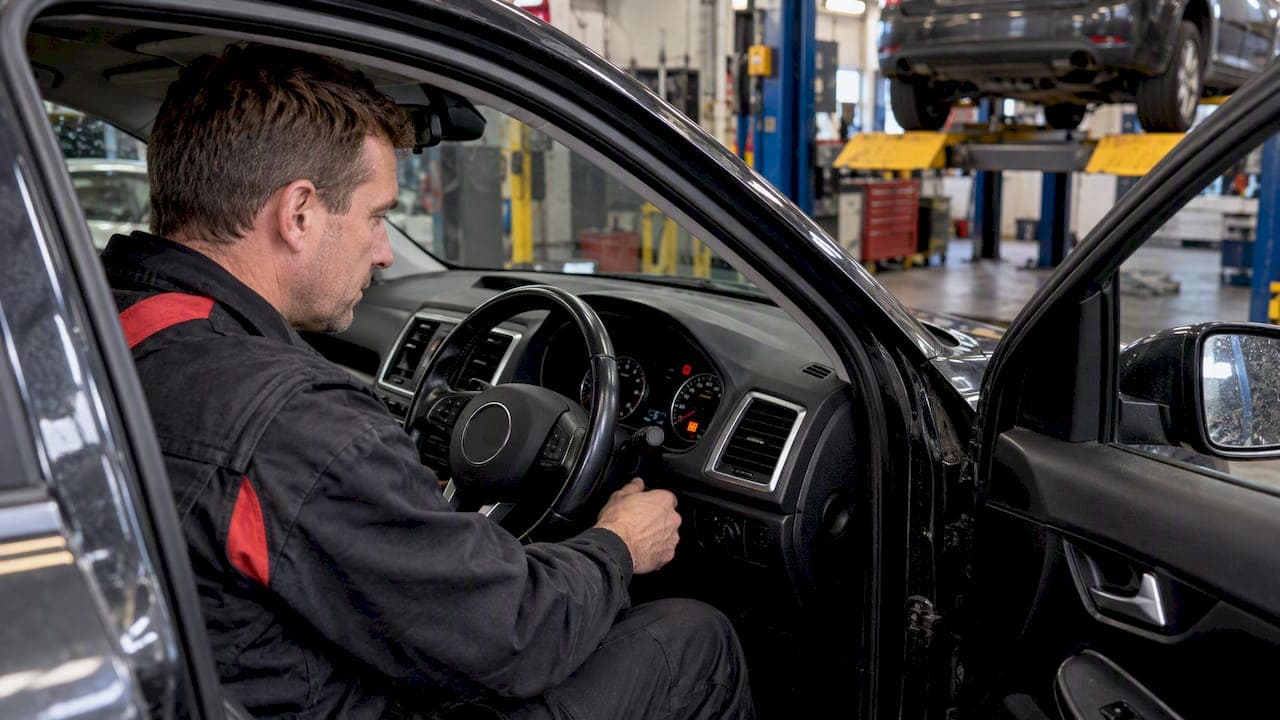
An illuminated airbag or SRS warning light is classed as a major defect under the MOT inspection manual and will fail the test until the fault is fixed. If your car carries a Category S history, treat the light as urgent: book an SRS diagnostic or a reputable reset service before your MOT date, not after.
TL;DR:
- Use an SRS scanner that can read airbag codes; generic readers may miss them, so inspect wiring, sensors, and pretensioners before choosing a reset.
- A deliberate passenger airbag off message is not an MOT defect, but a malfunction lamp that stays lit or returns during testing is.
- A module reset from £35 for standard cars and vans clears stored crash data only; damaged sensors, deployed pretensioners, or broken wiring require repair first.
- Cat S buyers should request repair records, check the MOT history, and arrange an independent SRS inspection if the seller cannot document the work.
- If the warning light appears after any impact, stop driving and seek an immediate professional inspection rather than assuming a reset will solve it.
Table of Contents
- What the SRS warning light means and why it matters on a Cat S car
- Most likely causes for an airbag light on a previously repaired car
- MOT, insurance and legal implications of an airbag light in the UK
- How to fix an airbag light in the UK: options and realistic costs
- How a postal crash-data reset actually works
- What owners and buyers of Cat S cars should do next
- Airbag Reset UK: postal resets for persistent airbag lights
- FAQ
- Sources
What the SRS warning light means and why it matters on a Cat S car
The SRS light, often labelled airbag on the dashboard, should illuminate briefly when you turn the ignition on and then switch off once the system completes its self-check. That brief flash is normal. A light that stays on, flickers intermittently or comes on while driving tells you the airbag control module has detected a fault somewhere in the system, whether that's a sensor, the wiring loom, a seatbelt pretensioner or the module itself.
There's an important distinction worth knowing. Some vehicles display a separate "passenger airbag off" message when that airbag has been deliberately deactivated, often for fitting a rear-facing child seat. That message is not a fault, and the MOT manual confirms testers should not mark it as a defect. The SRS malfunction indicator lamp (MIL) staying lit is a different matter entirely: it signals the system itself has a problem.
This distinction carries extra weight on a Category S vehicle, because Cat S status means the car suffered structural damage severe enough to be written off by an insurer before being repaired and returned to the road. Airbag sensors, crash wiring and pretensioners sit close to the structural areas that absorb impact, so repairs that focus on bodywork and paint can easily leave SRS components unaddressed.
Reasons a persistent light matters more on a repaired Cat S car:
- The original collision likely triggered the airbags or seatbelt pretensioners, meaning components may need replacing, not just resetting.
- Crash sensors mounted in the front, side or door areas can be knocked out of alignment during structural repair work.
- Wiring harnesses disturbed during bodywork can develop breaks or poor connections that only show up once the car is back on the road.
- Documentation proving a qualified technician checked and signed off the SRS system is the only real reassurance a buyer or owner has.
Most likely causes for an airbag light on a previously repaired car
When a Cat S car throws up an airbag light, the fault tends to sit in a handful of predictable places. Technicians working on post-accident repairs see the same patterns repeatedly, which makes a structured diagnostic approach far more efficient than guessing.
- Stored crash data in the airbag ECU: the module retains a record of the original deployment event, and that stored data alone can keep the light on even after physical repairs are complete.
- Damaged or misaligned crash sensors: impact sensors mounted in the bumper supports, door sills or B-pillars can be knocked out of position or damaged during the original collision and not replaced correctly.
- Seatbelt pretensioner circuit faults: pretensioners that deployed in the crash need replacing, and a wiring fault in that circuit is a common trigger.
- Clock spring failures: the rotating connector behind the steering wheel that carries the airbag circuit through the steering column wears out or gets damaged during airbag or column work.
- Broken wiring or loose connectors near repair zones: any area that was cut, welded or resprayed during structural repair is a likely spot for a damaged connector or chafed wire.
An intermittent light, one that comes and goes while driving, often points to a loose connector or an early-stage wiring fault rather than a failed component. A permanent light that stays on from the moment you start the engine usually means the ECU has logged a fault it considers unresolved, which is more consistent with stored crash data or a genuinely failed sensor.
Diagnosing the issue properly starts with reading the stored SRS fault codes using a scanner capable of accessing the airbag system specifically, since many generic code readers only cover engine and emissions systems — make sure you follow our guide with safe steps and ceramic protection when checking underbonnet wiring before any inspection. From there, a visual check of wiring and connectors around the repair parts, and a physical inspection of sensor mounting points and pretensioner circuits, narrows down whether you're looking at a reset job or a parts replacement job. Technician workflows published in the MOT testing service manual separate these two stages deliberately: reading codes and inspecting components comes first, and a decision on whether a reset is appropriate follows only once the physical system is confirmed sound. For owners who want to understand this process before booking anywhere, our guide to airbag diagnostics steps walks through what a proper check involves.

Pro Tip: Ask any garage or service whether they're clearing stored crash data or replacing a physical component, since those are two very different jobs with very different price tags.
MOT, insurance and legal implications of an airbag light in the UK
The MOT position is unambiguous. The MOT inspection manual lists an illuminated SRS malfunction indicator lamp as a major defect, and a major defect means an automatic fail. Testers check that the light behaves correctly at start-up: it should come on, then go out. If it stays on, or comes on and off during the test, that's a fail regardless of how the car drives or looks.
The MOT test checks that the SRS MIL illuminates at power-on and then extinguishes; if the lamp remains illuminated, the vehicle fails the MOT.
As covered above, a "passenger airbag off" message is treated differently from a genuine MIL fault, so don't assume every dashboard airbag symbol means an automatic fail. The test specifically targets the malfunction lamp, not status messages that reflect a deliberate setting.
Beyond the MOT itself, a Cat S history combined with an airbag fault creates practical complications for owners and buyers alike:
- Category S status is recorded permanently against the vehicle and must be disclosed to insurers and buyers, according to GOV.UK guidance on write-off categories.
- Insurers may ask for evidence of a structural repair and SRS inspection before offering standard cover on a Cat S car.
- Keeping a written-off vehicle involves specific paperwork with your insurer, including log book and duplicate V5C arrangements.
- Selling a Cat S car with an unresolved airbag fault, or without disclosing the history, exposes you to a misrepresentation claim from the buyer.
If you're buying rather than selling, treat an airbag light on an advertised "repaired Cat S" car as a reason to ask hard questions before handing over any money, not after.
How to fix an airbag light in the UK: options and realistic costs
Once you know roughly where the fault sits, you have several routes to clearing it, and they vary considerably in cost and suitability depending on whether the problem is stored data or a damaged part.
- Local garage diagnostic and repair: a general garage can usually read codes and handle straightforward wiring fixes, though complex SRS work sometimes gets referred to a specialist.
- Dealer repair: main dealers have manufacturer-specific diagnostic tools and genuine parts, but typically charge the most for labour and components.
- Bench or module reset: where the fault is purely stored crash data with no damaged components, a reset clears the ECU without replacing anything.
- Postal ECU reset service: you send the module by post to a specialist, who clears the crash data and returns it, often the same day.
- Module or sensor replacement: necessary when a physical component, such as a sensor, pretensioner or the ECU itself, has actually failed or deployed.
Diagnostic fees at a general garage typically run from around £50 upwards just to read codes and inspect the system, before any repair work begins. A postal reset service for the airbag module itself starts at £35 for standard modules, which is considerably less than most dealer diagnostic callouts, though motorhome-specific resets and complex or rare modules cost more to reflect the extra identification work involved. Replacement parts, particularly a new airbag ECU, pretensioner or sensor, push costs higher still, sometimes running into several hundred pounds once labour is included.
One figure worth knowing: an SRS MIL that fails to extinguish at start-up is specifically what MOT testers check for under the MOT inspection manual, so there's no ambiguity in how the fault is assessed on test day.
Avoid shortcuts that disguise rather than fix the fault. Bulbs removed, connectors smoked or bypassed, or warning lamps disabled through wiring tricks don't pass an MOT, because testers check for the lamp's correct behaviour, not just whether it's currently off. A car with a disabled warning system is arguably less safe than one that's honestly flagging a fault, since the driver has no way of knowing if a genuine new issue develops. If your light won't clear even after what looks like a fix, our piece on when an airbag light won't clear covers the usual reasons and what to check next.
How a postal crash-data reset actually works
A postal airbag reset solves one specific problem well: clearing stored crash data from an airbag ECU so the SRS light goes out once the underlying system has been confirmed sound. It does not, and shouldn't, replace a genuinely damaged airbag, pretensioner or sensor.
The process we run follows a consistent sequence:
- Identification: send us the module's part number or a photo, and we confirm which service and price applies before you commit.
- Secure postage: you post the module to us using a tracked service, so it's never left in transit without a record.
- Bench reset: we clear the stored crash data from the module on our bench, addressing the fault that's been triggering the light.
- Return and fit guidance: we post the module back with guidance on refitting, and most modules received in the morning go back out the same day.
This matters because a reset only ever addresses one category of fault: data the ECU has stored from a previous deployment or fault event. If your diagnostic shows a physically damaged sensor, a deployed pretensioner, or wiring that's actually broken, those parts need replacing first. Our team brings over 40 years of combined technician experience to identifying which situation you're in, which is why we ask for the part number or a photo before quoting rather than guessing from a model name.
We handle standard car and van modules from £35, offer a dedicated motorhome airbag reset service at £65 for the Ducato, Relay and Boxer platforms that commonly throw B0100-49 codes, and run trade accounts with discounted rates for garages and body shops processing modules on behalf of their own customers. For readers who've had no codes at all but still have a lit lamp, our article on fixing an airbag light with no codes explains what that usually means.
What owners and buyers of Cat S cars should do next
If you're buying a Cat S car, treat an unresolved airbag light as a deal breaker until proven otherwise, not a minor snag to sort out later.
- Insist on seeing documented evidence of SRS and structural repair work, including which parts were replaced and by whom.
- Ask for a recent MOT certificate and check it against the vehicle's history to confirm no major defects were outstanding.
- Walk away from any car advertised with an acknowledged, unresolved airbag light, since the seller is effectively asking you to inherit the diagnostic cost and risk.
- Get an independent SRS inspection before purchase if the seller can't produce clear repair documentation.
If you already own the car, don't wait until the week before your MOT is due. Get a scan and diagnostic early enough to arrange a reset or repair with time to spare, and keep the receipts, since they're useful evidence if a buyer or insurer ever asks about the car's history later.
Pro Tip: If access to a local SRS specialist is limited or the fault turns out to be stored crash data rather than a damaged part, a postal reset service often resolves it faster than booking a dealer appointment.
Stop driving and get an immediate professional inspection if the airbag light comes on suddenly after any impact, however minor, rather than assuming a reset alone will sort it.
— John
Airbag Reset UK: postal resets for persistent airbag lights
We built our service around one frustration owners kept raising: a persistent airbag light with no obvious damage, and a dealer quote that assumed a full module replacement was the only fix. Our postal reset clears stored crash data from the airbag ECU and returns most modules the same day when received in the morning, with fixed pricing from £35 for standard cars and vans.
We also run a dedicated motorhome airbag reset service at £65 for Ducato, Relay and Boxer-based motorhomes, and price match any like-for-like quote you've already received elsewhere.
- Send us your module's part number or a photo for a fast, accurate quote.
- Post the module using a tracked service and we'll confirm receipt.
- Get it back the same day in most cases, ready to refit before your MOT.
Ready to clear a persistent light before your test date? Check pricing and book your airbag module reset today.
FAQ
How much does it cost to fix an airbag light in the UK?
Costs depend on whether the fault is stored crash data or a damaged part. A postal reset for a standard module starts at £35, while dealer diagnostics and physical parts replacement typically cost considerably more once labour is included.
Can I pass MOT with an airbag light on?
No. An illuminated SRS warning light is classed as a major defect under the MOT inspection manual and causes an automatic fail until the underlying fault is corrected.
Can I still drive my car if the airbag light is on?
You can legally drive with the light on, since it isn't itself an offence, but it means your airbag system may not deploy correctly in a collision. Get it diagnosed promptly, especially if the light appeared suddenly or after any impact.
Can I remove the airbag light from my car for an MOT test?
Disabling or bypassing the warning lamp doesn't help, because MOT testers check that the lamp behaves correctly, not simply whether it's currently off. The underlying fault needs fixing, whether that's a reset of stored crash data or replacement of a damaged component, before the car will pass.