
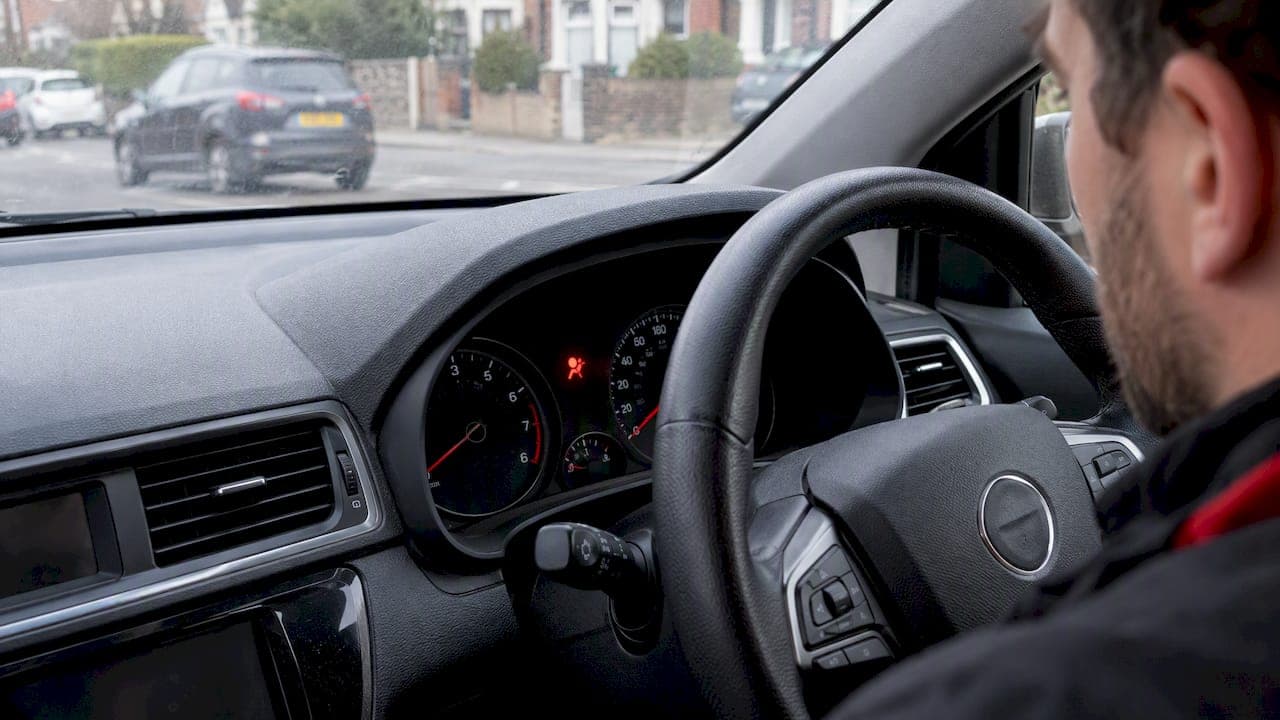
An airbag self test fail means the supplemental restraint system (SRS) has detected a problem and logged it before you have even pulled off the drive. That matters because your airbags or seat belt pretensioners may not deploy correctly in a crash, and under the MOT inspection manual an illuminated SRS warning light is a major defect that fails an MOT outright. Avoid long journeys and get a proper SRS diagnostic scan before you rely on the car again.
TL;DR:
- A healthy SRS lamp goes out after roughly seven seconds; a steady, flashing, or absent lamp warrants diagnosis, while an airbag disabled indicator is different.
- Until a technician checks the fault, restrict driving to short local trips, avoid long journeys, and never handle airbags or pretensioners yourself.
- A generic OBD2 reader rarely accesses SRS memory; request a scan that can read it and wiring checks before anyone clears codes or replaces modules.
- After an impact or voltage interruption, stored crash data may keep the light on; a reset can avoid module replacement if hardware is sound.
Table of Contents
- How the SRS self-test works and what a failure looks like
- Immediate steps to take when the airbag self-test fails
- Diagnostics: scans, tools and why a professional SRS-capable check matters
- Common faults that cause self-test failures and typical fixes
- MOT and safety implications of an airbag self-test fail
- Technician perspective: why diagnosis comes before clearing codes
- How we help when a module reset is the right fix
- FAQ
- Sources
How the SRS self-test works and what a failure looks like
Every time you turn the ignition on, the SRS module runs a short internal check on the airbags, pretensioners, sensors and wiring loom. On a healthy car, the airbag light illuminates for a few seconds and then goes out: manufacturer documentation, including Nissan's owner manual for the Ariya, describes exactly this pattern, with the lamp clearing after roughly seven seconds once the self-test passes. A fault is anything that breaks that pattern.
The light failing to extinguish, staying permanently lit, or flashing intermittently all signal that the self-test has found something it does not like, as explained in MotR's guide to the SRS warning light. The specific behaviour can hint at the type of problem: a steady light often points to a stored fault code sitting in memory, while flashing or erratic behaviour can suggest an intermittent connection, such as a loose plug under a seat that only drops out over bumps.
It helps to know what you are looking at before you call a garage:
- Brief flash then off: normal start-up behaviour, no action needed.
- Steady light, stays on: a fault has been logged and needs diagnosis.
- Flashing or intermittent light: often a wiring or connector issue rather than a failed component.
- No illumination at all on start-up: can itself indicate a bulb, wiring or module power fault, and still needs checking.
It is worth separating this from a specific "airbag disabled" indicator, which some vehicles use to show that a passenger airbag has been deliberately switched off, usually for a rearward-facing child seat. That is not a fault light; it is a status indicator. The SRS malfunction lamp is different: it tells you the system itself has a problem, and under the MOT inspection manual's rules on other equipment an SRS MIL signalling a malfunction is treated as a major defect, meaning the car cannot pass its test until it is resolved.
Immediate steps to take when the airbag self-test fails
Once you have confirmed the light is staying on rather than just flashing briefly at start-up, a few sensible steps will keep you safe and save a technician time later.
- Limit your driving to short, local trips and avoid motorways or long journeys until the fault is checked.
- Park safely and look for obvious issues, such as a loose seat belt buckle, a recently removed seat, or a child seat that has disturbed wiring underneath.
- Note recent work on the car: battery replacement, seat removal for valeting, or any interior trim work can disturb SRS connectors.
- Check for a prior low-speed knock or bump, since stored crash data can trigger a persistent light even after minor impacts.
- Call a garage or a specialist SRS service with the make, model, and a photo of the dashboard light, so they can advise whether you need a diagnostic appointment or a module reset.
Pro Tip: Take a photo of the dashboard the moment you notice the light, including the ignition position, as this helps a technician judge whether the fault is active or historical.
Do not attempt to open, remove or interfere with airbags or pretensioners yourself. The Health and Safety Executive's guidance on storing and handling airbags is clear that these are complex, potentially dangerous components, and inexperienced handling risks accidental deployment or leaves the system unable to protect you properly.
Diagnostics: scans, tools and why a professional SRS-capable check matters

A cheap, generic OBD2 reader bought online will usually tell you an engine fault code, but it rarely has the depth to read SRS module memory properly. Diagnosing an airbag fault accurately needs an SRS-capable scanner or a manufacturer-level tool that can interrogate crash data, sensor resistance values and stored fault history rather than just a generic code.
A proper diagnostic appointment typically includes:
- A visual inspection of seat belt buckles, connectors and wiring looms under seats and around the dashboard.
- A resistance and continuity check on key circuits, since a corroded or loose connector can mimic a component failure.
- A live diagnostic read of the SRS module to pull stored and active fault codes.
- A decision point: repair the wiring or connector fault, then decide whether the module itself needs a crash data reset or full replacement.
This matters because the module's fault memory can hold a genuine crash event, a voltage interruption, or a wiring fault, and each needs a different fix. Clearing a code without first understanding what caused it is guesswork, and guesswork on a safety system is not somewhere to cut corners. Our guide to airbag diagnostics steps walks through the visual checks worth doing before committing to a new module.
Common faults that cause self-test failures and typical fixes
Most SRS self-test failures trace back to a handful of recurring problems, and knowing which one you are dealing with shapes both the repair and the cost.
- Clock spring faults: the clock spring maintains electrical contact for the steering wheel airbag through full lock-to-lock rotation, and it wears out over years of use, typically causing a steady airbag light along with a horn or cruise control that stops working.
- Seat belt pretensioner and seat occupancy sensor faults: these often need physical parts replaced, since a pretensioner that has fired or a sensor that has failed cannot simply be reset away.
- Corroded or damaged connectors and wiring under seats: a common culprit after seat removal for cleaning or child seat fitting, and often fixable with a connector repair rather than a full part replacement.
- Stored crash data in the module's memory: after a low-speed impact or a voltage drop, the module can log a fault that keeps the light on even though nothing is physically broken, which is where a module reset service becomes the appropriate, lower-cost route rather than buying a new ECU.
A persistent SRS light after a low-speed impact often reflects stored crash data in the module rather than a damaged component, and a reset combined with a visual inspection can resolve it for considerably less than a full replacement, according to CompareAutoParts' guide to the airbag warning light.
Simply clearing the fault code without fixing the underlying wiring or hardware issue tends to bring the light straight back, because the module will log the same fault again the next time it runs its self-test. That is why technicians prioritise finding and fixing the physical cause first, and only reset or clear the memory once they are confident nothing is actually broken. If the light has come back after a previous clear, our piece on an airbag light that won't clear covers the usual reasons why.
MOT and safety implications of an airbag self-test fail
The practical consequence of an airbag self-test fail is straightforward: your car will not pass its MOT while the light is on. The MOT inspection manual's section on other equipment classifies an SRS malfunction indicator lamp, when it is signalling an actual fault, as a major defect, which means automatic failure rather than just an advisory note.
A few points are worth keeping in mind:
- Testers also check for tampering and incorrect fitment, including whether airbag covers are properly seated and whether a previously deployed airbag has been professionally replaced rather than bypassed, per MotR's overview of SRS testing.
- Driving with the fault outstanding carries real risk: your airbags or pretensioners may not activate as designed in a collision, so it is worth limiting journeys until the system is confirmed sound.
- Buying a used car with a history of airbag warning lights deserves extra scrutiny, since a flagged SRS fault can be evidence of a prior impact that was never properly repaired.
None of this means a self-test failure is a write-off. Most causes, from a loose connector to stored crash data, are repairable or resettable once correctly diagnosed. The point of the MOT rule is to make sure nobody drives around on a system that looks fine from the driver's seat but would not actually protect them.
Technician perspective: why diagnosis comes before clearing codes
The habit worth building into any airbag fault is sequence: find the physical cause, fix it, then clear the memory, never the other way round. A reset that papers over a loose connector or a failed sensor buys you a quiet dashboard and nothing else, and the fault returns the moment the self-test runs again. Where the fault genuinely is stored crash data rather than broken hardware, that is precisely when a specialist reset earns its keep, and identifying which category you are in is the job a proper SRS scan does.
— John
How we help when a module reset is the right fix
When your airbag light is being caused by stored crash data or a voltage memory error after battery work rather than a broken component, resetting the original module is usually quicker and cheaper than buying a replacement ECU. Airbag Reset UK offers a UK-wide postal service for exactly this.
- Module reset: our airbag module reset covers standard and complex modules with fixed, transparent pricing.
- Motorhome resets: a dedicated motorhome airbag reset service for Ducato, Relay, Boxer and similar base vehicles.
- Mobile resets: our mobile airbag reset option comes to you where a postal turnaround is not convenient.
- Same-day turnaround: most modules sent in on a weekday morning are returned the same day through a same-day airbag reset service.
If you are not sure which module you have, send us a photo or part number and we will confirm identification and the right next step before you commit to anything.
FAQ
Will a faulty airbag fail an MOT?
Yes, an illuminated SRS warning light that indicates a genuine malfunction is classed as a major defect under the MOT inspection manual, which means automatic MOT failure. The car will need the underlying fault diagnosed and resolved before it can pass retest.
Will an airbag light make you fail an emissions test?
No, the airbag or SRS warning light relates to the passive safety system and plays no part in the emissions assessment, which examines exhaust output separately. However, an illuminated SRS light is still assessed under the "other equipment" section of the MOT and can cause a major defect failure on its own.
Can you reset an airbag light yourself?
Clearing the code without fixing the underlying cause, whether that is a wiring fault, a sensor, or stored crash data, commonly results in the light returning and can mask a genuine safety problem. A proper SRS-capable diagnostic read is needed first to establish the cause, after which a repair, a specialist module reset, or replacement can be carried out appropriately.
How much does it cost to fix an airbag fault?
Costs vary with the cause: a connector repair or clock spring replacement involves parts and labour at a garage, while a fault caused by stored crash data or a memory error can often be resolved with a module reset. Our airbag module reset service pricing details are available on the client website.
Sources
- Gov
- HSE — Storing and handling airbags and seat belt pretensioners
- Airbag Warning Light | SRS Light Meaning, Causes & Costs | MotR
- Airbag warning light UK — What it means, MOT fail, repair costs