
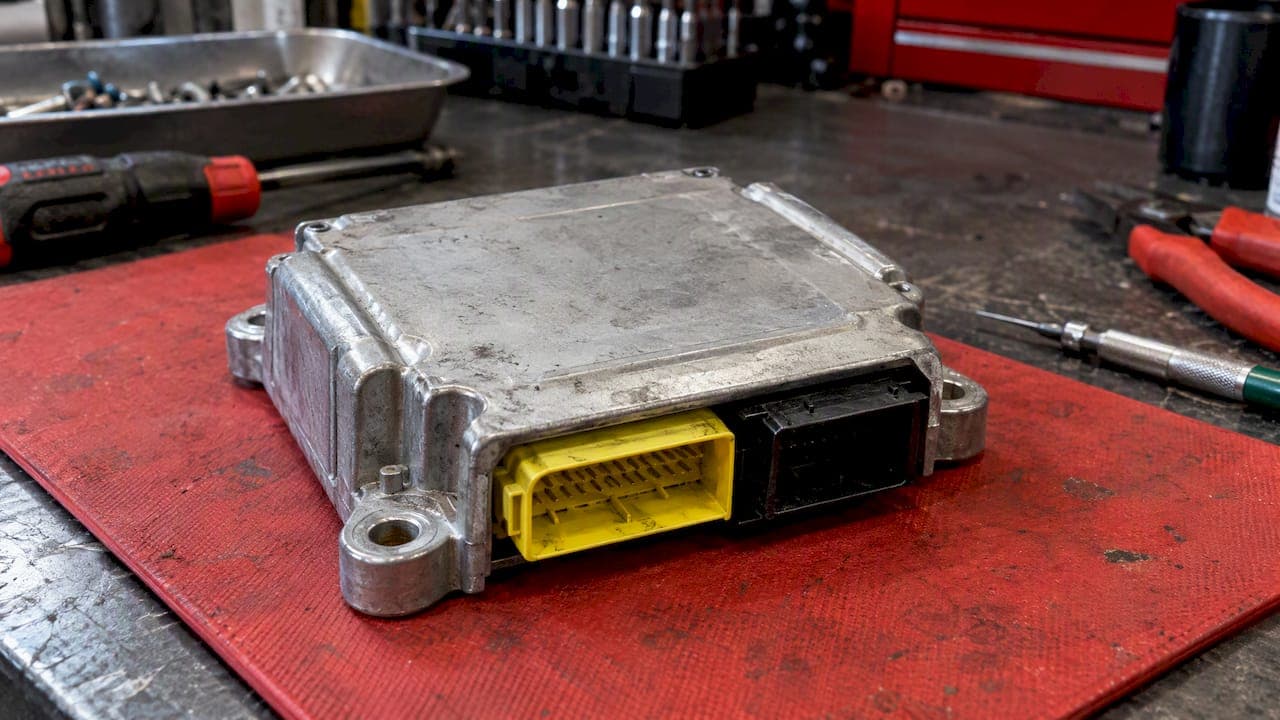
A "crash event stored" message means your airbag control unit (the ECU or SRS module) has logged a collision in its memory and, on most vehicles, now refuses to work normally until that record is cleared or the unit is replaced. The airbag light usually stays on. The usual fix is a specialist crash data reset on the original module, which at Airbag Reset UK costs £35 to £46 for a standard module and is done by post.
Below we explain what is actually stored, why the light will not go out by itself, what it means for your MOT, and the checks to make before you send anything off.
TL;DR
- "Crash event stored" means the airbag module has recorded an impact and locked itself into a crash state. It is a memory record, not necessarily a broken part.
- The airbag light will not clear on its own. The record has to be cleared from the module, either by a crash data reset or by fitting a replacement.
- A lit SRS warning lamp is a major defect at MOT, so the car will fail until the fault is dealt with.
- Check for other causes first: seat belt switches, a clock spring or damaged wiring can also light the lamp.
- Resetting the original module is often far cheaper than buying a new one. Our standard reset is £35 to £46, with same-day turnaround on most modules received in the morning.
Table of Contents
- What "crash event stored" actually means
- Crash data versus fault codes
- Why the light will not go out on its own
- Is the crash event the real problem? Check first
- What it means for your MOT
- Your options once a crash event is stored
- Perspective: what we see on the bench
- How a postal crash data reset works
- What it costs
- Ready to clear a stored crash event?
- Before you drive the car again
- FAQ
- Sources
What "crash event stored" actually means
Your airbag module is the computer that decides, in milliseconds, whether to fire the airbags and seat belt pretensioners. It reads a set of crash and occupant sensors. Ford's owner documentation describes the restraints control module as the unit that receives this sensor information and then deploys the pretensioners and airbags.
When the module sees an impact above its threshold, it writes the event to memory. Depending on the manufacturer, that record can include speed, braking, seat belt status, whether an airbag fired and the direction of the impact. Most modules then set a crash flag. Until the flag is cleared, the module treats the car as one that has just crashed and keeps the warning lamp lit.

This can happen without a dramatic accident. A kerb strike, a shunt in a car park or a low-speed rear impact can be enough on some vehicles, even when no airbag deployed. In that case the bodywork may look almost undamaged and the lamp is the only sign anything happened.
Crash data versus fault codes
These two things are often mixed up, and the difference decides what repair you need.
- Crash data is the event record: what the car was doing around the impact. Ford explains that event data recorders are designed to capture non-trivial crashes, typically the seconds before the event, and that the data is for diagnosing system performance rather than recording personal details.
- Fault codes are the system's complaints about a component: a sensor, a squib circuit, a seat belt buckle switch, a connector. They are what actually keep many warning lights on.
A crash can leave both behind. A deployed airbag, for example, leaves open circuits and a stored event. Clearing only the codes with a scan tool often does nothing, because the module still holds its crash record and sets the fault again at the next ignition. If you want a plain-English primer on the code side, understanding car fault codes covers how diagnostic codes differ from other stored information.
Why the light will not go out on its own
The Motor Ombudsman makes the point that an airbag light does not switch itself off once the fault is fixed: the fault has to be cleared from the system's memory. The same page warns that the airbags may not deploy correctly in an accident until the system is serviced and the lamp is out.
That is the practical risk. A car with a stored crash event and a lit lamp is not telling you something trivial. Treat it as a safety system that is not confirmed as working.
Is the crash event the real problem? Check first
Before you pay for any reset, rule out other causes. The Motor Ombudsman lists three common triggers for an airbag light: a faulty seat belt switch, a damaged clock spring (the cable between the steering wheel and column) and damaged or disconnected wiring. Those need diagnosing and repairing first. A module reset will not hold if the underlying fault is still there.
A sensible order of work:
- Read the SRS codes with a scan tool that can talk to the airbag system, not just the engine.
- Note what the codes say. A "crash data stored" or "collision detected" style code points to the module memory. Open-circuit codes on a squib, seat belt or sensor point to a component or wiring.
- Check for recalls. The BBC reported in October 2025 that owners can check a registration on the DVSA recall service. If a recall is the cause, the Motor Ombudsman notes the fix should be free from the manufacturer or dealer.
- Repair the physical fault, such as a replaced seat belt pretensioner, a new clock spring or a repaired connector.
- Clear the module memory once the hardware is sound.
Our own guides go deeper on the related cases: why an airbag light won't clear, what to do when there are no codes and a light that appears after a battery change. If you are working through the diagnosis yourself, these airbag diagnostic steps show how to avoid buying a new module unnecessarily.
What it means for your MOT
The MOT does not care why the lamp is on. Under the DVSA MOT inspection manual, an SRS malfunction lamp that stays illuminated and indicates a system malfunction is a major defect, which means a fail. The check applies to vehicles fitted with such systems as original equipment, excluding Class 3 vehicles.
The tester is only looking at the lamp. As the DVSA's own Matters of Testing blog explains, they check whether the lamp indicates a fault with the system. The GOV.UK list of parts checked at an MOT includes airbags and seat belt pretensioners among the items assessed via dashboard warning lights.
So a stored crash event that keeps the lamp on will fail the test, even if the car drives perfectly. If the car has had a repair after an accident, clearing the module properly before the MOT saves a retest.

Your options once a crash event is stored
There are three routes, and the cost gap between them is large.
| Option | What happens | Typical downside |
|---|---|---|
| Replace the module with a new one | Fit a new unit, then code it to the car | Often expensive, and usually needs dealer or specialist coding and programming |
| Fit a used module | Cheaper unit from a breaker | May carry its own crash record or be locked to another vehicle |
| Reset the original module | The crash record is cleared and the unit refitted | Not possible if the module is physically damaged or fails its checks |
Resetting the original keeps the car's own coding and identity, which is why it is often the neatest repair. We only do it when it is safe to do so. If a module has water damage, burnt circuits or other internal faults, we will say so rather than send back something that should not be trusted.
Perspective: what we see on the bench
Most of the modules we receive are fine electronically. The owner has had a minor bump, or a bodyshop has replaced a deployed airbag, and the module is simply refusing to work because of the record it holds. Replacing it with a new unit is the quote people are often given, and it is frequently unnecessary.
Our technicians have over 40 years of combined experience, and the rule they work to is simple: reset the original unit when it can safely be done, and tell the customer plainly when it cannot. We would rather you spend £35 to £46 and keep your original module than spend several times that on a part you did not need.
Two habits cause most of the grief we see. The first is clearing codes with a cheap scanner and assuming the job is done, when the crash flag is still set. The second is skipping the physical checks. A reset does not mend a broken clock spring or a cut connector, so confirm the hardware first.
If you are unsure which module you have, send us the part number or a photo and we will help you identify it by WhatsApp or phone before you post anything.
— John
How a postal crash data reset works
The process is deliberately simple, and it is the same whether you are a private owner or a garage.
- Identify the module. Note the part number on the label, or take a clear photo. We can confirm it is the right unit.
- Remove it safely. Disconnect the battery and wait before touching any airbag connector. Airbag modules sit next to live restraint circuits, so if you are not confident, have a garage or mobile technician remove it.
- Post it to us. Pack it in anti-static material or a padded box and use a tracked service.
- We reset and test it. Most modules received in the morning go back the same day.
- Refit and check. Once it is refitted, the lamp should go through its normal self-check and go out. If it does not, there is another fault to find.
A used or reset module is only half the job if the car still has a damaged seat belt pretensioner or a deployed airbag that has not been replaced. Make sure every deployed component is renewed before the reset module goes back in.
What it costs
Our prices are fixed and published, so you know the figure before you post anything.
- Standard airbag module reset: £35 to £46 per module, depending on the module.
- Motorhome airbag reset: £65 for the specialised modules used in motorhomes.
- Mobile airbag reset: from £75 for work carried out where the vehicle is.
If you hold a genuine like-for-like quote that is lower, we will price match it. Garages, bodyshops and fleet technicians can apply for a trade account with discounted rates.
We cover the full range of makes, from BMW and Mercedes to Honda and Toyota, so check your make's page for specifics.
Ready to clear a stored crash event?
If your diagnosis points to a stored crash record and the hardware is sound, send us the module. Start on the airbag module reset page for the price and how to book, or use the motorhome reset page if it is a motorhome unit. Send the part number or a photo first if you want us to confirm the module before you remove it.
Before you drive the car again
A few cautions that matter in real situations.
- Airbag deployed? Every deployed airbag, the pretensioners and often the seat belts need replacing. A reset on the module does not replace them. Have a qualified garage check the work.
- Car bought used with the lamp on? Ask for the SRS codes to be read before you buy. A stored crash event can hide a previous accident, and the MOT will fail it.
- Light flickers or only appears sometimes? That points to wiring or a connector. Take it to a garage for a proper SRS diagnosis rather than resetting repeatedly.
- Recall suspected? Check the registration on the DVSA service before paying for anything.
The airbag system exists to protect you in a crash. Make sure it is verified as working after any repair, and if you are in any doubt, ask a garage with SRS diagnostic equipment to test it.
FAQ
Can I clear a stored crash event with an ordinary OBD scanner?
Usually not. A generic engine scanner often cannot talk to the airbag system, and one that can may clear the codes while the module still holds its crash record. The fault then returns at the next ignition. A crash data reset clears the record from the module memory itself.
Will a crash event stored in the module fail my MOT?
If it keeps the SRS warning lamp lit, yes. The DVSA manual treats a lit SRS malfunction lamp as a major defect. Clear the record and fix any underlying fault before the test.
Do I need a new airbag module after a crash?
Not always. If the module is physically undamaged, the original can often be reset, which keeps its coding and costs far less than a new unit. If it is damaged, it should be replaced. Send us the part number or a photo and we will tell you which applies.
How long does the postal reset take?
Most modules received in the morning are reset and returned the same day. Add your courier's transit time each way. Complex or unusual modules can take longer, and we will tell you when we confirm the part.
Does the stored crash data contain personal information?
According to Ford's documentation, event data is diagnostic and does not record personal information, though it can be accessed in specific legal proceedings. Practices vary by manufacturer, so check your own handbook.
Sources
- MOT inspection manual: other equipment, GOV.UK
- Car parts checked at an MOT, GOV.UK
- Common mistakes made by MOT testers, Matters of Testing
- Getting to know airbags, The Motor Ombudsman
- Data recording introduction, Ford owner manual
- Crash sensors and airbag indicator, Ford owner manual
- Drivers reminded to check for outstanding airbag recalls, BBC