
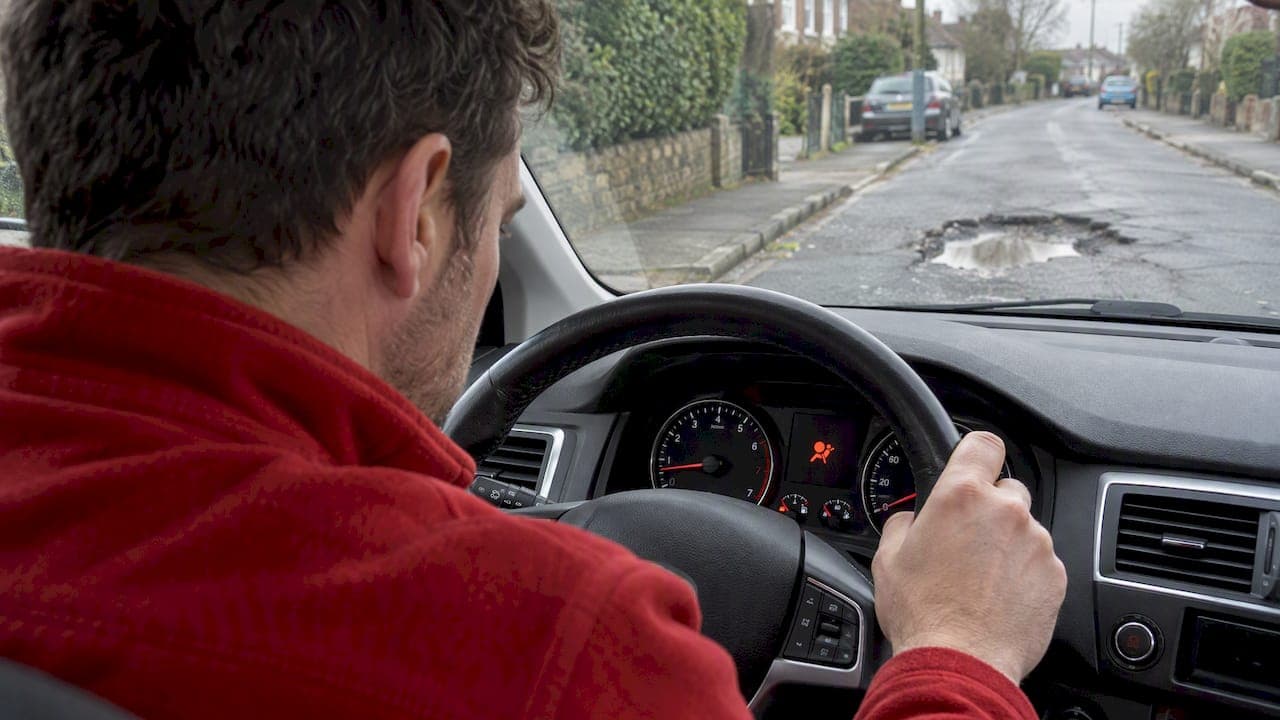
If your airbag light came on straight after a pothole, the cause is usually one of three things: a disturbed connector or sensor, a seat occupancy or seatbelt fault, or a stored fault (or crash) record in the airbag control unit. Treat it as a real fault until it is checked. The car may still drive normally, but the airbags may not work as designed in a collision, and the light is an automatic MOT failure.
Below we explain what a pothole can and cannot do to your airbag system, what to check first, what a proper diagnosis looks like, and when the answer is a crash data reset rather than a new module.
TL;DR
- A hard pothole hit can jolt a connector, an under-seat wire, a sensor or the seatbelt pretensioner, any of which can switch the airbag light on.
- Manufacturers say a lit or flashing airbag light means a system fault and the airbags may not deploy, so get it read promptly. Volkswagen UK's guidance is typical.
- An airbag light that indicates a malfunction is a major defect and an MOT failure.
- If the fault codes are cleared but the light returns, or the unit holds a locked crash record, the airbag module may need a crash data reset. Ours costs £35 to £46 by post.
- Check tyres, wheels and suspension too. The pothole that upset the airbag system may have damaged more than that.
Table of Contents
- Why a pothole can trigger the airbag light
- First checks in the first hour
- Is it safe to keep driving?
- Will the light clear itself?
- Airbag light and the MOT
- What a proper diagnosis looks like
- When it is a crash data problem
- What we think
- How our postal reset works
- Check the rest of the car, and think about a claim
- Quick decision guide
- FAQ
- Sources
Why a pothole can trigger the airbag light
The airbag system (often called SRS, supplemental restraint system) is a network. A control unit listens to impact sensors, seat occupancy sensors, seatbelt buckle switches and the connections to every airbag and pretensioner. Each time you start the car it runs a self-check, and the light comes on briefly, then goes out. If it stays on, the unit has found something it cannot trust.
A pothole delivers a sharp vertical shock through the wheel, suspension and body. It rarely deploys an airbag, because deployment logic looks for a severe frontal or side impact pattern. What it can do is more mundane:
- Loosen or interrupt a connector. Airbag connectors are usually yellow and sit under the seats, in the dash and in the steering column. A shock, or a recent job that disturbed them, can leave one with poor contact.
- Upset the wiring under a seat. Seat occupancy mats and seatbelt buckle sensors run on thin wires that are easily pinched or stretched as seats and passengers move around.
- Jolt a crash sensor. Front and side sensors sit low in the car, where a heavy hit travels. A sensor that sends an implausible signal is logged as a fault.
- Lock a seatbelt pretensioner. Some owners report a belt that locks after a bump and does not release. This is anecdotal, but if a belt behaves oddly, mention it to whoever scans the car.
- Log an impact the unit considers significant. Some control units store a crash record after a heavy enough hit, even with no airbag fired. Those records are different from ordinary faults, as explained further down.
The common factor is that the system lost confidence in itself. The light does not tell you which part is at fault. Only a scan can.
First checks in the first hour
You do not need tools for these, and none involves touching an airbag or its wiring.
- Pull over safely and check the tyres and wheels. A pothole hard enough to upset electronics can also bend a wheel or damage a tyre sidewall. Look for bulges, cuts, a flat spot or a wheel that looks out of line.
- Note which warning lights are on. Tyre pressure, traction control or ABS lights alongside the airbag light suggest a shared wheel-speed or sensor issue. One owner thread among the top results describes traction control going out while the airbag light stayed.
- Check the seats and belts. Make sure nothing is on the passenger seat, no bag, no heavy object, and that every belt is fully clicked in and released properly. Seat occupancy and buckle sensors are a frequent cause of a light that appears with no crash.
- Restart the car. If the light goes out and stays out for several days, it may have been a one-off. If it returns, the fault is stored.
- Do not disconnect the battery to "reset" it. It rarely clears the light, and a stored fault will simply return. Working around airbag wiring is dangerous: the system holds charge and can deploy if mishandled, so leave connectors and the steering wheel airbag alone.
If your light flickers on and off, our guide to an intermittent airbag light explains what that pattern usually means.
Is it safe to keep driving?
The honest answer is: it is not worth the gamble. Volkswagen, for example, says that if the airbag and seat belt lamp lights up or flashes there is a fault in the system, and the guidance points you to a repairer. Kia's dashboard warning guide explains that the light should go out after the start-up check, and that one that stays on needs attention.
In practice:
- The car will normally still drive, brake and steer as before, as the airbag light is separate from those systems.
- In a collision, an airbag system with a fault may not deploy one or more airbags, or may not tension belts.
- If the tyre pressure light, a pulling steering wheel, a new vibration or a noise came on with the airbag light, stop driving and have the wheel, tyre and suspension inspected first. The THINK! vehicle safety checks page notes that damaged or under-inflated tyres affect handling and braking, and that illegal tyres can bring a fine of up to £2,500 and three penalty points per tyre.
Keep trips short and book a scan within days, not weeks. Do not carry a child in a seat where the airbag status is uncertain.
Will the light clear itself?
Sometimes, yes, when the cause was a momentary sensor reading or a seat sensor that settled once the seat was occupied correctly. The unit re-runs its checks and a fault that no longer appears can drop off. Do not plan around it, though. Three things suggest it will not:
- The light returns every time you start the car.
- It flashes rather than staying steady.
- You can feel or hear something wrong with the seat, belt or suspension.
Any of these means a stored fault that needs reading. Our article on an airbag light that will not clear covers the next steps.
Airbag light and the MOT
The MOT inspection manual treats an airbag warning lamp that indicates a malfunction as a major defect. That means a fail. Section 7.1.5 also confirms that a passenger airbag that has been switched off is not a defect, but that is no workaround: if your light is on because of a fault, turning anything off will not make the car right.
If your MOT is due soon, book the airbag diagnosis before the test, not after. Our breakdown of airbag diagnostic costs and the £35 reset option shows how to avoid a failed MOT and a second test fee.
What a proper diagnosis looks like
A generic OBD reader usually does not talk to the airbag module. You need a scan tool that supports the SRS system on your make. The result is a list of fault codes, and they point to the area, not always the part. Typical outcomes after a pothole:
| What the scan shows | What it usually means | Typical next step |
|---|---|---|
| Seat occupancy or buckle circuit fault | Wiring or sensor under a seat | Inspect and repair the connector or mat, clear the fault |
| Crash sensor implausible or open circuit | Connector or sensor disturbed | Refit or replace the sensor, clear the fault |
| Airbag or pretensioner circuit resistance | Loose or damaged connector | Repair the connection, clear the fault |
| Crash data stored / unit locked | Control unit recorded an impact | Crash data reset of the original module |
| Several unrelated faults | Voltage, wiring harness or unit issue | Wider diagnosis, possibly module repair |
The key point: fix the cause first, then clear the fault. Clearing a code that is still live only hides the problem for a few miles.
BMW has even published a technical bulletin about the airbag lamp coming on because of a shorted wire in the front seat harness on certain F07 and F10 models. It shows how an ordinary wiring fault under a seat can look like a serious airbag failure.

When it is a crash data problem
This is where many owners lose money. An ordinary fault code can be cleared by a decent scan tool. A crash record is different. As one technician's explainer puts it, crash data is a permanent stored code that conventional diagnostic equipment cannot clear, because manufacturers design the unit that way. The module keeps the light on and the airbags disabled, even though nothing is physically wrong.
That can happen when:
- The pothole impact was heavy enough for the unit to log an event.
- You had a minor shunt as well as, or instead of, the pothole. See our 24 to 72 hour checklist after a minor crash.
- The car was previously recorded as an insurance write-off. Our page on the Cat S airbag light covers that.
Once the physical cause is fixed, a locked module does not need replacing. The usual dealer answer is a new unit, which means a part, coding and programming. Resetting the original often costs far less.
What we think
We see the same pattern again and again. A driver hits a pothole, the light comes on, a garage clears codes, the light returns, and the next quote is for a new airbag ECU. Nobody has asked whether the unit is actually damaged.
Our view, built on over 40 years of combined technician experience, is simple: diagnose the cause, repair the real fault, and only then decide whether the module needs anything. If the original unit is healthy and only holds a locked crash record, we reset it and send it back, rather than see an owner buy an unnecessary replacement.

Two cautions. First, a reset is not a fix for a broken sensor or a damaged connector. If the underlying fault remains, the light will come back, and that is exactly why the fault must be found first. Second, never reset a unit after a real collision in which airbags have deployed without the car being properly repaired. The reset restores the module, not the structure and components around it.
We also think people should not feel pressured. Send us a part number or a photo of the module label, and we will help identify it by phone or WhatsApp before you commit.
— John
How our postal reset works
We handle crash data resets and airbag ECU repair for cars, vans and motorhomes across the UK by post. The process is straightforward:
- Identify the module. Tell us your vehicle and send the part number or a photo of the label. We help you confirm the right unit.
- Remove and post it. Have the module removed by a competent garage or technician. Do not attempt to pull an airbag control unit without the correct safety procedure.
- We reset it. Most modules received in the morning are turned around the same day.
- Refit and check. Once it is back in the car, the garage should confirm the light is off and the system reports no faults.
Prices are fixed and published. A standard airbag module reset is £35 to £46. A motorhome airbag reset is £65. If removing and refitting the module yourself is not an option, our mobile airbag reset service starts from £75. If you have a like-for-like genuine quote that is lower, we price match it. Garages, bodyshops and mobile technicians can ask about trade accounts at discounted rates.
If you are unsure whether you need a reset at all, our page on airbag light on after an accident explains why the light stays on, and the airbag warning light guide covers both crash and no-crash causes. For lights with no stored codes, see airbag light with no codes.
Check the rest of the car, and think about a claim
A pothole that triggers an airbag warning has hit the car hard. Ask the garage to look at:
- Tyre sidewalls and wheel rims, inside and out
- Tracking and alignment
- Suspension arms, bushes, shock absorbers and springs
- Underbody and any low-mounted sensors
If the road defect caused the damage, you may be able to claim from the authority responsible for the road. The BBC's guide to pothole damage says to collect evidence: the precise location, photos of the damage and a garage report confirming the damage is consistent with the impact. The RAC adds that you can look up the relevant council on GOV.UK, and if the council thinks you have a valid claim it will normally send you a damage report form.
Keep the diagnostic report and invoices, because they show what was found and what it cost. Photograph the pothole next to a coin or tape measure before you leave, if it is safe to do so.
Quick decision guide
- Light came on and went off, belts and seats normal: keep an eye on it, and get a scan if it returns.
- Light stays on, no other symptoms: book an SRS scan within days.
- Light on plus tyre, steering or suspension symptoms: stop and have the wheel and suspension inspected first.
- Scan shows a circuit or sensor fault: repair the cause, clear the fault, retest.
- Scan shows crash data or a locked module: send the original module for reset instead of buying a new one.
- MOT due: get it sorted beforehand, because the light is a major defect.
For a broader explanation of the light itself, see what the SRS light means. If you want to avoid a replacement and understand the steps first, read our airbag diagnostics guide. Trade customers and owners alike can start from our home page.
FAQ
Can a pothole really cause the airbag light to come on?
Yes. A hard hit can disturb a connector, a seat occupancy sensor, a seatbelt buckle switch or a crash sensor, and the control unit then logs a fault and lights the warning. In some cars a heavy impact can also store a crash record. A scan with SRS-capable equipment will tell you which.
Can I pass an MOT with the airbag light on?
No, not if the light indicates a malfunction. The MOT inspection manual lists it as a major defect, so the car fails. Have the fault diagnosed and fixed before the test.
Can I still drive with the airbag light on?
The car will usually drive normally, but the airbags may not deploy in a crash, so manufacturers advise getting it checked promptly. If the light came on with tyre, steering or braking symptoms, do not drive on until the wheels and suspension have been inspected.
Will the airbag light clear itself after a pothole?
It can, if the cause was a temporary sensor or seat reading. If it returns on the next start, or flashes, a fault is stored and will not go away without being found and fixed. Disconnecting the battery is not a reliable cure.
Do I need a new airbag module after a pothole?
Usually not. Most pothole-related lights come from a wiring, connector or sensor fault. Where the original module holds a locked crash record and is otherwise healthy, a crash data reset can bring it back into service for a fraction of the price of a new unit.
Sources
- MOT inspection manual: 7. Other equipment, GOV.UK
- Vehicle safety checks, THINK!
- Pothole damage: What to do if your car is hit, BBC
- How to report a pothole and claim for damage, RAC
- Red airbag and seat belt system warning light, Volkswagen UK
- Warning and indicator icons, Kia UK
- BMW technical bulletin: airbag warning lamp, shorted wire in front seat harness
- How to reset airbag module crash data, Auto Repair Technician