
Crash data is a short recorded snapshot of what your vehicle and its safety systems were doing around an impact, while a diagnostic code only names a fault a module has detected. Whether crash data can be cleared depends on the module and the event, and it often needs a bench reset. UNECE and Gov set the ground rules, and we offer a postal reset.
TL;DR:
- Deployment events may lock nonvolatile memory, while manufacturers handle nondeployment events differently, so identify the module by its part number before choosing a reset route.
- Basic OBD scanners may clear fault codes without clearing event memory, so ask whether bench work includes verification that the module is ready to refit.
- A reset clears stored information, not deployed airbags, pretensioners, damaged wiring, or outstanding recall work; replace damaged parts and follow manufacturer recall instructions.
- Investigators treat event downloads as one evidence source and compare them with scene details, vehicle condition, service information, and repair records before drawing conclusions.
Table of Contents
- 1. What does crash data actually record?
- 2. How are diagnostic trouble codes different?
- 3. Can crash data be cleared or overwritten?
- 4. What does a professional crash-data reset involve?
- 5. What does resetting not change about safety, recalls and MOT?
- 6. How do investigators use crash data alongside other evidence?
- 7. What should you do after an incident? Our checklist
- 8. How our postal reset service can help
- FAQ
- Sources
1. What does crash data actually record?
Crash data, often called EDR data, is a time-series record of vehicle and safety-system behaviour immediately before and during a qualifying event. UNECE describes the window as beginning before the event and continuing until the vehicle comes to rest. Typical elements include:
- Vehicle speed in the seconds before impact
- Throttle or accelerator position
- Service brake applied or not applied
- Seat-belt status for the driver and front passenger
- Warning-lamp status
- Airbag or pretensioner activity, including whether deployment occurred
What it does not hold matters just as much. UNECE Regulation No. 160 explicitly excludes audio and video from EDR event data, so nothing is recorded of what was said or seen in the cabin. Which items appear depends on the vehicle's equipment and whether its systems were working at the time.
Regulation No. 160 excludes audio and video from EDR event data. That is why it works as evidence about the event rather than a full account of it.
2. How are diagnostic trouble codes different?
A diagnostic trouble code (DTC) is a fault identifier stored by a control module when it detects something wrong: a sensor reading out of range, an open circuit, a failed self-check. It tells you that a system is unhappy. It does not tell you what the vehicle was doing when it happened.

Crash data answers a different question. A DTC flags a malfunction, while the event record describes behaviour around a crash. UNECE's explanatory material separates the two on exactly this basis.
Two examples show the split:
- An airbag DTC might read "driver crash sensor circuit fault". It points at a component or wire to inspect.
- The event record for the same incident might show that deployment occurred and that the driver's belt was fastened. It points at what the restraint system did.
In practice you need both. The code guides the repair, such as replacing a sensor or fixing a damaged connector. The event record guides any investigation into what happened. Clearing a code removes the warning message, but it does not repair anything and it does not necessarily touch the stored event.
3. Can crash data be cleared or overwritten?
Sometimes, but not universally. The answer depends on the module and on what kind of event was stored. UNECE Regulation No. 160 explains that deployment events may lock non-volatile event memory against overwriting, while non-deployment events can be handled differently by each manufacturer. The regulation also leaves retrieval tools and methods to national or regional level.
In practical terms, an owner can expect one of these outcomes:
- The event memory is recoverable, and a bench reset clears it and restores the module to a ready state.
- The memory is locked after a deployment, and the module needs a manufacturer procedure or replacement.
- A minor non-deployment event is overwritten by the module's own strategy over time.
- The module stores both a crash record and active fault codes, and each must be dealt with separately.
Never assume one universal clearing method exists. A method that works on one manufacturer's module can do nothing on another, and a clear that looks successful on a scanner may leave the stored event in place.
Pro Tip: Note the part number printed on the module before you speak to anyone. It tells a specialist straight away which clearing route is realistic.
Our guide on whether airbag crash data can be cleared goes further on the safety side.
4. What does a professional crash-data reset involve?
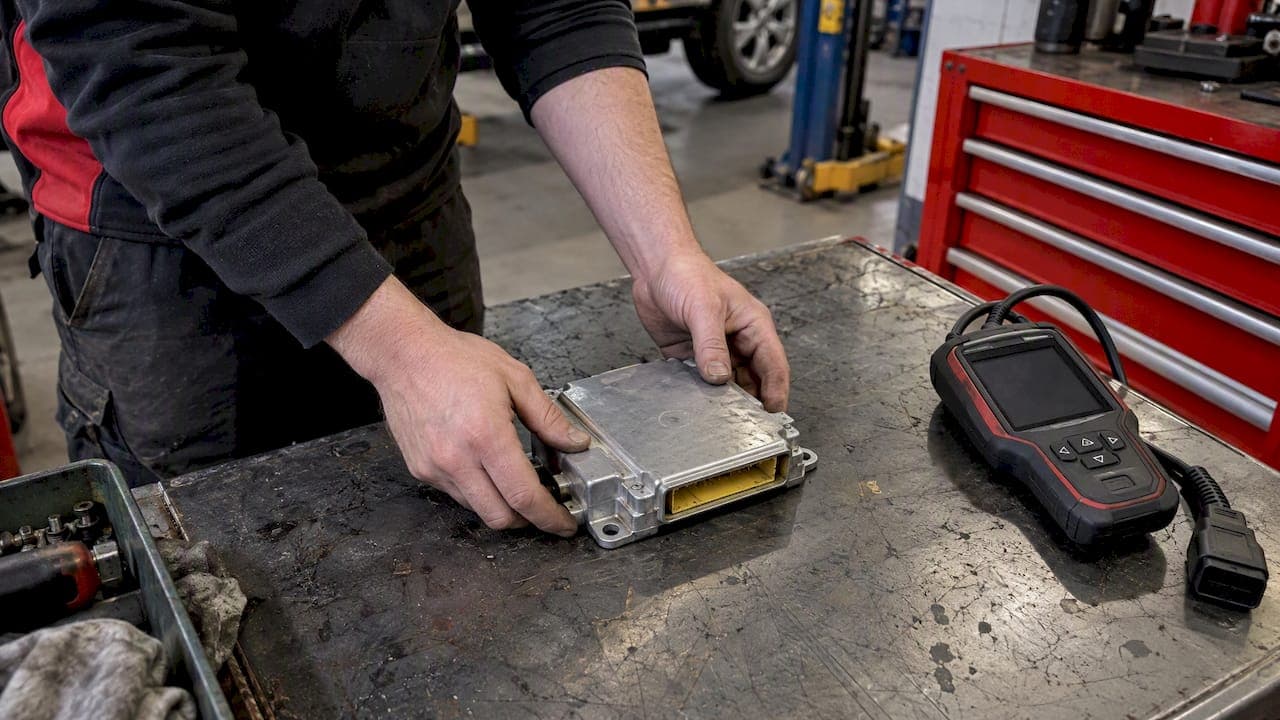
A bench or postal reset follows a set workflow. The module is identified from its part number or a photo. It is removed from the vehicle, or posted to us, and worked on at the bench. The event data is cleared or the unit reprogrammed, then the result is verified before it goes back.
Many basic OBD airbag scanners read and clear codes but cannot fully clear event memory. Where the data sits inside the module's own storage, specialist benchtop tools or manufacturer methods are sometimes required. Our comparison of coding versus crash data reset covers when bench work beats an in-vehicle attempt, and our piece on what a crash-data reset actually involves covers the technical detail.
When you arrange a reset, expect:
- Help to identify the module from its part number or a photo
- A clear turnaround time, agreed before you post anything
- Confirmation that the module was reset, not just powered up
- Verification that the unit is ready to refit
A reset cleans the module's memory. It does not replace parts that were deployed.
Pro Tip: Ask whether the price covers return postage and verification. Fixed pricing should state both.
5. What does resetting not change about safety, recalls and MOT?
A reset deals with stored data. It does not deal with the vehicle's physical condition or its recall status. GOV.UK guidance states that recall work is arranged through the manufacturer, and that a crash-data reset is not a substitute for an outstanding safety recall or for replacing deployed restraints, damaged wiring or other collision damage.
Keep these points in mind:
- Check your vehicle's recall status using the registration before and after any reset
- Replace any deployed airbag, belt pretensioner or damaged wiring before you rely on the system again
- Understand that a cleared warning light does not make a vehicle roadworthy if the underlying damage remains
- Be aware that a government MOT notice shows affected vehicles can still carry advisories where a recall remedy is outstanding
Follow the manufacturer's instructions for any recall repair, and treat the reset as one step in a repair, never the whole repair.
6. How do investigators use crash data alongside other evidence?
Investigators treat crash data as one evidence stream rather than a verdict. UNECE Regulation No. 160 sets out the mandatory data elements so the information can support safety analysis. HSE's HSG245 guidance frames crash analysis as a systematic examination that combines all available facts, and a crash-data download is evidence for that analysis, not the analysis itself. Transport-safety analysts make the same point: an EDR simplifies a complex event and needs to sit alongside service information and physical evidence.
A crash-data download is evidence for the analysis, not the analysis itself.
Our rule for owners is simple. Use the download to guide repairs and questions, and do not treat it as proof of fault without corroboration from the vehicle, the scene and the repair records.
7. What should you do after an incident? Our checklist
We keep our advice short. Check the recall status. Get a proper diagnostic read so you know which codes are stored. Avoid unproven DIY clears, which can leave you with a dark warning light and an uncleared module. If an airbag warning persists after a minor incident, or the module is one known to hold event memory, a specialist bench reset is the sensible route.
Replace anything that deployed or was damaged before you drive on the repaired system. Our guide to what a professional crash-data clear means explains the light itself.
— John
8. How our postal reset service can help
Posting the unit is straightforward. We help you identify the module from its part number or a photo, you send it in, and we carry out the bench reset. We verify the work before returning the module.
Our airbag module reset runs from £35 to £46, with a motorhome reset at £65 and a mobile airbag reset from £75. We can help identify your module before you post it. Our postal crash data clear page has the detail, and our Bosch module guide shows a typical example.
Send us your module's part number to help identify your unit. Start with a quote on our pricing page.
FAQ
What is the meaning of crash data?
Crash data is a short recorded snapshot of vehicle and safety-system behaviour around an impact, such as speed, braking, belt status and airbag activity. It is separate from diagnostic codes, which only name detected faults. UNECE's Regulation No. 160 material defines it this way.
Can you clear crash data?
Sometimes. It depends on the module and on whether the event was a deployment or not, because deployment events may lock the memory. A bench reset can clear many units, but you should not assume one method suits every module.
Can an airbag module be reset?
Often, yes, when the stored event is recoverable. A specialist reset clears the stored data and verifies the unit, but it does not replace deployed airbags, pretensioners or damaged wiring, and it does not replace recall work.
What is a crash analysis?
A crash analysis is a systematic examination of an incident that combines all available facts. HSE's HSG245 guidance treats a crash-data download as evidence within that process, not the whole of it.