
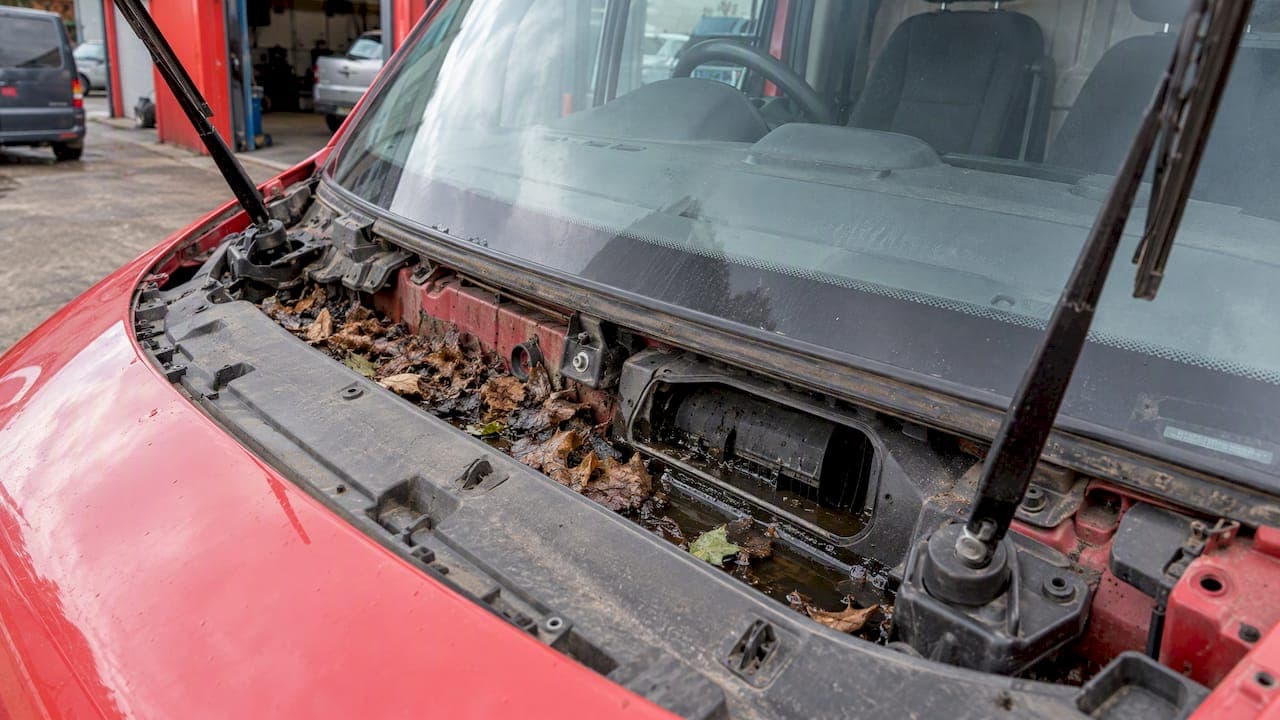
A scuttle leak can let rainwater run into the footwell and onto the airbag control module, which can short its circuit board and switch the airbag light on. Fix the leak first, then have the module checked. If the unit is sound, it can often be reset or repaired rather than replaced. Modules are usually fitted under the seats, in the centre console or behind the dash, so water that pools low in the cabin gets to them.
This guide explains how the damage happens, what to look for, what to do in what order, and where a postal crash data reset or repair fits.
TL;DR
- A blocked scuttle drain or displaced scuttle foam lets water into the cabin, where it can reach the airbag control module and its wiring.
- Wet modules can short, light the SRS lamp, disable the airbags or, rarely, cause unintended deployment, so treat a wet footwell and an airbag light together as a safety job.
- Dry the car and cure the leak before any module work, or the fault will come back.
- A lit SRS lamp is an MOT failure, so get the stored codes read before you buy a replacement unit.
- Our postal airbag module reset starts at £35, and we will tell you if your unit is beyond saving.
Table of Contents
- What a scuttle leak is and why it reaches the airbag module
- Signs that water has reached the SRS system
- What to do, in order
- Safety when working near airbag parts
- Reset, repair or replace after water damage?
- What does it cost?
- The MOT angle
- How our postal reset works
- Our perspective
- Need your module checked?
- Preventing a repeat
- FAQ
- Sources
What a scuttle leak is and why it reaches the airbag module
The scuttle is the panel at the base of the windscreen, under the wipers. Rain and screenwash run down the glass into it and drain out through small holes on each side. Leaves, pollen and debris block those drains. The water then backs up and finds the next way in: the cabin air intake, a cracked seal, or the bulkhead grommets where looms pass through.
One well-documented example is a Renault Master owner thread, where dislodged scuttle foam and blocked drainage let water pool, enter the airbox intake and run under the floor onto the airbag control module. Vans suffer in particular because the module often sits low, close to the front footwell. If you drive a Master, our Renault Master airbag module page lists the unit we handle.

The module is a small computer. Its circuit board has many closely spaced terminals, and moisture bridges them easily. A US Toyota recall notice states that if the board gets wet, a short between adjacent terminals could light the airbag warning lamp, disable the airbags or cause inadvertent deployment. That is a US recall for specific models, so it does not mean your car is affected. It does show why manufacturers take water around these modules seriously.
UK breakdown guidance makes the same general point about floods: water in control units and airbag wiring under the carpets can cause malfunction, potentially including unintended deployment. A slow scuttle leak is a much smaller event than a flood, but the route to the electronics is the same.
Signs that water has reached the SRS system
A leak rarely announces itself with one clear symptom. Look for a pattern:
- A damp or musty driver or passenger footwell. The Toyota notice lists damp carpet or a leak around the occupants' footwell as a warning sign, in the recall's owner notification.
- Misted windows or a smell of damp that does not clear when the heater runs.
- Water on the floor after heavy rain but not after a dry spell.
- The airbag light coming on intermittently, often after rain or a car wash, then going out.
- The airbag light staying on with no crash history.
- Other electrical oddities, such as a flickering dash, central locking glitches or comms faults, because several modules often share the same wet area.
The light is the one to take seriously. Service documentation for one manufacturer describes the normal pattern: the SRS lamp lights briefly at ignition then goes out; if it stays lit or comes on at another time, the system has a fault and should be read with a scan tool promptly. The principle applies across makes, even though the tools differ.
If you drive a van, the official daily walkaround guidance already asks you to check that warning lights, including the SRS lamp, work properly and to look for leaks, drips or puddles. Do the same on a car after any wet spell.
Why an intermittent light is not a good sign
A light that comes and goes after rain feels like a glitch. It is more often a damp connector or a board that is shorting only when wet. Each time it shorts, the module may store a fault. Corrosion builds quietly, and by the time the light stays on permanently, the damage can be harder to undo. Act at the first flicker.
What to do, in order
The order matters. Resetting a module in a car that is still taking in water just wastes money.
- Stop driving if you can. An SRS fault means the airbags may not work in a crash. If you must use the car, keep trips short and get it checked soon.
- Find and cure the leak. Remove the wiper arms and scuttle panel, clear the drains, and check the foam and seals. Our step list is below.
- Dry the car properly. Lift the carpets and underlay, and dry them thoroughly. Water travels along wiring looms by capillary action, so a proper repair plan covers lifting carpets, drying and decontaminating, then inspecting and repairing or replacing affected wiring and modules.
- Read the fault codes. Have a garage run an airbag diagnostic. UK guidance says that when the light stays on, a mechanic should run an airbag diagnostic and read the stored codes.
- Check the module and connectors. Look for corrosion, green or white deposits and tide marks on the module and plugs.
- Decide: reset, repair or replace. See the decision section below.
- Retest. Make sure the lamp goes through its normal start-up check and then goes out.
Curing the leak
Start at the scuttle. Pull the wipers and lift the panel, then clear leaf litter and silt from the drain channels with a soft brush or a length of flexible tubing. Check the foam seal under the scuttle sits flat, because a displaced strip sends water towards the intake. Pour a little water down the windscreen base and watch that it leaves under the car, not into the cabin. Then check the bulkhead grommets and the door and windscreen seals. If you are not comfortable removing trim around airbag components, leave it to a garage.
Drying out the interior
Surface drying is not enough. Foam underlay holds water for weeks. Mould follows if the dampness lingers, and mould on carpets and trim also hides near wiring. For the cleaning side, this guide on safe removal of mould from a car interior covers assessing and treating damp carpets, wiring and electronics. Keep any liquid cleaner well away from the airbag module and its connectors.
Safety when working near airbag parts
Airbag systems can injure if handled incorrectly. One manufacturer procedure for a 2022 Ford Edge warns that incorrect repair actions can cause accidental deployment and serious injury, and specifies disconnecting the battery and waiting at least one minute before continuing. Procedures differ by car, so follow the maker's wait time for yours.
The practical rules:
- Do not probe SRS connectors with a multimeter or test light.
- Do not open the module. Manufacturer guidance states that all SRS components are sealed units and should never be disassembled.
- Disconnect the battery and observe the wait time before unplugging anything.
- Never fit a used module of unknown history without it being coded and checked.
If you are a DIYer, our airbag diagnostics steps guide explains how to narrow the fault before spending money. We are a service for people who want a module reset or repaired, not a way to clear codes at home, so the next step after diagnosis is usually to send the unit to us or hand it to your garage.
Reset, repair or replace after water damage?
This is where most people overspend. A new module from a main dealer, plus coding, can cost several hundred pounds. Yet the unit is not always dead.
Three outcomes are common:
| Situation | Likely outcome | Notes |
|---|---|---|
| Light came on after a damp spell, connectors clean, module dry and undamaged | Crash data or fault memory reset may clear it | Cure the leak first |
| Light on, module has corrosion or has shorted internally | Repair or assessment needed | A reset alone will not hold |
| Module visibly corroded, burnt or physically damaged | Replacement may be the only safe route | Replacement unit needs coding |
No honest provider can promise the outcome without seeing the unit. What we can say is that sending the original module for assessment costs far less than a new ECU, and it can save you buying one you did not need. Our aim is to reset the original unit when that is safely possible.
Can crash data be cleared if the module is water damaged?
Only when the damage is not stopping the module from working. A reset clears a stored crash or fault record. It does not repair a corroded board. If the water has shorted components, the fault will return or the module will refuse to respond. In that case a repair, or a replacement, is the proper fix. If your light will not clear after a reset, our guide on why an airbag light won't clear explains the usual causes.
For trade readers, our article on diagnosing water-damaged airbag modules before reset sets out the checks we suggest before a unit is posted.
What does it cost?
Costs split into three parts: the leak fix, the diagnostic, and the module.
- The leak. Clearing blocked scuttle drains yourself costs next to nothing. A garage will charge for labour, and more if the wipers, scuttle and trim take time to remove. Ask for a quote before work starts.
- The diagnostic. Garages generally charge for an airbag code read. Our blog post on airbag diagnostic costs and the £35 reset option goes through what to expect.
- The module. Replacing means buying a unit and having it coded to the car. Resetting or repairing the original is usually the cheaper route when it is viable.
Our published prices are fixed: the standard airbag module reset costs £35 to £46 depending on the module, the motorhome airbag reset is £65, and our mobile airbag reset is from £75. If you have a genuine like-for-like quote that is lower, we price match it.
The MOT angle
A scuttle leak that sets the airbag light off has a direct consequence at test time. The DVSA MOT inspection manual treats an illuminated SRS warning lamp as a major defect, as summarised by one MOT test centre's guide, which means a fail. You cannot pass by waiting for the lamp to go out, and you should not remove the bulb to hide it.
If you are testing a car that has had water damage, expect the tester to see a lit lamp on the dash during the self-check. Having the codes read and the module sorted before the test saves a retest. If the car has been written off and rebuilt, see our note on a Cat S airbag light and postal reset.
If a self-test failure is what you are seeing, our page on airbag self test failure explains when a module reset fits.
How our postal reset works
We handle crash data reset and airbag ECU repair for cars, vans and motorhomes by post across the UK.
- Identify the module. Send us the part number or a photo, or message us on WhatsApp or call, and we will confirm the unit.
- Remove it safely. Disconnect the battery, wait the maker's time, then take the module out. Do not force a wet connector.
- Post it. Pack it dry, in an anti-static bag if possible, in a padded box.
- Same-day turnaround for most modules that reach us in the morning.
- Refit and retest. Refit the module, reconnect the battery and check that the lamp does its start-up check and goes out.
Garages and workshops can open a trade account for discounted rates.
Our perspective
We see the same story often. A car develops a damp footwell, the airbag light appears, a garage reads a fault from the module, and the quote for a new ECU lands. Sometimes that is right. A lot of the time nobody has asked whether the original unit is actually damaged, or whether the leak was ever fixed.
Our view is simple. Fix the water first, because a dry module in a leaking car is a short-term repair. Then find out what the module is really doing before buying anything. We would rather reset or repair your original unit when that is safe, and tell you plainly when it is not. Airbags are a safety system, so we never promise a result before a module has been checked.
Our team brings over 40 years of combined technician experience to that judgement. For motorhomes, which often have scuttle and cab roof leaks of their own, we offer a specific reset service.
— John
Need your module checked?
If your airbag light is on after a leak and the original module may still be good, send it to us. Most modules are back the same day they arrive in the morning, and pricing is fixed from £35. Start with our airbag module reset page, or check the airbag warning light guide to confirm your symptoms first.
We will help you identify the part from a number or photo, and we price match genuine like-for-like quotes.
Preventing a repeat
- Clear scuttle drains at least once a year, and more often if you park under trees.
- Check the scuttle foam and seals whenever the panel is off.
- Keep an eye on footwells after storms.
- Do not stack bags or wet items on the floor over the module.
- If you buy a used car with a sniff of damp, ask for the airbag code read before you pay.
- After any repair near the module, such as subframe or bulkhead work, check the lamp. Our guide on airbag lights after subframe work is a good example of how disturbed connectors cause faults.
The New Again guidance makes a useful point: electrical faults often sit at the end of a chain that starts with a physical leak, so ignoring the source lets problems return.
FAQ
Can a scuttle leak really set off my airbag light?
Yes. Water that reaches the module or its connectors can short the circuit and trigger a fault. The light may come on only after rain at first. Fix the leak, then have the stored codes read to confirm the cause.
Can I dry out a wet airbag module myself?
We would not. The module is a sealed unit that should not be opened, and probing it or the connectors risks accidental deployment. Dry the car, then send the module for assessment or ask a garage to check it.
Will a reset fix a water-damaged module?
Only if the module itself still works. A reset clears stored crash or fault data, but it cannot mend a corroded board. If the fault returns after a reset, the module needs repair or replacement.
Will the car pass its MOT with the airbag light on?
No. An illuminated SRS lamp counts as a major defect and results in a failure. Have the fault read and cured before the test.
How much does it cost to have my module reset?
Our standard airbag module reset is £35 to £46, motorhome resets are £65, and mobile resets start from £75. The price is fixed, and we match genuine like-for-like quotes.
Sources
- Airbag control module water ingress, Independent Renault forum
- NHTSA recall document 13V442, technical report
- NHTSA recall 13V442, owner notification
- How badly does flooding damage a car? Green Flag
- Carry out van daily walkaround checks, GOV.UK
- Exige S2 service notes, SRS section
- Why is my airbag light on? Start Rescue
- Technician Reference Booklet, NHTSA
- 2022 Ford Edge SRS procedure, I-CAR RTS
- Is a flashing airbag light an MOT failure?
- Electrical problems, New Again Car Care
- Safe mould removal from car interiors, Diamondbrite