
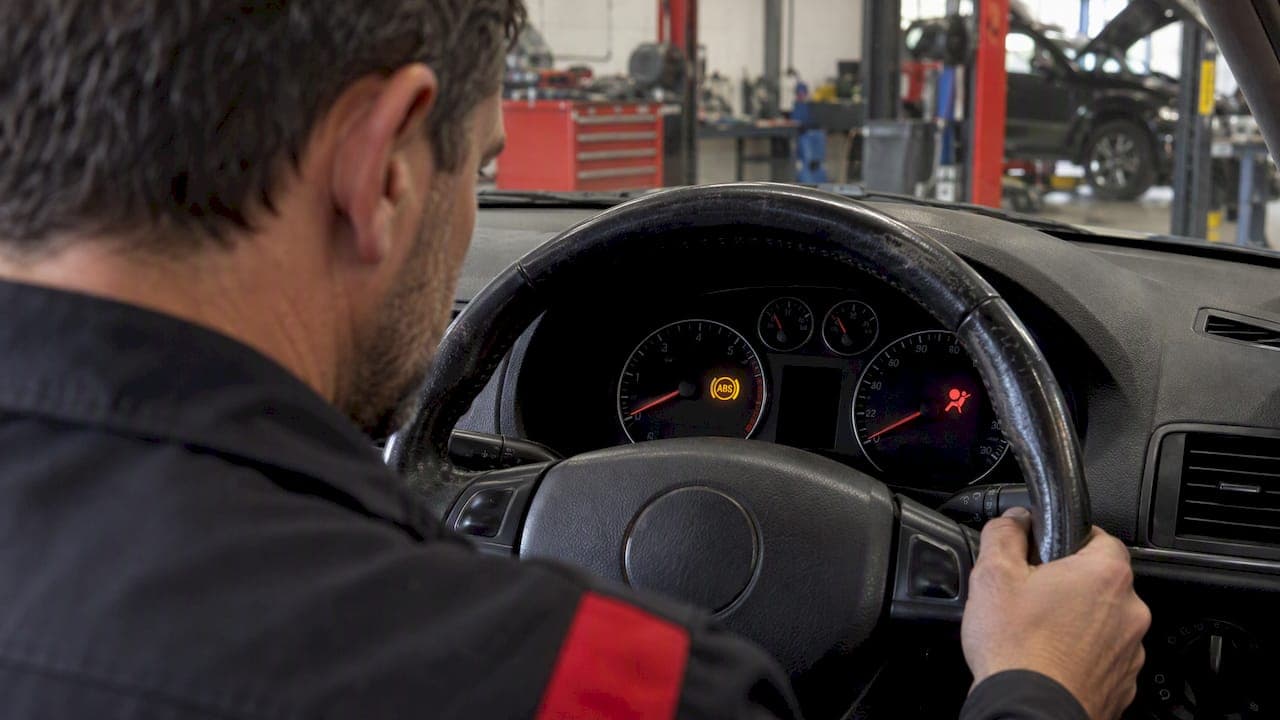
When the ABS and airbag lights come on together, the car has logged a fault in two safety systems at once. Often the two share one root cause: a weak battery, a wiring or connector problem, a wheel sensor fault or a module that has stored a crash event. Both lights are an MOT failure if they stay on, so the aim is to find the cause, not to hide the lights.
TL;DR
- ABS and airbag (SRS) lights appearing together usually point to a shared cause: low voltage, a wiring or connector fault, a wheel speed sensor, or an ABS or airbag module that has stored a fault.
- Neither light is cosmetic. Both are an MOT failure if they stay on, and the systems may not work as designed in an emergency.
- Read the fault codes first. Clearing lights without a diagnosis only hides the problem.
- If the cause is a stored crash event in the airbag ECU, a crash data reset (£35 to £46 for most modules) is often cheaper than a replacement unit.
Table of Contents
- Why the ABS and airbag lights can appear together
- The most common causes, from cheap to costly
- Is it safe to drive with both lights on?
- What it means for your MOT
- A sensible order of diagnosis
- Our view: diagnose first, then choose repair over replacement
- When a crash data reset is the right fix
- How our postal reset works and what it costs
- Mistakes that make this fault more expensive
- FAQ
- Sources
Why the ABS and airbag lights can appear together
The ABS and the airbag system look unrelated. One stops your wheels locking under braking; the other fires restraints in a crash. But both rely on sensors, wiring looms and control modules that talk to each other over the car's data network. A fault in one place can upset the other.
A quick reminder of what each system does. Anti-lock brakes are designed to stop the car skidding when you brake sharply by preventing the wheels from locking. The airbag, or SRS (supplemental restraint system), tracks crash sensors, seatbelt pretensioners and airbags, and decides whether to deploy them.
When a module cannot trust its inputs, it switches the system off and lights the warning. If two modules lose the same input, you see two lights.
The most common causes, from cheap to costly
Work through these in order. The first few cost little to check.

1. Low battery voltage
Modules are sensitive to voltage. A tired battery or a poor charging system can make several modules log faults at once, especially after a cold start or a flat battery. The lights may appear after a jump start or a battery change and sometimes clear on their own, but a stored fault code can remain. Have the battery and alternator tested before spending on anything else.
2. A wheel speed sensor
This is the classic ABS fault, and the sensors sit near the wheel hubs where dirt, road salt and water get at them. On many cars a wheel speed sensor fault also disables traction or stability control, which is why you often see ABS, ESP and traction lights together. The airbag light is less directly linked to a sensor fault, but on some cars one network fault triggers several warnings.

3. Wiring, connectors and the steering wheel clock spring
The clock spring is a coiled ribbon behind the steering wheel that carries the signal to the driver's airbag, horn and steering wheel controls. If it wears or breaks, the airbag light comes on. Damaged connectors under the seats are another frequent culprit, particularly if seats have been moved, cleaned or removed. Under-seat connectors carry the signals for the seatbelt pretensioners and side airbags, and a disturbed plug will trip the light.

4. Seat occupancy sensors and seatbelt buckle switches
These feed the airbag module. A faulty buckle switch or passenger mat sensor can light the SRS warning on its own.
5. The ABS module or the airbag module itself
Internal faults in either module can bring both lights on, especially where a shared network fault is involved. The module may be repairable rather than needing replacement, and that is where the cost difference matters.
6. A stored crash event
After a collision, even a minor one, the airbag ECU can record crash data. Once that data is stored the module will often keep the light on and may refuse to work until the record is cleared or the unit is replaced. If the car has had a knock, a kerb strike, subframe work or a seat belt pretensioner deployment, this is a strong suspect. Our guide to the airbag light after a minor crash walks through the first 24 to 72 hours.
| Symptom | Likely cause | First check |
|---|---|---|
| ABS, airbag and other lights after a flat battery or jump start | Low voltage or stored network faults | Battery and charging test, then code read |
| ABS and traction lights, airbag light as well | Wheel speed sensor or wiring | Code read for the sensor location |
| Airbag light plus steering wheel controls or horn not working | Clock spring | Code read, visual check |
| Lights after seat removal or cleaning | Under-seat connector | Inspect and reseat connectors, then code read |
| Lights after a collision or kerb strike | Stored crash data or a damaged sensor | Full diagnostic scan |
| Lights flash on and off | Loose connector or failing component | Code read, wiggle test by a technician |
Is it safe to drive with both lights on?
Treat it as unsafe until you know the cause. The AA's guidance on what ABS warning lights mean says that for most vehicles an ABS light alone may leave you able to drive, with extra care in wet or icy weather because the braking may not behave as normal. Check your handbook and listen for any noises from the wheels.
The airbag light changes the calculation. If it is on, the airbags may not fire in a crash, or the system may be in a state where it is not monitoring properly. Volkswagen's page on warning light colours explains that amber means the vehicle needs professional attention as soon as possible, and red means pull over when it is safe. If a brake warning (usually red) appears alongside ABS, stop and call for help. That is a different fault from ABS alone, and the AA notes that the combination can mean a serious braking problem.
As a practical rule:
- Amber ABS and airbag lights, car braking normally: drive carefully to a garage, avoid long journeys and avoid harsh braking.
- Red brake light, spongy pedal, grinding noises or pulling to one side: stop and get recovery.
- Lights after an accident: do not assume the car is fine. Have it checked before driving it with passengers.
What it means for your MOT
The DVSA MOT inspection manual covers both systems. A warning lamp for the ABS or the airbag that stays on is a failure, as is one that never lights at start-up, which can suggest the bulb has been tampered with. The tester expects the lights to come on briefly when the ignition goes on and then go out.
The manual's section on airbags also notes that a passenger airbag switched off by the driver is not a defect. A light that stays on is a different matter. A garage write-up, Ash Road Service Centre's MOT warning lights guide, lists the same warning lights among those that cause problems at test time.
Do not try to get through the test by clearing codes the day before. Many faults return within a few miles, and a technician will see a car that has just been wiped. The AA's advice is blunt: resist the urge to reset systems just to pass an MOT, because these systems exist to protect you. The same caution applies if you have fitted aftermarket electronics that tap into the car's data network. Poorly fitted add-ons can themselves cause warning lights, as this explainer on MOT checks when fitting a CAN bus immobiliser shows.
A sensible order of diagnosis
- Note when the lights came on. After a knock, a battery change, a service, seat work or bad weather? The timing narrows the cause quickly.
- Check the battery. Get a voltage and load test. Fix any weakness first.
- Read the codes from both modules. A basic engine code reader will often miss ABS and SRS faults. You need a scan tool that reads the airbag and ABS modules specifically.
- Look at the code, not the light. A code naming a wheel sensor, a clock spring, a seat connector or a stored crash event tells you where to go next.
- Fix the fault. Replace the sensor, repair the wiring, or deal with the module.
- Clear the codes and retest. Confirm the lights stay off over a test drive and across several ignition cycles.
If you have no scan tool and want to understand what a technician will do before the bill arrives, our airbag diagnostics steps lay out the process. If the light is on but no codes appear, see airbag light with no codes. If it comes and goes, intermittent airbag lights usually mean a loose connection or a marginal component.
Our view: diagnose first, then choose repair over replacement
We handle airbag ECUs every day, and the pattern is consistent. Owners are often told the airbag module is dead and needs replacing, when the unit has simply stored crash data from a minor impact. Replacement modules can be costly, and a new or second-hand unit usually has to be coded to the car, which adds more cost and delay.
Our approach is simple:
- Diagnose before you reset. A reset is the right answer when the module is holding crash data and the original unit is otherwise sound. It is the wrong answer when the real problem is a broken clock spring, a damaged sensor or a physically deployed component. Resetting a module on a car with a genuine fault only moves the problem. Our piece on diagnosing before a bench reset explains why.
- Replace deployed parts. If airbags, pretensioners or sensors have fired or are damaged, they must be replaced. Manufacturer repair information is clear on this point, for example i-CAR's published procedure for the 2024 Ford Mustang, which calls for removing and replacing deployed devices when the module holds a crash event. A reset does not replace a deployed airbag.
- Repair the original unit where it is safe to do so. That avoids buying a replacement ECU you did not need. See repair first for an airbag ECU.
- Be honest about ABS. We reset and repair airbag ECUs. If your ABS light has an unrelated cause, such as a wheel speed sensor, we will say so and point you to a brake specialist, because the airbag reset will not touch it.
If you do not know whether your light is crash-data related, a scan comes first. Our write-up on UK airbag diagnostic costs gives a realistic picture of what to expect.
— John
When a crash data reset is the right fix
A crash data reset suits a car where the scan shows the airbag ECU holding a stored crash event, the physical parts are in good order, and the light will not clear with a normal diagnostic tool. Typical situations:
- A minor collision or kerb impact that set the module's crash flag without deploying anything.
- A car bought at auction or after a repair, where the airbag light never went out.
- Work near the sensors, such as subframe repairs.
- A light that will not clear even after the fault is repaired.
A reset is not appropriate when the airbags have deployed and not been replaced, or when the fault is elsewhere in the car. Garages should read the workflow for garage airbag resets so the right checks happen before a unit is posted.
How our postal reset works and what it costs
We offer a UK-wide postal service. You remove the module (or your garage does), send it to us, and we clear the crash data and return it. Most modules that arrive in the morning are turned around the same day. If you are unsure which module you need, we can help identify it from the part number or a photo, and you can ask us by WhatsApp or phone.
Our published prices:
| Service | Price |
|---|---|
| Airbag module reset | £35 to £46 one-off |
| Motorhome airbag reset | £65 one-off |
| Mobile airbag reset | from £75 one-off |
Prices are fixed and transparent, and we price match genuine like-for-like quotes. Garages, bodyshops and mobile technicians can apply for discounted trade accounts. For more on the process, see our crash data reset page or go to the Airbag Reset UK homepage.
To be clear about scope: we deal with the airbag ECU. We do not repair ABS pumps or brake components. If your scan shows an ABS code only, start with a brake specialist.
Mistakes that make this fault more expensive
- Buying a replacement module on a guess. Without codes you may pay for a unit that does not fix anything, and a replacement often needs coding.
- Clearing codes and driving on. The light returns, and meanwhile the system is not protecting you.
- Disconnecting the battery to reset the lights. This does not clear a stored crash event and can add further faults.
- Working on airbag circuits without training. Repair information from manufacturers warns that incorrect repair techniques can cause accidental airbag deployment. Leave connectors and pyrotechnic parts to someone trained.
- Leaving it until the MOT. You then pay for a retest on top of the repair.
FAQ
Why are my ABS and airbag lights on at the same time?
Usually because of a shared cause. Low battery voltage, a wiring or connector fault, a faulty sensor or a module that has stored a fault can all trigger both warnings. A scan of both modules tells you which it is.
Can I drive with the ABS and airbag lights on?
Only cautiously and only to a garage, and not at all if a red brake warning is showing or the car brakes badly. With the airbag light on, the airbags may not fire in a crash, so avoid carrying passengers and long journeys until it is checked.
Will the car pass an MOT with these lights on?
No. The DVSA manual treats an ABS or airbag warning that stays lit as a failure. You need the fault diagnosed and fixed before the test.
Will a crash data reset turn off my ABS light?
Not by itself. A crash data reset clears stored crash information in the airbag ECU. If your ABS light comes from a wheel sensor or the ABS module, it needs a separate repair.
Can a weak battery really cause both lights?
Yes, it is a common cause because modules log faults when voltage drops. Test the battery and charging system first, then read the codes, since a stored fault can stay after the battery is fixed.
Sources
- DVSA MOT inspection manual: cars and passenger vehicles, GOV.UK
- MOT inspection manual, 7. Other equipment, GOV.UK
- What are anti-lock brakes and how do they work?, The AA
- Dashboard warning lights and what they mean, The AA
- Volkswagen car warning lights, Volkswagen UK
- MOT warning lights explained, Ash Road Service Centre
- 2024 Ford Mustang SRS repair information, i-CAR
- 2022 Ford Edge SRS repair information, i-CAR
- 5 checks to avoid MOT failure when fitting a CAN bus immobiliser, LRD Track