
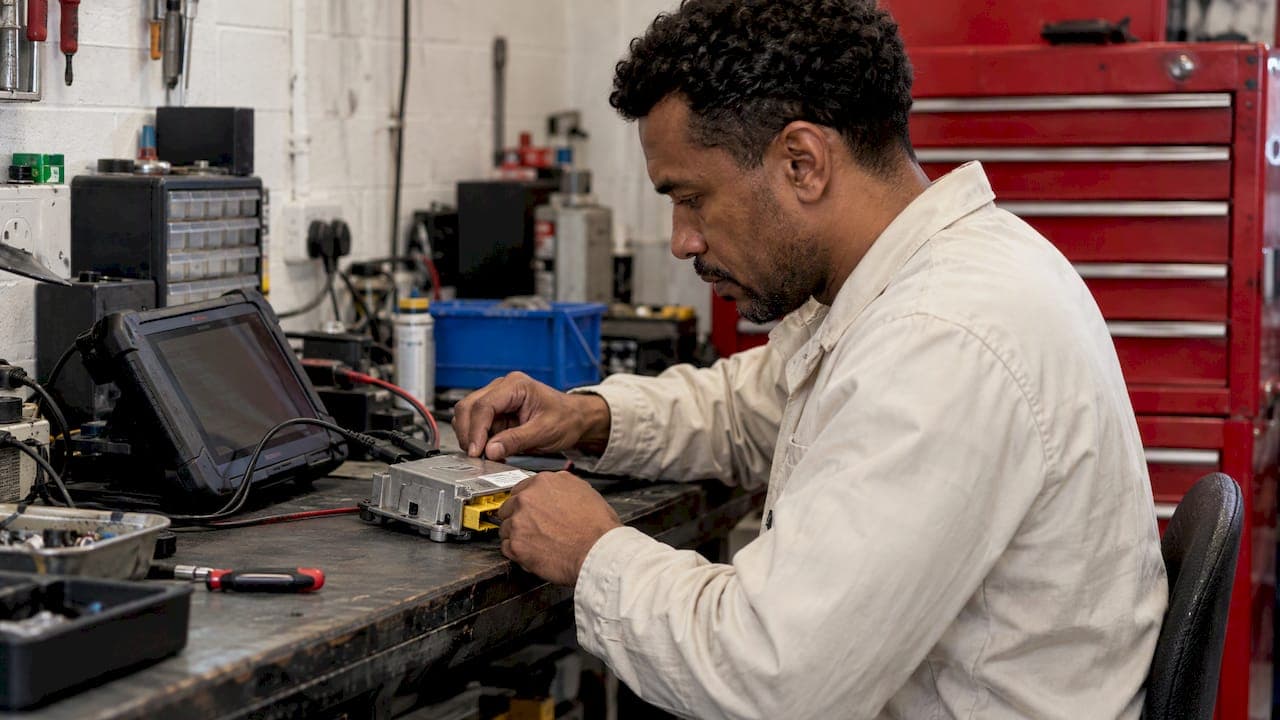
A SEAT crash data reset clears the stored crash record from the airbag (SRS) control module so the unit can work again, instead of you buying a new one. It is done on the module itself, usually on a bench, using the correct part number and manufacturer-compatible equipment. It only makes sense once every deployed airbag, pretensioner and damaged sensor has been replaced. At Airbag Reset UK, a standard module reset costs £35 to £46, and you can post the module to us from anywhere in the UK.
TL;DR
- A crash data reset wipes the stored crash event from the SEAT airbag module. It does not repair a crashed car, so deployed airbags, pretensioners and damaged sensors or wiring must be replaced first.
- Clearing the light with a code reader is not the same job. The module has usually locked itself after the impact and needs a bench reset.
- Identify the module by its exact part number (a clear photo of the label is enough) before you post anything.
- Our standard module reset is priced at £35 to £46, and most modules received in the morning are turned around the same day.
- After refitting, rescan the system. If the airbag light stays on, do not drive the car and have it checked by a specialist.
Table of Contents
- What a crash data reset actually does
- Why a code reader alone usually will not clear it
- Step by step: from accident to a working SEAT airbag system
- Safety checks before you drive again
- Will a SEAT with reset crash data pass its MOT?
- Is your SEAT module suitable for a reset, repair or replacement?
- What a SEAT crash data reset costs
- Our view: reset the original module when it is safe to do so
- Send us your SEAT module
- Common mistakes to avoid
- FAQ
- Sources
What a crash data reset actually does
When a SEAT is in a collision serious enough to trigger the restraint system, the airbag control unit records the event. It logs the crash, the devices that fired and the sensor readings. Once that record is stored, many modules lock out and keep the SRS warning lamp lit, even after new airbags have been fitted. The module is effectively telling the car that it has already been used.
A crash data reset removes that stored event and the associated hard codes, returning the unit to a state where it can be refitted, coded to the car and used again. The alternative is a new or second-hand module that often needs programming to the vehicle, which costs far more and brings its own complications. A SEAT dealer reported being unable to program a replacement airbag module at first, only managing it later after an update. That is one owner's experience on a forum, but it shows why many people prefer to keep and reset the original unit.
Two points are worth being clear about:
- A reset is not a repair of the crash damage. It only deals with the module's memory.
- A reset is not a way to hide a fault. If the system has a genuine fault, the light should stay on until it is fixed.
Why a code reader alone usually will not clear it
A basic OBD reader can read and sometimes clear engine codes. Crash records in an airbag module are a different matter. They are stored in protected memory, and many are classed as hard codes that a standard "clear faults" command will not remove. You may see the light go out for a moment and return on the next ignition cycle.
Collision-repair guidance makes a related point: an illuminated airbag lamp does not by itself prove that a deployment happened, and an OEM-level scan is needed to identify which airbags, pretensioners and other SRS devices have been triggered. The same scan shows which impact sensors have tripped and whether crash or deployment codes are latched. So the sensible order is always: scan, identify, repair, then reset.
If your light came on without any accident, for example after a battery change or a flat battery, the cause may be different. Our guides on the airbag light after a battery change and on an airbag light that will not clear explain the likely causes before you spend anything.
Step by step: from accident to a working SEAT airbag system
1. Have the whole SRS system inspected
Before thinking about the module, get a full diagnostic scan from a garage or bodyshop with equipment that reads SEAT restraint systems. The scan should list every deployed device and every circuit fault. Fix those first. SEAT's own UK owner guidance says that work on the airbag system should be carried out by a specialised workshop, and that is the right starting point whatever the model.
2. Replace everything that fired or was damaged
That means every deployed airbag, every belt pretensioner that fired, and any crash-damaged sensor, wiring or connector. Use correct parts for your exact model and year. Resetting a module that is still connected to a fired airbag circuit simply brings the fault straight back.
3. Identify the module
SEAT shares platforms and electronics with other Volkswagen Group cars, so module part numbers matter far more than the model name. The part number is printed on the label of the control unit, normally under the dash, centre console or under a seat depending on the car. A sharp photo of that label is usually enough for us to confirm whether a reset is possible. If your model is not listed on our site, our SEAT unlisted model page is the place to start, and if you are unsure we can help identify the unit over WhatsApp or phone from a photo.
4. Remove the module safely
Disconnect the battery and follow the manufacturer's procedure. The UK Health and Safety Executive warns that airbags and belt pretensioners can contain explosive charges, that work must follow the manufacturer's instructions, and that only appropriately trained people should discharge them. Do not poke around undeployed units, and do not attempt to repair or modify the devices themselves. If you are not confident removing the control unit, leave it to a garage.
5. Post it for a bench reset
Pack the module in an anti-static bag or padded box and send it with your contact details and a note of the vehicle. Our process on receipt is to confirm the part number, reset the crash data and hard codes on the bench, and return it ready to plug back in.

6. Refit, rescan and test
Refit the module using the manufacturer's procedure, then rescan the SRS and related control units. Some modules need coding to the car after fitting, so ask your garage to check this. Confirm there are no stored faults and that the warning lamp goes out after the normal self-check.
Safety checks before you drive again
This is the stage where people are tempted to cut corners, so it deserves care. Before the car goes back on the road, check that:
- all deployed airbags and belt pretensioners have been replaced with correct parts;
- damaged sensors, wiring and connectors have been repaired;
- the module passed a diagnostic test after the reset;
- the post-refit scan shows no remaining SRS faults and the lamp is off.
If the lamp stays on or the system reports a fault, do not use the car as normal. SEAT's guidance states that a faulty airbag system must be checked immediately by a specialised workshop, because airbags or belt tensioners might fail to trigger or might trigger incorrectly. Take that seriously: the point of the reset is a working restraint system, not just a dark dashboard.
Will a SEAT with reset crash data pass its MOT?
The MOT looks at whether the SRS warning lamp shows a fault. Under the official MOT inspection manual, an SRS malfunction indicator showing a system fault is a major defect, which means a fail. A lamp that simply indicates the passenger airbag has been switched off is not a defect.
In practice, a correctly reset module with all deployed parts replaced should let the lamp run its self-check and go out, which is what the tester expects to see. A reset on its own, with parts still missing, will not give you a lasting pass, because the lamp will return. If you are heading to a test with a light on and want to understand what a diagnosis costs first, read our guide on airbag diagnostics costs and the £35 reset option.
Is your SEAT module suitable for a reset, repair or replacement?
Not every airbag fault is a crash record. Here is a rough way to sort the situation:
| Situation | Likely route |
|---|---|
| Airbags deployed, new parts fitted, light stays on, module locked | Crash data reset |
| Light on, no accident, communication fault with the module | Diagnosis, then repair or reset depending on the cause |
| Self-test failure after work on the car | Check wiring and connectors, then consider a module reset |
| Module physically damaged (water, impact, burnt) | Repair if possible, otherwise replacement |
| Wrong or unidentified part number | Identify first, do not post blind |
For the second and third rows, our checklists on no communication airbag modules and airbag self-test failures show what to check before sending a unit away. Garages that want to understand what happens on the bench can also read about clearing airbag codes through a bench reset.
What a SEAT crash data reset costs
Prices vary between providers, and what you pay depends mainly on how complex the module is, whether it needs repair rather than a straightforward reset, and how you send it. With us the pricing is fixed and published, so you know the figure before you post anything.
| Service | Price |
|---|---|
| Airbag module reset (standard to more complex modules) | £35 to £46 |
| Motorhome airbag reset | £65 |
| Mobile airbag reset | From £75 |
Current figures are on our airbag module reset pricing page. We also offer price matching on genuine like-for-like quotes. Trade accounts for garages, bodyshops and mobile technicians receive discounted rates.
Turnaround is quick: most modules that reach us in the morning are returned the same day, though complex units can take longer. Postal time each way is on top of that, so use a tracked service and allow for it when booking the car into a garage for refitting.

When comparing quotes, check what each price includes. A fair comparison asks whether return postage is included, whether identification of the part number is covered, what happens if the module cannot be reset, and whether the price is fixed or "from".
Our view: reset the original module when it is safe to do so
At Airbag Reset UK, we see the same pattern every week. A car has been repaired, the new airbags are in, and then the garage or owner is told that a replacement control unit is needed, with a price that can run to hundreds of pounds plus programming. Often the original module is perfectly sound. It is just holding a crash record.
That is why our whole service is built around resetting the original unit whenever that can be done safely. Our technicians bring over 40 years of combined experience to the bench, and we would rather help you identify the correct part number from a photo than let you buy something you do not need.
We are equally firm about the other half of the job. A reset is not a shortcut around a damaged system. Replace what fired, repair what is damaged, rescan, and only then trust the lamp. Done in that order, a reset gives you a proven, original unit, a fixed price and a quick return.
John
Send us your SEAT module
If the repairs are finished and the only thing left is a locked module, our postal service is built for exactly that. Send a photo of the label or the part number, we will confirm that it can be reset, and most modules received in the morning go back out the same day. Garages can ask about a trade account for repeat work.
See our fixed pricing for airbag module resets or start from our home page to get your SEAT module identified. If you are working on a motorhome built on a SEAT-related platform or you need someone to come to you, take a look at our motorhome reset service and mobile airbag reset.
Common mistakes to avoid
- Resetting before repairing. If a deployed airbag is still missing, the light returns and you have paid twice.
- Buying a used module blind. Used units may carry their own stored crash data or the wrong coding, and they can be locked to another vehicle.
- Guessing the part number. Similar-looking SEAT modules can differ by a single digit. Always read the label.
- Relying on a generic scanner. A basic reader may not see the restraint system at all, let alone clear protected crash records.
- Ignoring the lamp. A lit SRS lamp means the system may not protect occupants properly. Do not treat it as cosmetic.
- Skipping the final scan. The rescan after refitting is your evidence that the system is healthy.
If you are a DIY-minded owner who wants to check things before spending money, our airbag diagnostics steps guide covers the checks that help avoid buying a new module unnecessarily. Anything involving the airbags themselves, though, belongs with a trained professional.
FAQ
Can I reset SEAT crash data myself?
Not realistically. The crash record sits in protected memory that standard code readers cannot clear, and handling airbag components carries real risk. The usual route is to remove the module, have it reset on a bench by a specialist, and refit it.
Do I need to replace the airbags before the reset?
Yes. Every deployed airbag and pretensioner, and any damaged sensor or wiring, should be replaced or repaired first. Otherwise the module will see the same fault again and the lamp will come back on.
How much does a SEAT airbag module reset cost?
Our standard module reset is priced at £35 to £46, depending on the module. Motorhome resets are £65 and mobile resets start from £75. Always check the pricing page for the current position.
Will the car pass its MOT after the reset?
It can, provided the SRS lamp goes out normally and no fault is present. The MOT manual treats an SRS lamp showing a system fault as a major defect, so the system must be fully repaired and rescanned first.
Can a crash sensor be reset on its own?
Crash sensors are usually checked and replaced if damaged, rather than reset separately. A proper scan shows which sensors have tripped and whether crash codes are latched in the module, and that tells your garage what needs replacing.
Sources
- SEAT Ibiza owner's manual (UK, 2022)
- HSE: Health and safety in motor vehicle repair (HSG261)
- GOV.UK: MOT inspection manual, other equipment
- Air bag systems estimates, diagnostics and repairs
- SEATCUPRA.NET forum: dealer unable to program airbag module