
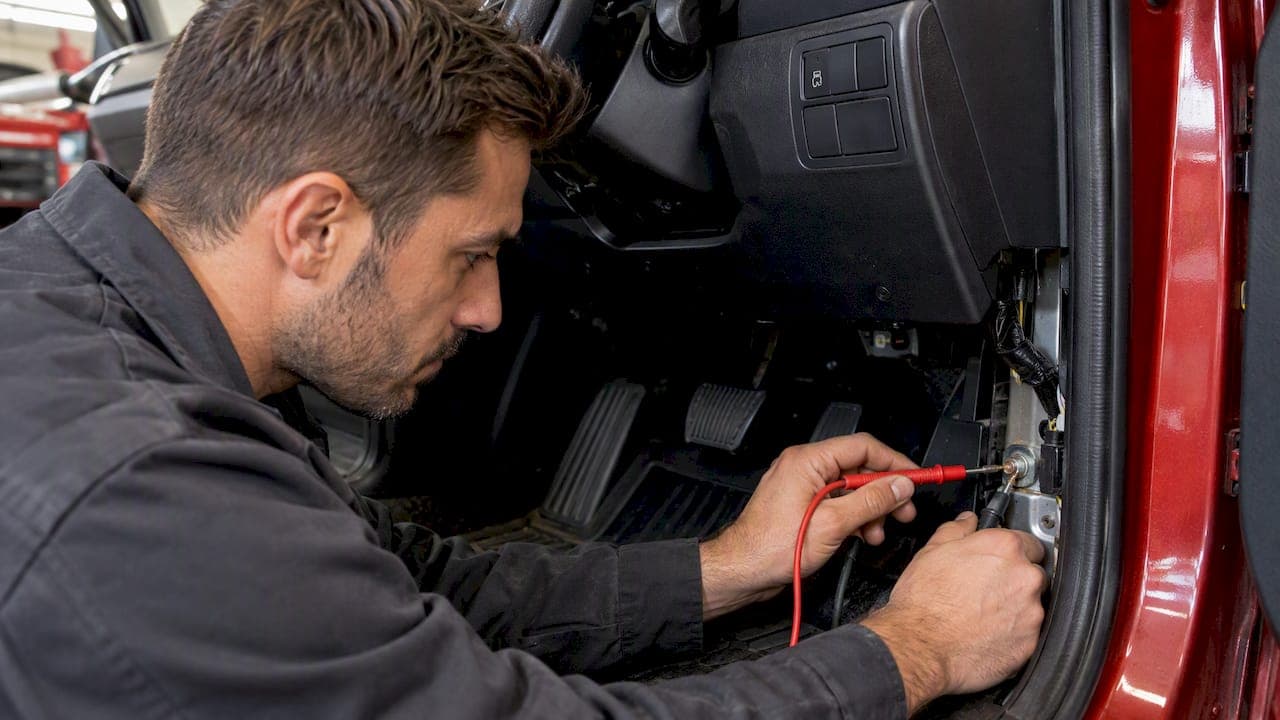
An airbag module ground fault means the airbag control unit, or one of the circuits it monitors, has an unwanted path to ground (earth) or has lost its own ground connection. The module notices during its self-test, stores a fault code and switches on the airbag (SRS) warning light. Often the cause is a wiring or connector problem, not a dead module. But if the fault code is actually a stored crash event, the wiring is fine and the module needs a crash data reset instead. Telling those two apart is the whole job, and it saves you from buying a replacement unit you may not need.
TL;DR
- A "ground fault" is either a circuit shorting to ground (for example a code for leakage to ground on a deployment circuit) or the module having a poor ground of its own.
- The usual suspects are the clock spring, seat or side airbag connectors, corroded earth points and damaged harnesses. Check these before condemning the module.
- Never probe airbag circuits with a multimeter while connected. It can fire an airbag.
- In the UK, an SRS warning light showing a malfunction is a major defect at MOT.
- If the module is sound but holds crash data, a postal reset from £35 to £46 is usually far cheaper than a new unit.
Table of Contents
- What an airbag module ground fault actually is
- Warning signs and the codes you may see
- What commonly causes it
- Ground fault, faulty module or crash data?
- How to diagnose it safely
- Repair or replace?
- MOT and legal implications
- Where a crash data reset fits
- Our perspective
- Our airbag module reset service
- FAQ
- Sources
What an airbag module ground fault actually is
The airbag control unit is the brain of the restraint system. According to HELLA's technical guide, it handles crash detection, supplies power to the firing circuits through an internal capacitor, runs self-diagnostics and stores faults in memory. Every time you switch the ignition on, it tests the squibs (the igniters in each airbag and pretensioner) and the wiring to them. If the resistance it measures is wrong, or a line reads as connected to ground, it logs a code and lights the warning.
"Ground fault" is used loosely, and it covers two quite different situations:
- A circuit shorted to ground. A wire in a deployment loop, such as the driver airbag feed, has chafed through and touches the body or a metal part. The module sees leakage to ground.
- A poor ground at the module. The control unit needs its own clean earth to work. If that connection is loose or corroded, readings drift and the light can come on intermittently.
The second type is the sneaky one. On some older systems, such as the Saab 9000, insufficient module grounding may not set a code at all, yet it can still upset airbag operation and cause erratic warning lamp behaviour.
Warning signs and the codes you may see
The obvious sign is the airbag light, which stays on after start-up or flickers on and off. On a Toyota Prius, for example, a light that stays on for about six seconds or more may indicate a malfunction, and occasional lighting for that long can point to a short to battery, a short to ground or an open circuit in the warning light circuit. Other symptoms include the light coming on when you turn the steering wheel, or only after hitting a bump.
Codes vary by manufacturer, but a few examples show the pattern:
| Code | Where it appears | What it describes |
|---|---|---|
| B0001:11 | Jaguar | Driver frontal stage 1 deployment control, leakage to ground |
| B1348 | 2011 to 2015 Kia Sorento | Driver airbag resistance circuit, short to ground |
| B1910 | Several makes | Airbag diagnostic monitor circuit failure; the exact definition depends on the manufacturer |
Note that both the Jaguar and Kia bulletins lead to the same area: the driver's airbag circuit through the steering column. The Jaguar document describes a dynamic test, turning the steering wheel while watching resistance on a scan tool, to catch wiring that changes as the clock spring moves. The Kia bulletin gives a clock spring replacement procedure for its code. That is why a code that says "short to ground" so often ends up as a clock spring or connector, not the module.
A generic OBD reader will rarely see these codes. Airbag faults sit in the SRS module, so you need a scan tool that can talk to it. Our guide to what the SRS light means explains how the dashboard lamp relates to stored faults.
What commonly causes it
In rough order of how often they turn up in practice:
- Clock spring (spiral cable). The ribbon behind the steering wheel flexes thousands of times and can fray or short.
- Under-seat connectors. Seat adjustment, cleaning and loose items under the seat can disturb the yellow airbag connectors, which feed side airbags and belt pretensioners.
- Corroded or loose earth points. Water ingress is the classic culprit. On a 2006 Jeep Wrangler, for instance, the control unit takes its ground through a single eyelet terminal held by a screw on the right cowl side inner panel. One corroded screw and the module has no reliable earth.
- Damaged harness. Chafing at door hinges, floor pan routing or after bodywork repairs.
- Previous crash repairs. A connector left unplugged or a wire trapped during a repair.
- The module itself. Internal faults do happen, particularly after water damage.
It helps to remember what the repair trade says about codes: the light and the code are symptoms of a fault, not the fault itself. Repairer Driven News's airbag glossary makes exactly this point, and says to follow a logical diagnostic approach instead of swapping parts. It also separates hard faults, which are present at the time of scanning and cannot be cleared until repaired, from intermittent ones, which are often down to loose or corroded connectors or poor grounds.
Ground fault, faulty module or crash data?
This is the question that decides what you spend. Three situations look alike on the dashboard but are fixed differently.
| Situation | What the scan shows | Typical fix |
|---|---|---|
| Real ground fault in wiring or connector | Live circuit fault that returns straight after clearing, often a resistance or short to ground code | Repair or replace the faulty wiring, clock spring or connector, then clear codes |
| Poor ground at the module | Intermittent or inconsistent faults, sometimes no code, light that comes and goes | Clean and tighten the earth point, check for corrosion |
| Stored crash data | A crash or deployment-related code, with no wiring fault found; the light stays on after a bump or accident repair | Crash data reset of the original module |
| Failed module | Module will not communicate or fails its own self-test | Repair or replace the module |
A useful rule: if the code clears and stays gone, it was not a hard fault. If it comes straight back, something is still wrong in the circuit. And if you have had an accident, had the airbags replaced or repaired, and the light remains, the module may simply still be holding the crash record. Our article on an airbag light that will not clear walks through that decision, and airbag self-test failures covers when a reset fits.
If you also see a blown fuse, look at the wiring before fitting another. We cover that in airbag fuse keeps blowing, and power-side problems in airbag module power faults.
How to diagnose it safely
Airbag circuits are not like other car wiring. The firing circuits carry the means to deploy an airbag, and careless testing can set one off. Ford's repair guidance, last revised in 2023, warns that SRS procedures must be followed precisely, because incorrect techniques can cause accidental deployment with risk of serious injury or death. So the sensible rule for owners is simple: look, do not probe.
What a careful owner or a garage can do:
- Read the codes first with a scan tool that supports the SRS module. Write them down before clearing anything.
- Look for the obvious. Check under-seat connectors are seated, nothing has been spilled or kicked into them, and there is no damp in the footwells.
- Note when the light appears. Only after turning the wheel points to the clock spring. After rain points to water or a corroded earth.
- Check the module's earth point visually, once the battery is disconnected and the system has been left to discharge as the manufacturer's procedure states. Corrosion or a loose screw is easy to spot. For general guidance on checking a ground connection, the principles of cleaning and securing a clean metal-to-metal contact apply to any vehicle wiring, though airbag circuits themselves are not for testing with a meter.
- Leave live testing to trained technicians. Never put a multimeter or test lamp across a connected airbag or pretensioner circuit.
Our DIY airbag diagnostic steps cover the checks you can do without touching the firing circuit, and the intermittent airbag light guide helps if the lamp comes and goes.
Repair or replace?
If the fault is in an airbag circuit harness, expect replacement rather than patching. Jaguar's technical publications state that harness repairs to airbag circuits are not acceptable because of the legal implications of a system failure, so "repair the circuit" typically means a new harness section. That is a sound principle for any make: a twisted-and-taped airbag wire is not a repair.
Once the wiring fault is fixed, the module may still hold the fault history or crash data. At that point the options are:
- Clear the fault if it was a simple hard fault now repaired.
- Reset the crash data on the original module if it was in a collision.
- Repair the module if the unit itself is faulty.
- Replace the module only when it cannot be restored safely. A new or used replacement usually also needs coding to the car, which adds cost.
MOT and legal implications
In the UK this matters beyond safety. The MOT inspection manual treats an SRS malfunction indicator lamp showing a system malfunction as a major defect, which means a fail. The same principle applies elsewhere: for the driving instructor part 3 test, a car with any safety-related warning light on, including the airbag light, cannot be used, apart from specific recalled vehicles with proof of safety.
Recalls are a separate case. Under MOT special notice 03-25 on the Citroën stop drive recall, affected vehicles can still pass, but the tester should issue an advisory telling the owner to contact the manufacturer for a free repair. If your car has an airbag recall, check with the manufacturer before anything else.
A lit airbag light also means you cannot rely on the airbags in a crash, so do not treat it as cosmetic. For the costs and the MOT angle, see airbag diagnostic costs and the £35 reset option. Buying a car that was written off? The Cat S airbag light guide explains the buyer risks.

Where a crash data reset fits
A reset does not repair a damaged wire. What it does is clear stored crash data from a module that is otherwise healthy, so the car stops reading as if it has just been in an accident. That is the right answer when the wiring is sound, the airbags and sensors have been replaced or checked, and the module still shows a crash fault.

It is also a reason to find out what is really wrong before paying for a replacement. Resetting the original unit when it is safe to do so avoids the cost of a new module and the coding that goes with it.
Our perspective
Most customers who write to us have been told they need a new airbag module. Often, the scan says something different: a stored crash record, with nothing wrong in the unit. Our technicians, who have over 40 years of combined experience, see the same pattern repeatedly. The earlier steps matter, though. If there is a genuine ground fault in the car's wiring, a reset will not hold, and we would rather tell you that than take your money.
Our advice is to scan first, fix any live wiring fault, and only then consider a reset. If you are unsure which module you have, send us the part number or a photo and we will help you identify it by phone or WhatsApp. We reset the original unit where it is safe to do so.
— John
Our airbag module reset service
If the wiring checks out and your module holds crash data, you can post it to us. Standard modules cost from £35 to £46 on our pricing page, with most modules received in the morning turned around the same day. Motorhome modules are £65, and our mobile airbag reset starts from £75. We also price match like-for-like genuine quotes, and garages can apply for a trade account. Garages will find our workflow in airbag resets for garages.
FAQ
Can I drive with an airbag module ground fault?
The car will usually still drive, but you should not rely on the airbags to work in a crash. An illuminated SRS light also counts as a major MOT defect. Get it scanned soon.
Can a bad ground at the module cause the airbag light on its own?
Yes. A loose or corroded earth can upset the module's readings and cause intermittent warnings, sometimes without a stored code on older systems. Check and clean the earth point with the battery disconnected and the system discharged as the manufacturer specifies.
Will a crash data reset fix a ground fault?
No. A reset clears stored crash data from a healthy module. If a circuit is still shorted to ground, the fault will return, so repair the wiring or connector first.
Can I test the airbag wiring with a multimeter?
Not on connected airbag circuits. Manufacturer guidance warns that incorrect procedures can cause accidental deployment. Have a trained technician with the right diagnostic tool do any live testing.
Sources
- Car airbag system: design and function, HELLA
- Saab 9000 airbag control module service bulletin
- Toyota Prius airbag system
- Jaguar drivers airbag warning light diagnostic bulletin, NHTSA
- Kia Sorento bulletin, NHTSA
- B1910 trouble code, YourMechanic
- Jeep Wrangler air bag control module service precautions
- Air Bag Systems Glossary, Repairer Driven News
- SRS safety guidance, I-CAR
- Jaguar X350 airbag technical service publication
- MOT inspection manual: other equipment, GOV.UK
- ADI part 3 test car rules, GOV.UK
- MOT special notice 03-25, GOV.UK
- Checking a ground connection, All Star Truck Parts