
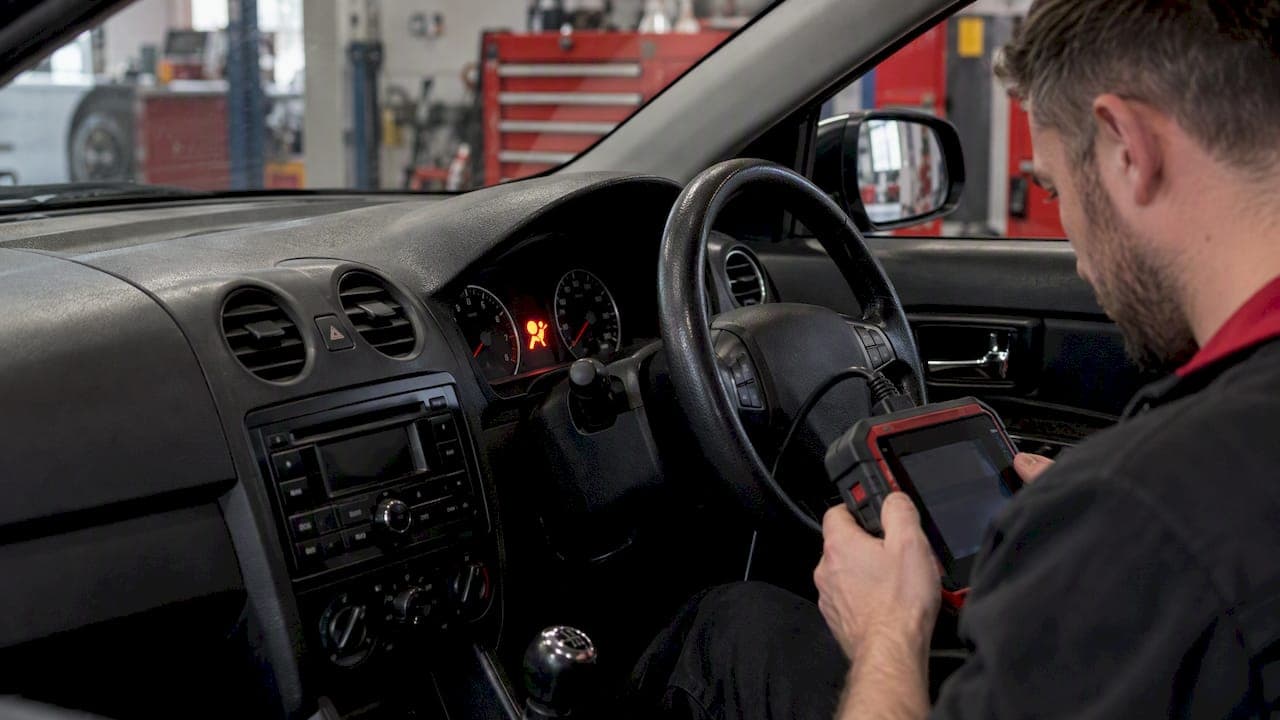
If you have fitted an airbag emulator and the warning light is still lit, the cause is usually one of three things. The fault is still stored in the airbag module. The emulator does not match the circuit it replaced. Or the real problem sits elsewhere, such as a connector, a clockspring or the module itself. A stored fault will not clear on its own in many cars, and if the module holds crash data, an emulator will never fix that. The module needs a proper reset.
This guide explains what an emulator actually does, why the light stays on after installation, what the MOT says about it, and how to get the lamp out for the right reason.
TL;DR
- An emulator is a resistor-type device that imitates a missing airbag or sensor so the control unit stops seeing an open circuit. It is sold for diagnosis and for jobs such as seat or steering wheel changes.
- The light often stays on because the fault is latched in the module's memory, the resistance value is wrong for your car, or the fault is not in the circuit you plugged into.
- An SRS warning lamp showing a system malfunction is a major defect at MOT, so a lit light is not something to live with.
- If the module stores crash data after an impact, the fix is a crash data reset or repair, not another emulator.
- Our postal reset starts at £35, with most modules turned around the same day when they arrive in the morning.
Table of Contents
- What an airbag emulator does
- Why the light stays on after you fit it
- A sensible order of checks
- Where an emulator is the wrong tool
- Do not repair or modify the module at home
- When the right answer is a module reset
- Perspective
- What a reset costs with us
- Send us the module
- Fitting an emulator for a seat change: staying safe
- FAQ
- Sources
What an airbag emulator does
The airbag control unit constantly checks the resistance of each circuit it manages: driver airbag, passenger airbag, seat belt pretensioners, side bags and, on many cars, the passenger seat occupancy mat. If a circuit reads open or out of range, the unit stores a fault and switches on the SRS lamp.
An emulator is a small plug-in device that presents the resistance the unit expects to see. One UK product listing describes a plug-and-play resistor that simulates an airbag system for diagnosis and for suppressing warning lights and fault codes during jobs such as steering wheel changes, seat installations and SRS fault tracing.
That description matters. In a workshop, an emulator is a test tool. A technician plugs it in place of a driver airbag, for instance, and sees whether the fault clears. If it does, the original airbag or its feed is suspect. If it does not, testing moves toward the connector or the clockspring behind the steering wheel. The resistance is specific to the vehicle, so a generic part is a guess.
The search results for this topic show two very different uses:
- Seat occupancy emulators. Fitted under a passenger seat when the original mat sensor is removed, for example when fitting aftermarket seats.
- Airbag resistors. Used on bench tests, or in place of an airbag that has been taken out of a circuit.
The first is common among people changing seats. The second is where safety gets serious, and we come to it below.
Why the light stays on after you fit it
A lit lamp after installation rarely means the emulator is "broken". Work through these causes in order.
The fault is stored and has not been cleared
Fitting a device that fixes the circuit does not necessarily wipe the history. Some modules turn the lamp off on their own once the fault stops being present. Others hold a latched fault until a scan tool clears it. Product pages for emulators often say that in many cases the light goes out automatically, which is a sign that in other cases it does not. Reading the codes before and after the fitting tells you which situation you are in.
The value or wiring does not match your car
The resistance a module expects differs between makes, models and even years. A wrong value leaves the circuit out of range, and the lamp stays lit. The seat mat connector also needs matching to the right wires. Instructions in the results talk about identifying a three-wire connector by colour, which only applies to cars that use that layout. If the pin-out on your car differs, follow the instructions for your exact model rather than the nearest one.
The fault is not the circuit you plugged into
The lamp can be triggered by something unrelated to the seat: a corroded connector, a damaged clockspring, a seat belt buckle switch, or a fault inside the module. Our guide to why an airbag light will not clear covers the UK checks that separate these. If you see no codes at all, an airbag light with no codes is a different path, and water ingress is another; see corroded airbag modules.
The module holds crash data
After an impact, many modules record the event and lock out. In that state the unit may keep the lamp on, or refuse to accept new input, regardless of what is plugged into any circuit. No emulator can clear that. The module has to be reset or repaired. We explain what is involved in airbag crash data and whether it can be cleared safely, and in what a crash data reset actually involves.
A sensible order of checks
Whether you are a home owner or a garage, this sequence keeps you from chasing the wrong thing.
- Switch off and disconnect the battery before touching any SRS connector. Airbag circuits can deploy a device if handled wrongly, so follow the vehicle maker's procedure for how long to wait.
- Read the fault codes with a scan tool that supports the SRS system. A basic engine code reader often does not.
- Note the exact circuit named in the code: passenger seat occupancy, driver airbag, pretensioner, and so on.
- Confirm the device is for that circuit and your model, and that connectors are fully seated.
- Clear the codes and cycle the ignition. See whether the lamp returns.
- If it returns with the same code, test the wiring and connectors. If there is no fault in the wiring, the module is the next suspect.
- If the car has been in a collision, stop and treat the module as holding crash data.
The Renault owners' discussion that appears in the results illustrates the logic: a fault clears with the emulator in place of an airbag, so the airbag is suspect; it does not clear, so look at the connector or clockspring. Treat that as a diagnostic idea only, because the correct resistance varies by vehicle.
Where an emulator is the wrong tool
There is a hard line between a seat occupancy emulator used when a sensor mat has been removed, and an airbag resistor used to cover a missing or deployed airbag. The second leaves you driving without the protection the car was built with, with the lamp telling nobody. We would not fit one in a road car for that purpose.
The official position is clear on what the MOT tester looks at. The DVSA MOT inspection manual treats an SRS lamp indicating a system malfunction as a major defect. It separately treats an obviously missing or inoperative original airbag, and a missing or deployed original seat belt pretensioner, as major defects. A lamp showing that the passenger airbag is deliberately disabled is not a defect.
So the lamp is only acceptable when it is reporting something true and intended, such as a switched-off passenger airbag with a child seat. Hiding a fault does not make the car safer, even where the lamp goes dark.

What the MOT does and does not prove
The SRS lamp check came in following EU Directive 2010/48/EU and applies to most vehicles, excluding Class 3. The tester checks that the lamp behaves correctly and reads the visible state of the system. An MOT is a snapshot of the vehicle's condition on the day. It is not a guarantee that every circuit will perform in a crash, so a clear lamp matters most when it is clear because the system is healthy.
Do not repair or modify the module at home
Health and Safety Executive guidance for the motor trade says technicians should never attempt to repair or modify airbag modules, as accidental discharge can cause injury, and that airbags should only be deployed by appropriately trained personnel following the manufacturer's procedures. See the HSE page on storing and handling airbags and seat belt pretensioners.
That advice concerns the pyrotechnic parts, not the control unit's memory. Resetting crash data happens on the control unit, on the bench, with the airbags themselves not involved. Even so, it is work for specialists, and you should not open a control unit yourself.
If you need to send a module in the post, our guide to packing and posting an airbag module safely covers the MOT and HSE points.
When the right answer is a module reset
A reset is the right route in these situations:
- The car has been in an accident and the lamp has stayed on, or the module has locked after crash data was stored.
- You have replaced the airbags or pretensioners that deployed and the module still reports the old event.
- You are buying or have bought a vehicle with a history, where the lamp is the sign of unresolved crash data. Our piece on Cat S airbag lights, MOT failure and buyer risk goes through it.
- You are a garage dealing with repeat SRS failures. See our technician workflow for garage airbag resets.
You will also see a lamp stay on where an airbag fired with no crash, usually from wiring faults. We cover that in airbags deploying without a crash. In every case, a reset clears the stored data in the module, but any physical cause, such as a spent airbag or a damaged loom, still has to be put right by a qualified garage.
Perspective
Most people reach us after trying the quick route. They plugged something in, the lamp stayed on, and the car still would not pass or run clean. When we look at the module, the story is usually in its memory, not in the seat connector.
Our view is simple. A warning lamp is the car telling you what it has found. The aim is to fix what it found, then clear the record, so the lamp goes out because the system is right and not because it was told to be quiet.
That is why we focus on resetting the original unit when it is safe to do so. It saves buying an unnecessary replacement ECU, and it keeps the car's own airbag system working as the maker designed it. Our technicians bring over 40 years of combined experience to that work, and we will help you identify the right module from a part number or a photo, by phone or WhatsApp, before you post anything.
If you are unsure whether you have a seat sensor problem or a stored crash event, ask us first. It costs nothing to talk it through.
John
What a reset costs with us
Our prices are fixed and published, so you know the figure before you post the module.
| Service | Price | Notes |
|---|---|---|
| Airbag module reset | £35 to £46 | Cars and vans, postal, most modules back the same day if received in the morning |
| Motorhome airbag reset | £65 | Specialised motorhome modules |
| Mobile airbag reset | From £75 | We come to you |
We price match like-for-like genuine quotes, and approved trade accounts for garages and workshops receive discounted rates. The best-value route depends on the module, so send us the part number or a photo and we will confirm the tier.
If you want to compare with a garage diagnosis first, our breakdown of airbag diagnostic costs and the £35 reset option explains what a quote should include. Whoever you ask, a fair quote should name the diagnostic step, say whether the module is being reset, repaired or replaced, and state what happens if the original unit cannot be saved.

Send us the module
If the lamp is still on after your emulator fitting and the codes point at the module, or the car has had an impact, we can reset the original unit and return it quickly. Our airbag module reset service is UK-wide and postal. Motorhome owners can use the motorhome airbag reset, and if you cannot remove the unit, there is the mobile airbag reset.
Have your make, model, year and the module part number ready. If you cannot read the label, a clear photo is enough for us to identify it.
Fitting an emulator for a seat change: staying safe
If you have swapped seats and your car uses a passenger occupancy sensor, keep these points in mind:
- Use a device made for your car's occupancy circuit, not a generic resistor, and check the instructions for your model.
- Understand what the emulator changes. If the seat mat is bypassed, the system may treat the seat as occupied or empty, depending on the device, so the passenger airbag behaviour changes. Read the supplier's description of how it behaves.
- Do not use any device to cover a driver airbag, side airbag or pretensioner that is missing, deployed or faulty in a car that will be driven on the road.
- Take the car to a garage for a scan after the work, so the codes are read and cleared properly.
- Check recalls for your vehicle. For example, the government's recall checker lists a 2022 VW ID.3 recall over a front passenger airbag that may not be securely bolted in place, and contacting the dealership about a recall costs nothing. Use the same checker for your own make and model.
FAQ
Why is my airbag light still on after fitting an emulator?
The fault may still be stored in the module, the emulator value may not suit your car, or the problem may be elsewhere in the circuit, such as a connector or clockspring. Read the codes with an SRS-capable scan tool, then clear them and see if the lamp returns. If the car has had a collision, the module may hold crash data that needs a reset.
Will an airbag emulator pass an MOT?
The tester checks that the SRS lamp is not signalling a malfunction, and treats a missing or inoperative original airbag as a major defect. A lamp that is dark because a fault is hidden does not make the system sound. The sensible aim is a car where the lamp is off because nothing is wrong.
Can a crash data reset replace an emulator?
They do different jobs. An emulator imitates a circuit that is absent or removed. A reset clears recorded crash data from the control unit so it works with the car's real airbags and sensors again. If the module is locked after an impact, a reset is what you need.
How much is an airbag module reset?
Our standard reset is £35 to £46 depending on the module, £65 for motorhomes and from £75 for the mobile service. Send a part number or photo and we will confirm the figure before you post anything.
Sources
- Universal Airbag Resistor SRS Emulator listing
- MOT inspection manual: other equipment (GOV.UK)
- Common mistakes made by MOT testers (Matters of Testing)
- Storing and handling airbags and seat belt pretensioners (HSE)
- VW ID.3 2022 recalls (GOV.UK)