
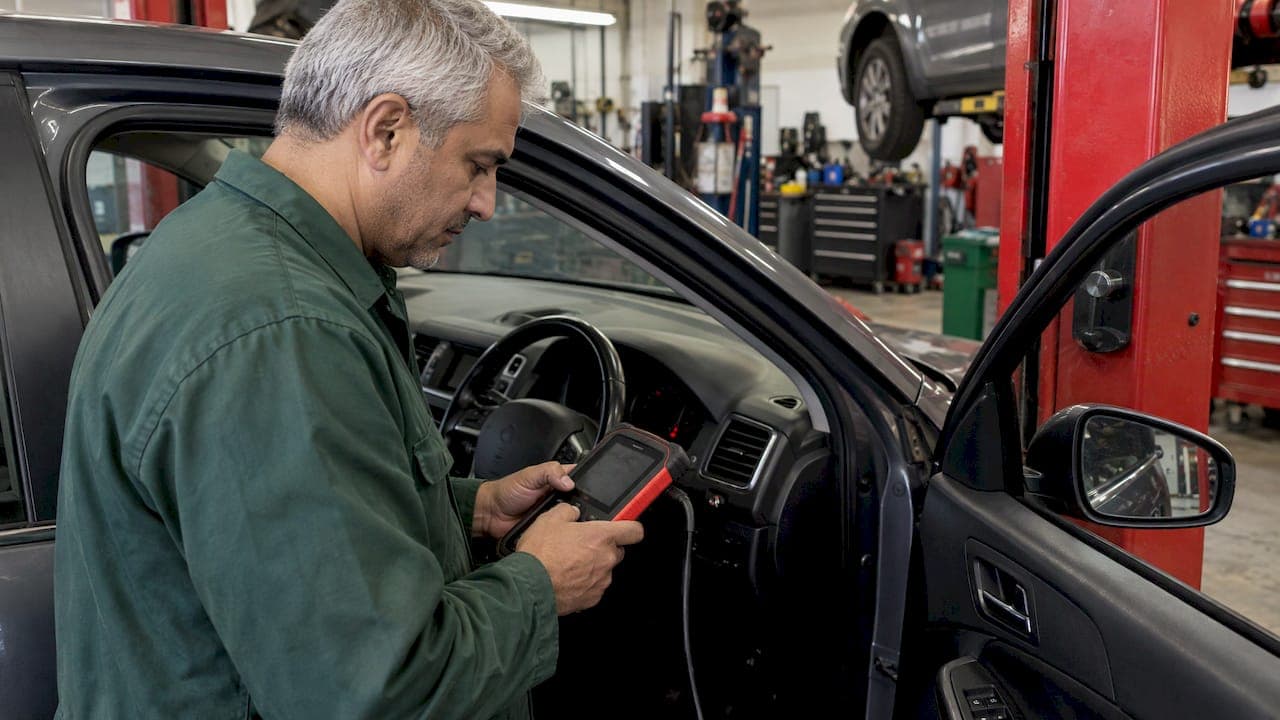
If the airbag light stays on after a sensor has been replaced, the new part is usually not the whole story. The module that watches the sensor often keeps a stored fault or crash record that has to be cleared, or the fault sits in the wiring, connector, seat or clock spring rather than in the sensor itself. The fix is to read the SRS fault codes, repair what they point to, then clear the module properly. If the module is holding crash data, a bench reset clears it and costs from £35 with us.
TL;DR
- A new sensor does not switch the light off by itself. The airbag control module can keep a stored fault or crash record until it is cleared with the right equipment.
- An engine-only code reader will not see the SRS system. You need an SRS-capable scan tool to read the codes and tell a live sensor fault from a stored crash record.
- A lit SRS warning is a major MOT defect, and the airbags may not inflate in a collision while it is on, so do not leave it.
- If the module holds crash data, you can post it to us for a reset. Our standard module reset is £35 to £46, with same-day turnaround on most modules received in the morning.
- Do not disconnect the battery and hope. Stored history codes survive it.
Table of Contents
- Why the light stays on after a new sensor
- Crash data and history codes: why a reset matters
- How a garage diagnoses it properly
- Other jobs that leave the same symptom
- Is it safe to drive, and what about the MOT?
- What it can cost in the UK
- Can you reset the light yourself?
- Our view
- Get the module reset by post
- A sensible order of work
- FAQ
- Sources
Why the light stays on after a new sensor
The airbag light is not a live reading of one part. The control module runs a self-test every time you start the car, checks every sensor, squib circuit, seat-belt pretensioner and switch it is connected to, and lights the lamp if anything fails. Fitting a good sensor fixes the part. It does not tell the module to forget what it saw.
There are four common reasons the lamp is still lit after the sensor job:
- A stored fault or crash record is still in the module. The module remembers the fault that triggered the light, and in some cases a recorded impact, until it is cleared.
- The new sensor is not seen properly. It may be mounted wrongly, the connector may not be fully clicked home, or the part may not be the right one for that car.
- The fault was never the sensor. A seat-belt switch, a damaged clock spring, seat wiring or a passenger occupancy sensor can all produce the same lamp.
- The module itself has a fault. Internal faults in the airbag control module are a listed cause of persistent warnings.
The Motor Ombudsman lists a faulty seat-belt switch, a damaged clock spring, and a defective or uncleared crash sensor among the reasons the light can come on, and advises having it put right promptly at an independent garage or franchised dealer. ANCEL adds passenger occupancy sensor faults, seat wiring, low battery voltage and control module faults to that list.
The pattern we see most often is simple. Someone replaces a damaged or faulty sensor, the lamp stays on, and they assume the new part is also faulty. In many cases the sensor was fine, and the module is still holding the old fault.
Crash data and history codes: why a reset matters
Most airbag modules store three kinds of information: current faults, history faults and crash data. A current fault is something the module sees right now. A history fault is something it saw before. Crash data is the record of an impact that met the deployment or recording threshold.

Service documentation for the Lotus Exige shows how this works on one system. Disconnecting the battery may clear current codes held in volatile memory, but history codes held in permanent memory remain until cleared with the scan tool, and stored crash data cannot be erased on that particular system. The same notes say disconnecting the battery is no substitute for diagnosis or clearing codes. Other makes differ, but the principle is common: pulling the battery lead is not a reset.
That is why a garage can replace a sensor, clear the codes with a generic SRS tool, and still see the lamp return. If the module holds a crash record or a locked fault that the tool cannot remove, the light comes straight back.
Some manufacturers go further. Jaguar's repair information for the I-PACE, reproduced by I-CAR, says sensors must be replaced if damaged or registering a fault, and the restraints control module replaced if three crashes or impacts are stored. Rules like that are specific to the make and model, so always check what applies to your car before deciding that a module is beyond saving.
Sensor circuit code or crash record?
This is the key distinction when you read the codes:
| What the scan shows | What it usually means | Typical next step |
|---|---|---|
| Sensor circuit fault that is still current | Wiring, connector, mounting or the part itself | Check the connector, wiring and mounting, then retest |
| Fault only in history, circuit now healthy | The module remembers an old fault | Clear it; if it will not clear, the module needs a bench reset |
| Crash record or impact stored | The module logged an impact | Crash data reset on the bench |
| Steering wheel buttons or horn dead as well | Possible clock spring fault | Inspect and test the clock spring |
| Seat-related code | Belt switch, occupancy sensor or seat wiring | Check the seat connectors and sensor |
| No communication with the module | Power, earth or internal module fault | Test supply and earth, then consider module repair |
A crash record points to the module rather than the sensor, while a sensor-circuit code points to the circuit. Treat the table as a guide to the questions to ask, not a verdict. The manufacturer's own diagnostic flow for your code decides the actual repair.
How a garage diagnoses it properly
The method is the same on most cars, and it starts with the right tool. An engine-only reader cannot talk to the SRS module. You need a scan tool with SRS functions that is compatible with the make.
Following the procedure in Innova's scan tool manual, a technician connects the tool to the 16-pin diagnostic socket with the ignition on and the engine off, selects the SRS function and retrieves the stored diagnostic trouble codes. Then:
- Record every code, including ones that look unrelated, before clearing anything.
- Use the code description to pick the manufacturer's diagnostic flow chart for that circuit or component.
- Confirm the cause with the checks that flow chart specifies: visual inspection, connector and wiring checks, power supply, continuity, resistance or live data.
- Repair the fault first. Only then clear the codes.
- Rescan and restart to confirm the lamp goes through its normal start-up check and then goes out.
Honda's service information describes the same logic: the self-diagnostic system locates the problem, stores it in memory and makes it retrievable through the data link, after which the technician follows the troubleshooting procedure for that code.
If you want a plain framework for working from the symptom to a verified fix, this step-by-step fault diagnosis guide sets out the order: complaint, codes, measurements, repair, then verification. The key habit is the last step. Never call a job finished until the lamp has been seen to behave normally after a restart.
We have also written a more detailed walkthrough of airbag diagnostics steps that avoid buying a new module, and a guide to when an airbag light will not clear.
Other jobs that leave the same symptom
A sensor swap is only one of several repairs after which the light comes back. If your situation is a little different, these pages cover the specifics:
- Dashboard removal or trim work: airbag light on after dash work
- Panel, door or bumper repairs: airbag light on after bodywork
- A flat or disconnected battery: postal SRS reset after a battery problem
- Underbody and axle work: airbag light after subframe repair
- A lamp that comes and goes: intermittent airbag light
- A lamp with nothing in the fault memory: airbag light with no codes
The common thread is that someone has disturbed a connector, a sensor or the power supply, and the module has logged the interruption. For a wider view of crash and non-crash causes, see our guide to the airbag warning light in the UK.
Is it safe to drive, and what about the MOT?
Do not treat a lit airbag lamp as cosmetic. The Motor Ombudsman notes that the warning may not stop the car being driven, but the airbags may not inflate in a collision while the light stays on. That is the reason to fix it quickly, not to live with it.
There is a hard test too. GOV.UK's MOT inspection manual classes an SRS malfunction indicator lamp showing a system fault as a major defect for cars and passenger vehicles, which is a fail. A passenger-airbag-disabled lamp is not itself a defect. GOV.UK also lists airbags, seat-belt pretensioners and load limiters among the warning systems checked at an MOT.
So if a sensor job has left the lamp on and the MOT is coming up, deal with the module before the test, not after the fail.
What it can cost in the UK
The cost depends heavily on where the fault actually is. A This is Money guide to dashboard warning lights gives example airbag-warning repair costs from as low as £139 for a cable connection fault, £540 to £768 for a sensor-related repair, and £1,440 to £2,160 for an airbag replacement.
Those figures show why the order of work matters. If the real fault was a stored code or crash record, replacing parts one after another can burn a lot of money without touching the cause. Reading the codes first, and resetting the original module where it is safe to do so, avoids buying parts the car did not need.
Can you reset the light yourself?
The honest answer is that the safe route is to leave SRS work to someone with the right tools. Airbag systems can deploy accidentally if worked on incorrectly. Ford's service information for the Transit, reproduced by I-CAR, warns of accidental deployment and requires the ignition to stay off during work, with a wait of at least one minute after disconnecting the battery on that vehicle. The Lotus procedure similarly requires the ignition off, stored codes read before the battery is disconnected, the negative lead secured, and a 30-second wait before working near the SRS.

Those are procedures for trained technicians following a specific vehicle's instructions. They are not a recipe for a driveway fix. If you are not trained, do not probe connectors on the airbag circuit or use a multimeter on squib wiring. The practical DIY job is limited to this: write down the lamp behaviour, make sure you have not left a seat connector unplugged, and get the codes read.
Our view
We handle this symptom every week. A customer swaps a sensor, the lamp stays on, and the next suggestion they hear is a new control module that can cost several times more than a reset.
Our view is that the original module should be tested and, where it is safe, reset before anyone buys a replacement. Most of the time the unit is sound and is simply holding a stored fault or crash record. Clearing that on the bench, then testing the module, gets the car back to a normal start-up check without a replacement ECU, a re-coding job or a wait for a part.
Where a module cannot be safely reset, we say so. The aim is a working, correctly reporting airbag system, not a quick light-off.
John
Get the module reset by post
If the codes show a stored fault or crash record in the module, you do not need to book the car in or buy a replacement. Remove the airbag module, or have your garage do it, and post it to us. We identify the unit from the part number or a photo, and you can ask us on WhatsApp or by phone if you are unsure which module you have. Most modules received in the morning go back the same day.
Our standard airbag module reset is priced between £35 and £46. A motorhome airbag reset is £65, and our mobile airbag reset starts from £75. We also price match like-for-like quotes, and garages and workshops can ask about trade accounts with discounted rates.
We also keep make and model pages if you want to see how we handle your car, such as the Audi A4, Vauxhall Corsa E or Mazda MX-5. For garages doing this regularly, our guide to clearing airbag codes by bench reset explains the workflow.
A sensible order of work
Here is the order we recommend to anyone with the lamp still lit after a sensor job:
- Check the obvious. Make sure the new sensor is mounted as the manufacturer specifies and its connector is fully seated. Check seat connectors if anyone has moved the seats.
- Read the SRS codes with an SRS-capable tool, and write down every code before clearing.
- Classify the code. Is it a live circuit fault, a wiring or connector issue, a clock spring problem, or a stored crash record?
- Repair what the code points to. Follow the manufacturer's flow for that code.
- Clear and rescan. If the code returns instantly, the fault is not fixed or the module will not release it.
- Reset the module if it holds crash data or a locked fault. This is where the postal bench reset applies.
- Verify. The lamp should light at start-up, then go out and stay out. Test over a few drives.
Never skip step 2 in favour of clearing codes blind. A cleared code you never read is a lost clue.
FAQ
Why is my airbag light still on after I changed the sensor?
The module usually still holds the old fault or a crash record, or the fault was in the wiring, a seat switch or the clock spring rather than the sensor. A new part does not clear the module's memory. Have the SRS codes read, repair what they point to, then clear or reset the module.
Will disconnecting the battery turn the airbag light off?
Not reliably. On the Lotus system documented by the manufacturer, history codes survive battery disconnection and only a scan tool clears them. Disconnecting an airbag system without following the vehicle's procedure can also be a safety risk, so leave it to a technician.
Can I pass an MOT with the airbag light on?
No. GOV.UK classes an SRS warning lamp that indicates a system malfunction as a major defect for cars, so the car would fail. Fix the cause and confirm the lamp behaves normally before the test.
Does a crash data reset replace the airbag module?
No. A reset clears stored crash data or locked faults from your original module, so you can keep it rather than buy a replacement. It only suits modules that can be safely reset, and it does not repair damaged airbags, belts or sensors that still need replacing.
Sources
- Getting to know airbags, The Motor Ombudsman
- How to Handle an Airbag Warning Light, ANCEL
- Exige S2 service notes (SRS section)
- 2024 Jaguar I-PACE repair information, I-CAR
- Innova scan tool manual
- How to Troubleshoot the SRS, Honda service information
- MOT inspection manual: other equipment, GOV.UK
- Car parts checked at an MOT, GOV.UK
- Warning lights and repair costs, This is Money
- 2020 Ford Transit SRS service information, I-CAR
- Storingsdiagnose stappenplan, Carozo