
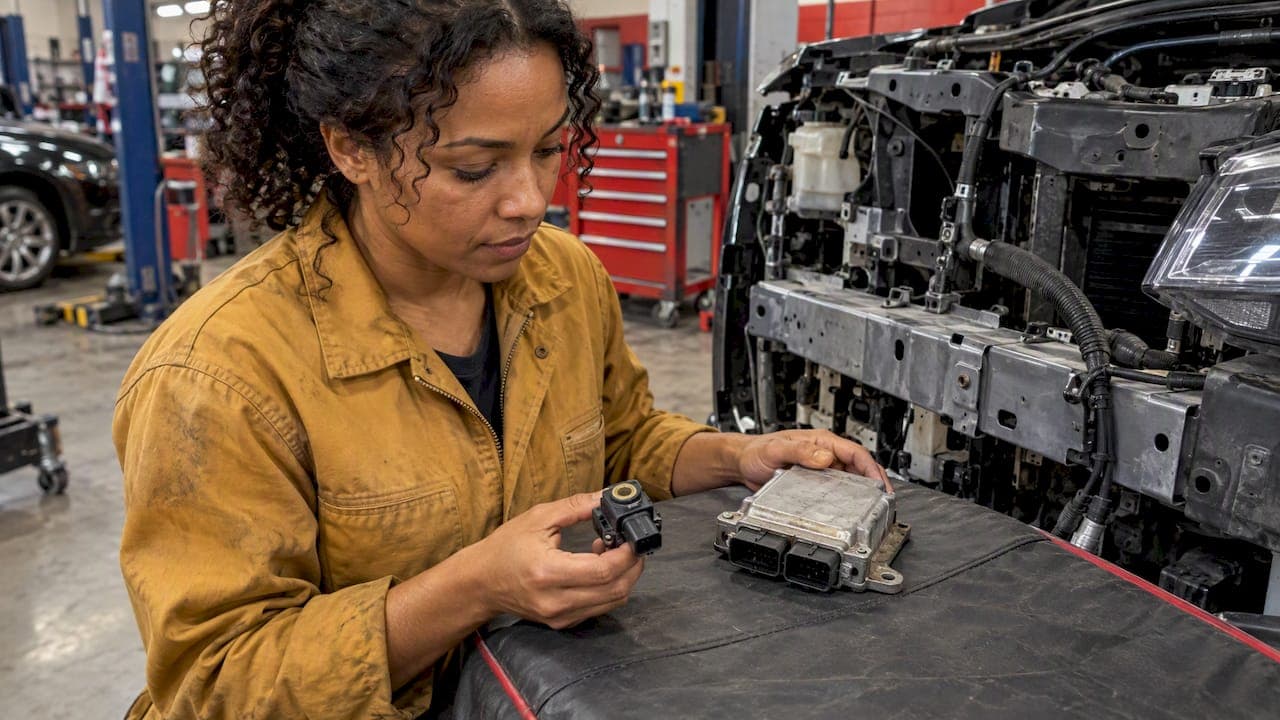
The airbag sensor detects an impact. The airbag module, also called the airbag control unit or SRS ECU, decides what to do about it, fires the airbags and records the crash. After an accident, the sensors are rarely the part that keeps your warning light on. The module is, because it stores a crash flag that stays until it is cleared.
The two terms get mixed up constantly, and so do the repairs. This guide explains the difference, how the parts work together, and how to tell which one is behind your warning light.
TL;DR
- Sensors are the peripheral parts that measure impact force. The module is the central computer that judges the crash and fires the airbags.
- The module stores crash data. That is why the SRS light can stay on after the airbags and sensors have been replaced.
- A lit SRS warning lamp is an MOT failure in the UK, so it needs sorting before the test.
- Many modules can be reset and reused, which can avoid buying a replacement. Our postal reset starts at £35.
- Diagnose first. Reading the fault codes tells you whether you have a sensor fault, a wiring fault or a stored crash flag.
Table of Contents
- The short answer: sensor vs module
- What the airbag sensors do
- What the airbag module does
- Why the module, not the sensor, keeps the light on after a crash
- Sensor fault, module fault or wiring fault?
- Diagnose before you buy anything
- The MOT angle
- Our perspective: reset the module, don't just replace it
- Reset service and prices
- Worked examples
- What to ask any garage
- FAQ
- Sources
The short answer: sensor vs module
Think of the system as nerves and a brain. The sensors are the nerves, and the module is the brain.
| Airbag sensor | Airbag module (control unit) | |
|---|---|---|
| Role | Measures acceleration or deformation at its location | Reads all sensors, decides whether to deploy, fires the igniters |
| Where it sits | Front crumple zone, doors, pillars, sometimes inside the module itself | Usually central: dashboard area or centre tunnel |
| Stores crash data | No (or very little) | Yes |
| Count per car | Several | Usually one, though some cars have more than one unit |
| Typical fault | Open circuit, damaged connector, impact damage | Stored crash flag, internal fault, water damage, corroded pins |
| Typical remedy | Replace the sensor and clear codes | Reset crash data, repair, or replace |
The terminology causes the confusion. People say "airbag module" for three different things: the control unit, the bag-and-inflator assembly in the steering wheel or dashboard, and occasionally the whole system. In this article, "module" means the control unit. That is also the part our service deals with.
What the airbag sensors do
Crash sensors detect sudden deceleration. According to HELLA's technical guide to airbag systems, the deployment threshold is typically an acceleration of roughly 3 to 5 g. Modern sensors often work on a spring-mass principle or silicon-based capacitance.
Two details matter in practice.
Sensors are directional. They are calibrated to a specific direction, and the housing carries an arrow showing how it must be fitted. HELLA's guide explains that a sensor installed the wrong way round can cause system failures or false deployment signals. That is why a sensor swap is not a casual job.
One sensor should not be enough. The same source notes that systems need at least two independent signals to confirm a crash before the module triggers an airbag. This protects against a pothole, a kerb strike or a slammed door causing a deployment.
Sensors come in several types. Front impact sensors sit in the crumple zone at the front of the car. Side impact sensors are in doors or pillars. Seat occupancy sensors, such as the sensor mat in the passenger seat, tell the module whether to arm the passenger airbag. HELLA describes sensor mats that can only be integrated into the front passenger seat. Seatbelt buckle switches feed in too.

What the airbag module does
The module is the heart of the system. It usually sits centrally in the car, often under the dashboard or on the centre tunnel. Its jobs are:
- Continuously reading signals from the sensors.
- Judging crash severity and deciding which airbags and pretensioners to fire, and in what order.
- Firing the igniters through dedicated circuits.
- Monitoring the whole system and switching on the warning lamp if anything fails.
- Recording what happened in a crash.
That last job is the one that matters to most readers. Research from the CITA study on airbag systems describes the module as an active safety system that runs checks before and during each journey. If any part of the loop from sensor to igniter fails to respond, the default is to warn the driver and disable itself so that nothing deploys unsafely.
The module is also built to survive the crash. The same study explains that internal capacitors, often charged to around 30 to 40 V, can power the firing circuits for 200 to 300 milliseconds after the battery has been destroyed. That is why the module keeps working even when the car's power is cut in an impact.
Why the module, not the sensor, keeps the light on after a crash
When an airbag deploys, or in some cases when a crash threshold is reached without deployment, the module writes a crash record and sets a flag. Per this overview of diagnostic and reset practice, that flag effectively locks the system out until it is cleared with professional tools or a specialist reset service. Standard OBD-II scan tools often cannot reach SRS-level data, which is why a basic code reader may show nothing useful or fail to clear the fault.
The usual story goes like this:
- You have a collision and the airbags deploy.
- The bags, seat belt pretensioners and damaged sensors are replaced.
- The SRS light stays on anyway.
- The garage says the module is "locked" and quotes for a new one.
At that point the hardware is fine, but the module still holds the crash record. It does not mean the module is broken. It can often be reset to a clean state and refitted. We explain what is and is not possible in our guide to whether airbag crash data can be cleared and whether that is safe.
Sensor fault, module fault or wiring fault?
Not every lit SRS lamp comes from a crash. Here is how the common causes divide.
Signs it is a sensor or connector fault
- The light came on with no accident, often after a seat was moved, a battery was changed or interior trim was removed.
- The fault code names a specific location, such as a seat occupancy sensor, a side impact sensor or a squib circuit.
- The light flickers, particularly over bumps. Our piece on an intermittent airbag light covers the usual connector culprits.
Under-seat yellow connectors are a classic source of trouble. Reading the code is the quickest way to find out.
Signs it is the module
- There was a crash and the light remained after all damaged parts were replaced.
- The codes mention a crash record, an internal fault, or a lost communication with the unit.
- The light is on but no codes are stored at all. See our guide to an airbag light with no codes.
- The module has had water in the footwell or under the seat.
Signs of something more unusual
If an airbag fired when there was no accident, the cause is almost always a wiring or connection fault rather than a sensor failure. We cover this in airbags that deploy without a crash.
One more detail: some cars, BMWs in particular, are not built with a single unit. TRW's operating instructions for its diagnostic tool note that tools may need to scan each airbag control unit separately, or select all of them, to clear crash data and warning lights fully. If a garage reset one unit and the light stayed on, another may still hold the flag.
Diagnose before you buy anything
Buying a sensor because the lamp is lit is a gamble. Buying a new module can be a costly one, because a replacement often has to be coded to the car. The sensible order is:
- Read the SRS codes with a tool that can access the airbag system, not just the engine.
- Check the cheap, physical causes: connectors under the seats, the clock spring if the steering-wheel airbag circuit is flagged, and any recent trim or seat work.
- Replace what is actually faulty, following the manufacturer's procedure and sensor orientation.
- Clear the crash data if the module is holding a crash flag.
Our airbag diagnostics steps walk through this, and diagnosing before a bench reset explains why skipping step 1 can leave you with the light still on and an MOT failure.
One safety point deserves emphasis. HELLA's guidance states that the airbag system should never be treated as just another electrical component. Fitting hardware without following the manufacturer's procedure, or ignoring the crash flag, can leave a system that is dead or, worse, live but misaligned. If you are not trained to work on airbag systems, leave steps 3 and 4 to a qualified technician, and do not probe airbag connectors with a multimeter, because the circuits can fire an igniter.
The MOT angle
The SRS inspection is part of the MOT. Under the GOV.UK MOT inspection manual, the airbag check covers airbags fitted as original equipment on all vehicles except Class 3, and an SRS warning lamp showing a system malfunction fails the test. A passenger airbag that has been deliberately switched off is not a defect.
Testers look at what the lamp is telling them. DVSA's Matters of Testing blog explains that the check is about whether the lamp indicates a system fault. A lamp that never illuminates at all cannot indicate a fault, so it is itself a problem.
The practical upshot: do not clear a light by disconnecting the bulb or hiding it. Sort out the real cause. For a closer look at the light itself, read what the SRS light means and our guide to why an airbag light won't clear. A flashing airbag light means the airbags may not deploy, so treat it as urgent.
Our perspective: reset the module, don't just replace it
We see the sensor-versus-module mix-up every week. Someone has had a minor shunt, the bags have been replaced and the light is still on. A quote arrives for a replacement module that may cost many times a reset.
In our experience the original unit can usually be reset when it is safe to do so. That means the car keeps its own module, with no coding to a new one and no chasing a part that may be hard to source. Our technicians have over 40 years of combined experience, and we would rather identify the right job than sell the biggest one.

We also say no when it is the honest answer. If a module has internal damage or a hardware fault rather than a stored crash flag, a reset will not cure it, and we will tell you before you spend more. And a reset never replaces fitting good sensors and airbags after a crash. The module can only protect you if everything it controls is sound and fitted correctly.
If you are unsure which part you have, send us the part number or a photo of the label and we will help identify it, by WhatsApp or phone.
— John
Reset service and prices
If your diagnosis points to a module holding crash data, our postal service is straightforward. You post the module, we reset it, and most modules received in the morning go back the same day. Prices are fixed and published:
- Airbag module reset: £35 to £46 one-off, depending on the module.
- Motorhome airbag reset: £65 one-off.
- Mobile airbag reset: from £75 one-off.
We price match like-for-like genuine quotes, and garages and workshops can apply for a discounted trade account. If you already know your car, check whether we have a page for it, such as the Audi A4 or the Mercedes A Class. The Airbag Reset UK homepage is the place to start for anything else.
Worked examples
Scenario 1: front-end collision, bags replaced, light still on. The driver and passenger airbags and the pretensioners were replaced, but the light never went out. The sensors and bags are new, so this points at a crash flag in the module. The fix is a crash data reset, not another sensor.
Scenario 2: no accident, light on after a seat was removed. There is no crash record. The codes point to a seat circuit. A reconnected or damaged under-seat connector is the likely cause, and the module is probably innocent. Resetting it would just put the light back on.
Scenario 3: light on with no stored codes. A basic scanner shows nothing. The module may be holding data that only an SRS-capable tool can read. This is worth a proper diagnosis before any parts are bought.
Scenario 4: motorhome with the light on after a minor impact. Motorhome modules are often different from the van they are built on, so identification matters. We offer a dedicated motorhome reset for this.
What to ask any garage
- Which fault codes did you read, and with what tool?
- Is the problem a sensor, a circuit or the module itself?
- Has the crash data been cleared, and have all the airbag units on the car been checked?
- Can the original module be reset instead of replaced?
- Will the SRS lamp go through its normal self-test at start-up when you are done?
A good answer names a specific component. "The airbag computer" with no detail is a cue to ask more.
FAQ
Is it easy to replace an airbag sensor?
Physically it can be simple, but the job is not forgiving. Sensors are directional and must be fitted exactly as the manufacturer specifies, and the system must be checked and cleared afterwards. If you are not trained in airbag work, have a qualified technician do it.
Is the airbag sensor the same as the airbag module?
No. The sensor detects the impact. The module is the control unit that reads the sensors, decides whether to deploy and stores crash data. Some modules contain a sensor inside the same housing, which adds to the confusion.
Can I clear an airbag crash flag with a cheap code reader?
Usually not. Standard OBD-II readers often cannot access SRS crash data, which is why professional tools or a specialist reset service are used. Clearing the flag also does not replace repairing the hardware that caused it.
Do I need a new module after an accident?
Not always. If the module holds a crash flag but is otherwise undamaged, it can often be reset and refitted. A module with physical or internal damage may need replacing, which is why we help you identify the unit before you post it.
Sources
- Car airbag system: design and function, HELLA
- Airbag systems study, CITA
- Car diagnostics and SRS programming, O.G.S. Mechanics
- TRW easycheck operating instructions
- MOT inspection manual: other equipment, GOV.UK
- Common mistakes made by MOT testers, DVSA Matters of Testing